May 19, 2026
The Sanctions Architecture Behind Global Oil Disruptions
Energy markets rarely operate in a vacuum. The modern crude oil trade is not simply a network of producers, tankers, and refineries — it is a system increasingly shaped by the architecture of financial sanctions, jurisdictional legal regimes, and the geopolitical calculations of major powers. When that architecture shifts, even temporarily, the ripple effects extend far beyond the countries directly targeted, reaching import-dependent economies that had no part in the original policy dispute.
That dynamic is precisely what makes the U.S. stranded Russian oil cargoes license such a revealing case study. It exposes not only the mechanics of how sanctions create unintended market dislocations, but also how regulators attempt to correct those dislocations without dismantling the broader policy framework they spent years constructing. Furthermore, understanding this licence requires grasping the sanctions on Russian oil trading that set the entire chain of events in motion.
When big ASX news breaks, our subscribers know first
How Russian Oil Became Legally Stranded at Sea
The OFAC Sanctions Framework and Its Energy Targets
The U.S. Treasury's Office of Foreign Assets Control operates one of the most complex sanctions enforcement regimes in the world. Following Russia's full-scale invasion of Ukraine in 2022, OFAC progressively expanded its designation list to include major Russian energy entities, with Rosneft and Lukoil among the most consequential targets given their dominant roles in Russian crude production and export logistics.
Under this framework, any transaction involving a designated entity — including the purchase, transport, financing, or insurance of crude oil associated with those entities — becomes legally prohibited for U.S. persons and, through secondary sanctions risk, for many non-U.S. counterparties as well. The practical result was a progressive fragmentation of Russia's established oil trade routes, forcing buyers toward shadow fleet operators, non-Western insurers, and alternative payment mechanisms.
What Makes a Cargo Legally Stranded?
A stranded cargo in the sanctions context refers specifically to crude oil or refined petroleum products that have already been loaded onto a vessel but cannot legally complete their delivery because of intervening legal restrictions. This is distinct from simply unsold oil — these are cargoes that were mid-journey when the legal environment changed beneath them.
The mechanics work as follows:
- A cargo is loaded onto a vessel under terms that were legally permissible at the time of loading.
- A sanctions designation, licence expiry, or new restriction is imposed before the cargo reaches its destination.
- The receiving counterparty, financier, or insurer withdraws from the transaction to avoid sanctions exposure.
- The vessel enters legal limbo, unable to discharge cargo without risking violations by all parties involved.
- The cargo becomes a stranded asset on the water, neither deliverable nor easily reversible without explicit regulatory authorisation.
This phenomenon accelerated significantly following the Trump administration's decision to sanction Rosneft and Lukoil, creating a backlog of in-transit cargoes that had been loaded under prior licensing conditions.
The Hormuz Disruption Layer
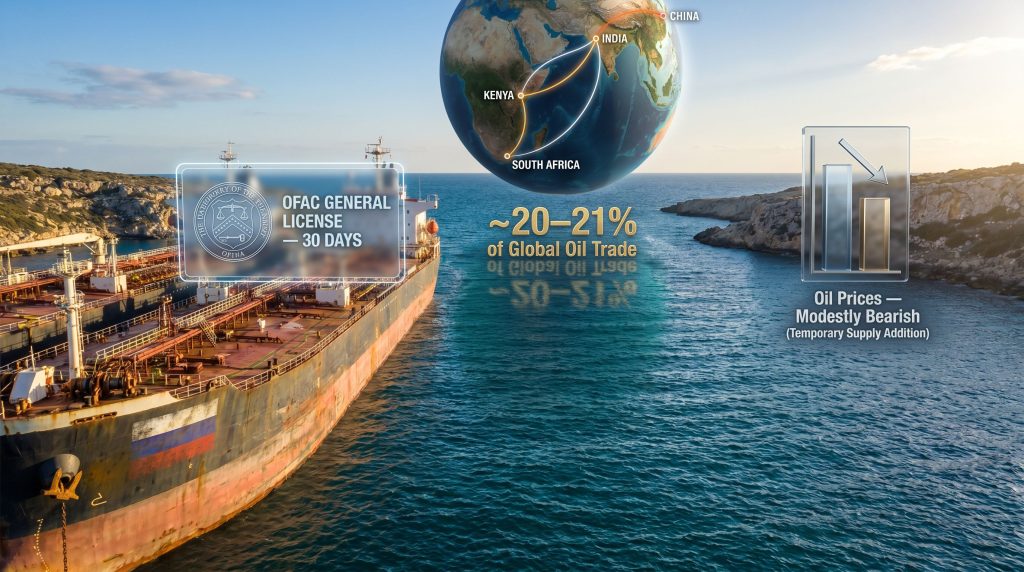
The stranded cargo problem did not emerge in isolation. Compounding the sanctions-driven supply restriction was a separate and equally consequential disruption: constrained flows through the Strait of Hormuz. Under normal conditions, approximately 20 to 21 percent of global oil trade transits this narrow passage, making it one of the most strategically sensitive chokepoints in the world.
Disruptions linked to U.S.-Israel-Iran tensions reduced the reliability of Gulf supply routes for import-dependent nations, creating acute vulnerability precisely at the moment when Russian cargo rerouting was already hampered by sanctions restrictions. The intersection of these two simultaneous pressures is what ultimately drove the licensing response, and the resulting oil price movements reflected that compounded market anxiety.
Understanding the 30-Day General License
Scope, Permissions, and Explicit Exclusions
The U.S. Treasury's temporary general licence is a precision instrument with clearly defined boundaries. According to reporting from Riviera Maritime Media, the waiver was specifically structured to address cargoes already physically at sea. Understanding what it does and does not authorise is essential to evaluating its real-world significance.
What the licence permits:
- Purchase, transport, and delivery of Russian-origin crude oil and petroleum products already loaded onto vessels before the defined cutoff date
- Transactions by eligible recipients — specifically defined as energy-vulnerable nations and, in reported versions, Indian refiners operating under Indian law
- Coordination with vessel operators to confirm or reroute delivery of qualifying cargoes
What the licence explicitly excludes:
- Newly produced Russian oil of any grade or origin
- New contracts for future Russian crude supply
- Any transactions with sanctioned entities outside the specific carve-out provisions
- Any expansion of Russian export capacity or production flows
Critical Policy Distinction: The licence does not represent a relaxation of the broader sanctions regime. It is a narrow carve-out covering only cargoes already physically at sea, designed to prevent a specific logistical market failure rather than to restore any dimension of Russian energy revenues.
A Pattern of Tactical Flexibility
What distinguishes this licence from a one-time administrative correction is that it represents the second time the U.S. Treasury has allowed the waiver to lapse and then reissued it. The first extension came in March, triggered by the price spike that followed U.S.-Israeli strikes on Iran. The May 2026 extension responded to the continued accumulation of stranded cargo backlogs and persistent Hormuz flow constraints.
| Licence Issuance | Trigger Event | Duration | Primary Beneficiaries |
|---|---|---|---|
| First Extension (March) | U.S.-Israeli strikes on Iran; oil price spike | 30 days | Vulnerable import-dependent nations |
| Second Extension (May 2026) | Continued Hormuz disruptions; stranded cargo backlog | 30 days | Energy-vulnerable countries; India-bound cargoes |
This lapse-and-reissuance pattern is not incidental. It reflects a deliberate policy of maintaining strategic ambiguity, preserving the credibility of the sanctions regime while retaining the flexibility to prevent allied and vulnerable economies from absorbing disproportionate supply shocks.
The Geopolitical Layer: Redirecting Supply Away from China
U.S. Treasury Secretary Scott Bessent made clear that the measure was designed to stabilise the physical crude market and ensure oil reaches the most energy-vulnerable countries. Crucially, he also articulated that the arrangement was intended to help reroute existing supply to countries most in need by reducing China's ability to accumulate discounted Russian barrels.
This dual objective transforms the licence from a purely humanitarian instrument into something more strategically layered. The broader context of the US-China trade war adds another dimension to this calculation, as Washington is using the licensing mechanism simultaneously as a supply stabilisation tool and a competitive geopolitical lever.
How Global Oil Markets Responded
The Bearish Price Signal
Oil prices fell following the licence announcement, reflecting the incremental supply relief the measure introduces into physical crude markets. The mechanism is straightforward: releasing stranded cargoes into deliverable supply increases near-term availability, easing immediate price pressure for buyers of physical barrels.
However, the price effect is bounded and temporary for several reasons:
- The licence covers only cargoes already in transit, with no mechanism to increase Russian production or unlock new supply channels
- The 30-day duration limits the sustained impact on forward market pricing
- Physical crude market relief does not automatically translate into equivalent moves in Brent or WTI benchmark futures, which reflect a broader range of supply and demand variables
Physical vs. Paper Markets: A Key Distinction
One of the more technically significant aspects of this measure is that it operates primarily in the physical crude market rather than the derivatives or futures complex. Physical crude markets involve actual cargo transactions, refinery intake scheduling, and delivered barrel pricing. The discounts applicable to Russian-origin Urals-grade crude in the physical market do not map directly onto benchmark paper prices.
For buyers with the infrastructure to participate in physical crude procurement, this creates a differentiated opportunity. For those relying on price signals from futures exchanges, the licence's impact appears more muted than it may be in practice for real cargo transactions. Consequently, crude oil trade geopolitics continue to exert influence well beyond what benchmark price moves alone might suggest.
Which Countries Stand to Benefit — and How?
Import-Dependent Economies: Direct Beneficiaries
Kenya faces a structurally vulnerable position in African energy markets, heavily dependent on imported refined petroleum products with limited domestic refining capacity. Improved global supply conditions resulting from the release of stranded cargoes could ease import costs and reduce short-term fuel price inflation. The binding constraint is operational: Kenya's ability to secure contracts within the compressed 30-day window and the shipping logistics involved in routing cargoes from their current positions.
South Africa, despite its industrial scale, remains a significant importer of refined petroleum products. The country's existing refinery infrastructure and import terminal capacity position it to benefit from improved global supply availability, though refinery compatibility with Urals-grade crude remains a variable that determines the degree of benefit that can actually be realised.
India occupies a distinct category. Reporting from the Financial Express indicates that some versions of the licence explicitly reference purchases by entities organised under Indian law, reflecting India's established role since 2022 as one of the largest buyers of discounted Russian crude globally. India's well-developed trading relationships, refinery flexibility, and established payment channels with Russian counterparties make it among the best-positioned nations to convert the licence window into delivered supply.
Oil-Producing Economies: Mixed and Competing Effects
Nigeria presents the most complex impact profile among African nations. As Africa's largest crude producer, Nigeria's exposure operates in multiple competing directions simultaneously:
- Additional Russian supply in global markets, even temporarily, exerts marginal downward pressure on crude benchmarks, which directly affects Nigerian export revenue
- At the same time, Nigeria remains heavily dependent on imported refined petroleum products despite its production status, meaning improved global supply conditions could ease domestic fuel costs
- The net effect depends on the relative magnitude of benchmark price sensitivity versus refined product import cost savings — a calculation that varies with prevailing price levels and Nigeria's refinery utilisation at any given point
Comparative Impact Framework
| Country Profile | Primary Exposure | Licence Impact | Key Constraint |
|---|---|---|---|
| Kenya (import-dependent) | Refined product import costs | Positive — supply relief | 30-day contracting window |
| South Africa (import-dependent) | Fuel price inflation | Positive — improved availability | Refinery compatibility |
| India (specific carve-out) | Russian crude procurement | Direct positive — explicit inclusion | Legal/organisational eligibility |
| Nigeria (producer + importer) | Export revenue + import costs | Mixed — competing effects | Benchmark price sensitivity |
| China (major Russian buyer) | Discounted barrel access | Constrained — policy targets Chinese stockpiling | Geopolitical positioning |
Operational Barriers to Realising the Licence's Benefits
The Compressed Contracting Timeline
The 30-day window creates a structural access challenge that disproportionately favours large, well-resourced trading entities with established relationships, legal infrastructure, and financing lines already in place. For smaller African importers — despite being among the intended beneficiaries of the policy — the steps required to convert the licence into delivered supply represent a formidable operational sequence:
- Identify eligible stranded cargoes by vessel location and cargo manifest verification
- Negotiate and execute purchase agreements within the active licence window
- Coordinate with vessel operators on rerouting or confirmed delivery scheduling
- Secure trade finance and marine insurance from institutions willing to transact on Russian-origin oil
- Align destination port logistics and refinery intake scheduling
Each of these steps carries its own delays, and the sequential nature of the process means that a bottleneck at any stage can render the remaining steps moot within the available window.
Refinery Compatibility and Crude Grade Considerations
The primary crude grade represented in stranded Russian cargoes is Urals, a medium-sour grade that requires refineries configured for higher sulphur content feedstock. Not all African refineries have the hydrodesulphurisation capacity or crude flexibility to process Urals efficiently. This is not a minor logistical footnote — it represents a fundamental constraint on how much of the available stranded supply can actually reach end markets in Africa without being redirected through intermediary trading hubs or blended with other grades.
Insurance and Compliance Risk
Western marine insurers and major financial institutions have developed highly cautious postures toward Russian-origin oil transactions, even under temporary licences. Reputational risk, compliance team conservatism, and uncertainty about the legal boundaries of each specific cargo transaction mean that many institutions require detailed legal opinions before participating. The lapse-and-reissuance pattern of the licence itself compounds this caution, as counterparties planning multi-week supply arrangements face uncertainty about whether the legal authorisation underpinning their transaction will still exist by the time delivery is completed. In addition, the broader disruption to trade war supply chains has made global financing partners even more risk-averse across commodity transactions.
The next major ASX story will hit our subscribers first
Is This a Sanctions Rollback or a Precision Policy Instrument?
Structural Integrity of the Sanctions Regime
The temporary general licence does not alter the fundamental architecture of U.S. sanctions targeting Russian energy revenues. Key sanctions designations against Rosneft, Lukoil, and associated entities remain fully in force. There is no pathway created for new Russian oil sales, no mechanism for expanding Russian export capacity, and no signal of a broader policy reversal.
The correct analytical framing is that this instrument functions as a pressure valve, not a valve reset. The pressure — sanctions-driven restriction of Russian oil revenues — remains fully applied. The valve release is narrow, temporary, and scoped to a category of supply that was already physically committed before the legal environment changed.
Historical Precedent: Sanctions Waivers as Policy Tools
This is not the first time the U.S. has used temporary licensing exceptions within a broader sanctions architecture to manage allied vulnerability. The Iranian oil waiver system under the Joint Comprehensive Plan of Action framework provided a comparable precedent, where specific countries received time-limited exemptions to continue purchasing Iranian crude while the broader sanctions pressure was maintained. The pattern reflects a consistent recognition within U.S. sanctions policy that absolute rigidity can produce unintended consequences that harm sanctioning nations' allies more than the sanctioned party itself.
Scenarios When the 30-Day Licence Expires
The rolling nature of this instrument creates three plausible forward pathways:
- Scenario A: No further extension. Remaining stranded cargoes re-enter legal limbo, renewed supply uncertainty returns, and vulnerable importers face the same constraints as before the licence was issued.
- Scenario B: A third 30-day extension. Supply relief continues, but growing questions emerge about the coherence of a sanctions posture that repeatedly issues the same exception, potentially undermining the deterrent signal.
- Scenario C: Transition to individual specific licences. Treasury shifts from general authorisation to case-by-case approvals for designated countries or transactions, increasing administrative complexity but allowing more granular control over which buyers benefit.
Analytical Observation: The repeated deployment of short-duration licences reflects a deliberate policy of maintaining strategic ambiguity. This preserves the credibility of the sanctions regime while retaining the operational flexibility to prevent allied economies from absorbing disproportionate supply shocks generated by a policy designed to punish a third-party actor.
Frequently Asked Questions
What Exactly Is a U.S. Treasury General Licence for Russian Oil?
A general licence issued by OFAC is a regulatory authorisation that permits specific categories of transactions otherwise prohibited under sanctions law. It allows eligible parties to purchase, transport, and receive qualifying Russian crude oil and petroleum products without requiring individual transaction-by-transaction approval, provided the cargo meets the defined criteria.
Does the Licence Mean U.S. Sanctions on Russia Are Being Relaxed?
No. The U.S. stranded Russian oil cargoes license represents a narrow, time-limited exception covering only cargoes already physically at sea. Core sanctions designations against major Russian oil companies and associated entities remain fully in force, and no new Russian supply contracts or production flows are authorised.
Why Did Oil Prices Decline After the Licence Announcement?
The release of stranded cargoes into deliverable supply increases near-term physical market availability, easing immediate supply concerns for buyers. This incremental addition exerted modest downward pressure on benchmarks, though the effect remains temporary given the bounded scope and 30-day duration of the measure.
Which African Countries Are Best Positioned to Benefit?
Import-dependent economies with established crude import infrastructure and refinery capacity, particularly Kenya and South Africa, are most directly positioned to benefit from improved global supply conditions. However, realising those benefits depends on contracting speed, refinery grade compatibility, and access to trading intermediaries.
Is India Specifically Named in the Licence?
Reporting indicates that some versions of the licence explicitly reference deliveries to purchasers organised under Indian law, reflecting India's established and substantial role as a buyer of discounted Russian crude since 2022.
What Happens to Cargoes Not Delivered Within the 30-Day Window?
Cargoes not delivered or contracted within the active licence period risk re-entering legal uncertainty, unable to complete delivery without further specific authorisation. This creates genuine urgency for all qualifying buyers to move quickly on contracting and logistics arrangements.
Disclaimer: This article is for informational purposes only and does not constitute financial, legal, or investment advice. References to market price movements, policy outcomes, and country-level impact assessments involve forward-looking elements that are inherently uncertain. Readers should seek independent professional advice before making decisions based on the information presented here.
Want To Stay Ahead of the Resource Discoveries Shaping Global Markets?
Discovery Alert's proprietary Discovery IQ model delivers real-time alerts on significant ASX mineral discoveries, transforming complex resource data into actionable investment insights for both short-term traders and long-term investors — explore historic discovery returns to understand the scale of opportunity, then begin your 14-day free trial at Discovery Alert to position yourself ahead of the broader market.