July 27, 2026
The Industrialisation Imperative: Why Raw Ore Exports Are No Longer Africa's Best Option
For most of the twentieth century, the dominant logic governing African mineral wealth was straightforward: extract, load, and ship. Commodities left the continent in their rawest form, with nearly all of the economic complexity, employment intensity, and margin capture occurring elsewhere. Today, the African critical minerals beneficiation strategy is being systematically reshaped by a convergence of forces that have rarely aligned so favourably for the continent. Global demand for critical minerals is accelerating, supply chains are being restructured by clean energy transitions, and African policymakers are increasingly asserting that the next resource cycle must generate different outcomes.
The fundamental question is no longer whether Africa should process its own minerals. It is whether the institutional, infrastructural, and financial conditions can be assembled quickly enough to capitalise on a window that, in strategic terms, may not remain open indefinitely.
When big ASX news breaks, our subscribers know first
What the Value Chain Gap Actually Costs Africa
The economic cost of exiting the mineral value chain at the earliest possible stage is difficult to overstate. When raw lithium ore is shipped from Zimbabwe or the Democratic Republic of Congo without processing, the exporting nation captures perhaps five to ten percent of the value that the same material will eventually represent in a finished battery cell. Every processing stage that occurs offshore is a stage of employment, tax revenue, skills development, and industrial learning that stays offshore.
This dynamic, sometimes described in policy circles as the raw materials paradox, captures an uncomfortable reality: Africa sits atop some of the world's most strategically critical mineral reserves while remaining structurally excluded from the industries those minerals make possible. According to the African Development Bank, the continent holds approximately 30% of the world's mineral reserves yet accounts for a fraction of global mineral processing and manufacturing output.
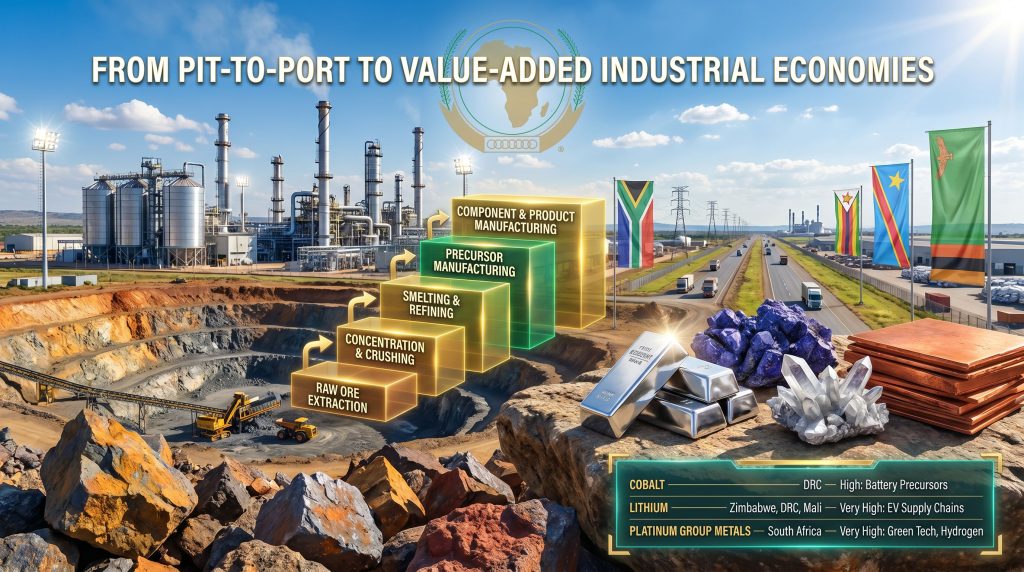
The progression from raw ore to refined industrial input involves multiple distinct stages, each representing a step-change in economic value:
| Processing Stage | Value Addition Level | Key Infrastructure Required |
|---|---|---|
| Raw ore extraction | Minimal | Basic mining infrastructure |
| Concentration and crushing | Low to moderate | Processing plant, water, power supply |
| Smelting and refining | High | Reliable energy, skilled labour |
| Precursor manufacturing | Very high | Advanced processing, R&D capacity |
| Component and product manufacturing | Maximum | Full industrial ecosystem |
Most African nations currently exit this progression at stage one or two, leaving the highest-value stages entirely to processors in Asia, Europe, and North America. Furthermore, the critical minerals energy transition is accelerating pressure on Africa to retain more value domestically before these strategic windows close.
The African Green Minerals Strategy: A Continental Framework Takes Shape
The adoption of the African Union's African Green Minerals Strategy (AGMS) in February 2025 represents the most ambitious continental-level effort to reframe this dynamic. The AGMS is not simply a policy statement; it is a structured framework designed to redirect Africa's mineral wealth toward domestic processing, participation in global value chains, and a broader industrialisation agenda.
The strategy rests on four interconnected pillars, each targeting a distinct layer of the beneficiation challenge:
- Geological knowledge and exploration infrastructure — Strengthening the foundational data and feasibility capacity that informs investment decisions and processing viability assessments.
- Human capital, research, and technological innovation — Developing the technical skills, institutional research capacity, and technology transfer mechanisms necessary for advanced mineral processing.
- Integrated mineral value chains — Building the industrial linkages, processing facilities, and downstream manufacturing ecosystems that transform raw extraction into resource-based industrialisation.
- Governance reform and regional policy coordination — Harmonising regulatory environments, improving transparency, and building collective negotiating power across African states in global supply chain conversations.
Each pillar addresses a genuine bottleneck. The framework's strength lies in its recognition that beneficiation failure is rarely caused by a single factor; it is typically the product of compounding deficits across all four dimensions simultaneously. You can review the full AGMS document for a comprehensive understanding of these continental commitments.
South Africa's National Strategy as a Beneficiation Blueprint
Within this continental context, South Africa occupies a position of particular importance. The country's Critical Minerals and Metals Strategy has attracted significant attention from industry specialists, though the prevailing expert view is that the document's value will ultimately be determined by its implementation rather than its ambitions.
Mintek, South Africa's state mineral research and development organisation, plays a central role in translating strategic intentions into operational mineral processing capability. As the institution responsible for developing and testing new processing technologies at laboratory and pilot scale, Mintek serves as a critical bridge between policy design and industrial application.
Mintek's mineral processing leadership has emphasised that South Africa's Critical Minerals and Metals Strategy must evolve into a genuine operational roadmap — one that produces measurable beneficiation outcomes, supports downstream manufacturing development, and positions South Africa as a regional anchor for industrial value chain development. This is distinct from simply cataloguing the nation's mineral endowments.
This distinction between a policy declaration and an operational roadmap is more than semantic. Numerous African nations have produced well-articulated mineral development strategies over the past two decades without translating them into structural changes in export composition. The challenge of execution is precisely where most beneficiation ambitions have historically stalled. Consequently, the critical minerals demand surge currently underway makes the urgency of implementation all the more pressing.
Platinum Group Metals: The Beneficiation Case Study With Global Implications
No discussion of African critical minerals beneficiation strategy is complete without examining platinum group metals (PGMs). The platinum and palladium market illustrates both the extraordinary opportunity and the complexity involved in moving up the value chain.
South Africa accounts for approximately 70–75% of global platinum mine supply, making it the most concentrated source of any strategically significant mineral on earth. Yet the majority of that production has historically been refined domestically before being sold into international fabrication and manufacturing markets, with limited downstream participation in the hydrogen, fuel cell, or catalytic converter industries that platinum enables.
The platinum investment case has attracted renewed attention from researchers tracking market fundamentals. The World Platinum Investment Council has noted that investment demand for platinum remains extremely strong, with structural market conditions continuing to support platinum as a compelling asset. Several dynamics are converging to reinforce this view:
- Green hydrogen production requires platinum as a catalyst in electrolysers, creating structural demand directly linked to the pace of the global energy transition
- Fuel cell vehicle adoption, particularly in heavy transport, is generating sustained industrial demand that differs meaningfully from cyclical automotive catalytic converter demand
- Above-ground stockpile drawdown has been occurring as investment and industrial demand absorb previously accumulated inventory
- South African supply constraints, linked to energy costs, ageing infrastructure, and labour dynamics, limit the production flexibility that might otherwise dampen price signals
The platinum market presents a relatively rare combination of supply concentration, increasing demand diversity, and a genuine green technology premium that distinguishes it from most base metals.
For the African beneficiation agenda, platinum's trajectory matters beyond its direct market dynamics. It demonstrates that processing depth, when achieved, creates substantially greater economic leverage. South Africa's existing PGM refining capacity provides a template — imperfect but instructive — for what deeper value chain participation can deliver.
The Infrastructure Bottleneck: Why Policy Alone Cannot Drive Beneficiation
Brookings Institution analysis has consistently identified a core set of preconditions that must be satisfied before beneficiation ambitions can materialise at scale. Moving up the mineral value chain from concentrates through smelting, refining, and precursor production is technically achievable across multiple African nations. However, this progression remains contingent on resolving persistent gaps in several foundational areas.
The barriers are interconnected and mutually reinforcing:
- Power reliability — Smelting and refining are energy-intensive processes requiring consistent, high-quality electricity. Load-shedding and grid instability impose costs and operational risks that make industrial-scale processing economically unviable in many African jurisdictions.
- Transport and logistics — Processing facilities require efficient movement of inputs and outputs. Inadequate road, rail, and port infrastructure raises costs and reduces the competitive viability of locally processed materials.
- Technical skills — Advanced mineral processing requires metallurgists, chemical engineers, and process technologists. Skills gaps at this technical level are among the most persistently cited constraints across the continent.
- Access to capital — Processing infrastructure is capital-intensive, long-cycle, and carries significant technical and market risk. Mobilising patient capital requires risk frameworks that many African markets have not yet established.
- Governance consistency — Investors in processing infrastructure require policy stability over decade-long time horizons. Regulatory uncertainty, shifting royalty frameworks, and inconsistent permitting environments deter the long-term commitments that beneficiation projects demand.
The next major ASX story will hit our subscribers first
The AfCFTA as a Regional Value Chain Multiplier
Perhaps the most underappreciated structural enabler of African beneficiation is the African Continental Free Trade Area (AfCFTA). The conceptual logic is straightforward: no single African nation possesses the complete suite of infrastructure, skills, capital, and market scale required to build a vertically integrated mineral processing industry from mine gate to finished product.
What regional integration enables is comparative advantage specialisation — where individual countries develop processing competence in specific stages or specific minerals, linked by harmonised trade rules and shared infrastructure investment into functional cross-border value chains.
The mineral endowment map across the continent suggests a compelling division of processing labour:
| Mineral | Key African Producers | Beneficiation Potential | Strategic Application |
|---|---|---|---|
| Cobalt | DRC | High — battery precursor chemicals | EV supply chains |
| Lithium | Zimbabwe, DRC, Mali | Very high — battery-grade compounds | EV and grid storage |
| Manganese | South Africa, Gabon | High — steel and battery-grade | Industrial and energy transition |
| Platinum Group Metals | South Africa | Very high — green tech, hydrogen | Fuel cells, catalysts |
| Copper | DRC, Zambia | High — electrification infrastructure | Grid buildout, EVs |
| Rare Earth Elements | South Africa, Tanzania | High — defence and clean energy | Advanced manufacturing |
In addition, rare earth supply chains across the continent are increasingly central to global defence and clean energy conversations, reinforcing the urgency of AfCFTA-enabled processing coordination. The Institute for Security Studies (ISS) Africa has identified governance quality and infrastructure investment as the twin unlocks for regional integration to function as a genuine value chain mechanism rather than a theoretical framework.
A Practical Scenario: Southern African Lithium Processing Corridor
To understand what successful beneficiation integration could look like in practice, consider a hypothetical but analytically grounded scenario. Zimbabwe holds some of Africa's most significant hard-rock lithium deposits. South Africa possesses established chemical processing infrastructure, research institutions, and a partially developed battery precursor industry. SADC member states collectively offer the geographic and industrial base for a distributed processing corridor.
Under a fully realised AfCFTA framework with harmonised trade rules and coordinated infrastructure investment, such a corridor could theoretically capture three to four additional processing stages before export. This would transform lithium from raw spodumene concentrate into battery-grade lithium hydroxide or lithium carbonate before it enters global supply chains. The revenue and employment differential between those two export positions is measured not in percentage points but in multiples.
Industrial parks positioned near existing mining corridors, supported by special economic zone structures offering targeted investment incentives and technology transfer provisions, represent the most commonly proposed mechanism for anchoring such corridors. Furthermore, understanding the broader battery metals investment landscape is essential context for evaluating the capital flows these corridors would need to attract.
Frequently Asked Questions: African Critical Minerals Beneficiation Strategy
What does beneficiation mean in the context of African mining?
Beneficiation refers to the process of adding economic value to raw minerals before export, moving from unprocessed ore through concentration, smelting, refining, and ultimately into manufactured components or industrial inputs. In the African context, it represents a deliberate policy shift away from raw commodity export dependency toward domestic industrial development.
What is the African Green Minerals Strategy?
The African Green Minerals Strategy is a continent-wide policy framework adopted by the African Union in February 2025. It establishes four strategic pillars covering mineral development, human and technological capacity, value chain development, and governance, to guide African nations toward integrated participation in global critical mineral supply chains.
Why is beneficiation difficult to achieve at scale in Africa?
The primary barriers include inadequate energy infrastructure, fragmented transport and logistics networks, inconsistent governance and regulatory environments, limited technical skills in advanced processing, and insufficient access to long-term patient capital for industrial-scale processing investments.
Which African minerals present the highest beneficiation opportunity?
Cobalt, lithium, platinum group metals, manganese, copper, and rare earth elements all present significant beneficiation opportunities, particularly given their centrality to clean energy technologies, electric vehicles, green hydrogen production, and advanced manufacturing supply chains.
How does South Africa's position reinforce the continental beneficiation agenda?
South Africa's combination of established mineral processing infrastructure, research institutions including Mintek, platinum group metal production dominance, and its national strategy positions it as a potential anchor for regional beneficiation initiatives. You can review South Africa's critical minerals strategy in full to understand the scope of these national commitments.
Key Strategic Takeaways
- Africa's mineral wealth will only generate transformative economic returns if processing and manufacturing capacity is built domestically rather than exported as raw ore, with value capture occurring at each additional stage retained on the continent
- The African Union's AGMS provides a structured four-pillar framework, but implementation requires country-level commitment to infrastructure investment, skills development, governance reform, and regional policy coordination
- South Africa's national strategy must function as a genuine operational roadmap rather than a policy declaration, with Mintek's institutional capacity serving as a critical implementation bridge
- Platinum group metals demonstrate the complexity and the opportunity of deeper value chain participation, with green hydrogen and fuel cell demand creating new structural demand drivers beyond traditional applications
- Infrastructure investment, particularly reliable power supply and logistics connectivity, remains the single most critical precondition for any beneficiation ambition to move from strategy document to industrial reality
- The AfCFTA is the structural mechanism through which cross-border value chains can achieve the scale necessary to justify processing investment, but governance quality and infrastructure must precede its full potential being realised
This article contains forward-looking analysis and scenario projections based on publicly available data and industry research. It does not constitute financial or investment advice. Readers should conduct independent research before making any investment or business decisions related to African critical minerals or mineral processing.
Want to Know Which ASX Mineral Discoveries Are Generating the Biggest Returns Right Now?
Discovery Alert's proprietary Discovery IQ model delivers real-time alerts on significant ASX mineral discoveries — including critical minerals central to the clean energy transition — instantly translating complex geological data into actionable investment insights for traders and long-term investors alike. Explore historic discovery returns on Discovery Alert's dedicated discoveries page and begin your 14-day free trial to position yourself ahead of the market.