May 18, 2026
The Continent That Pays Twice: Understanding Africa's Industrial Paradox
Consider a continent that holds roughly one-fifth of all mineral wealth on Earth, yet consistently imports the very industrial products derived from those same resources. This is not a historical anomaly or a transitional phase. It is a structural condition that has persisted across decades, costing African economies at both ends of every transaction. The architecture required to break this cycle is not a single policy reform or an isolated infrastructure project. It is a continental rewiring of how resources, infrastructure, and markets connect with each other, and African trade corridors industrialisation sits at the very centre of that rewiring.
Understanding why this matters requires looking beyond headlines about mineral discoveries or trade agreements. The real question is whether Africa can shift from being a supplier of raw inputs to becoming a producer of value-added industrial outputs, and whether that shift can happen at a pace and scale that matches the continent's demographic and economic trajectory.
When big ASX news breaks, our subscribers know first
Why the FOB-CIF Trap Is More Damaging Than It Appears
Before examining corridors themselves, it is worth understanding precisely how Africa's structural fragmentation generates economic losses at every stage of the value chain. The mechanism operates through two opposing cost structures that compound each other.
When African producers export raw commodities, transactions typically occur on a Free on Board (FOB) basis. This means the exporting country absorbs all inland transportation, logistics, and handling costs before goods leave the continent. Foreign buyers receive the commodity at the port, having contributed nothing to the cost of moving it from mine to ship.
When African countries then import processed goods derived from those same raw materials, transactions typically occur on a Cost, Insurance and Freight (CIF) basis. This means the importing country pays again, this time for international shipping, insurance, financing costs, and embedded risk premiums that foreign exporters build into their pricing.
The result is a structural double penalty:
| Cost Layer | What Africa Absorbs | Who Captures Value |
|---|---|---|
| FOB Export | Inland transport and logistics before goods leave the continent | Foreign buyers acquire commodities at competitive prices |
| CIF Import | Shipping, insurance, financing on re-imported finished goods | Foreign producers capture processing and manufacturing margins |
| Net Position | Africa pays at both ends of the value chain | External economies capture the bulk of industrial value creation |
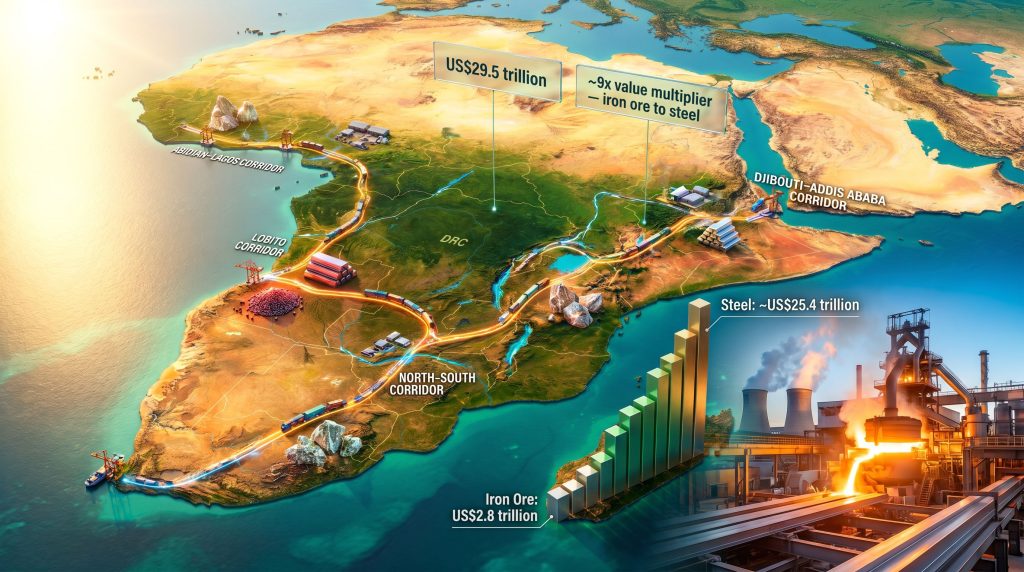
This is not simply a trade imbalance. It is a structural mechanism that systematically transfers wealth out of Africa while locking the continent into commodity dependence. According to the Africa Finance Corporation's inaugural Compendium of Africa's Strategic Minerals, released in partnership with Mining Indaba, Africa's mineral endowment is estimated at US$29.5 trillion in mine-site value, representing approximately 20% of global mineral wealth, with US$8.6 trillion still undeveloped, a figure equivalent to roughly 2.5 times the continent's entire annual GDP.
The scale of undeveloped endowment is striking. But the more important number is what that endowment could be worth if processed domestically rather than exported raw. The Compendium estimates that Africa's US$2.8 trillion in mine-gate iron ore value translates into approximately US$25.4 trillion in steel value at the point of industrial use. That is a nearly nine-fold expansion in value, generated almost entirely through downstream processing and manufacturing, activities that currently occur overwhelmingly outside Africa.
The Three Structural Misalignments Preventing Value Chain Integration
The fragmentation of African supply chains is frequently attributed to colonial trade patterns or institutional weaknesses. These factors are real, but they obscure a more operational set of misalignments that must be addressed for industrialisation to take hold.
Across much of the continent, the three structural anchors of industrial viability — resource endowment, enabling infrastructure, and regional demand — rarely co-locate or function as integrated systems. Specifically:
- Misalignment 1: Mineral deposits are frequently located far from reliable power sources, rail networks, ports, and processing facilities, making standalone industrial investment uneconomic
- Misalignment 2: Industrial and agricultural demand remains fragmented across relatively small national markets that individually lack the scale to justify large industrial investments
- Misalignment 3: Energy infrastructure is typically disconnected from mining and manufacturing clusters, creating power constraints that undermine production economics
None of these misalignments is individually insurmountable. However, their simultaneous presence across most of the continent means that isolated investments in any single element tend to underperform or fail entirely. A phosphate mine without rail access, processing capacity, or a regional fertiliser market is simply an extraction operation. A fertiliser plant without reliable gas supply, logistics infrastructure, and aggregated agricultural demand is a stranded asset.
This is precisely where the corridor model offers a different logic.
What an African Trade Corridor Actually Is
The term corridor is frequently misunderstood. In popular usage it often implies a road or railway connecting two points. In the context of African industrialisation, a corridor is something considerably more complex: an integrated economic system that aligns resource endowment, enabling infrastructure, regional market demand, and policy frameworks to create scalable industrial investment platforms.
A functional corridor includes:
- Port and deep-water terminal infrastructure
- Multimodal rail and road connectivity linking resource zones to processing facilities and consumer markets
- Dry ports and inland logistics hubs that extend corridor reach into landlocked regions
- Industrial parks and special economic zones positioned along the corridor route
- Reliable energy infrastructure connecting power sources to processing and manufacturing clusters
- Digital customs and trade facilitation platforms reducing administrative friction at borders
- Policy coordination mechanisms across multiple national jurisdictions
The critical distinction between a trade route and an industrial ecosystem lies in whether the corridor actively generates economic activity along its length, or merely transports commodities between extraction points and export terminals. The former requires deliberate integration of all the above elements. The latter requires only roads and ports.
Research commissioned by the Australian Aluminium Council provides a striking illustration of how value distribution shifts across a processing chain. The study found that of the total value contributed by the aluminium industry, mining accounted for approximately 30% while processing generated the remaining 70%. The ore itself is not the prize. The transformative economic activity happens midstream and downstream.
Africa's Major Trade Corridors: Strategic Profiles
The Lobito Corridor: Central Africa's Critical Minerals Backbone
The Lobito Corridor connecting Angola's Atlantic coast with the Democratic Republic of Congo and Zambia has emerged as one of the most strategically significant infrastructure routes on the continent, particularly given its proximity to the world's largest copper and cobalt producing regions. The Lobito Atlantic Railway has attracted substantial international attention as a potential backbone for critical minerals supply chains serving global battery and clean energy industries.
Beyond mineral transit, the corridor's industrial development potential includes downstream copper and cobalt processing, which would allow the DRC and Zambia to capture substantially more value from resources they currently export in semi-processed or concentrate form. Realising this potential requires not just the railway itself but coordinated development of power infrastructure, smelting and refining capacity, and logistics systems capable of handling finished metal products.
The North-South Corridor: Southern Africa's Manufacturing Spine
Connecting South Africa's industrial heartland with ports in Mozambique and Namibia while linking northward through Zimbabwe, Zambia, and beyond, the North-South Corridor spans some of the continent's most resource-intensive and manufacturing-capable economies. It serves as both a mineral export route and a potential distribution network for regionally manufactured goods serving southern and central African markets.
The Abidjan-Lagos Corridor: West Africa's Industrial Powerhouse
Spanning five countries with a combined population exceeding 250 million people, the Abidjan-Lagos Corridor represents arguably the highest short-term industrial activation potential of any African corridor due to its extraordinary concentration of manufacturing clusters, consumer markets, and port infrastructure. The corridor's population density creates demand aggregation opportunities that most other African corridors cannot match, making it well-suited for consumer goods manufacturing, food processing, and light industrial development in the near term.
The Central Corridor and East African Gateway
Tanzania's position as the primary ocean access point for Rwanda, Burundi, Uganda, and portions of the DRC gives the Central Corridor strategic importance that extends well beyond its own national boundaries. Expanded port capacity at Dar es Salaam combined with rail connectivity improvements has progressively reduced transit times and costs for landlocked markets that previously had no viable alternative to expensive road freight.
The Djibouti-Addis Ababa Corridor: Ethiopia's Industrial Anchor
The Djibouti-Addis Ababa corridor has demonstrated that corridor investment can catalyse manufacturing investment at scale. Ethiopia's industrial park strategy, supported by the corridor's connectivity, attracted significant foreign manufacturing investment in sectors including textiles and apparel. The corridor illustrates both the potential and the challenges of corridor-led industrialisation, including the critical importance of political stability and consistent policy frameworks for sustaining investor confidence.
The Fertiliser Paradox: A Case Study in Corridor Logic
No single sector better illustrates the structural dysfunction of Africa's current economic configuration than fertilisers. The continent holds approximately 80% of global phosphate rock reserves, possesses abundant undeveloped natural gas resources suited to ammonia and urea production, and hosts significant untapped potash deposits across the Gulf of Guinea basin.
Yet Africa remains a net fertiliser importer, structurally exposed to global price volatility, shipping disruptions, and foreign exchange pressures. Every major geopolitical shock, whether involving the Strait of Hormuz, Black Sea trade routes, or Russian export restrictions, transmits directly into African agricultural input costs, food prices, and government subsidy bills.
The fertiliser paradox is not a resource problem. Africa has what it needs. It is an infrastructure and integration problem. The resources, the demand, and the economic rationale for domestic production all exist simultaneously, but in disconnected systems that cannot interact without corridor-scale infrastructure connecting them.
A corridor-based approach to fertiliser development would require systematic integration of multiple components:
- Develop domestic natural gas resources to supply feedstock for ammonia and urea production
- Connect phosphate mining operations to processing facilities via rail networks
- Link processing output to regional port infrastructure for domestic distribution and export
- Aggregate national agricultural demand across regional markets to justify investment scale
- Establish consistent policy frameworks that progressively reduce import dependency while protecting against market disruption during the transition
The reason standalone fertiliser plants have historically underperformed or failed across Africa is precisely because they attempt to solve one part of this system without addressing the others. A urea plant without reliable gas supply operates on an uneconomic input cost base. A phosphate processor without rail access to the mine and port access to the market cannot compete with imported product. Integration is not optional. It is the precondition for economic viability.
The next major ASX story will hit our subscribers first
Iron Ore and the Steel Value Chain: Corridor Economics in Practice
Iron ore offers a particularly clear illustration of how corridor development can unlock exponential value multiplication. Countries including Guinea, Gabon, and South Africa host some of the world's highest-grade iron ore deposits, grading 62-66% iron content, material that is well-suited for hydrogen iron ore reduction production and lower-carbon steelmaking processes.
The demand case is structurally compelling. Africa currently records the world's lowest steel consumption per capita. Its infrastructure development requirements, spanning transport networks, energy systems, urban housing, and industrial facilities, imply structurally rising domestic steel demand for decades. The continent is simultaneously among the largest potential suppliers of high-quality steelmaking raw materials and among the largest potential consumers of finished steel products, as the global steel outlook makes abundantly clear.
The challenge is that building a regional steel industry requires far more than mining assets alone:
| Corridor Component | Role in Steel Value Chain |
|---|---|
| High-grade iron ore deposits (62-66% Fe) | Primary steelmaking feedstock, suitable for DRI process |
| Railway networks across West Africa and Gulf of Guinea | Economical ore transport from mine to processing facility |
| Natural gas supply | Heat and steam generation for DRI production |
| Hydropower infrastructure | Competitive electricity for electric arc furnace steelmaking |
| Port access and logistics | Regional distribution of finished steel products |
| Regional demand aggregation through AfCFTA | Market scale sufficient to justify integrated investment |
The mine-gate value of US$2.8 trillion in African iron ore reserves translating into roughly US$25.4 trillion in steel value at the point of industrial use is not a theoretical projection. It reflects the empirical reality of how value accumulates through steelmaking, fabrication, and construction applications. Capturing even a fraction of that value multiplication within Africa, rather than transferring it to steelmakers in Asia, Europe, or the Americas, would represent a transformative shift in the continent's economic trajectory. Furthermore, advances in steel decarbonisation are making it increasingly viable to build lower-carbon processing capacity within Africa itself.
What Makes a Corridor Investable: The Four Pillars
Not all corridors succeed, and understanding the conditions that differentiate viable corridors from underperforming ones is essential for investors, policymakers, and development finance institutions. Four pillars consistently determine corridor viability:
Pillar 1: Resource Endowment Alignment
The corridor must connect meaningful resource endowments with the infrastructure required to extract, process, and distribute them economically. Corridors that traverse resource-poor regions or that fail to connect existing endowments to processing capacity lack the economic engine needed to sustain industrial activity.
Pillar 2: Enabling Infrastructure at Scale
Physical infrastructure, including rail, road, port, power, and water systems, must be developed at a scale that supports industrial operations rather than simply transit. Undersized infrastructure creates bottlenecks that constrain throughput and increase operating costs, undermining the economic case for industrial investment along the corridor.
Pillar 3: Regional Demand Aggregation
Individual national markets across most of Africa are insufficient to justify the capital expenditure required for large-scale industrial facilities. Corridors that aggregate demand across multiple national markets create the customer base and revenue certainty that industrial investors require. This is where AfCFTA's tariff reduction architecture becomes operationally critical.
Pillar 4: Policy Coherence and Institutional Coordination
Cross-border corridors require harmonised regulatory frameworks, coordinated customs procedures, and consistent policy environments across multiple national jurisdictions. World Bank research confirms that infrastructure upgrades generate measurable welfare gains only when combined with border reform and trade facilitation improvements. Physical infrastructure alone is insufficient.
The AfCFTA Connection: Policy Architecture Meets Physical Infrastructure
The African Continental Free Trade Area represents the most significant continental trade policy framework in African history, with the potential to create a single market of over 1.4 billion people across 54 countries. The Economic Commission for Africa estimates that full AfCFTA implementation could increase intra-African trade by over 52% and eliminate tariffs on approximately 90% of goods.
However, AfCFTA's potential cannot be realised through tariff reduction alone. The structural barriers to intra-African trade are primarily logistical and infrastructural rather than purely regulatory. Without physical corridors connecting national economies, removing tariffs does not materially reduce the cost of trading across borders. The policy architecture and the physical infrastructure must advance together.
For landlocked countries, this challenge is particularly acute. Port access constraints mean that even with zero tariffs, inland countries face transport cost disadvantages that external competitors do not. Corridor development that includes dedicated dry port facilities, bonded warehousing, and seamless rail connectivity between inland centres and ocean terminals is the practical mechanism through which AfCFTA's tariff benefits become commercially actionable for landlocked economies. Afreximbank's push for intra-African trade and industrialisation aligns directly with this corridor-first logic, recognising that financing alone cannot substitute for integrated physical and institutional infrastructure.
External Capital and Geopolitical Dimensions
The strategic significance of African trade corridors industrialisation has not gone unnoticed by global powers. The European Union's Global Gateway initiative has identified 11 EU-Africa strategic corridors as priority development areas, reflecting recognition that corridor infrastructure shapes long-term trade relationships, supply chain dependencies, and geopolitical influence.
Other international actors including China, the United States through its Development Finance Corporation, Japan through JBIC and JOGMEC, and Gulf sovereign wealth funds have all demonstrated interest in African corridor infrastructure through various financing and investment mechanisms.
For African policymakers and development institutions, the challenge is balancing the genuine need for external capital with the imperative of ensuring that corridor development serves African industrial interests rather than simply creating more efficient export routes for raw commodities. The critical distinction is between corridors designed to extract resources for foreign processing and corridors designed to support domestic value addition. The physical infrastructure can look similar. The economic outcomes are fundamentally different depending on how industrial development zones, processing facilities, and ownership structures are configured alongside the transport infrastructure.
The Biggest Obstacles: What Still Needs to Happen
Despite genuine progress in several corridor development initiatives, significant obstacles remain:
- Multimodal connectivity gaps: Road-rail-port integration remains incomplete across most corridors, creating costly transshipment requirements and delays
- Power infrastructure disconnection: Energy systems frequently remain physically separate from industrial clusters, forcing manufacturers to develop expensive private generation capacity
- Border delays and regulatory fragmentation: Average customs clearance times across Africa remain dramatically longer than in comparable regions, with associated costs adding 15-25% to the value of goods
- Financing gaps: The capital requirements for corridor-scale industrial infrastructure exceed what development finance institutions alone can provide, requiring innovative blended finance mechanisms to mobilise private capital
- Digital trade facilitation underinvestment: Single window customs systems, digital trade documentation platforms, and AI-powered logistics optimisation remain underdeveloped across most African corridors
World Bank research confirms that corridor infrastructure upgrades generate measurable welfare gains, but only when physical improvements are combined with border reform and trade facilitation measures. Infrastructure without institutional reform underdelivers consistently.
Strategic Scenarios for 2040: Three Pathways
The trajectory of African trade corridors industrialisation over the next 15 years will depend critically on the pace of investment, policy coordination, and institutional development. Three broad scenarios capture the range of plausible outcomes:
| Scenario | Intra-African Trade Share | Industrial Value-Add Outcome | Regional Employment Impact |
|---|---|---|---|
| High Integration | 35-40% of total trade | Substantial manufacturing base across multiple sectors | Tens of millions of formal employment opportunities |
| Partial Development | 20-25% of total trade | Selective industrial clusters in highest-potential corridors | Moderate employment gains concentrated in corridor zones |
| Status Quo | ~15% of total trade | Continued commodity export dependency | Limited structural transformation, persistent informality |
The high-integration scenario requires accelerated physical infrastructure investment, rapid AfCFTA implementation, coordinated industrial policy across multiple national governments, and a sustained pipeline of blended finance mechanisms capable of mobilising private capital at scale. It is achievable but requires a level of institutional coordination that has historically proven difficult to sustain.
The status quo scenario carries the highest long-term cost. Africa's population is projected to reach 2.5 billion by 2050, creating labour force pressures that commodity-dependent economies cannot absorb. Without industrial diversification underpinned by corridor development, demographic growth becomes an economic liability rather than a growth dividend. In addition, the critical minerals energy transition underway globally means African economies that fail to industrialise now risk missing a generational window to capture value from their own resource endowments.
Frequently Asked Questions: African Trade Corridors and Industrialisation
What is the difference between a trade corridor and a development corridor in Africa?
A trade corridor primarily facilitates the movement of goods between points, typically focused on transport efficiency. A development corridor is an integrated economic system that uses transport infrastructure as a foundation for stimulating industrial activity, processing capacity, agricultural development, and urban growth along its entire length. Development corridors aim to generate economic value rather than simply move it.
Which African trade corridor has the most industrial development potential?
The Abidjan-Lagos Corridor holds the highest short-term activation potential due to its population density, existing manufacturing clusters, and established port infrastructure. The Lobito Corridor holds the highest long-term strategic significance for critical minerals processing given its connection to the DRC and Zambia's copper-cobalt belt.
How does AfCFTA support corridor-led industrialisation?
AfCFTA provides the tariff reduction framework that makes regional value chains commercially viable by removing the cost penalty on intermediate goods traded across borders. It also creates the demand aggregation logic that justifies industrial investments that would be uneconomic within individual national markets alone.
Why does Africa still import fertilisers despite holding most of the world's phosphate reserves?
Phosphate deposits, natural gas resources for ammonia production, and agricultural demand centres exist in disconnected locations without the integrated rail, processing, and logistics infrastructure needed to connect them into viable value chains. The resources exist. The corridor infrastructure to connect them into a functioning domestic fertiliser industry largely does not.
What investment is required to activate Africa's major trade corridors?
Estimates vary widely, but the African Development Bank has identified an infrastructure funding gap of approximately US$68-108 billion annually across the continent. Corridor-scale development requires blended finance combining development finance institution concessional lending, export credit agency support, and private capital mobilised through project finance structures with appropriate risk allocation.
Key Takeaways
- Africa's US$29.5 trillion mineral endowment (with US$8.6 trillion still undeveloped) cannot generate industrial wealth without integrated corridor infrastructure connecting resources to processing capacity and regional markets
- Value multiplication through downstream processing is substantial: iron ore alone expands approximately nine-fold in value from mine gate to steel at point of industrial use
- The corridor model solves market fragmentation by aggregating national demand into regionally competitive investment platforms that justify industrial-scale investment
- AfCFTA provides essential policy architecture, but physical and digital corridor infrastructure must be developed alongside it to activate the framework's commercial potential
- Africa's per capita deficits in steel consumption, electricity access, and fertiliser application represent the largest addressable industrial demand growth opportunity on Earth
- Successful corridor activation requires combining infrastructure investment with customs reform, special economic zones, blended financing mechanisms, and digital trade facilitation systems working as an integrated whole
This article contains forward-looking analysis and scenario projections based on publicly available data and institutional research. Such projections involve inherent uncertainty and should not be interpreted as investment advice or financial recommendations. Readers should conduct independent research and seek qualified professional advice before making investment or policy decisions.
Want to Capitalise on the Resource Discoveries Driving Africa's Industrial Transformation?
As Africa's trade corridors unlock billions in mineral value across copper, cobalt, iron ore, and phosphates, Discovery Alert's proprietary Discovery IQ model delivers real-time ASX alerts the moment significant mineral discoveries are announced, ensuring subscribers can act on actionable opportunities before the broader market reacts — explore historic discoveries and their returns and begin a 14-day free trial today.