May 18, 2026
The Fracturing of a Global Market: How Geopolitics Is Rewriting the Rules of PGM Pricing
Commodity markets have historically priced risk through the lens of supply and demand. Ore grades decline, mine output fluctuates, industrial consumption shifts, and prices respond accordingly. For decades, platinum group metals operated within this framework, with London benchmark pricing serving as the universally accepted clearing mechanism. The Middle East conflict and regionalisation of PGM markets is now fundamentally fracturing that architecture, and the forces driving its dissolution are geopolitical rather than geological.
The convergence of Middle East conflict risk, Western critical mineral policy, and China's accelerating strategic accumulation agenda has introduced a new layer of complexity into PGM price formation. Understanding this transformation requires moving beyond conventional supply-demand analysis and examining how the structural redesign of global trade relationships is reshaping where PGMs flow, who prices them, and what premium the market assigns to jurisdictional security.
When big ASX news breaks, our subscribers know first
Three Policy Forces Fragmenting the Integrated PGM Market
For much of the past two decades, PGM trade flowed through relatively predictable channels. South African and Russian producers dominated primary supply, London set the benchmark price, and industrial consumers across Europe, North America, and Asia sourced material through established intermediaries. What is emerging now is fundamentally different: three distinct policy ecosystems, each constructing its own PGM sourcing and processing architecture simultaneously.
| Policy Framework | Jurisdiction | Strategic Objective | PGM Market Impact |
|---|---|---|---|
| Section 232 Proclamation | United States | Domestic critical mineral security | Reshapes import sourcing and processing flows |
| 15th Five-Year Plan | China | Strategic material self-sufficiency | Drives domestic futures infrastructure and stockpiling |
| Critical Raw Materials Act | European Union | Diversify single-source dependencies | Accelerates European refining and recycling investment |
These three frameworks are not coordinated. They are competitive. Each jurisdiction is independently constructing barriers, incentives, and institutional infrastructure designed to reduce reliance on the others. The practical consequence for PGM markets is the emergence of regional pricing premiums, bifurcated logistics corridors, and a gradual decoupling of price discovery from any single global benchmark.
Furthermore, the critical raw materials transition across major economies is reinforcing these competitive dynamics, with each bloc treating PGM access as a matter of strategic necessity rather than commercial convenience.
China's GFEX and the Parallel Pricing Architecture
The launch of platinum and palladium dynamics on China's Guangzhou Futures Exchange in November 2025 represents arguably the most structurally consequential development in PGM market architecture in decades. For the first time, China possesses a domestic price discovery mechanism for both metals, independent of London Metal Exchange or LBMA benchmark frameworks.
The significance of this extends beyond mere market infrastructure. Under conditions of trade fragmentation or geopolitical stress, GFEX pricing could increasingly diverge from London benchmarks, effectively creating a two-tier global price. This divergence risk is not theoretical. With Chinese retail investment in platinum rising 96% to 402,000 ounces in 2025 and Chinese buyers accounting for approximately 60% of global purchases, the gravitational pull of GFEX on physical market pricing will only intensify as liquidity deepens.
In addition, China's strategic stockpiling behaviour across critical commodities suggests that GFEX is not merely a commercial tool but an instrument of national resource security policy.
The Middle East Conflict Risk Premium: How Regional Instability Transmits Into PGM Pricing
The relationship between Middle East conflict and PGM markets operates through several distinct transmission channels, each of which compounds the others under stress conditions. According to analysis from Argus Media, these transmission mechanisms are becoming increasingly interconnected across global commodity markets.
-
Energy cost escalation: PGM smelting and refining operations in South Africa are extraordinarily energy-intensive. Elevated oil prices, driven by Strait of Hormuz risk premiums and regional instability, feed directly into production cost structures for primary producers already operating under margin pressure.
-
Dollar dynamics: Geopolitical tension typically strengthens the US dollar as capital seeks safe-haven assets. A stronger dollar creates a headwind for USD-denominated commodity prices, including PGMs, even as the underlying metals benefit from precious metals demand during risk-off periods. These forces simultaneously push in opposing directions, creating pricing volatility rather than clean directional moves.
-
Shipping corridor disruption: Conflict-related interference with key maritime routes elevates insurance costs and transit risk for industrial commodity flows globally, adding logistical friction to an already supply-constrained complex.
-
Investor sentiment transmission: Oil price spikes drive inflation expectations upward, which historically supports gold and, by correlation, platinum as a store-of-value proxy. This linkage has become increasingly significant as platinum's investment narrative has strengthened.
The Russian Palladium Variable: A Compounding Geopolitical Layer
Middle East instability is not the only geopolitical force reshaping PGM flows. Russian palladium supply, which represents a dominant share of global primary production, continues to face sanctions-related trade disruption that has been redirecting metal flows and distorting historical pricing relationships.
The combination of Russian supply uncertainty and Middle East logistics risk creates a scenario in which both the dominant palladium supplier and key transit corridors face simultaneous geopolitical pressure. Consequently, no supply chain model designed before 2022 was built to accommodate this confluence of pressures. These trade-driven supply chain shifts are forcing industrial consumers to fundamentally rethink procurement strategies.
The 2025 Deficit Landscape: Five Metals, One Direction
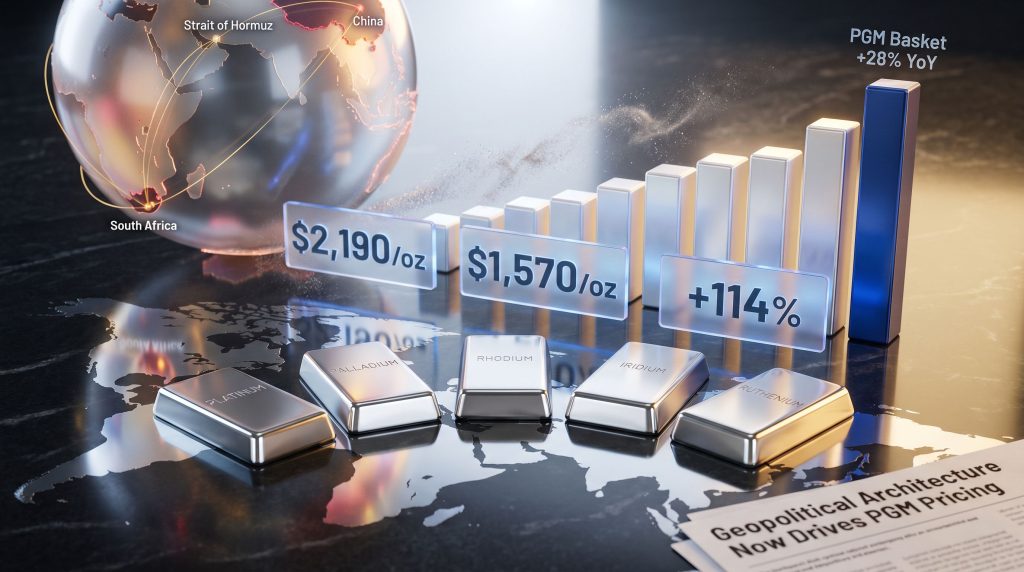
The physical fundamentals underpinning the geopolitical narrative are unambiguous. All five platinum group metals recorded deficits in 2025, with the PGM basket price rising 28% year-on-year, driven by tightening physical balances, intensifying investor interest, and trade policy uncertainty.
| Metal | 2025 Deficit | Above-Ground Stock | Demand Cover |
|---|---|---|---|
| Platinum | 461,000 oz | 9.3 million oz | ~14 months |
| Palladium | 433,000 oz | 10.7 million oz | ~13 months |
| Rhodium | 116,000 oz | Below 4 months cover | Critical |
| Iridium | 34,000 oz | Tight/illiquid | Constrained |
| Ruthenium | 312,000 oz | Deficit conditions | Tightening |
Primary mine supply contraction amplified these deficits. Total platinum mine output fell 4% year-on-year to 5.6 million ounces in 2025, with palladium mirroring this decline at 6.3 million ounces. South African production was disrupted by flooding across multiple operations, while North American supply fell sharply following Stillwater West's placement on full-year care and maintenance status. These are structural supply impairments, not temporary operational blips.
The supply constraints in PGMs across the complex underscore how geopolitical pressures are compounding already challenging physical market conditions.
According to Metals Focus, price outcomes across the PGM complex will increasingly be shaped by investor flows, stock movements, and policy intervention rather than physical supply-demand balances operating in isolation. This represents a material shift in how the market's underlying price formation mechanism should be understood by investors.
Above-ground stock drawdowns across the complex reduce the market's capacity to absorb unexpected supply shocks. Rhodium's stocks falling below four months of demand cover is particularly notable: at that level, any meaningful disruption to primary supply would translate almost immediately into acute physical tightness with no buffer available.
Demand Transformation: Where PGM Consumption Is Heading
The Automotive Sector's Gradual Displacement
Automotive platinum, palladium, and rhodium demand fell 2% to 11.9 million ounces in 2025, the first time this combined metric dropped below 12 million ounces since the chip shortage period impacted production in 2022. Light-duty vehicle production grew 3%, but gains were concentrated in battery electric vehicles, which achieved a 16% global market share.
The critical nuance here is pace. BEV penetration is accelerating, but internal combustion engine and hybrid vehicles still represent the overwhelming majority of global light vehicle production. The displacement of ICE-based PGM demand is gradual enough that deficit conditions across the complex are expected to persist across the near-to-medium term, even as the long-term structural shift continues.
Emerging Demand Vectors: The New Consumption Architecture
| Demand Segment | 2025 Change | Volume | Key Driver |
|---|---|---|---|
| Platinum Jewellery | +10% | 2.2 million oz (9-year high) | Gold price substitution effect |
| Electronics (all metals) | +8% | 1.3 million oz | AI infrastructure buildout |
| Chemical Demand | +3% | 1.9 million oz | Caprolactam expansion; Chinese plastic precursors |
| Glass (Pt and Rh) | Sharp decline | Significant reduction | LCD capacity closures across Asia |
| Autocatalyst Recycling | +7% (total scrap) | 4.9 million oz | Chinese scrappage schemes; US rebuilding |
The gold-platinum substitution dynamic deserves particular attention. When gold prices sustain elevated levels, jewellery manufacturers face margin compression that incentivises the substitution of platinum as a cost-competitive alternative with comparable aesthetic properties. Platinum jewellery demand reaching a nine-year high of 2.2 million ounces in 2025 introduces a gold-correlated demand variable into platinum pricing that was not operating at meaningful scale in prior market cycles.
This creates a new feedback loop: gold price strength now supports platinum demand as well as platinum's investment narrative. Ruthenium's electronics demand story is particularly compelling and underappreciated. AI-driven expansion of data storage infrastructure has created sustained demand growth for hard disk drive components, where ruthenium is used as a thin-film deposition material.
2026 Price Outlook: Scenario-Based Analysis Under Geopolitical Uncertainty
The following price forecasts represent analyst projections and should not be construed as investment advice. All forecasts are subject to material revision based on geopolitical developments, policy changes, and market conditions.
Platinum and Palladium: Diverging Investment Narratives
Platinum is forecast to record a 312,000-ounce deficit in 2026, with above-ground stocks declining to nine million ounces. Following its sharp re-rating in 2025, the metal is projected to consolidate at elevated levels, averaging $2,190/oz, representing a 71% year-on-year increase. The strategic accumulation narrative and gold price correlation are expected to sustain elevated pricing even as the physical deficit narrows modestly.
Palladium faces a structurally different investor psychology despite entering its fifth consecutive annual deficit at 376,000 ounces. Limited institutional investor appetite keeps palladium trading at a structural discount to platinum, with an average price forecast of $1,570/oz, up 37% year-on-year. The disconnect between persistent physical tightness and subdued investor interest in palladium illustrates how investor sentiment can override fundamental signals in smaller, less liquid markets.
The Minor PGMs: Where the Most Dramatic Price Moves Are Forecast
| Metal | 2026 Price Forecast | YoY Change | Primary Driver |
|---|---|---|---|
| Rhodium | $10,200/oz | +62% | Stock drawdown; glass demand recovery; supply constraints |
| Iridium | $7,200/oz | +64% | Illiquid market; 34,000-oz deficit; stable mine supply |
| Ruthenium | $1,560/oz | +114% | AI-driven hard disk drive demand; 210,000-oz deficit |
Ruthenium's projected 114% price increase is the most dramatic forecast across the entire complex. The 210,000-ounce deficit, combined with AI-related data storage demand continuing to outpace supply capacity, positions ruthenium as the PGM most exposed to the structural technology investment cycle of 2026. However, data centre capex cycles are lumpy and difficult to forecast, and any slowdown in AI infrastructure investment would represent a meaningful downside risk to this projection.
The next major ASX story will hit our subscribers first
Strategic Implications: Recycling, Jurisdictional Diversification, and the Long-Term Supply Architecture
Total PGM scrap supply rising 7% to 4.9 million ounces in 2025 is more significant than it might initially appear. Secondary supply from recycling is increasingly functioning as a strategic geopolitical buffer, reducing dependence on primary mine output from jurisdictions facing either sanctions pressure or logistical vulnerability. Nations with developed autocatalyst and industrial recycling infrastructure gain a structural advantage that cannot be replicated quickly by countries without established processing capacity.
For investors and project developers, the Middle East conflict and regionalisation of PGM markets dynamic is accelerating portfolio-level reassessment of where PGM assets are located relative to geopolitical risk corridors. As noted in recent market commentary from J.P. Morgan, regional conflict exposure is now a primary variable in commodity investment frameworks, not a peripheral consideration.
Development-stage assets in jurisdictions with secure logistics, politically stable operating environments, and proximity to growing regional demand centres are attracting structural premiums that did not exist within the previous integrated global market framework.
The three scenario pathways for PGM market regionalisation — ranging from accelerated fragmentation driven by conflict escalation, through managed multipolarity where GFEX and London pricing coexist, to a policy-driven realignment without acute conflict — all converge on the same conclusion: the era of a single globally integrated PGM market governed by a London benchmark is ending. What replaces it will be more complex, more regionally differentiated, and more sensitive to geopolitical developments than any prior cycle in the history of these metals.
The investment implication is straightforward even if the execution is not: supply chain provenance, jurisdictional security, and recycling infrastructure are no longer secondary considerations in PGM market analysis. They have become primary determinants of both pricing and access.
Want To Track The Next Major ASX Mineral Discovery Before The Broader Market?
Discovery Alert's proprietary Discovery IQ model delivers real-time alerts on significant ASX mineral discoveries across the commodities reshaping global supply chains, turning complex geological and market data into clear, actionable investment insights. Explore Discovery Alert's dedicated discoveries page to understand how historic mineral discoveries have generated substantial returns, and begin your 14-day free trial today to position yourself ahead of the market.