
August 24, 2026
The Ownership Gap at the Heart of African Resource Development
For decades, the architecture of mining investment in Africa has followed a familiar pattern: foreign capital enters, raw commodities exit, and the economic multiplier effects accumulate elsewhere. This is not simply a matter of historical grievance. It reflects a structural gap between where resources originate and where the financial returns ultimately reside. Understanding why this pattern persists, and what it would take to fundamentally alter it, is the central challenge that the Africans for Africa Responsible Resource Investment model attempts to address.
The continent's resource endowment is extraordinary by any measure. Africa holds some of the world's highest concentrations of critical minerals, including lithium, cobalt, rare earth elements, gold, and iron ore, all of which sit at the intersection of the global energy transition and advanced manufacturing demand. Yet the economic architecture surrounding these assets has historically been designed to serve external capital, not African communities. The gap between resource endowment and retained economic benefit is not a gap in geology. It is a gap in governance, ownership structure, and capital deployment.
When big ASX news breaks, our subscribers know first
Why Structural Ownership Changes the Investment Equation
There is a well-documented tension in African mining that rarely surfaces in investment prospectuses: the risk of retroactive policy change. When foreign investors commit capital to a project and the host nation subsequently seeks a larger share of revenues through renegotiated royalties, windfall taxes, or forced equity dilution, the resulting friction damages both project economics and the country's investment reputation. This cycle, often labelled resource nationalism, is frequently presented as an irrational political risk. A more accurate framing is that it represents the predictable consequence of structuring projects without genuine local ownership from inception.
This is the core insight behind the Africans for Africa Responsible Resource Investment framework. Rather than treating African ownership as a political concession to be negotiated mid-project, the model engineers it into the foundation of project design. When African capital, governance, and institutional interests are embedded at the outset, the incentive for unilateral policy intervention diminishes significantly. The project's success becomes aligned with national interests from day one rather than becoming a source of ongoing political friction.
The 51% Benefit Principle: Beyond Local Content Rhetoric
Most readers familiar with African mining policy will recognise the language of local content requirements. Governments across the continent have long mandated that foreign mining operators source a defined percentage of goods, services, or labour locally. While these frameworks have delivered some benefit, they have consistently fallen short of structural transformation. A mining company that procures 30% of its consumables from local suppliers while repatriating the bulk of its profits to shareholders in London, Toronto, or Sydney has technically satisfied local content obligations while leaving the fundamental ownership imbalance untouched.
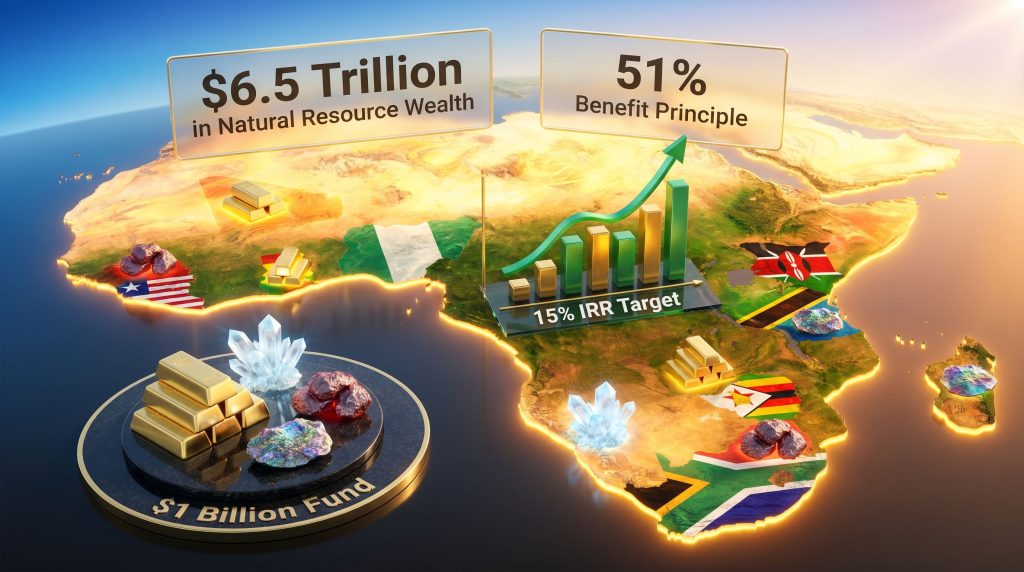
The Africans for Africa Initiative approaches this problem through what it terms the 51% benefit principle: a commitment that the majority of economic returns generated by any project, including equity returns, employment, processing revenues, and downstream supply chain participation, must flow to African nations, communities, and investors through enforceable, transparent partnership agreements. This is not a discretionary corporate social responsibility commitment. It is a structural feature of how projects are assembled and governed.
The distinction matters enormously in practice. Discretionary CSR frameworks can be scaled back when commodity prices fall or when management priorities shift. Structural ownership, however, cannot be undone without material legal and financial consequence. That permanence is precisely what gives the 51% principle its credibility as a risk-management mechanism, both for African governments seeking durable development outcomes and for international co-investors seeking predictable operating environments.
How the Africans for Africa Fund Is Designed for Institutional and Retail Participation
The Africans for Africa Initiative is not solely a governance philosophy. It is backed by a formal investment vehicle with defined financial parameters designed to attract both institutional capital and diaspora investors who want alignment with the model's core principles. Furthermore, understanding African mining finance trends helps contextualise why this fund structure represents a meaningful departure from conventional approaches.
The fund's management and governance architecture includes two key entities:
-
New Frontier Developments Limited (NFD) was appointed as Fund Manager in April 2025, bringing operational oversight to capital deployment decisions.
-
Allied Trust Asset Management Limited (ATAM) handles fund administration, deal execution, and governance oversight, providing the operational infrastructure required for institutional participation.
The Investment Committee operates under a unanimous decision-making model for project selection. This is a deliberately conservative governance design. By requiring full consensus rather than simple majority approval, the framework creates a structural barrier against rushed or poorly underwritten capital deployment. For investors accustomed to seeing African resource funds undermined by governance failures, this decision-making architecture provides a meaningful risk signal.
The fund's two-tier participation structure is equally deliberate:
| Investor Category | Minimum Entry | Notes |
|---|---|---|
| Retail / Diaspora | $1,000 | Democratises access for pan-African community |
| Institutional | $200,000 | Targets sovereign wealth funds, DFIs, fund managers |
| Target IRR | 15% | Across portfolio of vetted projects |
| Fund Size Target | $1 billion | Across 50+ curated projects |
| Liquidity Tranche 1 | 50% after 3 years | Defined exit pathway |
| Liquidity Tranche 2 | Remaining 50% after 5 years | Full portfolio liquidity horizon |
Disclaimer: Fund parameters including the target IRR, minimum entry thresholds, and liquidity tranches are drawn from publicly available outline materials and the African Mining Market report. Prospective investors should conduct independent due diligence and refer to official fund documentation before making any investment decisions. Past performance and target returns are not guarantees of future outcomes.
The deliberate inclusion of a $1,000 retail entry threshold is a strategically significant design choice. The global African diaspora represents an enormous pool of patient, mission-aligned capital that has historically lacked a structured, investor-grade vehicle through which to participate in the continent's resource economy. By lowering the participation floor while maintaining institutional governance standards, the fund attempts to capture both the scale of institutional capital and the values-alignment of diaspora investment. In addition, mining private equity dynamics globally suggest that this blended participation model addresses a genuine structural gap in how African resource projects are capitalised.
Mining Indaba 2026: Where Institutional Validation Met Sovereign Engagement
Cape Town's Mining Indaba is widely regarded as the premier gathering of African mining capital, and the 2026 edition served as the formal public launch of the Africans for Africa Fund. What distinguished AFA's presence was not simply participation in the conference agenda but a structured programme of bilateral engagements with sovereign governments that produced tangible next steps. The Africans for Africa Initiative's activities at Mining Indaba 2026 offer a detailed account of the engagements and commitments that emerged.
Sovereign Partnerships Across Priority Jurisdictions
The breadth of government-level engagement across multiple jurisdictions within a single week signals a level of institutional momentum that is difficult to manufacture through marketing alone:
-
Kenya: The delegation was led by Cabinet Secretary of Mining, Blue Economy and Maritime Affairs, H.E Hassan Ali Joho. AFA secured an invitation to lead the investment deal room at Kenya Mining Week in April 2026, directly supporting the country's strategic push into rare earths development. Kenya's rare earth ambitions are notable given the country's relatively underexplored geology compared to established African mineral exporters, suggesting early-mover positioning advantages for investors.
-
Zimbabwe: Strategic alignment was established with the Mutapa Investment Fund, Zimbabwe's sovereign wealth vehicle, creating a co-investment framework that brings domestic sovereign backing alongside AFA's structured capital platform. The timing is noteworthy given Zimbabwe's recent moves to restructure its approach to lithium export, signalling a broader policy direction toward value-addition rather than raw mineral export.
-
Liberia: Discussions led by the Honorable Minister of Mines and Energy, Hon. Matenokay Tingban, focused on incorporating a high-value gold project into the AFA project pipeline while simultaneously supporting Liberia's national capacity for geological data generation. The data generation dimension is particularly important: one of the persistent barriers to investor confidence in West African projects is insufficient baseline geological data, meaning that support for data infrastructure directly addresses a fundamental bankability constraint.
-
Saudi Arabia: Bilateral discussions explored co-investment partnership models spanning lithium, gold, and iron ore processing hubs. This engagement extends AFA's reach beyond the African continent itself, reflecting the initiative's ambition to integrate African resource development into broader global supply chains rather than limiting its co-investor base to domestic or diaspora capital.
Institutional Financial Partnerships
Beyond sovereign engagement, AFA advanced discussions with Empire Investment Bank, Westlake Capital, and the Development Bank of Southern Africa (DBSA) to secure technical and financial partnerships for project development capital. The inclusion of DBSA is particularly relevant given the institution's mandate for development-oriented investment across Southern Africa and its established credibility with international co-investors.
The Cape Town Club Event: Validating Market Appetite
AFA hosted an invitation-only networking event at the Cape Town Club during Mining Indaba 2026, drawing approximately 40 to 50 stakeholders including sovereign representatives from Nigeria, Liberia, and the Democratic Republic of Congo, alongside fund managers and senior executives from the mining, oil, and gas sectors. Feedback from attendees confirmed strong appetite for pipeline access, co-investment models, and priority jurisdiction engagement, providing meaningful third-party validation of the AFA investment thesis.
A consistent theme validated across Mining Indaba 2026 was that while capital exists within Africa, the structural mechanisms to channel that capital into well-governed, investor-ready projects have historically been limited. AFA's platform was received as a practical solution to bridge this gap.
Why Visible African Capital Participation Strengthens Bankability
One of the less widely understood dynamics in African mining finance is the relationship between local ownership visibility and access to international capital markets. Development finance institutions and commercial lenders increasingly apply rigorous ESG and governance screens to project applications. Projects that can demonstrate genuine structural alignment with host country interests, rather than superficial local content compliance, tend to score materially better against these screens.
This creates a concrete financial incentive for the AFA model beyond its governance rationale. A project structured with African capital co-invested from inception, operating under a framework that structurally directs the majority of economic benefits toward African stakeholders, is better positioned to satisfy DFI lending criteria, attract lower-cost debt, and access a broader pool of international co-investors who require ESG credibility rather than simply tolerating it.
The transformation of resource nationalism from a political risk into a structured resource partnership, as stakeholders at Mining Indaba 2026 acknowledged, is not merely a philosophical reframing. It is a bankability upgrade. International partners at the conference emphasised that stability, transparency, and predictable partnership frameworks are the primary determinants of long-term capital commitment to African projects, and that AFA's model directly addresses all three criteria.
Gender-Inclusive Leadership as an Integral Component of Responsible Investment
AFA's participation as Silver Sponsor of the AWIMA Leadership Awards during Mining Indaba 2026 reflects an understanding that governance reform in African mining cannot be separated from the question of who participates in that governance. The Association of Women in Mining Africa recognises and elevates women's leadership, entrepreneurship, and institutional capacity across the sector.
Inclusive participation is treated within AFA's framework not as peripheral corporate responsibility but as an integral dimension of the Responsible Resource Investment mandate. A capital mobilisation model that claims to prioritise African benefit while leaving the majority of women in mining communities without meaningful participation in governance or economic returns would be internally contradictory. By aligning with AWIMA's mission, AFA signals that its definition of structural ownership extends to questions of gender equity within the mining value chain.
The next major ASX story will hit our subscribers first
The Commodity Focus: Why Battery Metals, Gold, and Rare Earths
The Africans for Africa Initiative's commodity concentration is not arbitrary. The focus on lithium, gold, iron ore, and rare earth elements reflects a deliberate alignment between Africa's geological endowments and the specific minerals driving global demand growth through the energy transition and advanced technology manufacturing. Consequently, both critical minerals demand and rare earth supply chains are reshaping how investors assess project value across the continent.
Each commodity plays a distinct role within the portfolio logic:
-
Lithium sits at the centre of the battery supply chain for electric vehicles and grid storage, where demand is projected to grow substantially through the 2030s.
-
Rare earth elements are critical inputs to permanent magnets used in wind turbines and EV motors, with supply chains currently concentrated in ways that create strategic vulnerability for technology-importing nations.
-
Gold provides portfolio stability and remains one of Africa's most deeply developed commodity sectors, offering near-term revenue generation alongside longer-term critical mineral development.
-
Iron ore processing hubs, as discussed in the Saudi Arabia bilateral engagement, represent an opportunity to move up the steel value chain rather than exporting unprocessed ore.
The common thread across all four is the gap between extraction value and processing value. Africa has historically captured the extraction end of these commodities while downstream processing, refining, and manufacturing have occurred elsewhere. The AFA framework explicitly targets supply-chain integration as a strategic objective, positioning participating nations as active contributors to global value chains rather than passive raw material exporters.
What the Africans for Africa Model Means for Africa's Development Trajectory
The Africans for Africa Responsible Resource Investment initiative is best understood not as a single fund but as a proof-of-concept for a fundamentally different architecture of resource development financing. If the institutional momentum generated at Mining Indaba 2026 can be converted into formalised, bankable co-investment structures at scale, the model has the potential to serve as a replicable template for restructuring how African resource wealth is captured, governed, and reinvested across the continent.
The next concrete milestone is Kenya Mining Week in April 2026, where AFA has been invited to lead the investment deal room. This represents the first major post-Indaba test of whether bilateral sovereign engagements can be translated into operational investment structures. Beyond Kenya, the initiative is advancing formalisation of partnerships across Zimbabwe, Liberia, Nigeria, and the broader Africa Minerals Strategy Group member states.
The macro context lends urgency to this work. Global demand for critical minerals and energy security is accelerating, and the window for African nations to negotiate favourable terms for participation in clean energy supply chains is finite. Countries and investment platforms that establish credible governance frameworks, transparent ownership structures, and bankable project pipelines early in this cycle will be substantially better positioned than those attempting to attract capital into poorly structured projects later. The AFA fund's formal appointment of a fund manager to drive investment further underscores the initiative's transition from concept to operational platform.
The fundamental question AFA poses to African resource development is straightforward: whether the continent will continue to export the raw inputs for other nations' industrial transformation, or whether it will build the structural architecture to capture the returns from its own geological wealth. The answer will be written in the investment structures that get formalised over the next several years, not in policy declarations.
This article contains forward-looking statements and projections based on publicly available information and institutional announcements. Readers should not interpret any content herein as financial advice. Independent due diligence is recommended before making any investment decisions related to the Africans for Africa Initiative or associated investment vehicles.
Want to Track the Next Major African Mineral Discovery Before the Market Catches On?
Discovery Alert's proprietary Discovery IQ model delivers real-time alerts on significant ASX mineral discoveries across critical minerals including lithium, rare earths, and gold — instantly translating complex geological announcements into actionable investment insights for both short-term traders and long-term investors. Explore historic discoveries and their exceptional market returns, then begin your 14-day free trial to position yourself ahead of the broader market.