July 12, 2026
Africa's strategic emergence in global energy markets gained unprecedented momentum during Q1 2026, as continental producers achieved remarkable 27% LNG export growth while international buyers sought alternatives to disrupted traditional supply corridors. The natural gas price trends 2025 reflected broader market volatility that elevated Africa's position as a critical component of global energy security. Maritime chokepoints that historically facilitated seamless energy flows encountered systematic disruptions, forcing international buyers to rapidly diversify procurement strategies and creating immediate opportunities for previously underutilised supply sources.
What's Driving Africa's LNG Export Renaissance in 2026?
The continental energy landscape underwent a dramatic transformation during the first quarter of 2026, establishing Africa's LNG exports 2026 as a critical component of global supply security. African producers achieved a remarkable 27% year-over-year export growth, reaching 11.32 million tons during Q1 2026, according to The Energy Research Unit report published by Ecofin Agency. This surge elevated Africa's share of global LNG exports to 9.96% of the total 113.6 million tons traded internationally during the quarter.
The acceleration reflects deeper structural changes beyond simple capacity additions. Five African nations dominated continental exports, collectively accounting for 88% of total African LNG shipments during the period. This concentration demonstrates the maturation of established production infrastructure while highlighting the strategic importance of operational reliability during periods of market volatility.
The Continental Supply Chain Revolution
Africa's energy export infrastructure demonstrated remarkable scalability capabilities that enabled rapid response to international demand fluctuations. The continent's geological positioning along the Atlantic Basin provides inherent logistical advantages for European markets, with delivery timelines significantly shorter than competing Pacific Basin suppliers. This geographic positioning became increasingly valuable as European utilities sought alternatives to traditional pipeline gas sources.
The infrastructure foundation supporting this growth encompasses multiple technological approaches. Traditional onshore liquefaction complexes provide established production capacity whilst floating LNG facilities enable rapid deployment to offshore gas fields. Furthermore, cross-border collaboration projects unlock previously inaccessible reserves, and modular processing technologies reduce development timelines.
Recent technological innovations, particularly floating liquefied natural gas (FLNG) deployment, enabled several African producers to achieve production scaling without extensive onshore infrastructure investments. This approach proved particularly effective for countries with limited industrial capacity but substantial offshore gas reserves.
Geopolitical Supply Chain Disruptions as Market Catalysts
Middle Eastern energy infrastructure disruptions created immediate market opportunities that African LNG producers successfully captured. The influence of oil price movements 2025 and broader geopolitical tensions affected global energy flows. The Strait of Hormuz, typically facilitating passage for approximately 21% of global petroleum and 3% of international LNG shipments, experienced reduced maritime traffic that forced significant supply chain reoptimisation among major importing nations.
European and Asian buyers responded by accelerating procurement diversification strategies, with African suppliers becoming primary beneficiaries of this strategic shift. However, the tariff impact insights 2025 demonstrated how trade policies further complicated global energy markets. The disruptions functioned as a stress-test for global energy market resilience, revealing Africa's infrastructure had achieved sufficient maturity to serve as reliable alternative supply rather than marginal capacity.
| Market Impact Factors | Direct Effects | African Response |
|---|---|---|
| Middle East Infrastructure Damage | Supply Chain Disruptions | Increased Production Capacity |
| Reduced Strait of Hormuz Traffic | Alternative Route Demand | Atlantic Basin Advantage |
| European Energy Security Concerns | Procurement Diversification | Long-term Contract Negotiations |
| Asian Import Requirements | Supply Source Expansion | Market Share Growth |
When big ASX news breaks, our subscribers know first
Which African Nations Are Leading the 2026 LNG Export Boom?
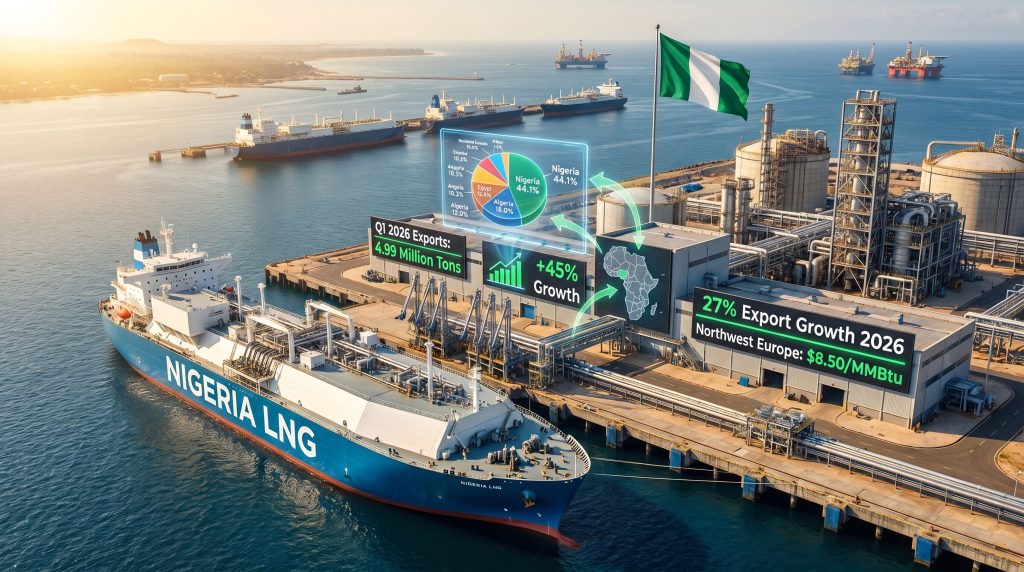
Nigeria established itself as the continental leader with 4.99 million tons exported during Q1 2026, representing a substantial 45% year-over-year increase and commanding 44.1% of African market share. This performance demonstrated Nigeria's position as the anchor producer capable of rapid capacity scaling in response to international demand surges.
The country's success reflects optimisation of existing liquefaction infrastructure rather than completion of new facility construction. Nigeria's LNG facilities operate multiple processing trains, and the Q1 2026 expansion likely resulted from improved capacity utilisation rates and operational efficiency enhancements rather than entirely new infrastructure commissioning.
Nigeria's Production Capacity Expansion
Nigeria's remarkable growth trajectory stems from the country's ability to leverage established infrastructure for rapid production scaling. The West African nation's strategic positioning provides access to both European and Asian markets, with shipping routes offering competitive delivery timelines compared to alternative suppliers.
The 45% production increase reflects several operational improvements. Enhanced capacity utilisation at existing liquefaction trains, improved feedstock supply chain optimisation, operational efficiency gains reducing downtime, and accelerated response to international procurement requests all contributed to this growth.
Nigeria's established relationships with international buyers enabled rapid contract activation when Middle Eastern supply disruptions created immediate demand. Long-term supply agreements with European utilities and Asian importers provided the foundation for sustained production increases throughout the quarter.
Algeria's Infrastructure Maintenance Strategy
Algeria maintained its position as the continent's second-largest exporter with 2.04 million tons, despite experiencing an 8% year-over-year decline that reduced its African market share to 18.0%. This temporary reduction reflects strategic infrastructure modernisation at the Arzew liquefaction complex in Algeria's northwest region.
The maintenance programme involves comprehensive facility upgrades executed through partnership between the Industrial Maintenance Company of Arzew (SOMIZ), a Sonatrach subsidiary, and China's Sinopec. The project aims to double the facility's production capacity, with benefits anticipated by 2027.
Algeria's decision to execute major maintenance during market volatility demonstrates confidence in medium-term demand prospects and reflects long-term capacity planning rather than short-term opportunism.
The Arzew complex modernisation represents one of Africa's most significant liquefaction infrastructure investments. The capacity doubling initiative involves deep technical interventions requiring extended facility downtime, explaining the temporary 8% production decline during Q1 2026. International engineering partnerships enable accelerated modernisation timelines whilst incorporating advanced processing technologies.
Mauritania's Emergence as Regional Gas Hub
Mauritania achieved the most dramatic growth trajectory among African exporters, with LNG shipments surging 1,574% year-over-year from 42,000 tons in Q1 2025 to 703,000 tons in Q1 2026. This exceptional performance positioned Mauritania as the sixth-largest African LNG exporter within just one year of commencing operations.
The transformation results from the Grand Tortue Ahmeyim (GTA) project, a cross-border collaboration with Senegal involving international partners BP and Kosmos Energy. The project commenced LNG exports in 2025, utilising floating liquefaction technology to process offshore gas reserves located in the shared maritime boundary between both countries.
| Country | Q1 2026 Exports (Million Tons) | Year-over-Year Growth | African Market Share |
|---|---|---|---|
| Nigeria | 4.99 | +45% | 44.1% |
| Algeria | 2.04 | -8% | 18.0% |
| Angola | 1.25 | +30% | 11.0% |
| Mozambique | 0.914 | -3% | 8.1% |
| Equatorial Guinea | 0.735 | -6% | 6.5% |
| Mauritania | 0.703 | +1,574% | 6.2% |
The GTA project demonstrates the effectiveness of cross-border resource development models, enabling both countries to monetise previously inaccessible offshore reserves through shared infrastructure investments. This collaborative approach establishes a template for future African energy integration projects.
How Are New Market Entrants Reshaping Africa's LNG Landscape?
Emerging African LNG producers achieved remarkable growth rates during Q1 2026, demonstrating the scalability of modern liquefaction technologies and the commercial viability of previously marginal projects. These developments indicate broader transformation of the continental energy sector, with smaller producers contributing increasingly significant export volumes.
Republic of Congo's Production Acceleration
Republic of Congo achieved near-doubling of export volumes with a 98% year-over-year increase to 273,000 tons, positioning the country as the eighth-largest African exporter. This dramatic growth demonstrates the effectiveness of modular floating LNG technology in rapidly scaling production capacity without extensive onshore infrastructure requirements.
The country's FLNG approach eliminates traditional infrastructure dependencies, enabling deployment directly to offshore gas fields within significantly compressed development timelines. Floating liquefaction vessels typically achieve commercial operations within 3-5 year development cycles compared to 7-10 year timelines for conventional land-based facilities.
Congo's production acceleration likely reflects optimisation of existing FLNG capacity utilisation, enhanced feedstock supply from offshore gas fields, improved operational efficiency reducing processing downtime, and market positioning advantages during supply disruption periods.
Egypt's Supply Restoration and Regional Dynamics
Egypt re-entered Africa's LNG exports 2026 statistics with 162,000 tons during Q1 2026 after recording zero shipments in the corresponding 2025 period. This restoration highlights the interconnected nature of regional gas networks and demonstrates vulnerability in cross-border energy dependencies.
Egyptian LNG operations experienced temporary suspension in March 2026 due to supply disruptions from Israeli gas imports through the Arish-Damietta pipeline. These disruptions illustrated how regional geopolitical tensions directly impact individual country export capabilities, even for established producers with functioning liquefaction infrastructure.
The Egyptian experience demonstrates several critical factors affecting African LNG development. Regional interdependency risks where cross-border supply agreements create operational vulnerabilities, infrastructure resilience requirements for sustained export operations, market re-entry capabilities enabling rapid production restoration following disruptions, and geopolitical sensitivity affecting energy sector operational continuity all play crucial roles.
Egypt's ability to resume exports in April 2026 indicates the flexibility of modern LNG operations in responding to changing supply conditions. This adaptability becomes increasingly valuable as global market recession trends create ongoing uncertainties in energy markets.
What Market Forces Are Driving European and Asian Demand for African LNG?
International procurement strategies underwent fundamental transformation during Q1 2026, with African suppliers benefiting from sustained demand growth across multiple geographic markets. European energy security imperatives and Asian supply diversification requirements created simultaneous demand pressures that African producers successfully addressed.
European Energy Security Imperatives
European utilities accelerated procurement from African suppliers as part of strategic diversification away from traditional pipeline gas sources. The continent's proximity to European markets provides substantial logistical advantages, with shipping costs and delivery timeframes significantly favourable compared to alternative suppliers.
African LNG typically trades at modest discounts to Asian spot prices due to transportation cost advantages. Northwest European markets experienced average LNG pricing of $8.50/MMBtu during Q1 2026, with African suppliers offering approximately $0.30/MMBtu discount compared to US Gulf Coast exports whilst providing 7-10 day delivery advantages.
Asian Market Penetration Strategies
Asian LNG importers increasingly recognise African suppliers as reliable alternatives to traditional Pacific Basin sources. Major Asian economies developed long-term purchase agreements with African producers, indicating fundamental shifts in procurement strategies rather than temporary supply adjustments.
Northeast Asian markets averaged $9.20/MMBtu for LNG during Q1 2026, with African suppliers providing $0.15/MMBtu discounts compared to Australian exports whilst offering 12-15 day shipping advantages. These competitive positioning factors enabled African producers to capture sustained market share growth.
Pricing Dynamics and Market Competitiveness
African LNG pricing demonstrates competitive positioning across multiple international markets, with transportation cost advantages providing fundamental economic benefits for importing nations. Mediterranean markets particularly benefited from African proximity, with average pricing of $8.10/MMBtu and African suppliers offering $0.45/MMBtu discounts compared to Qatari exports.
| Market Region | Average LNG Price (Q1 2026) | African Price Advantage | Delivery Time Benefit |
|---|---|---|---|
| Northwest Europe | $8.50/MMBtu | -$0.30/MMBtu | 7-10 days vs. US Gulf |
| Northeast Asia | $9.20/MMBtu | -$0.15/MMBtu | 12-15 days vs. Australia |
| Mediterranean | $8.10/MMBtu | -$0.45/MMBtu | 3-5 days vs. Qatar |
These pricing advantages reflect fundamental economic factors rather than temporary market conditions. African producers benefit from shorter shipping distances, reduced transportation costs, and established maritime infrastructure connecting to primary consuming markets.
How Will Infrastructure Investments Shape Africa's LNG Future Beyond 2026?
Continental LNG development encompasses multiple mega-projects targeting substantial offshore gas reserves across East and West Africa. These initiatives represent some of the world's largest energy infrastructure investments, with potential to fundamentally reshape global LNG market dynamics by 2030.
Mozambique's Mega-Project Pipeline
Mozambique's LNG development trajectory represents unprecedented scale in African energy infrastructure, with multiple liquefaction projects targeting different offshore gas fields in the Rovuma Basin. These developments could position Mozambique among the world's top-three LNG exporters by 2030, fundamentally altering global supply concentration patterns.
The country's offshore gas reserves rank among the world's largest undeveloped resources, with estimated recoverable volumes supporting sustained export capacity for multiple decades. International oil and gas companies committed multi-billion dollar investments to unlock these resources through advanced deepwater extraction and processing technologies.
Despite experiencing a 3% decline to 914,000 tons during Q1 2026, Mozambique's temporary production reduction reflects project development cycles rather than resource constraints. Multiple liquefaction facilities under construction will substantially increase national export capacity throughout the late 2020s.
Cross-Border Integration Projects
The success of the Senegal-Mauritania Grand Tortue Ahmeyim project establishes a proven template for cross-border gas development across Africa. Similar partnerships could unlock additional offshore reserves requiring shared infrastructure investments, particularly along West Africa's continental margin.
Regional integration projects offer several advantages. Shared development costs reduce individual country financial burdens, enhanced resource accessibility through collaborative extraction techniques, integrated infrastructure networks improve overall system efficiency, and risk mitigation through diversified operational partnerships.
Future cross-border initiatives under consideration include Ghana-Côte d'Ivoire offshore developments and Tanzania-Mozambique regional cooperation projects. These partnerships could accelerate Africa's LNG exports 2026 growth trajectory whilst optimising infrastructure utilisation across multiple countries.
Technology Innovation in African LNG
Floating LNG technology adoption represents a transformative approach to African gas monetisation, reducing traditional infrastructure requirements whilst enabling faster project execution. This technological innovation particularly benefits countries with limited onshore industrial capacity but substantial offshore gas reserves.
FLNG deployment advantages include reduced onshore infrastructure requirements minimising environmental impact, accelerated development timelines achieving commercial operations within 3-5 years, enhanced project flexibility enabling relocation between different gas fields, and lower capital requirements compared to traditional onshore facilities.
Multiple African countries are evaluating FLNG technology for future gas development projects. This approach enables rapid capacity scaling without extensive port facility construction or onshore processing complex development.
What Are the Long-Term Implications for Global LNG Market Structure?
Africa's emergence as a major LNG supplier fundamentally alters global energy market dynamics, reducing traditional supply concentration risks whilst providing enhanced geographic diversification for international buyers. The continent's growing export capacity offers strategic alternatives to established suppliers facing various operational or geopolitical constraints.
Supply Concentration Risk Mitigation
Historical LNG market concentration among a limited number of exporting regions created systemic vulnerabilities that became apparent during regional supply disruptions. The OPEC meeting impact on global energy policies demonstrates how producer coordination affects international markets. Africa's expansion to approximately 10% of global exports with potential growth to 15-20% by 2030 provides markets with essential risk mitigation through geographic diversification.
The continent's substantial proven gas reserves support sustained export growth over multiple decades. Reserve-to-production ratios indicate African producers can maintain current production levels whilst simultaneously expanding capacity to meet growing international demand.
Investment Capital Flow Patterns
International energy companies demonstrate increasing confidence in African LNG projects through substantial capital commitments extending beyond 2030. Major oil companies' multi-billion dollar investments signal long-term market confidence in continental resource development and political stability improvements.
Investment flows increasingly target deepwater offshore exploration and development projects, advanced liquefaction technology deployment, regional infrastructure integration initiatives, and environmental sustainability and carbon mitigation programmes.
These investment patterns indicate sustained international commitment to African energy sector development, providing the foundation for continued export capacity expansion throughout the 2020s.
Environmental and Sustainability Considerations
African LNG projects increasingly incorporate carbon capture and environmental mitigation technologies to align with international buyers' sustainability requirements whilst maintaining competitive pricing structures. These developments reflect broader industry transformation toward lower-carbon energy production methodologies.
Sustainability initiatives include carbon capture and storage integration at major liquefaction facilities, renewable energy utilisation for processing operations power requirements, methane emission reduction programmes minimising environmental impact, and community development initiatives supporting local economic development.
These environmental considerations become increasingly important as international buyers implement stricter sustainability criteria for long-term procurement agreements. African producers incorporating advanced environmental technologies maintain competitive advantages in securing future contracts.
The next major ASX story will hit our subscribers first
FAQ: Understanding Africa's LNG Export Dynamics
How does Africa's current LNG production compare to other global regions?
Africa currently accounts for approximately 9.96% of global LNG exports based on Q1 2026 data, with potential to reach 15-20% by 2030 based on planned project developments. The continent's substantial reserve base and improving infrastructure position it for sustained growth compared to mature producing regions experiencing declining output.
Which countries represent the biggest growth opportunities in African LNG?
Mozambique, Tanzania, and the Senegal-Mauritania partnership represent the largest near-term growth potential, with combined planned capacity exceeding 40 million tons annually. Nigeria and Algeria remain established producers with significant expansion capabilities through infrastructure modernisation and capacity optimisation.
What infrastructure challenges affect Africa's LNG export growth?
Port facilities, pipeline networks, and skilled workforce development represent primary infrastructure requirements. However, floating LNG technology deployment reduces traditional infrastructure dependencies whilst enabling more rapid project development timelines compared to conventional onshore facilities.
How do African LNG prices compare to global benchmarks?
African LNG typically trades at modest discounts to Asian spot prices due to transportation cost advantages and shorter shipping distances to European markets. This competitive positioning provides sustainable market access whilst generating attractive economic returns for producing countries.
What role does cross-border cooperation play in African LNG development?
Cross-border partnerships, exemplified by the successful Mauritania-Senegal Grand Tortue Ahmeyim project, enable efficient resource development through shared infrastructure investments. These collaborative approaches reduce individual country financial burdens whilst accelerating overall regional capacity expansion.
Conclusion: Africa's Strategic Position in Global Energy Markets
Africa's LNG exports 2026 performance establishes the continent as an indispensable component of global energy security architecture. This transformation reflects fundamental changes in international energy market structure, with African suppliers evolving from marginal capacity providers to strategic supply partners for major importing regions.
The combination of substantial proven reserves, improving infrastructure capabilities, and advantageous geographic positioning creates sustainable competitive advantages for African LNG producers. As traditional supply sources face various operational constraints, African exports provide essential diversification options whilst generating significant economic benefits for producing nations.
Continental LNG sector maturation enables sustained response to international demand fluctuations, as demonstrated during Q1 2026 supply chain disruptions. The infrastructure foundation supporting this growth encompasses diverse technological approaches, from traditional onshore facilities to innovative floating liquefaction platforms, providing operational flexibility and scalability.
Investment capital flows increasingly target African energy infrastructure development, with international companies committing substantial resources to unlock the continent's extensive offshore gas reserves. These investments, combined with regional cooperation initiatives and technological innovations, position Africa for continued market share expansion throughout the remainder of the 2020s.
Future developments will likely focus on expanding production capacity, improving infrastructure connectivity, and developing long-term supply relationships with major importing regions. Environmental sustainability considerations become increasingly important as international buyers implement stricter procurement criteria, creating opportunities for African producers incorporating advanced environmental technologies.
The continent's LNG sector represents a cornerstone of broader economic development strategy, generating substantial export revenues whilst supporting infrastructure development and technology transfer initiatives. As global energy markets continue evolving, Africa's strategic positioning ensures continued relevance in international supply networks.
Furthermore, the integration of African LNG infrastructure developments with continental energy policies demonstrates the sector's maturation and strategic importance to regional economic growth.
Disclaimer: This analysis is based on data from The Energy Research Unit report published by Ecofin Agency (April 21, 2026) and other publicly available sources. Energy market projections involve inherent uncertainties, and actual developments may differ from stated expectations. Readers should conduct independent research and consult qualified professionals before making investment decisions related to African LNG sector developments.
Ready to Capitalise on Africa's Explosive LNG Growth?
Discovery Alert's proprietary Discovery IQ model delivers instant notifications when African energy companies announce major discoveries or infrastructure breakthroughs, ensuring you're positioned ahead of market movements. Explore why historic discoveries can generate exceptional returns by examining major energy sector successes, then begin your 14-day free trial to gain immediate access to actionable investment opportunities across Africa's rapidly expanding energy landscape.