May 22, 2026
The Capital Intensity Calculus Behind Arctic Gold's Next Major Cycle
Few investment decisions in the global mining industry carry as much symbolic and financial weight as a multi-billion-dollar commitment to an Arctic redevelopment. The economics of remote mine construction are notoriously unforgiving: logistics chains stretch across hundreds of kilometres of frozen terrain, seasonal constraints compress construction windows, and the gap between budgeted and actual capital expenditure has historically been wider in northern jurisdictions than almost anywhere else on earth. Against that backdrop, the Agnico Eagle Hope Bay redevelopment in western Nunavut represents one of the most consequential capital allocation calls in Canadian mining in 2026.
Understanding why this decision matters requires looking beyond the headline figures and examining the structural conditions that made it possible, the technical architecture underpinning the project's economics, and the broader infrastructure investment thesis quietly taking shape across the Kitikmeot region.
When big ASX news breaks, our subscribers know first
What the 2026 PEA Actually Tells Investors
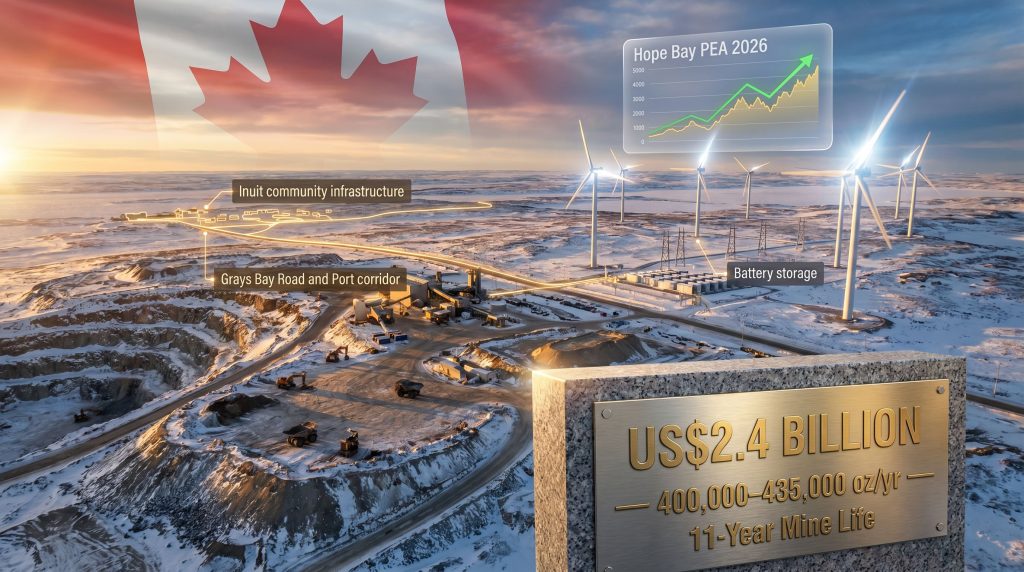
A preliminary economic assessment is, by regulatory definition under National Instrument 43-101, a study that includes inferred mineral resources and therefore carries a higher degree of uncertainty than a prefeasibility or definitive feasibility study. That context matters for how investors should interpret Hope Bay's numbers. With that caveat clearly stated, the 2026 PEA establishes a production profile of between 400,000 and 435,000 ounces of gold annually over an initial mine life of 11 years, underpinned by a capital commitment of approximately US$2.4 billion.
The implied capital intensity of that commitment is instructive. Dividing the initial capital by the midpoint of the annual production range yields a figure in the range of roughly US$5,500 to US$6,000 per annual ounce of production capacity. That metric, commonly used in mining equity analysis, sits at the higher end of the spectrum for gold projects globally, reflecting the genuine cost premium associated with Arctic construction rather than any fundamental weakness in the ore body itself.
A high capital intensity number does not automatically signal a poor investment. In Arctic mining, it often reflects the infrastructure deficit being addressed, not the quality of the deposit being developed.
What the PEA does not yet disclose publicly, at least in the recaps available, are unit operating cost assumptions and the full range of net present value and internal rate of return scenarios under varying gold price assumptions. Those figures, when released in subsequent studies, will be the critical determinants of whether US$2.4 billion in committed capital generates acceptable risk-adjusted returns. Furthermore, the gold price outlook across a realistic range of scenarios will be central to any serious valuation of this project.
Hope Bay's Geology and Why the Greenstone Belt Matters
The Hope Bay greenstone belt is one of the most geologically compelling but logistically challenging gold corridors in Canada. Greenstone belts are ancient volcanic and sedimentary sequences that host a disproportionate share of the world's major gold deposits, including the prolific Abitibi Greenstone Belt in Ontario and Quebec that underpins several of Agnico Eagle's existing operations.
Hope Bay's belt extends over a considerable strike length, and the project's 11-year initial mine life is widely regarded within technical circles as a conservative baseline rather than a ceiling. The broader land package retains significant exploration upside, meaning the declared resource underpinning the PEA likely represents only a portion of the mineralised system. This exploration optionality is a meaningful but often underweighted component of the asset's long-term value proposition.
Key geological characteristics relevant to the project's economics include:
- Orogenic gold mineralisation style, which typically produces structurally controlled, high-grade shoots amenable to selective underground mining methods
- Strike length and depth continuity that remain incompletely defined, preserving the potential to extend mine life beyond the initial 11-year projection
- Proximity to historical Nuna Group operational support since 2022, which has included quarry development and drilling activity that advances geological understanding of the deposit
The Clean Energy Architecture: More Than an ESG Box-Tick
One of the most technically significant, and strategically underappreciated, elements of the Hope Bay redevelopment is the integration of wind generation and battery storage into the site's existing diesel-dependent power infrastructure. This approach, supported by a C$25 million federal commitment, reflects a broader shift toward renewable mining solutions that is gaining traction across remote Canadian operations.
At remote Arctic operations, diesel is not simply a fuel source. It is a logistical constraint. Every litre consumed at the mine site must be transported across hundreds of kilometres, typically by sea during the limited open-water season, and stored on-site through the winter. The delivered cost of diesel at a location 685 km northeast of Yellowknife is substantially higher than at any southern Canadian operation, and that cost compounds across an 11-year mine life.
A hybrid wind-battery microgrid addresses this structural cost problem in two ways:
- Direct diesel displacement during periods of sufficient wind generation, reducing fuel consumption and its associated freight costs
- Battery buffering of intermittent wind output, allowing a higher proportion of renewable energy to be practically utilised rather than curtailed
The Hope Bay wind initiative follows a pattern already emerging at other northern Canadian operations. A C$5 million low-emissions heating and ventilation pilot at B2Gold's Goose gold mine, announced in the same week, reflects a parallel push to reduce diesel dependency across Nunavut's operating mines. These are not isolated experiments. They represent the early stages of a broader energy transition in Arctic mining, driven as much by cost economics as by emissions policy.
At remote Arctic mines, the business case for renewable energy is often more compelling than at southern operations, because the delivered cost of the fuel being displaced is so much higher.
The Federal Infrastructure Cluster: Reading the Kitikmeot Signal
The week of May 22, 2026 produced an unusually concentrated burst of federal capital allocation toward the Kitikmeot region of Nunavut. When viewed in aggregate, the announcements suggest a deliberate effort to build shared enabling infrastructure around a cluster of mineral development opportunities.
| Federal Investment | Amount | Strategic Purpose |
|---|---|---|
| Hope Bay Wind and Battery Storage | C$25 million | On-site clean power for Hope Bay mine |
| Grays Bay Road and Port (pre-construction) | Up to C$50 million | Arctic transport corridor for critical minerals |
| B2Gold Goose Mine Low-Emissions Pilot | C$5 million | Heating and ventilation emissions reduction |
| Total (week of May 22, 2026) | C$80 million+ | Northern infrastructure and energy transition |
The Grays Bay Road and Port project deserves particular attention. Led by the West Kitikmeot Resources Corporation, it proposes to create a year-round land and marine access corridor through one of Canada's most mineral-rich but infrastructure-poor regions. The Kitikmeot hosts not only Hope Bay but a broader constellation of critical mineral deposits whose development has historically been constrained by the absence of reliable ground transport.
Up to C$50 million allocated for planning and pre-construction work represents a meaningful de-risking investment. Road and port infrastructure of this type, once built, functions as a shared platform that lowers the individual project economics threshold for multiple developers simultaneously. That compounding effect on regional development potential is the central strategic logic of the federal investment, even if the returns are diffuse and long-dated.
Indigenous Economic Participation: A Structural Shift, Not a Footnote
The model of Indigenous engagement embedded in the Hope Bay redevelopment is materially different from the consultation-centric approaches that characterised earlier generations of Canadian mine development. The community-owned structure of the Hope Bay wind project, rather than a simple benefit-sharing arrangement layered over a company-controlled asset, places Inuit communities in a position of long-term economic ownership of critical infrastructure.
That distinction matters for several reasons:
- Post-mine durability: Energy infrastructure that remains community-owned after mining operations cease provides an ongoing revenue stream and capacity base independent of the mine's life cycle
- Nunavut Agreement framework: Inuit rights over land use and resource development in the territory, established under the Nunavut Agreement, create a legal and governance architecture that makes meaningful ownership participation more structurally accessible than in many other jurisdictions
- Social licence durability: Projects embedding community ownership from the outset have demonstrated, across comparable Canadian and international cases, more resilient social licence and lower regulatory friction than those relying on consultation alone
For investors assessing project execution risk, the quality of Indigenous partnership structures is increasingly a leading indicator of schedule certainty. A community that holds an ownership stake in project infrastructure has materially different incentives from one that is merely consulted during an approval process.
The next major ASX story will hit our subscribers first
How Hope Bay Reshapes Agnico Eagle's Portfolio Geometry
Agnico Eagle's existing operations and production base are heavily concentrated in Ontario and Quebec, anchored by assets including Detour Lake and Macassa and the broader Abitibi corridor. Those operations are high-quality, well-established, and geographically proximate to southern Canadian infrastructure networks. However, the Agnico Eagle Hope Bay redevelopment adds a fundamentally different dimension to that portfolio.
| Portfolio Dimension | Existing Operations | Hope Bay Addition |
|---|---|---|
| Geography | Ontario and Quebec focus | Western Nunavut, Arctic |
| Production scale contribution | Multi-million oz/yr combined | +400,000 to 435,000 oz/yr |
| Infrastructure environment | Southern Canadian grid access | Remote Arctic, off-grid |
| Exploration maturity | Established resources | Greenstone belt upside |
| Mine life (initial) | Various | 11 years, with extension potential |
The addition of a geologically distinct, geographically isolated, high-volume Arctic asset introduces both diversification benefits and new categories of operational risk into Agnico's consolidated profile. The company's demonstrated competency in northern Canadian environments, built across decades of operating in subarctic Ontario and Quebec, provides relevant but not identical experience for the full Arctic conditions at Hope Bay.
Risk Calibration: What the Bull and Bear Cases Actually Hinge On
No honest analysis of this project can avoid the execution risk question. For context, the broader gold market outlook remains a key variable in how investors will ultimately price these risks. The bull case rests on three pillars:
- Sustained gold price strength translating the 400,000 to 435,000 ounce annual output profile into material cash generation
- The exploration potential of the Hope Bay greenstone belt extending mine life well beyond the 11-year initial projection
- Agnico Eagle's operational track record in northern Canada providing genuine cost and schedule management advantages relative to less experienced Arctic operators
The bear case centres on capital intensity and Arctic execution complexity. A US$2.4 billion commitment in a remote location with compressed construction seasons, complex logistics, and limited existing infrastructure creates meaningful exposure to cost overruns. Arctic redevelopments have a historical tendency to surface unexpected ground conditions, permafrost engineering challenges, and supply chain bottlenecks that do not appear in southern feasibility assumptions.
Investors modelling this project should stress-test a range of capex scenarios, not simply the base case, and apply Arctic-specific contingency buffers that reflect the actual historical variance of comparable northern developments. The difference between a 10 percent and a 25 percent cost overrun on a US$2.4 billion initial commitment is a US$360 million swing that materially alters the project's return profile.
This article is informational in nature and does not constitute financial advice. Investors should conduct independent due diligence and consider their individual risk tolerance before making investment decisions related to mining equities or project-stage assets.
Key Takeaways for 2026 and Beyond
The Hope Bay redevelopment decision is not a single data point. It is a convergence of elevated gold prices, maturing Arctic infrastructure policy, evolving Indigenous partnership models, and Agnico Eagle's strategic conviction about the long-term value of its Nunavut land position. Each of those forces is durable enough to sustain the project's strategic logic across market cycles, provided execution discipline holds.
What Does This Mean for the Broader Canadian Mining Sector?
The broader implication for the Canadian mining sector is that high gold prices are actively unlocking projects that were previously marginal on a standalone infrastructure cost basis. As a northern mining jurisdiction, the Kitikmeot region continues to attract federal co-investment that addresses the shared infrastructure deficit, consequently lowering the economic threshold for Arctic project development not just for Hope Bay, but for the pipeline of mineral opportunities sitting behind it.
That pipeline, and the infrastructure now being built to serve it, may ultimately prove to be the more consequential story than any single mine approval, including this one.
Want to Capitalise on the Next Major Mineral Discovery Before the Market Moves?
Discovery Alert's proprietary Discovery IQ model delivers real-time alerts on significant ASX mineral discoveries, transforming complex geological and market data into actionable investment insights for both short-term traders and long-term investors. Explore historic examples of major discovery returns and begin your 14-day free trial today to position yourself ahead of the broader market.