August 3, 2026
Mexico's Most Complex Industrial Bankruptcy Reaches a Critical Threshold
When a country's largest integrated steelmaker collapses, the legal machinery that governs what happens next rarely moves in a straight line. Mexico is living that reality in real time. The bankruptcy proceedings surrounding Altos Hornos de México (AHMSA) and its mining supply arm Minera del Norte (Minosa) have now entered a phase that will define whether more than 14,000 workers receive what they are owed, and whether approximately 4 million tonnes of annual steel capacity returns to Mexican supply chains before the end of 2026.
The publication of the AHMSA and Minosa labor credit list ahead of auction on August 3, 2026, is not simply a procedural box being ticked. It represents the formal quantification of a human and economic crisis nearly three years in the making, and it sets the stage for a September 25 bidding session that carries consequences far beyond the walls of any courtroom.
When big ASX news breaks, our subscribers know first
Understanding the Scale: Why This Bankruptcy Stands Apart
Mexico's Ley de Concursos Mercantiles has processed hundreds of commercial insolvencies since its enactment in 2000, but the AHMSA-Minosa case occupies a different category entirely. The sheer concentration of industrial exposure, geographic impact, and creditor complexity makes this one of the most consequential bankruptcy proceedings in Latin American industrial history.
Consider what the combined entity represented before operations ceased in November 2023:
- AHMSA held the distinction of being Mexico's largest domestically integrated steelmaker, with production capacity underpinning construction, automotive, and infrastructure sectors nationwide
- Minosa functioned as AHMSA's primary raw material supply engine, creating a vertically integrated production chain that, when severed, disrupted multiple tiers of industrial output simultaneously
- The geographic concentration of both entities in and around Monclova, Coahuila, transformed what would normally be a corporate restructuring into a regional economic emergency
- Downstream industries reliant on AHMSA's output were forced to pivot toward costlier import alternatives almost overnight
The combined productive unit being offered at auction is not simply a collection of industrial assets. It is an integrated operational system capable of being reactivated, which is precisely why Mexican bankruptcy law favours a consolidated sale over piecemeal liquidation in cases like this.
The Labor Credit List: What It Is and What It Means for Workers
Preferred vs. Non-Preferred Claims: A Legal Distinction With Real Financial Consequences
Under Mexico's commercial bankruptcy framework, labor creditors are not treated as a single homogeneous group. The law distinguishes between preferred (privileged) claims and non-preferred claims, and this classification has direct implications for how much each worker can expect to recover and in what sequence those payments occur.
Preferred labor claims carry first-priority status over auction proceeds, meaning they are satisfied before secured commercial creditors, bondholders, or any other claimant class. Non-preferred labor claims follow in the distribution waterfall but still rank ahead of most unsecured creditors. The July 22, 2026 court ruling, issued by presiding judge Ruth Haggi Huerta García of Mexico's Second District Court in Commercial Bankruptcy Matters, formally established the methodology for calculating both categories before the final list was published.
What the Numbers Look Like
| Metric | Figure |
|---|---|
| Total recognised workers (AHMSA + Minosa) | 14,000+ |
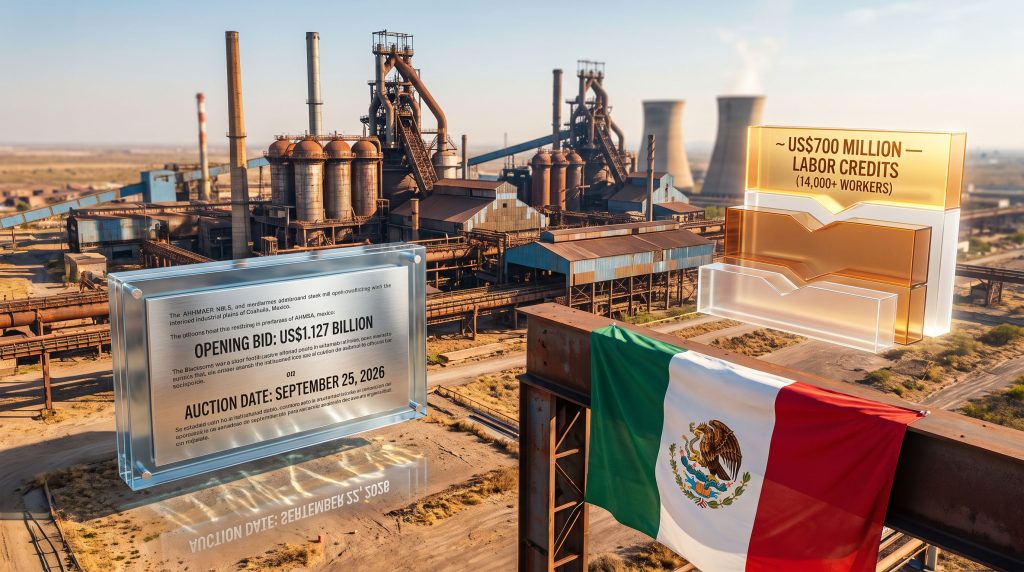
| Estimated total labor liability | ~US$700 million |
| Period of unpaid wages and severance | ~3 years (since Nov. 2023) |
| Court-established opening bid | US$1.127 billion |
| Reported combined sale authorisation | ~US$1.326 billion |
| Labor credit contestation deadline | August 28, 2026 |
| Scheduled auction date | September 25, 2026 |
The arithmetic here matters enormously for worker confidence. If the auction achieves a result within the US$1.127 billion to US$1.326 billion range established by the court, the combined proceeds would, in theory, be sufficient to fully cover the approximately US$700 million labor liability before distribution to other creditor classes. That outcome is not guaranteed, but the structure of the sale has been deliberately designed to maximise the probability of full labor recovery.
Furthermore, as court documents confirm, the consolidated sale approach preserves going-concern value more effectively than asset-by-asset liquidation would.
The Ley de Concursos Mercantiles is specifically engineered to enable consolidated asset sales that preserve going-concern value, ensuring the pool of distributable proceeds is as large as possible before creditor claims are satisfied in order of legal priority.
How Workers Can Access and Contest Their Listed Amounts
The final labor credit list is accessible through two primary digital channels: the AHMSA-Minosa company website and the IFECOM (Federal Institute of Bankruptcy Specialists) portal. For workers without reliable internet access, physical copies are available at Federal Public Defense offices across five locations:
- Mexico City
- Coahuila delegation
- Zacatecas delegation
- Chihuahua delegation
- Durango delegation
Workers have a 10-business-day window from the August 3 publication date to review their listed figures and formally contest any discrepancies. That window closes on August 28, 2026. The court has explicitly cautioned against relying on any unofficial information circulating outside IFECOM-published documentation, noting that partial or misleading interpretations risk undermining the integrity of the entire process.
Workers should verify their individual credit amounts exclusively through IFECOM-published data and seek guidance from Federal Public Defense representatives before the August 28 contestation deadline.
IFECOM and the Court: How Oversight Architecture Shapes the Process
The Role of Mexico's Federal Institute of Bankruptcy Specialists
IFECOM functions as the institutional backbone of Mexico's commercial insolvency system. It trains, certifies, and supervises the bankruptcy trustees (known as síndicos) who manage distressed estate assets, and it maintains the official documentation portals that give creditors and the public access to verified case information.
In the AHMSA-Minosa proceedings, IFECOM's role extends beyond documentation management. Its oversight function creates formal accountability checkpoints that must be satisfied before the auction can legally proceed. The publication of the AHMSA and Minosa labor credit list ahead of auction through IFECOM's portal is itself one of those checkpoints, signalling that the pre-auction documentation phase has been completed to the court's satisfaction.
Trustee Víctor Aguilera has publicly committed to advancing the sale process with strict adherence to legal requirements, a commitment that the coming weeks will put to the test as the August 28 contestation deadline and September 25 auction date approach in rapid succession.
A Chronology of Delays: Why the September 25 Date Is Not Guaranteed
| Date | Procedural Event |
|---|---|
| November 2023 | AHMSA halts operations; liquidity collapse triggers bankruptcy |
| February 2026 | First auction attempt declared void; no bidders meet qualification requirements |
| June 2, 2026 | Court sets US$1.127 billion opening bid; trustee granted 3 days to finalise documentation |
| June 2026 | Second extension granted for trustee to complete bid terms |
| July 22, 2026 | Court establishes calculation methodology for preferred and non-preferred labor credits |
| July 28, 2026 | Formal auction calendar approved |
| August 3, 2026 | Final labor credit list published via IFECOM and company website |
| August 28, 2026 | Deadline for worker review and contestation |
| September 25, 2026 | Scheduled auction at Federal Judiciary headquarters auditorium, Mexico City |
The February 2026 failure is a critical data point for anyone assessing the credibility of the September 25 date. The initial sale was declared void after none of the prospective buyers satisfied the court's qualification requirements, effectively resetting a process that had already taken years to reach. Business leaders in Coahuila publicly acknowledged that the resulting delay, while economically painful, followed legally necessary procedures designed to protect all parties.
The Ancira Variable: Criminal Proceedings and Auction Risk
The reactivation of an arrest order against former AHMSA chairman Alonso Ancira introduces a distinct category of risk to the timeline. The order relates to an alleged breach of a reparation agreement connected to the sale of Agronitrogenados to PEMEX, a transaction that has generated legal proceedings running parallel to the bankruptcy case.
Importantly, under Mexico's Ley de Concursos Mercantiles, criminal proceedings against former executives do not automatically suspend a court-ordered bankruptcy sale. However, the reputational and procedural complications created by active criminal proceedings involving the company's former leadership can influence bidder due diligence timelines and confidence levels in ways that are difficult to quantify in advance.
A further layer of controversy surrounds the appearance of former AHMSA executives on the labor creditor list itself, with reported claims reportedly approaching US$50 million from individuals who held senior payroll positions. The bankruptcy court retains full discretion over final payment determinations for disputed creditor classifications, meaning these claims will face additional scrutiny before any distribution occurs.
Who Would Buy AHMSA-Minosa and Why
The Strategic Logic of Acquiring 4 Million Tonnes of Idle Capacity
The AHMSA-Minosa productive unit represents a rare opportunity in the current Mexican industrial landscape. The country's nearshoring boom, driven by multinational manufacturers relocating supply chains closer to the United States, has created structural demand for domestically produced steel that cannot currently be met from local sources. AHMSA's shutdown has widened that gap significantly, forcing construction firms, automotive manufacturers, and infrastructure developers to rely on imported steel at higher cost and with longer lead times.
Any acquirer that successfully reactivates the AHMSA-Minosa integrated operation would gain an immediate competitive advantage in a market where domestic supply is acutely constrained. The global steel outlook for 2025 and beyond underscores precisely this kind of structural demand pressure in emerging industrial economies. Both domestic and international industrial groups have reportedly expressed interest, though the February 2026 failure to produce a qualified bidder serves as a reminder that interest and qualification are not the same thing.
What Bidders Must Demonstrate Before September 25
The court's qualification requirements following the first failed auction are stricter than they might appear from the outside. Prospective buyers must satisfy:
- Demonstrated financial capacity to fund the opening bid of at least US$1.127 billion
- Legal standing to acquire the assets under Mexican commercial and foreign investment regulations
- Technical credibility to assume operational responsibility for an integrated steelmaking and mining system
- Compliance with documentation requirements within the court-mandated timeframe
The labor credit list publication directly affects bidder due diligence obligations. Any serious buyer must now factor the formally quantified US$700 million labor liability into their acquisition modelling, understanding both the legal priority of those claims and the distribution mechanics that will govern how auction proceeds flow to creditors.
In addition, potential acquirers are navigating a broader trade environment shaped by steel and aluminium tariffs that continue to reshape global procurement and sourcing decisions, adding another variable to the investment calculus.
The next major ASX story will hit our subscribers first
What Recovery Looks Like: The Creditor Waterfall Explained
If the auction achieves a result within or above the court-established range, the distribution sequence under Mexican bankruptcy law would follow this structure:
- Preferred labor claims are satisfied first, ahead of all other creditor classes
- Non-preferred labor claims follow, drawing from remaining proceeds
- Secured commercial creditors receive distributions from whatever remains after labor obligations are met
- Unsecured creditors access any residual proceeds at the bottom of the waterfall
In a shortfall scenario, where auction proceeds fall below the total of all recognised claims, preferred labor creditors would still receive full satisfaction before any other class is paid, while non-preferred labor creditors would receive a pro-rata share of remaining funds. The court's role in adjudicating contested credit amounts after August 28 will directly influence the final distribution calculations.
The Broader Stakes: Mexico's Steel Supply Chain and Industrial Competitiveness
The human dimension of this case, measured in the reported deaths among former employees linked to nearly three years of unpaid wages and severance, sits alongside a macro-economic dimension that extends well beyond Monclova. Approximately 4 million tonnes of annual steel production capacity has been absent from Mexico's industrial ecosystem since late 2023, creating import dependency at precisely the moment when nearshoring investment is accelerating demand for domestically sourced materials.
Consequently, the outcome of this auction carries implications that resonate across the region. Indian steel prices and broader emerging-market steel dynamics illustrate how quickly supply constraints translate into pricing pressure across interconnected industrial economies, and Mexico's situation is no different.
Furthermore, as interest in green steel pricing grows among international investors, any prospective buyer of the AHMSA-Minosa assets will face questions about the environmental modernisation pathway for a facility that has been idle since late 2023. The AHMSA and Minosa labor credit list ahead of auction resolves one critical uncertainty, but the decarbonisation challenge remains an open variable. Notably, top aluminium producers have already demonstrated that large-scale industrial transitions are achievable when capital, legal certainty, and operational expertise align.
A successful auction and credible operational restart timeline would do more than resolve a bankruptcy proceeding. It would restore a critical node in Mexico's industrial supply chain and signal to global investors that large-scale distressed asset sales in Mexico can be resolved through the legal framework rather than around it. That signal, in the current environment of heightened supply chain nationalism, carries strategic weight that extends well beyond the steel sector.
According to reporting from Recycling Today, prospective bidders including major international steel groups have evaluated the assets, underscoring the genuine global appetite for a facility of this scale and strategic position.
Disclaimer: This article contains forward-looking timelines, procedural assessments, and financial estimates based on publicly available court documentation and reported figures. Auction outcomes, creditor recovery amounts, and procedural timelines remain subject to legal developments, bidder qualification, and court rulings. This article does not constitute legal or financial advice.
Want to Stay Ahead of Major Resource and Industrial Discoveries on the ASX?
Discovery Alert's proprietary Discovery IQ model delivers real-time alerts on significant ASX mineral discoveries, transforming complex resource data into clear, actionable investment insights for traders and investors at every experience level. Explore how historic discoveries have generated substantial returns on Discovery Alert's dedicated discoveries page and begin a 14-day free trial to position yourself ahead of the broader market.