August 3, 2026
The Structural Gap at the Heart of America's Battery Metal Ambitions
For decades, the architecture of global critical mineral supply chains has followed a predictable and problematic pattern: raw materials extracted in resource-rich nations, shipped to processing hubs concentrated in a handful of Asian countries, and returned as refined products to Western manufacturers. This model worked efficiently in a world where supply chain resilience was a secondary consideration. It no longer does.
The vulnerability is not primarily a mining problem. The United States holds meaningful domestic reserves of cobalt, nickel, and lithium. The bottleneck sits in the middle of the chain, in the refining and processing infrastructure that transforms raw concentrates into battery-grade materials. Closing that gap is now one of the most strategically significant industrial challenges in North America, and it is the precise challenge that the decision to have Worley to build USSM Missouri cobalt plant infrastructure is designed to address.
When big ASX news breaks, our subscribers know first
Understanding the Processing Bottleneck: Why Mid-Stream Matters Most
It is easy to conflate mining capacity with supply chain security, but the two are fundamentally different problems. A nation can extract ore at scale and still remain entirely dependent on foreign processors to convert that ore into usable material. This is exactly the situation North America finds itself in with cobalt.
The overwhelming majority of the world's cobalt refining capacity sits in China, which processes an estimated 70 to 80 percent of global cobalt supply into battery-ready forms. Furthermore, even cobalt mined in the Democratic Republic of Congo, which accounts for roughly 70 percent of global cobalt production, is largely routed through Chinese refining infrastructure before reaching North American and European battery manufacturers.
This concentration of mid-stream processing in a single geopolitical bloc represents a structural single point of failure for any nation attempting to build a domestic battery supply chain.
Consequently, North American battery manufacturers, defence contractors, and electronics producers all operate with a dependency on foreign-refined cobalt that cannot be quickly or cheaply resolved through mining investment alone. What is needed is domestic refining capacity, and building it from scratch requires engineering expertise, process technology, and the willingness to accept first-of-kind project complexity.
The Fredericktown Hub: More Than a Cobalt Refinery
The facility under development in Fredericktown, Missouri by United States Strategic Metals (USSM) is positioned as a multi-metallic processing hub rather than a single-commodity cobalt plant. This distinction matters enormously from both a commercial and strategic standpoint.
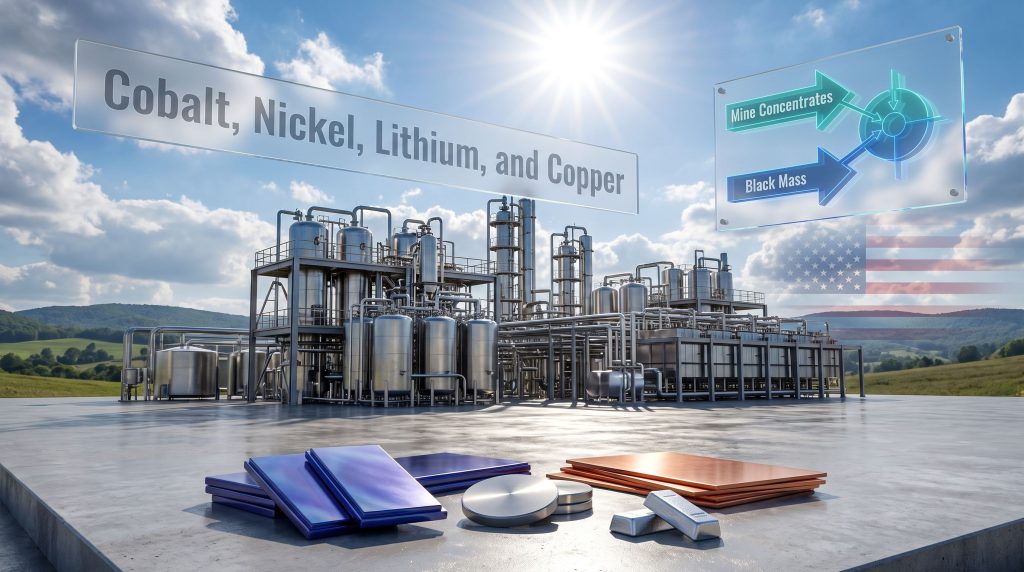
The facility is designed to produce four battery-critical metals:
- Cobalt – the primary target, aligned with lithium-ion battery cathode chemistry requirements
- Nickel – a complementary metal with growing demand in higher-energy-density battery formats
- Lithium – recoverable from recycled battery feedstock, adding a third revenue stream
- Copper – a structural metal present in battery cells and recoverable as a processing by-product
What makes the Fredericktown design particularly sophisticated is its dual-feedstock architecture. The facility is engineered to process both primary mine concentrates sourced from conventional mining operations and black mass, the dense, metallic residue recovered from shredded end-of-life lithium-ion batteries.
Black mass is an increasingly important material in the battery recycling process. As the first generation of electric vehicles reaches end-of-life and battery recycling infrastructure scales up, the volume of recoverable black mass entering the market is growing rapidly. A processing facility capable of handling both virgin ore concentrates and recycled battery material is not simply hedging its feedstock risk — it is deliberately positioning itself at the intersection of two converging supply streams.
USSM's Evolution: From Missouri Cobalt to a Multi-Metal Developer
USSM was formerly known as Missouri Cobalt, a name that reflected the company's original focus on single-metal cobalt production. The rebranding to United States Strategic Metals signals a deliberate expansion of scope and ambition. The Fredericktown site already benefits from major environmental permits and phased construction history, which materially reduces the greenfield development risk that plagues many competing projects. For a first-of-kind domestic processing facility, this existing permitting foundation is a genuine competitive advantage.
Worley's Engineering Role: Scope, Structure, and Strategic Value
Worley's engagement at Fredericktown is structured as an engineering services and procurement support contract within an integrated project management team (IPMT). This model differs from a traditional EPC (engineering, procurement, and construction) arrangement in important ways.
| Contract Model | Worley's Role | Owner's Role | Risk Allocation |
|---|---|---|---|
| EPC Contract | Design, procure, build | Oversight and acceptance | Primarily contractor |
| IPMT Model | Engineering and procurement support | Active project management | Shared between owner and specialists |
| Worley at Fredericktown | Engineering services, procurement support | USSM retains project control | Collaborative, milestone-based |
In an IPMT structure, the project owner maintains greater control over decision-making while drawing on the technical expertise of specialist firms for defined work packages. For a facility as technically complex as a multi-metallic hydrometallurgical plant, this approach allows USSM to leverage Worley's deep process engineering capabilities without surrendering project governance.
Why Worley Brings Specific Expertise to This Project
Worley's relevance to this contract extends well beyond its scale as a global engineering firm. Australian engineering companies have accumulated disproportionate expertise in hydrometallurgical process design through decades of involvement in the country's nickel, lithium, and cobalt processing industries.
Australia's laterite nickel processing sector, its lithium hydroxide conversion facilities, and its cobalt refining operations have created a deep talent pool in wet chemistry metallurgy that simply does not exist at equivalent depth in the United States. In addition, Worley's published thinking on building competitive battery supply chains in the Americas reinforces the strategic alignment underpinning this engagement.
This knowledge transfer dynamic is one of the less-discussed aspects of North America's critical minerals buildout. U.S. project developers are increasingly contracting Australian engineering firms not just for their size, but for their specific technical literacy in the processing chemistries required for battery metal refining.
Hydrometallurgy: The Processing Route Explained
The Fredericktown facility is built around hydrometallurgical processing, a wet chemistry approach that uses aqueous solutions to selectively dissolve, separate, and recover individual metals from complex mixed-metal feedstocks. Understanding why this processing route was selected requires a brief technical explanation.
The three core stages of hydrometallurgical processing are:
- Leaching – the feedstock is contacted with acidic or alkaline solutions that dissolve the target metals into solution while leaving gangue minerals largely undissolved
- Solvent extraction (SX) – the pregnant leach solution is contacted with organic extractants that selectively remove individual metal species, achieving chemical separation
- Electrowinning (EW) – an electrical current is applied to the purified metal solution, depositing high-purity metal onto cathode plates as a saleable product
The alternative, pyrometallurgy, uses high-temperature smelting to process metal-bearing materials. While effective for certain ore types, pyrometallurgical routes are less suited to processing recycled battery materials because the high temperatures destroy lithium value and create complex slag management challenges. Hydrometallurgy, however, preserves lithium recovery and allows more selective metal separation, making it the technically superior choice for a facility handling both mine concentrates and black mass.
The Technical Complexity of Multi-Metal Separation
One of the more underappreciated challenges in facilities like Fredericktown is that separating four metals from a single mixed solution requires exquisite control of solution chemistry. Each metal has different extraction characteristics, and the process must be calibrated to achieve battery-grade purity thresholds for each product stream simultaneously.
Battery-grade cobalt, for example, typically requires purity levels exceeding 99.8 percent, with strict limits on impurities such as iron, copper, and zinc that can degrade cathode performance. Achieving these specifications consistently at commercial scale is significantly more complex than pilot-plant results often suggest, and it is one of the primary reasons hydrometallurgical plant commissioning timelines routinely extend well beyond initial projections.
The additional complication of processing black mass alongside primary concentrates is that black mass composition varies considerably depending on the battery chemistry of the source material. A batch of black mass derived from nickel-manganese-cobalt (NMC) cells has a fundamentally different elemental profile than material from lithium-iron-phosphate (LFP) cells. The processing circuit must accommodate this variability without compromising product quality.
North America's Cobalt Processing Landscape: A Comparative View
| Metric | Current Status (North America) |
|---|---|
| Domestic cobalt refining capacity | Minimal, heavily reliant on imported refined material |
| Primary cobalt sourcing | Predominantly DRC-origin concentrate |
| Mid-stream processing geography | Largely routed through Asian refining hubs |
| Black mass recycling infrastructure | Early-stage and fragmented across operators |
| First-mover domestic refinery projects | Small number of advanced-stage projects, including Fredericktown |
The Fredericktown project sits within a competitive landscape that includes several other announced North American cobalt and battery metal processing initiatives. However, USSM's existing major permits and phased construction history give it a meaningful lead on projects that are still navigating the front-end permitting process. In the United States, environmental permitting for a hydrometallurgical facility typically takes multiple years and represents one of the most significant execution risks for greenfield developers.
Facilities that already hold their major operational licences have a structural advantage over greenfield competitors that is rarely reflected in early-stage project valuations.
The next major ASX story will hit our subscribers first
Key Risk Factors Investors and Observers Should Monitor
Despite the strategic logic underpinning the Fredericktown project, several material risks warrant careful assessment:
-
Feedstock security: Securing consistent, long-term supply contracts for both mine concentrates and black mass at commercial scale is non-trivial. Black mass supply in particular remains fragmented and price-volatile as the recycling industry matures.
-
Technology scale-up risk: The gap between pilot-scale hydrometallurgical performance and full commercial plant operation is one of the most consistent sources of project delay in the battery metals processing sector. First-of-kind facilities almost universally encounter commissioning challenges that laboratory and pilot data do not fully predict.
-
Cobalt price volatility: Cobalt has historically been one of the most price-volatile battery metals, having swung from approximately US$95,000 per tonne in early 2018 to below US$30,000 per tonne in subsequent years. Project economics built on cobalt price assumptions are inherently sensitive to market cycles that are difficult to forecast over multi-year construction timelines.
-
Battery chemistry evolution: The trend toward reduced-cobalt and cobalt-free battery chemistries, particularly the adoption of LFP chemistry in the passenger EV segment, introduces long-term demand uncertainty. However, cobalt remains essential in high-performance cathode chemistries used in aerospace, defence, and premium EV applications, providing a more durable demand floor than headline narrative sometimes suggests.
-
Permitting continuity: Holding existing permits does not guarantee their ongoing validity across an extended construction programme. Regulatory compliance requirements can evolve, and any material change to facility design or operational scope may trigger additional permitting obligations.
Worley's Broader Strategic Direction
For Worley, the Missouri contract reflects a deliberate repositioning of its project portfolio. The company has been actively shifting its engineering services business toward critical minerals, clean energy, and industrial decarbonisation projects as traditional fossil fuel infrastructure investment contracts. Winning engineering mandates for battery metal processing facilities in the United States is consistent with this strategic direction.
The Missouri engagement also demonstrates how engineering services firms can capture value in the critical minerals transition without taking commodity price exposure. Unlike project developers or mining companies, Worley generates revenue from technical expertise regardless of whether cobalt prices rise or fall. This structural characteristic makes critical minerals engineering a defensible growth segment, particularly in the context of the evolving battery metals landscape, even in a volatile commodity environment.
Furthermore, the growing critical minerals demand driven by the global energy transition continues to underpin long-term project pipelines for engineering firms with the right technical capabilities. For Worley, the Fredericktown contract is both a near-term revenue opportunity and a proof point for its positioning in a structurally growing market.
Frequently Asked Questions: Worley, USSM, and the Missouri Cobalt Project
What is Worley building in Missouri?
Worley has been contracted to provide engineering services and procurement support for a multi-metallic processing hub in Fredericktown, Missouri. The facility, developed by United States Strategic Metals, is designed to produce battery-grade cobalt, nickel, lithium, and copper from both mine concentrates and recycled battery materials. The decision to have Worley to build USSM Missouri cobalt plant infrastructure reflects the project's complexity and the specialised engineering expertise required.
Who is United States Strategic Metals?
United States Strategic Metals is a domestic critical minerals developer formerly known as Missouri Cobalt. The company is advancing a hydrometallurgical processing facility at its Fredericktown, Missouri site with a mandate to produce multiple battery-critical metals from both primary and secondary feedstocks.
What is black mass and why does this facility process it?
Black mass is the material recovered from shredded end-of-life lithium-ion batteries. It contains recoverable quantities of cobalt, nickel, lithium, manganese, and copper. Including black mass processing alongside primary concentrate refining allows the Fredericktown facility to serve both the primary mining supply chain and the growing battery recycling economy through shared hydrometallurgical infrastructure.
What type of engineering contract has Worley been awarded?
Worley's contract covers engineering services and procurement support as part of an integrated project management team overseeing construction. This is a professional services engagement structured within an IPMT model rather than a full EPC contract, with USSM retaining primary project management authority.
Why is Missouri a strategic location for cobalt refining?
The Fredericktown site benefits from existing infrastructure, major environmental permits already secured, and a phased construction history that substantially reduces greenfield development risk. Missouri's central geographic position also provides logistical advantages for serving battery manufacturers and recycling operators across a broad domestic catchment area.
What processing technology will the facility use?
The Fredericktown facility is designed around hydrometallurgical processing, using leaching, solvent extraction, and electrowinning to separate and refine individual metals from complex mixed-metal solutions derived from both mine concentrates and recycled battery black mass. Additionally, direct lithium extraction technologies are increasingly relevant to facilities seeking to maximise lithium recovery from secondary feedstreams, representing a potential future enhancement to the processing circuit.
This article is intended for informational purposes only and does not constitute financial or investment advice. Forecasts, timelines, and project outcomes discussed involve inherent uncertainty and should not be relied upon as indicators of future performance. Readers seeking additional context on North American critical minerals processing infrastructure may find relevant technical coverage at Mining Magazine.
Want to Track the Next Major Battery Metal Discovery Before the Market Moves?
Discovery Alert's proprietary Discovery IQ model scans ASX announcements in real time, instantly alerting subscribers to significant mineral discoveries across cobalt, nickel, lithium, and other battery-critical commodities — turning complex data into actionable opportunities. Explore how major mineral discoveries have historically delivered exceptional returns on Discovery Alert's discoveries page, and begin your 14-day free trial today to position yourself ahead of the broader market.