August 3, 2026
Europe's Battery Storage Market Reaches a Chemistry Crossroads
For most of the past decade, the economics of grid-scale battery storage moved in one direction: downward. Lithium iron phosphate technology became the default architecture for utility-scale deployments across Europe, underpinned by relentless cost reductions driven by Chinese manufacturing scale. That deflationary tailwind is now reversing. LFP battery prices have risen approximately 20% over the past six months, a shift that is forcing developers, integrators, and grid operators to reconsider assumptions about chemistry concentration risk that were largely ignored during the boom years.
This is the structural backdrop against which Alfen and CATL sodium-ion storage in Europe, targeting 5 GWh of sodium-ion battery energy storage systems across European markets, must be understood. It is not simply a product announcement. It represents a deliberate repositioning by two established players ahead of what many analysts believe will be a period of sustained chemistry diversification in European grid-scale procurement.
When big ASX news breaks, our subscribers know first
The Scale of Europe's Storage Buildout and Why Chemistry Diversity Now Matters
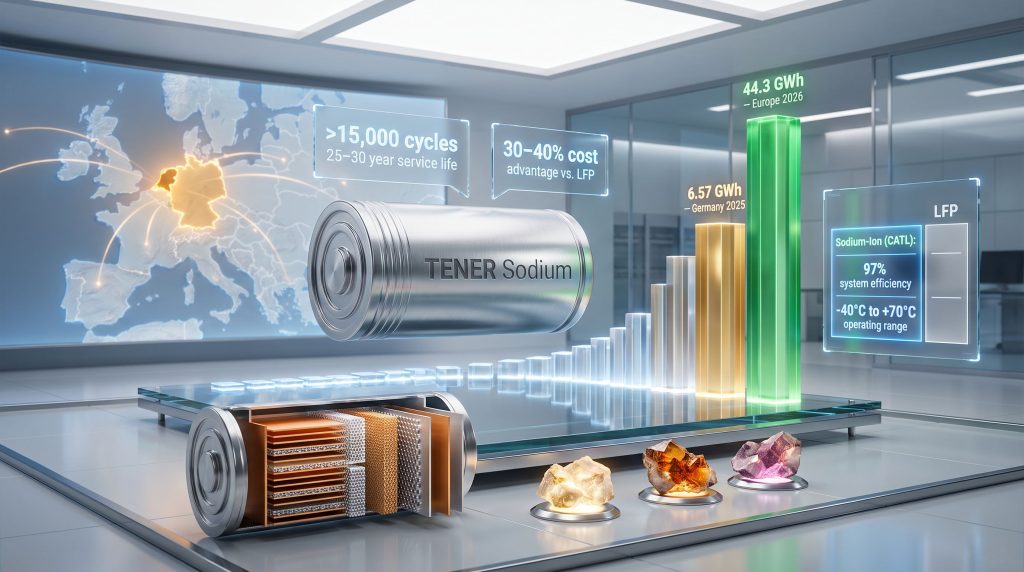
The numbers underlying European storage demand are striking. According to InfoLink Consulting, Europe's energy storage capacity additions are projected to reach approximately 44.3 GWh in 2026, representing growth exceeding 60% year-on-year. The EU has formally approved a 45 GW energy storage target as part of a broader strategy to reduce dependence on gas-fired peaking generation, with binding obligations now placed on 22 member states under a tripartite policy agreement.
Germany illustrates the trajectory at a national level. Total installed battery storage capacity in the country has reached approximately 24 GWh, following the addition of 6.57 GWh in 2025 alone, representing an 8% annual increase according to analysis from the Battery Charts data platform at RWTH Aachen University. Across Europe more broadly, long-duration storage deployments exceeded 15 GWh globally in 2025, growing 49% year-on-year, though financing constraints continue to limit the pace of commercialisation for emerging technologies, according to a Wood Mackenzie report.
Within this environment, procurement criteria are evolving. Flexibility, grid code compliance, and supply chain resilience are increasingly decisive alongside raw cost per megawatt-hour, creating structural openings for alternative chemistries that would have struggled to compete during LFP's deflationary years.
What makes the current moment particularly significant is that the reversal in LFP pricing has not been caused by a temporary supply disruption. It reflects structural tightening in the battery raw materials market, a dynamic that sodium-ion chemistry is architecturally designed to sidestep entirely.
How the Alfen and CATL Sodium-Ion Storage Partnership in Europe Was Built
The commercial relationship between Alfen and CATL did not emerge overnight. It originated in 2023 with a lithium-ion battery supply agreement, establishing operational familiarity between the two organisations. A multi-year supply agreement deepened that collaboration in 2024, creating the procurement, logistics, and integration infrastructure that now underpins the sodium-ion expansion.
The 2026 announcement targets 5 GWh of deployed sodium-ion capacity across European markets, with initial installations scheduled to begin in 2027 in the Netherlands before expanding to broader Western European markets. The specific product being integrated is CATL's TENER Sodium platform, deployed within Alfen's stationary energy storage portfolio. According to reporting from Energy Storage News, the agreement signals a meaningful shift in how European integrators are approaching chemistry selection.
What Each Party Gains From the Arrangement
| Stakeholder | Primary Strategic Benefit |
|---|---|
| Alfen | Broader chemistry portfolio; improved competitiveness across European tenders |
| CATL | European grid-scale deployment experience for sodium-ion; grid code approvals |
| European Grid Operators | Chemistry diversification reducing lithium price exposure |
| European Energy Policy | Alignment with EU storage obligations and energy security goals |
From Alfen's perspective, the move addresses a competitive vulnerability. As European tenders grow in scale and sophistication, integrators offering only LFP-based solutions face increasing risk that procurement specifications will begin to reward chemistry flexibility. Sodium-ion allows Alfen to compete across a wider range of project types without abandoning its existing LFP capabilities.
For CATL, the strategic logic operates at a different level. The company has progressively shifted its European market approach from component supply toward embedded partnerships with locally trusted integrators. Deploying sodium-ion at grid scale in Europe, with a credible local partner, generates the reference portfolio and regulatory track record that accelerates future market penetration far more effectively than standalone product sales.
CATL TENER Sodium: Technical Performance Against LFP Benchmarks
Understanding why sodium-ion has crossed from laboratory promise to commercial deployment requires examining what the CATL TENER Sodium platform actually delivers at a specifications level.
Performance Comparison: Sodium-Ion vs. LFP
| Parameter | CATL TENER Sodium | Typical LFP Benchmark |
|---|---|---|
| Cell Capacity | >300 Ah | 200-280 Ah |
| Energy Density | ~160 Wh/kg | 150-175 Wh/kg |
| System Efficiency | 97% | 93-96% |
| Cycle Life | >15,000 cycles | 6,000-10,000 cycles |
| Projected Service Life | 25-30 years | 10-15 years |
| Operating Temperature Range | -40°C to +70°C | -20°C to +55°C |
| Cobalt Content | None | None |
| Nickel Content | None | None |
| LFP Format Compatibility | Yes | N/A |
Several of these specifications carry implications that are less obvious at first glance. The cycle life figure of 15,000+ cycles is particularly consequential for revenue modelling. Battery energy storage systems that participate in frequency regulation and intraday arbitrage markets can undergo multiple full charge-discharge cycles per day. Higher cycle life directly translates into longer revenue-generating asset life, which materially improves project internal rates of return when modelled over 20-year investment horizons.
The operating temperature range deserves equal attention. LFP systems can experience significant capacity degradation at temperatures below approximately -10°C, a limitation that is commercially relevant across Scandinavia, the Baltic states, and highland Germany. Sodium-ion's rated performance down to -40°C removes a technical constraint that has historically limited LFP deployment in Northern European climates.
The 97% round-trip system efficiency figure also merits scrutiny. A one to three percentage point efficiency advantage over LFP may appear marginal, but when compounded across thousands of annual cycles over a 25-year asset life, the cumulative energy loss differential becomes economically significant at utility scale.
Where Sodium-Ion Sits on the Storage Duration Spectrum
The Alfen-CATL deployment targets discharge durations of two to eight hours, positioning sodium-ion firmly within the medium-duration storage segment. This is commercially important because it places the technology in direct competition with the most actively tendered segment of the European market, rather than in the more specialised long-duration space where flow batteries currently hold advantages.
The cell format compatibility with existing LFP infrastructure is an underappreciated enabler. It means integrators do not need to redesign system architectures, retrain installation teams, or develop entirely new balance-of-plant specifications. This drop-in compatibility compresses deployment timelines and reduces the engineering cost premium that typically accompanies first-of-kind technology integration.
The Raw Material Equation: Why Sodium Changes the Supply Chain Calculus
One of the least discussed but most structurally significant aspects of sodium-ion chemistry is its raw material profile. CATL's sodium-ion cells rely primarily on sodium, iron, and manganese as active materials. These are among the most geographically distributed and abundant elements in the Earth's crust, with no meaningful supply concentration risk equivalent to lithium's reliance on a handful of producing nations.
This matters for European buyers in several dimensions. Furthermore, it aligns closely with broader efforts around critical raw materials transition policy that the EU has been actively pursuing:
- Lithium supply is heavily concentrated in South America and Australia, creating geopolitical exposure for European procurement programmes
- Cobalt supply has historically been dominated by the Democratic Republic of Congo, introducing ethical sourcing complexity
- Nickel markets experienced severe volatility in 2022 following the Russian invasion of Ukraine, demonstrating how quickly single-commodity exposure can destabilise battery economics
- Sodium and iron face none of these concentration dynamics, providing a structurally more stable cost floor
The EU Critical Raw Materials Act, which establishes benchmarks for strategic mineral sourcing, creates a policy environment that increasingly favours chemistries with lower critical mineral intensity. Sodium-ion's raw material profile aligns more naturally with these frameworks than conventional lithium-based architectures, though it should be noted that this alignment does not constitute any form of specific regulatory support or project designation for the Alfen-CATL deployment.
In addition, innovations in direct lithium extraction may eventually ease some lithium supply constraints, but sodium-ion sidesteps the issue entirely by design. Meanwhile, the battery storage-driven lithium boom continues to put upward pressure on procurement costs for LFP-dependent projects, reinforcing the case for chemistry diversification.
Competing Chemistries and Where Sodium-Ion Fits the European Landscape
Alternative Chemistry Comparison for European Grid-Scale Applications
| Chemistry | Cycle Life | Cost Position vs. LFP | Duration Sweet Spot | Commercial Maturity |
|---|---|---|---|---|
| Sodium-Ion (CATL) | >15,000 cycles | 30-40% lower (claimed) | 2-8 hours | Early commercial |
| LFP (mainstream) | 6,000-10,000 cycles | Baseline | 1-4 hours | Fully commercial |
| Vanadium Flow Battery | >20,000 cycles | Premium | 4-12+ hours | Commercial niche |
| Second-Life Li-Ion | Variable | Below LFP | 1-2 hours | Emerging |
The 30-40% claimed cost advantage over LFP is the figure that will attract the most scrutiny from European project developers and lenders. It is worth noting that this represents CATL's own projection for comparable deployment scales, and independent third-party validation at commercial scale has not yet been established. The cost advantage is expected to follow a learning-curve trajectory analogous to LFP's cost compression between 2018 and 2024, but investors should treat forward-looking cost projections with appropriate caution until production volumes justify greater confidence.
The Greenvolt Power 200 MW / 800 MWh BESS commissioned in Poland in 2026 illustrates the project scales at which European grid storage is now being executed. At that magnitude, a 30-40% chemistry cost differential translates into tens of millions of euros in capital expenditure difference, which would be decisive in competitive tendering. CATL's own announcements further underscore the manufacturer's confidence in the sodium-ion platform's commercial readiness.
The next major ASX story will hit our subscribers first
Scenario Analysis: Three Pathways for the Deployment's Outcome
Scenario 1: Accelerated Adoption
LFP prices continue rising, widening sodium-ion's cost advantage to the upper end of the claimed range. European grid operators begin explicitly rewarding chemistry diversification in tender specifications. CATL achieves manufacturing scale sufficient to drive sodium-ion cell costs below current LFP spot pricing. Under this pathway, the 5 GWh commitment is deployed ahead of schedule, with the partnership scope expanding toward 10+ GWh by 2029.
Scenario 2: Measured Base Case Rollout
LFP prices stabilise, maintaining but not expanding the sodium-ion cost differential. Tenders remain broadly chemistry-neutral, with procurement driven by total cost of ownership analysis. Alfen deploys the 5 GWh across the Netherlands and two to three additional Western European markets between 2027 and 2030. Sodium-ion establishes a credible reference portfolio without capturing dominant market share.
Scenario 3: Execution Headwinds
LFP prices reverse, compressing sodium-ion's competitive cost position. Grid code certification in key European markets takes longer than anticipated, delaying first revenues. Competing chemistries, particularly vanadium flow batteries, capture the longer-duration tender segments that sodium-ion was positioned to address. Deployment timelines extend beyond 2030 and partnership scope is renegotiated.
Disclaimer: The scenario projections above represent analytical frameworks, not financial forecasts. Investors and project developers should conduct independent due diligence before making capital allocation decisions based on emerging technology adoption curves.
Frequently Asked Questions: Alfen and CATL Sodium-Ion Storage in Europe
What is the total capacity commitment in the Alfen-CATL sodium-ion agreement?
The partnership targets 5 GWh of sodium-ion battery energy storage systems deployed across European markets, with first installations scheduled from 2027 beginning in the Netherlands.
How does the CATL TENER Sodium platform's cycle life compare with LFP?
CATL's sodium-ion platform claims a cycle life exceeding 15,000 cycles, compared with the 6,000-10,000 cycle range typical of commercial LFP systems. This extended cycle life is particularly valuable for high-utilisation applications such as frequency regulation and daily energy arbitrage.
Why is sodium-ion compatible with existing LFP installation infrastructure?
CATL's sodium-ion cells are designed to be compatible with existing lithium-ion cell formats, meaning system integrators like Alfen can incorporate the technology without fundamental redesign of housing, battery management systems, or balance-of-plant components, significantly reducing integration costs and timelines.
What raw materials does CATL's sodium-ion technology rely on?
The TENER Sodium platform uses sodium, iron, and manganese as primary active materials, containing no cobalt or nickel. This eliminates exposure to two of the three commodity markets that have historically generated the greatest supply chain volatility in battery manufacturing. Consequently, this positions sodium-ion favourably within frameworks assessing China's lithium-ion battery recycling pressures and upstream mineral dependencies.
When did Alfen and CATL begin their commercial relationship?
The partnership originated in 2023 with a lithium-ion supply agreement, was formalised through a multi-year supply deal in 2024, and expanded into sodium-ion technology with the 2026 agreement targeting European grid-scale deployments.
Key Takeaways for Industry Participants and Observers
The Alfen and CATL sodium-ion storage in Europe agreement carries implications that extend well beyond a single commercial arrangement. In summary, the most significant points are:
- The 5 GWh commitment represents one of the largest commercial-scale validations of sodium-ion technology for European grid storage announced to date
- The progression from lithium-ion to sodium-ion within an established partnership reflects deliberate chemistry diversification rather than a wholesale technology pivot
- CATL's drop-in format compatibility design decision was strategically calculated to lower adoption barriers for European integrators already operating LFP infrastructure
- Europe's 45 GW storage policy target and the accelerating deployment pipeline create structural demand conditions that support sodium-ion's entry into a competitive market
- The 30-40% claimed cost advantage over LFP, if validated at commercial scale, would represent a genuinely disruptive pricing position within European grid procurement
The Alfen-CATL sodium-ion agreement is best understood not as a bet on a single technology replacing another, but as a structural hedge positioning both companies to capture share across a European market that is simultaneously scaling at record pace and beginning to diversify the chemistry architectures underpinning that growth. Whether sodium-ion fulfils its commercial promise at the scale implied by this partnership will depend as much on manufacturing ramp execution and grid code approvals as on the underlying electrochemistry.
Further coverage of sodium-ion battery technology developments and European energy storage market dynamics is available through ESS News (pv magazine group) at ess-news.com.
Want to Know Which ASX Battery Materials Discoveries Could Benefit From Europe's Storage Revolution?
Discovery Alert's proprietary Discovery IQ model scans ASX announcements in real time, delivering instant alerts on significant mineral discoveries across the battery materials and energy storage supply chain — from sodium and manganese to lithium and beyond. Explore historic discovery returns on Discovery Alert's dedicated discoveries page and begin your 14-day free trial to position yourself ahead of the market.