August 3, 2026
The Real Bottleneck Holding Back Mine Electrification Is Not the Truck
For most of the past decade, the conversation around mining decarbonisation centred on a single question: could battery electric vehicles be engineered to handle the brutal demands of open-pit and underground haulage? That question has largely been answered. Multiple OEM platforms now offer commercially viable electric haul trucks across a broad range of payload classes, and high-profile industry partnerships, including Fortescue's zero-emission collaborations with Liebherr and XCMG, have signalled that the technology transition is well underway.
The conversation has shifted. The engineering frontier is no longer the truck itself. It is the infrastructure required to keep that truck moving.
According to analysis from Cambridge-based market intelligence firm IDTechEx, mining ranks among the fastest-growing off-highway sectors for battery electric vehicle adoption, with the decade spanning 2026 to 2036 representing the decisive window for large-scale fleet conversion. Yet the central challenge facing mine planners today is not procuring the right vehicle. It is engineering a power delivery system capable of sustaining multi-hundred-tonne machines through continuous, productivity-critical work cycles.
Understanding why electric mining truck charging infrastructure has become the defining constraint on decarbonisation timelines requires stepping back from the vehicle itself and examining the unique demands of the mining operating environment. Furthermore, the mining electrification trends reshaping the sector make this infrastructure challenge more urgent than ever before.
When big ASX news breaks, our subscribers know first
Why Mining Charging Is a Fundamentally Different Problem
Commercial road transport electrification and mining electrification share a vocabulary but almost nothing else. Road freight trucks operate across variable, unpredictable route networks. Mining haul trucks, however, operate on fixed, repetitive circuits with geometries that are known years in advance. This predictability is both an advantage and a constraint.
The advantage is that charging windows can be engineered precisely into the operational schedule. The constraint is that a haul truck not moving is a haul truck not generating revenue. At payloads exceeding 200 tonnes, even a 45-minute unplanned charging stop has measurable consequences for shift productivity.
Add to this the reality that mine site power grids are frequently isolated from national infrastructure, capacity-constrained, and subject to multi-year lead times for meaningful upgrades. The result is a systems integration challenge that spans electrical engineering, mine planning, grid infrastructure, OEM interoperability, and operational safety simultaneously.
The charging infrastructure challenge in mining is not purely an electrical engineering problem. It is a multi-disciplinary constraint that touches mine layout design, haul cycle scheduling, grid capacity planning, OEM procurement strategy, and physical safety systems, all at once.
Three Charging Architectures Defining the Field
Current deployments of electric mining truck charging infrastructure have converged around three primary technical approaches. Each carries distinct trade-offs across capital cost, operational flexibility, and productivity impact.
Static High-Power Fast Charging
The most widely adopted approach positions high-power chargers at fixed locations where trucks experience natural, operationally justified downtime. Loading zones, crusher stations, transfer points, and maintenance depots are the primary candidates.
Power levels for this architecture have scaled rapidly:
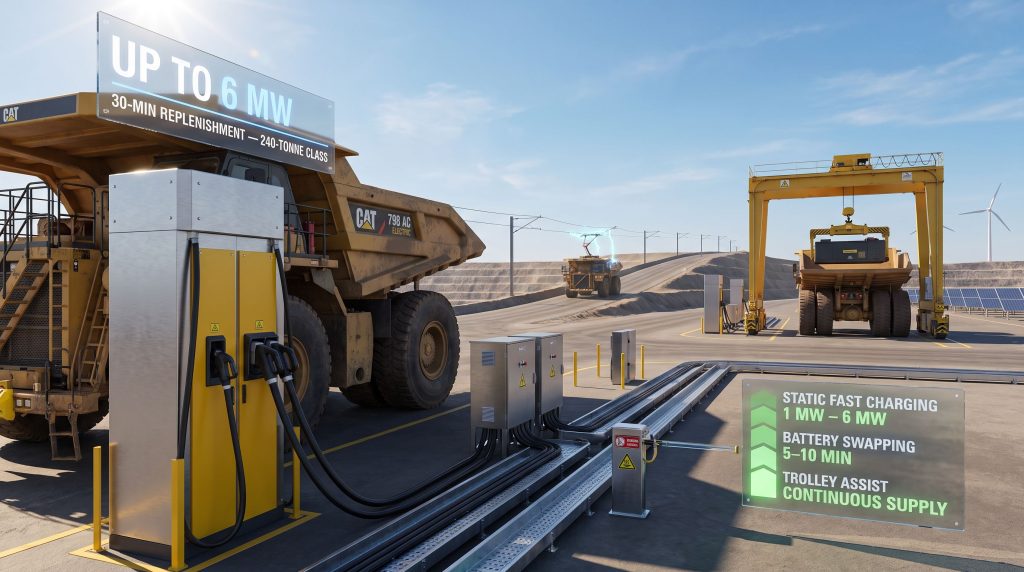
- Ultra-class haul trucks (200+ tonnes) can now be serviced by chargers delivering up to 6 MW, enabling a full replenishment cycle in approximately 30 minutes
- Heavy-duty trucks in the 100 to 200 tonne class are typically served by systems in the 1 MW to 3.75 MW range
- Smaller haul trucks operating with opportunistic charging windows can achieve a state-of-charge increase from 30% to 90% in as little as 6 to 24 minutes, depending on battery configuration and charger output
Critically, modular and skid-mounted charger designs allow repositioning as open-pit mining faces advance. This flexibility addresses one of the most frequently underestimated challenges in mine electrification planning: the mine face does not stay in the same place.
Battery Swapping Systems
Rather than waiting for an onboard battery to recharge, swapping systems replace depleted packs entirely at dedicated exchange stations. Under optimised conditions, the turnaround time for a battery exchange can be reduced to 5 to 10 minutes, broadly comparable to diesel refuelling at a well-managed fuel point.
The operational appeal is obvious. The trade-offs, however, are significant:
- Substantial capital investment in spare battery inventory
- Specialised handling equipment with significant footprint requirements
- Operational viability depends on standardised battery form factors across the fleet, a condition that currently limits cross-OEM applicability
Battery swapping performs best in single-OEM fleets where standardisation can be enforced through procurement. Mixed-fleet environments face significant compatibility barriers that require resolution at the contract stage, before any equipment is ordered.
Dynamic Charging and Trolley Assist
The third architecture takes a fundamentally different approach by supplying traction power directly to the truck while it is in motion. Overhead catenary lines, supported by wayside substations and rectifiers, deliver power to the truck via pantograph-mounted receivers during the most energy-intensive haul segments, particularly long uphill gradients.
This is not battery charging in the conventional sense. Trolley assist reduces the rate at which battery energy is consumed rather than replenishing it. On descending return trips, regenerative braking can partially recover energy to the onboard battery, creating a complementary cycle that extends effective operating range between static charging events.
Capital intensity is high, requiring civil works for pole installation, overhead conductor systems, and dedicated substation infrastructure. However, at large-scale operations with consistent, high-traffic haul routes, the operational cost per tonne-kilometre can be competitive over the asset life of the installation.
Comparing the Three Approaches
| Charging Architecture | Typical Power Level | Downtime Impact | Infrastructure Complexity | Best Application |
|---|---|---|---|---|
| Static Fast Charging | 1 MW to 6 MW | 6 to 30 min per session | Moderate (modular options available) | Fixed-route operations, opportunistic charging |
| Battery Swapping | N/A (battery exchange) | 5 to 10 min per swap | High (spare inventory plus handling equipment) | Standardised single-OEM fleets |
| Dynamic / Trolley Assist | Variable (continuous supply) | Minimal (charges during operation) | Very High (catenary, substations, pantographs) | Long haul ramps, high-tonnage operations |
No single architecture is universally optimal. Consequently, selecting the right approach requires simultaneous assessment of truck class, haul cycle geometry, available grid capacity, capital budget, and tolerance for operational downtime.
Engineering Variables That Determine System Selection
Mine Layout and Route Geometry
Charger placement must align precisely with natural pause points in the haul cycle. Forced charging stops that interrupt productive truck movement undermine the economic case for electrification entirely. Open-pit operations with advancing faces require portable or relocatable solutions. Underground environments require fixed installations constrained by tunnel geometry and ventilation requirements.
Gradient profiles also determine whether trolley assist investment is justified. Only haul roads with sufficient elevation change and consistent traffic density generate the energy recovery volumes that make catenary infrastructure economically viable.
Grid Capacity and Power Distribution
Fleet-scale electrification of heavy haul trucks can impose peak power demand increases that require major grid infrastructure upgrades. These upgrades frequently involve high-voltage transmission works, new substation installations, and utility coordination processes that take two to five years to complete in remote mining jurisdictions.
This timeline mismatch is one of the least-discussed risks in mining electrification planning. A mine that commits to electric truck procurement without securing grid capacity commitments in parallel risks deploying vehicles that cannot be adequately charged for years after arrival on site. In addition, the broader clean energy transition introduces further pressure on utilities and grid operators across remote regions.
On-site power management systems capable of sequencing charging events and managing simultaneous peak demand are increasingly essential components of any large-scale electric fleet deployment. Furthermore, renewable energy in mining is increasingly being paired with battery storage systems to buffer these peak demand spikes.
OEM Interoperability and Charging Interface Standardisation
Unlike road transport, where connector standards such as CCS have achieved broad adoption, the mining sector has not yet converged on universal charging interface standards. Proprietary connectors and communication protocols from individual OEMs create fleet lock-in risk. A mine that standardises its charging infrastructure around one manufacturer's interface may face substantial switching costs when procurement cycles rotate.
Operators procuring mixed fleets from multiple OEMs must negotiate charging compatibility requirements explicitly at the contract stage, before infrastructure investment is committed. This is a dimension of procurement strategy that mining organisations with diesel heritage frequently underestimate.
Physical Safety and Environmental Protection
Megawatt-scale charging events in proximity to large lithium battery packs introduce safety engineering requirements with no direct precedent in diesel mine infrastructure. Key considerations include:
- Ventilation management: Heat dissipation from high-power charging requires active ventilation design, particularly in enclosed underground environments
- Fire separation: Battery thermal runaway events necessitate physical separation of charging zones from operational areas, with purpose-designed suppression systems rather than adaptations of diesel fire infrastructure
- Electrical protection: Ground-fault detection, insulation monitoring, and arc-flash protection are non-negotiable requirements at these power levels
- Site hazard exposure: Charger placement must account for flooding risk, rockfall proximity, and traffic management in high-movement operational zones
A Phased Infrastructure Roadmap
Given the complexity of these variables, mine electrification infrastructure is best approached as a phased programme rather than a single capital investment decision.
- Site Assessment and Power Baseline (Years 1 to 2): Conduct detailed haul cycle analysis, commission grid capacity studies, and evaluate OEM charging interface standards before any procurement commitments are made.
- Pilot Infrastructure Deployment (Years 2 to 3): Install modular fast chargers at highest-priority locations, commission power management software, and validate charging cycle integration with operational scheduling systems.
- Fleet-Scale Rollout and Infrastructure Expansion (Years 3 to 7): Scale charging infrastructure in parallel with truck fleet conversion. Evaluate trolley assist feasibility based on pilot data. Integrate renewable energy generation assets to manage per-tonne energy cost and emissions outcomes.
- Optimisation and Interoperability (Ongoing): Implement predictive charging scheduling using fleet telematics, participate in industry standardisation working groups, and continuously reassess infrastructure placement as mine geometry evolves.
The next major ASX story will hit our subscribers first
Key Technical Specifications at a Glance
| Metric | Value | Operational Significance |
|---|---|---|
| Ultra-class fast charge power | Up to 6 MW | Enables 30-minute replenishment for 240-tonne trucks |
| Heavy-haul charging range | 1 MW to 3.75 MW | Standard range for 100 to 200 tonne class trucks |
| Opportunistic charge window | 6 to 24 minutes (30% to 90% SoC) | Fits within natural haul cycle pause points |
| Battery swap turnaround | 5 to 10 minutes | Comparable to diesel refuelling at optimised stations |
| Grid upgrade planning horizon | 2 to 5 years | Must precede truck procurement decisions |
Risks That Derail Charging Infrastructure Projects
Several risk categories emerge consistently across mining electrification projects that encounter serious execution difficulties.
Grid upgrade timelines outpacing fleet conversion schedules remain the most structurally dangerous. Utility connection upgrades and high-voltage distribution installations in remote jurisdictions can take years to complete, and these timelines are largely outside the mine operator's direct control.
OEM lock-in through proprietary charging systems constrains future procurement flexibility in ways that may not be apparent when the initial infrastructure investment decision is made.
Underestimating civil and electrical infrastructure scope is a persistent issue in early-stage electrification business cases. Charger foundations, cable routing, switchgear, and safety systems represent substantial engineering scope that is frequently omitted from initial cost estimates.
Inadequate fire and safety system design represents the highest-consequence risk category. Diesel mine fire infrastructure is not an adequate baseline for lithium battery environments. Purpose-designed detection, suppression, and evacuation systems are required from the outset.
The Strategic Outlook for Mine Operators
Electric mining truck charging infrastructure is advancing rapidly across multiple OEM platforms. The pace of fleet electrification is increasingly determined not by vehicle availability but by whether the supporting power infrastructure exists to operate those vehicles productively.
Mines that invest in charging infrastructure ahead of fleet conversion will carry a meaningful operational advantage as regulatory pressure on diesel emissions continues to intensify. Data-driven mining operations are emerging as the next layer of optimisation, integrating fleet telematics, battery state-of-charge data, and grid demand monitoring beyond the physical infrastructure itself. Moreover, AI mining efficiency tools are beginning to enable predictive charging scheduling that further reduces unplanned downtime.
Industry-wide charging interface standardisation would significantly reduce infrastructure investment risk and enable competitive multi-OEM procurement. The mining sector's path toward standardisation will likely follow the commercial road transport sector's trajectory, but with a meaningful lag. Early engagement with standards bodies and interoperability working groups represents a strategic priority for large fleet operators planning infrastructure investments intended to last a decade or more.
This article contains forward-looking statements and industry forecasts. Readers should conduct their own due diligence before making infrastructure or procurement decisions based on any projections cited. Market conditions, technology developments, and regulatory environments may change materially from current expectations.
For additional coverage of electric vehicle deployments, infrastructure developments, and OEM partnerships across the global mining sector, readers can explore ongoing reporting at Mining Magazine.
Want to Stay Ahead of the Mining Sector's Next Major Discovery?
As electrification reshapes mining operations and capital flows accelerate toward next-generation projects, Discovery Alert's proprietary Discovery IQ model delivers real-time alerts on significant ASX mineral discoveries, turning complex data across more than 30 commodities into clear, actionable insights. Explore historic discoveries and their remarkable returns to understand the opportunity, then begin your 14-day free trial to position yourself ahead of the broader market.