June 13, 2026
When Industrial Giants Fall: Understanding Mexico's Most Significant Bankruptcy Auction in Decades
Large-scale industrial insolvencies rarely occur in isolation. They are typically the culmination of decades-long pressures, including commodity price volatility, capital underinvestment, shifting trade dynamics, and the gradual erosion of competitive positioning in global markets. When an integrated steelmaker and its upstream iron ore supplier simultaneously enter court-supervised bankruptcy proceedings, the consequences extend far beyond balance sheets and creditor recovery rates. They touch the livelihoods of entire communities, reshape regional supply chains, and test the boundaries of a country's legal and industrial policy frameworks.
The AHMSA and MINOSA auction in Mexico represents precisely this kind of watershed moment. What is unfolding in Monclova, Coahuila is not simply a distressed asset sale. It is a stress test for Mexican bankruptcy law, a signal to global investors about the country's industrial restructuring capacity, and a defining episode in the future of domestic flat-rolled steel supply at a time when Mexico's manufacturing sector is experiencing structural transformation driven by nearshoring trends.
When big ASX news breaks, our subscribers know first
What Is the AHMSA and MINOSA Auction? A Structural Overview
At its core, the AHMSA and MINOSA auction in Mexico is a court-supervised bankruptcy proceeding designed to transfer ownership of two deeply interconnected industrial operations through a single, bundled sale structure. Altos Hornos de México (AHMSA), one of Mexico's largest integrated flat-rolled steel producers, and Minera del Norte (MINOSA), its iron ore mining subsidiary, are being offered together as what Mexican insolvency law terms a unidad productiva or single productive unit.
Understanding the Single Productive Unit Framework
The going-concern auction model is a deliberate legal mechanism that prioritises operational continuity over piecemeal asset liquidation. Under Mexican bankruptcy law, when a court determines that the combined value of an enterprise as a functioning operation exceeds the sum of its individual parts, it may mandate a bundled sale structure. This is precisely the reasoning applied in the AHMSA and MINOSA proceedings.
The logic is straightforward from both economic and social perspectives:
- Separating MINOSA's iron ore extraction operations from AHMSA's blast furnaces and rolling mills would sever the vertical supply chain that underpins the entire production economics of the Monclova complex
- A fragmented sale would expose the steel operations to raw material supply risk, likely reducing the bid value for the steelmaking assets significantly
- Employment continuity is materially more achievable under unified ownership than under fragmented asset disposal, where individual buyers may have no incentive to maintain the full operational workforce
- Creditors collectively tend to achieve higher recovery rates in going-concern auctions compared to liquidations, which is a critical consideration in proceedings of this magnitude
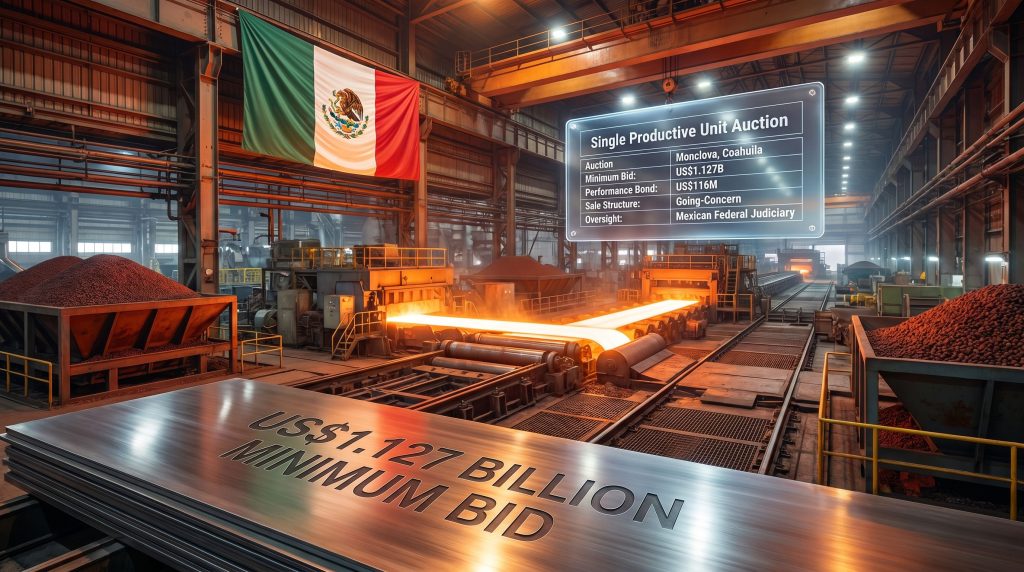
The US$1.127 Billion Minimum Bid: Context and Calculation
The court-approved minimum bid of US$1.127 billion is not an arbitrary figure. It represents 85% of the independently appraised combined asset value of the AHMSA and MINOSA operations, a threshold calculated to serve two simultaneous objectives: protecting creditors from distressed-sale undervaluation while setting a price floor that remains credibly accessible to qualified strategic and financial acquirers.
The 85% threshold is a significant calibration choice. Setting the floor too close to full appraised value risks deterring bidders who factor in turnaround costs, legacy liabilities, and integration risk. Setting it too low exposes creditors to unnecessary value destruction. The 85% figure reflects a court determination that recovery probability and creditor protection are best balanced at this level.
This appraisal methodology in Mexican insolvency proceedings typically draws on independent valuations conducted by court-appointed experts, assessed against comparable transaction multiples in the Latin American metals and mining sector. For context, integrated steel and mining combinations of this scale are relatively rare in the region, making direct comparable transactions limited and appraisal methodology particularly consequential.
How Mexico's Bankruptcy Framework Governs the AHMSA Sale Process
Mexico's commercial insolvency regime, governed primarily by the Ley de Concursos Mercantiles enacted in 2000, establishes the procedural architecture for proceedings of this complexity. The federal judiciary holds jurisdiction over major commercial insolvencies, with proceedings administered through specialised courts that oversee creditor committees, asset appraisals, and ultimately the auction process itself.
Key Procedural Milestones in the AHMSA and MINOSA Auction Timeline
The auction timeline has undergone at least one significant revision, reflecting the procedural complexity inherent in proceedings of this scale. The following table summarises the reported key dates and their current status:
| Procedural Stage | Reported Date | Status |
|---|---|---|
| Bid acceptance window opens | January 19, 2026 | Reported |
| Auction notice published | February 3, 2026 | Reported |
| Bid acceptance window closes | February 16, 2026 | Reported |
| Initial court hearing (adjusted) | January 30, 2026 | Reported (earlier schedule) |
| Revised auction hearing | March 2, 2026 | Reported (adjusted schedule) |
| Postponement trigger | Unmet legal requirements | Confirmed |
Why Was the AHMSA Auction Postponed? The Performance Bond Requirement Explained
One of the most technically significant aspects of this proceeding is the US$116 million performance bond requirement for bidder qualification. According to reporting from Steel Market Update, a federal judge postponed the auction after these requirements were not fully met by the original scheduled date. This figure, representing approximately 10.3% of the minimum bid price, functions as a serious participant filter built directly into the auction's procedural architecture.
Performance bonds in large-scale industrial bankruptcy auctions serve multiple simultaneous functions:
- They screen out undercapitalised or non-credible parties who might otherwise submit bids without genuine acquisition capacity
- They provide the court and creditors with financial recourse if a winning bidder fails to complete the transaction on agreed terms
- They signal to the market that the auction is structured for substantive outcomes rather than exploratory participation
- They create a quantifiable commitment threshold that forces potential bidders to conduct serious due diligence before entering the process
The postponement of the auction hearing was directly connected to these requirements not being fully satisfied by the original scheduled date. This is not unusual in proceedings of this complexity. The sheer scale of the qualification requirements means that even well-capitalised potential acquirers require extended preparation periods to arrange the financial instruments necessary to participate.
Regulatory Insight: A performance bond at 10.3% of the minimum bid price is a significant capital commitment even for major industrial acquirers. For context, arranging a US$116 million financial instrument specifically structured to satisfy Mexican court requirements involves coordination between legal counsel, financial institutions, and potentially foreign regulatory bodies, each adding timeline complexity.
What Are the Industrial Policy Dimensions of the AHMSA and MINOSA Bundle Sale?
The decision to structure the AHMSA and MINOSA auction in Mexico as a single productive unit carries implications that extend well beyond the immediate proceedings. It reflects a deliberate policy orientation toward preserving Mexico's integrated steelmaking capability at a moment when the country's industrial geography is shifting meaningfully.
Going-Concern Doctrine vs. Asset Fragmentation
The economic argument for preserving integrated steelmaking and mining operations under unified ownership rests on several reinforcing pillars. AHMSA's flat-rolled steel output feeds directly into downstream manufacturing sectors including automotive, construction, and appliance production. Disruption to this supply relationship, even temporarily, would create cascading effects across industries that depend on reliable domestic steel sourcing.
MINOSA's iron ore supply from deposits in the Coahuila region is specifically calibrated to AHMSA's blast furnace requirements in terms of ore grade, particle size distribution, and mineral chemistry. Blast furnace operations are notoriously sensitive to changes in raw material specifications, and an operator purchasing only the steel assets without assured iron ore supply would face material production risk that would be reflected in a substantially lower bid price.
AHMSA's Position in Mexico's Steel Supply Chain
AHMSA has historically occupied a structurally important position as one of Mexico's primary producers of flat-rolled steel products, including hot-rolled coil, cold-rolled coil, and galvanised sheet. Furthermore, these product categories serve as critical inputs for:
- Automotive body panels and structural components manufactured at facilities across Coahuila, Nuevo León, and Guanajuato
- Construction materials used in infrastructure projects throughout northern Mexico
- Consumer appliance manufacturing that has grown substantially in response to nearshoring-driven industrial investment
- Packaging and industrial applications requiring consistent flat-rolled specifications
Nearshoring as a Structural Demand Catalyst
The timing of the AHMSA and MINOSA proceedings coincides with a period of meaningful structural change in the country's manufacturing base. Mexico's growing role as a nearshoring destination for North American manufacturers, accelerated by supply chain realignment trends following pandemic disruptions and shifting trade wars and supply chains dynamics, has generated new industrial investment across multiple sectors that consume flat-rolled steel products.
This context is critical for understanding why the outcome of this auction matters beyond the immediate creditor recovery question. A new owner with capital commitment and operational modernisation capability could potentially position the Monclova complex to serve a meaningfully larger and more diversified customer base than AHMSA historically captured.
The nearshoring dynamic creates a genuine investment thesis for an acquiring entity willing to commit to operational improvement. Flat-rolled steel demand from newly established or relocated manufacturing facilities in Mexico represents a growing addressable market that a restructured and modernised AHMSA could theoretically serve more competitively than import alternatives.
Who Are the Likely Bidder Profiles for the AHMSA and MINOSA Auction?
Understanding the potential bidder universe requires examining both strategic and financial acquisition logics, as well as the specific barriers that make this transaction structurally complex. Reports from Recycling Today have identified major international names including ArcelorMittal, Nippon Steel, and Cargill as potential parties with varying degrees of interest in the assets.
Strategic Acquirers: Integrated Steel Producers Seeking Latin American Capacity
For a major integrated steel producer with existing Latin American operations or a stated growth strategy in the region, the AHMSA and MINOSA bundle offers a specific combination of attributes that would be difficult to replicate through greenfield development:
- Existing blast furnace and rolling mill infrastructure, however requiring modernisation investment, eliminates decade-long development timelines
- Established customer relationships with Mexican manufacturers provide immediate commercial access to an existing revenue base
- The MINOSA iron ore assets provide upstream raw material security that reduces exposure to global iron ore market impact from price volatility
- The Monclova location in northern Mexico provides proximity to U.S. border manufacturing corridors
Financial Investors and Private Equity: The Turnaround Acquisition Logic
Distressed industrial assets at structured pricing often attract private capital seeking operational turnaround returns, particularly when court-supervised pricing mechanisms create acquisition entry points that reflect financial distress rather than underlying industrial value. At 85% of independently appraised asset value, the minimum bid structure provides a modest but meaningful discount to the assessed replacement or going-concern value.
Key due diligence considerations for any financial acquirer would include:
- Labour obligations: Mexico's Federal Labour Law creates significant employment protection requirements that any new owner must absorb and manage
- Environmental liabilities: Decades of integrated steel and mining operations create potential remediation obligations that require thorough environmental assessment
- Infrastructure condition: Blast furnace relining cycles, rolling mill maintenance requirements, and mining equipment state materially affect post-acquisition capital expenditure projections
- Energy costs: Integrated steel production is intensively energy-dependent, and securing competitive electricity and natural gas supply is a critical operational consideration in Mexico's evolving energy market
Barriers to Entry That Shape the Bidder Pool
The structural complexity of this auction functions as a natural filter that narrows participation to genuinely capable acquirers:
- The US$116 million performance bond requirement eliminates undercapitalised parties before the process begins
- Cross-border regulatory approvals for foreign acquirers involve multiple Mexican government bodies and potentially foreign investment review requirements
- The scale and complexity of due diligence required for a combined steelmaking and mining operation of this size demands significant pre-bid investment in technical, legal, and financial analysis
- Legacy creditor priority structures require legal sophistication to understand fully before committing to acquisition terms
What Does the AHMSA Insolvency Reveal About Mexico's Industrial Restructuring Landscape?
Structural Pressures on Legacy Industrial Enterprises
AHMSA's trajectory into insolvency reflects broader structural pressures that have tested legacy state-linked or formerly state-linked industrial enterprises across Latin America. The combination of global steel overcapacity driven by China steel and iron ore market production growth, periods of suppressed commodity prices, historically high debt levels accumulated during expansion phases, and underinvestment in technological modernisation created a deteriorating financial position that proved unsustainable.
Mexico's steel sector has faced particular pressure from import competition, with finished steel imports capturing meaningful domestic market share in product categories where AHMSA historically competed. Furthermore, the trade war impact on metals has added additional strain on cost structures and pricing dynamics across the region. The inability to match the cost structures of lower-cost producers without significant capital investment created a structural earnings challenge that compounded over time.
Political and Regulatory Risk for Prospective Buyers
Any acquirer of the combined AHMSA and MINOSA assets will inherit a stakeholder environment of considerable complexity. In addition, the broader context of mining industry consolidation trends across Latin America means that precedents set in this proceeding will resonate well beyond Mexico's borders.
Policy Risk Consideration: The Monclova operations represent a significant employer and economic anchor for the Coahuila regional economy. This reality creates a stakeholder environment in which government bodies at federal, state, and municipal levels will have legitimate interests in the post-acquisition operational decisions of any new owner, without this constituting formal direction or control over private commercial decisions.
The organised labour dimension is particularly significant. Mexico's mining and steel workers have historically been represented by powerful union structures, and any new owner must navigate collective bargaining frameworks that create both obligations and operational constraints. These labour considerations are not peripheral — they are central to the financial modelling of any acquisition at the stated minimum bid level.
The next major ASX story will hit our subscribers first
Frequently Asked Questions: AHMSA and MINOSA Auction in Mexico
What is the AHMSA and MINOSA auction in Mexico?
It is a court-supervised bankruptcy auction offering AHMSA's integrated flat-rolled steelmaking operations and MINOSA's iron ore mining assets as a combined single productive unit, with a court-approved minimum bid of US$1.127 billion.
Why are AHMSA and MINOSA being sold together?
The bundled sale structure reflects a going-concern determination that the combined operations have greater value as an integrated unit than as separately disposed assets, and that preserving the upstream and downstream supply chain relationship best protects employment, creditor recovery, and operational continuity.
Where are AHMSA and MINOSA located?
Both operations are based in Monclova, in the northern Mexican state of Coahuila, a region with significant historical importance in Mexico's industrial and mining development.
What is the minimum bid for the AHMSA auction?
The court-approved minimum bid is US$1.127 billion, equivalent to 85% of the independently appraised combined asset value.
Why was the AHMSA auction postponed?
The process experienced at least one schedule revision because legal prerequisites, including a reported US$116 million performance bond requirement, had not been fully satisfied by the original hearing date.
Who can bid on the AHMSA and MINOSA assets?
Both domestic and international strategic and financial investors may participate, subject to meeting the court's qualification requirements, including the performance bond threshold and judicial approval of bidder credentials.
Key Metrics at a Glance: AHMSA and MINOSA Auction Summary
| Dimension | Detail |
|---|---|
| Assets | AHMSA flat-rolled steel operations + MINOSA iron ore mining |
| Location | Monclova, Coahuila, Mexico |
| Minimum Bid | US$1.127 billion (85% of appraised value) |
| Sale Structure | Single productive unit (going-concern auction) |
| Performance Bond | Approximately US$116 million (~10.3% of minimum bid) |
| Auction Oversight | Mexican federal judiciary |
| Primary Policy Objective | Operational continuity and employment preservation |
| Key Risk Factor | Bidder qualification barriers and procedural compliance |
What Comes Next: Monitoring the AHMSA and MINOSA Sale Process
Critical Indicators to Watch
The most consequential near-term signal will be whether a qualified bidder submits a compliant bid at or above the US$1.127 billion minimum threshold. If no qualifying bid emerges, the court faces a decision with significant implications: reduce the minimum price, extend the bidding period, or consider alternative restructuring mechanisms, each carrying distinct consequences for the thousands of workers, creditors, and supply chain participants whose futures depend on the outcome.
Beyond bid qualification, observers should monitor:
- Court decisions on any further procedural adjustments or additional timeline revisions
- Signals from major Latin American or global steel producers regarding interest in Mexican capacity expansion
- Mexican federal and state government commentary on industrial policy preferences for the post-auction operational model
- Union statements regarding acceptable transition frameworks for workers under new ownership
Long-Term Implications for Mexico's Steel and Mining Sectors
The ownership outcome of the AHMSA and MINOSA auction in Mexico will shape flat-rolled steel supply dynamics in the domestic market for years to come. For a country positioning itself as a nearshoring manufacturing hub for North American industrial production, the question of whether Monclova's integrated steel complex operates under capable, well-capitalised ownership is not a peripheral industrial policy matter. It is a structural supply chain question with direct relevance to Mexico's competitiveness as a manufacturing destination.
The precedent this proceeding sets for future large-scale industrial insolvency proceedings in Latin America is also consequential. How courts, creditors, government bodies, and potential acquirers navigate the AHMSA process will inform the frameworks applied to comparable situations across the region, making this one of the most closely watched industrial insolvency proceedings in Latin American economic history.
Disclaimer: This article is intended for informational purposes only and does not constitute financial, legal, or investment advice. All figures, timelines, and procedural details referenced are based on reported information and are subject to change as proceedings evolve. Readers should conduct independent verification of all material facts before making investment or commercial decisions related to this matter.
Want to Stay Ahead of Major Mineral Discoveries Before the Broader Market Reacts?
While industrial restructuring events like the AHMSA and MINOSA auction reshape regional supply chains, the real wealth-creation moments in metals and mining often begin far earlier — at the point of discovery. Discovery Alert's proprietary Discovery IQ model delivers real-time alerts on significant ASX mineral discoveries, turning complex geological and market data into actionable insights for both short-term traders and long-term investors. Explore historic examples of exceptional discovery returns and begin your 14-day free trial today to position yourself ahead of the market.