August 24, 2026
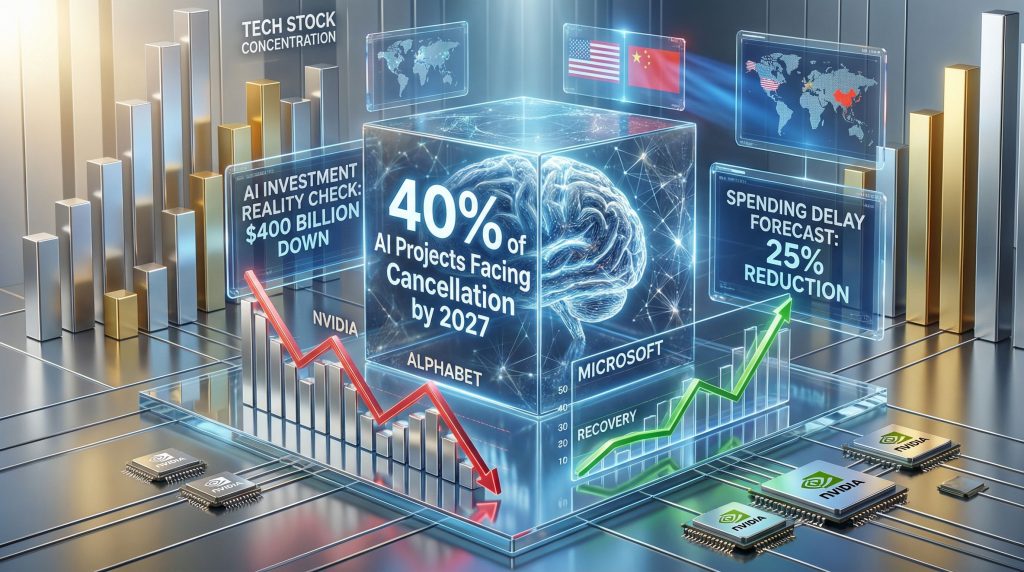
The artificial intelligence sector stands at a critical juncture where distinguishing between healthy market correction and catastrophic collapse becomes essential for investors and enterprises alike. Current market dynamics suggest selective pruning rather than systemic failure, though the $400 billion in AI infrastructure investments across major technology companies creates unprecedented concentration risks. Understanding the nuances of an AI bubble market correction requires examining both enterprise adoption patterns and broader economic indicators.
What Defines an AI Market Correction vs. Complete Bubble Burst?
Market corrections typically involve 20-30% price declines from recent highs, while bubble bursts can result in 80-90% losses sustained over multiple years. The current AI market shows characteristics of correction rather than collapse, with enterprise adoption continuing despite valuation concerns. Furthermore, effective investment strategy components become crucial during these periods of uncertainty.
Distinguishing Market Adjustment from Catastrophic Collapse
Historical precedent analysis reveals important distinctions between the dot-com crash and current AI investment patterns. Unlike the late 1990s internet bubble, where many companies lacked viable business models, today's AI leaders demonstrate measurable revenue generation and established market positions.
| Indicator | Market Correction | Bubble Burst |
|---|---|---|
| Duration | 3-12 months | 2-5 years |
| Price Decline | 20-40% | 70-90% |
| Revenue Growth | Continues but slower | Collapses entirely |
| Enterprise Adoption | Delayed, not abandoned | Mass cancellations |
| Innovation Pipeline | Maintains momentum | Stagnates significantly |
In addition, implementing robust diversification strategies helps investors navigate volatile periods whilst maintaining exposure to AI growth potential.
The $400 Billion Investment Reality Check
Major technology corporations have committed unprecedented capital to AI infrastructure development. Amazon, Alphabet, Meta, and Microsoft collectively represent the largest concentrated investment in emerging technology since the internet's commercialisation.
ROI timeline expectations versus current monetisation challenges create tension in quarterly earnings cycles. Only 15% of decision-makers report EBITDA gains from AI investments, according to recent enterprise surveys, highlighting the gap between investment scale and immediate returns.
Current AI investments require 3-5 year horizons for meaningful return realisation, conflicting with traditional quarterly performance expectations in public markets.
When big ASX news breaks, our subscribers know first
Why Are 40% of AI Projects Facing Cancellation by 2027?
Gartner's projection that 40% of AI projects will face cancellation by 2027 reflects fundamental implementation challenges rather than technological inadequacy. Security vulnerabilities, employee resistance, and unclear return calculations drive project terminations across enterprise environments.
The ROI Challenge Driving Project Failures
Enterprise AI initiatives encounter specific obstacles that traditional technology deployments typically avoid. Integration complexity, data quality requirements, and workforce adaptation timelines exceed initial planning assumptions in most organisations.
Top 5 Reasons Enterprises Are Pulling Back from AI Initiatives:
• Insufficient data quality for training requirements
• Security and compliance concerns with sensitive information
• Lack of skilled personnel for implementation and maintenance
• Unclear return on investment metrics and timelines
• Integration challenges with existing technology infrastructure
Case study frameworks reveal successful AI implementations share common characteristics: focused use cases, executive sponsorship, dedicated teams, and realistic timeline expectations. Failed projects typically suffer from scope creep and unrealistic performance expectations.
CFO Scrutiny and the P&L Accountability Gap
Forrester's forecast of 25% spending delays extending into 2027 reflects increased financial discipline around AI investments. Chief Financial Officers now demand detailed ROI projections and milestone-based funding rather than experimental budget allocations.
The shift from experimental budgets to performance-based allocation represents a maturation of AI investment strategies. Companies increasingly require proof-of-concept validation before scaling AI initiatives across broader organisational contexts.
How Will Tech Stock Concentration Amplify Market Volatility?
Technology sector concentration within major market indices creates systemic vulnerability during AI market corrections. The 40% weighting of tech stocks in the S&P 500 means AI-related volatility ripples through broader market performance. However, understanding share market fundamentals remains crucial for navigating these turbulent periods.
The 40% S&P 500 Concentration Risk
Market capitalisation distribution across major AI-focused companies creates unprecedented concentration in equity markets. Seven technology companies now represent more market value than entire sectors in previous market cycles.
| Company | Market Cap (Trillions) | AI Revenue Exposure | Market Weight |
|---|---|---|---|
| Microsoft | $3.2 | High | 7.1% |
| Apple | $3.0 | Medium | 6.8% |
| Nvidia | $2.8 | Very High | 6.2% |
| Alphabet | $2.1 | High | 4.7% |
| Amazon | $1.8 | High | 4.0% |
Vulnerability assessment of these positions reveals potential for coordinated declines if AI monetisation timelines extend beyond investor expectations. Portfolio managers face difficult decisions about maintaining exposure whilst managing concentration risk.
Nvidia's Position as the Market's "Shovel Seller"
Hardware demand sustainability during correction phases historically provides more stability than software and service providers. Nvidia's semiconductor market position resembles gold rush equipment suppliers, potentially maintaining revenue streams even as AI investments face monetisation challenges.
Competitive landscape analysis suggests chip shortage scenarios remain more likely than oversupply through 2026, supporting semiconductor pricing power. Investment implications for the broader semiconductor supply chain extend beyond AI-specific applications into automotive, industrial, and consumer electronics markets.
Which Enterprise Strategies Will Survive the AI Correction?
Enterprise AI deployment strategies vary significantly in their resilience to market corrections and budget scrutiny. Top-down implementation approaches face different challenges than grassroots experimentation, with success metrics heavily dependent on organisational culture and leadership commitment.
Top-Down Implementation vs. Grassroots Experimentation
Success metrics for enterprise-wide AI programmes require clear governance frameworks and realistic timeline expectations. Organisations pursuing systematic AI integration demonstrate higher success rates than those implementing disconnected pilot projects.
Essential Governance Frameworks for AI Deployment:
• Data governance policies establishing quality standards and access controls
• Risk management protocols addressing security, compliance, and operational concerns
• Performance measurement systems tracking both technical and business outcomes
• Change management processes supporting workforce adaptation and training
• Vendor evaluation criteria ensuring technology alignment with business objectives
Talent alignment strategies during market uncertainty focus on retaining critical AI expertise whilst optimising resource allocation. Companies investing in internal capability development show greater resilience than those dependent on external consulting relationships.
Building "Agentlakes" for Fragmented AI Ecosystems
Infrastructure requirements for sustainable AI integration extend beyond computational resources to encompass data architecture, security frameworks, and integration platforms. The concept of centralised AI management systems addresses enterprise needs for coordinated deployment across multiple business units.
21% of enterprises cite readiness barriers as their primary AI adoption challenge, indicating infrastructure gaps rather than technology limitations constrain deployment success. Cost-benefit analysis of centralised versus distributed AI architectures reveals trade-offs between control, efficiency, and innovation speed.
What Does the Installation-to-Deployment Cycle Mean for AI Markets?
Carlota Perez's framework for technology adoption provides useful context for understanding current AI market positioning. The installation phase, characterised by infrastructure investment and speculation, typically transitions to deployment phase focused on practical application and broader economic integration.
Carlota Perez's Framework Applied to Current AI Trends
Historical technology adoption patterns suggest AI currently occupies the late installation phase, where infrastructure development accelerates whilst practical deployment remains limited. This positioning indicates potential market turbulence as the transition to deployment phase begins.
Transition indicators from hype phase to practical deployment include increased focus on specific use cases, improved ROI measurement, and reduced speculative investment. Current market conditions show mixed signals across these dimensions.
Timeline for AI Market Maturation (Hypothetical Scenario):
- 2025-2026: Continued installation phase with infrastructure buildout
- 2027-2028: Transition period with increased deployment focus
- 2029-2031: Deployment phase with widespread practical application
- 2032+: Mature market with established integration patterns
People-First Transformation Strategies
Workflow redesign versus task augmentation approaches represent fundamentally different philosophies toward AI integration. Organisations focusing on human capability enhancement rather than replacement demonstrate higher success rates and employee acceptance.
Change management requirements for AI integration exceed traditional technology adoption challenges. Skills development priorities during market correction focus on AI literacy, critical thinking, and human-AI collaboration rather than technical specialisation for most roles.
How Will Global Market Dynamics Shape AI Correction Outcomes?
International competition and regulatory frameworks significantly influence AI bubble market correction trajectories. U.S. versus China development paths create different risk profiles and investment opportunities as market dynamics evolve. Moreover, recent global recession insights suggest broader economic factors may compound AI-specific corrections.
U.S. vs. China AI Development Trajectories
Comparative analysis of investment sustainability reveals different government support mechanisms and market structures. Chinese state-directed investment provides stability but may limit innovation diversity, while U.S. market-driven approaches offer greater flexibility with increased volatility.
| Region | Investment Model | Government Role | Market Characteristics |
|---|---|---|---|
| United States | Market-driven | Regulatory oversight | High volatility, innovation focus |
| China | State-directed | Strategic planning | Stable funding, application focus |
| European Union | Regulated innovation | Strong governance | Moderate growth, compliance emphasis |
DeepSeek and emerging competitor impact on market dynamics demonstrates the global nature of AI development. Competition from international players may accelerate innovation whilst pressuring profit margins for established providers.
Vanguard's 2.25-3% Growth Projection Analysis
Economic growth projections from AI adoption vary significantly across sectors and implementation timelines. Manufacturing and logistics sectors show the highest near-term productivity potential, whilst knowledge work applications require longer development periods.
Sector-specific adoption timelines suggest uneven economic impact distribution through 2030. Early adopters in transportation, logistics, and manufacturing may realise measurable productivity gains within 2-3 years, whilst healthcare, education, and professional services require 5-7 year implementation cycles.
The next major ASX story will hit our subscribers first
What Investment Opportunities Emerge During AI Market Corrections?
Market corrections create opportunities for value-oriented investors willing to accept longer-term holding periods. The projected $512 billion agentic AI market by 2029 suggests substantial growth potential despite near-term volatility concerns. Furthermore, monitoring tariffs impact on markets becomes essential given AI supply chain globalisation.
Identifying Value in the $512 Billion Agentic AI Market by 2029
Market segmentation analysis reveals varying resilience levels across AI application categories. Infrastructure providers, specialised software developers, and service companies demonstrate different risk profiles during market corrections.
7 Investment Criteria for AI Correction Resilience:
- Diversified revenue streams beyond pure AI applications
- Strong balance sheet capable of sustaining development through market cycles
- Established customer base with recurring revenue characteristics
- Defensive market position in essential business functions
- Reasonable valuation metrics relative to traditional technology companies
- Clear monetisation path with measurable customer value creation
- Experienced management team with previous technology cycle experience
Due diligence frameworks for AI-focused investments require deeper technical assessment than traditional technology investments. Understanding model capabilities, data requirements, and competitive sustainability becomes essential for investment success.
Infrastructure and Support Service Opportunities
Data centre demand sustainability analysis suggests continued growth despite AI application volatility. Training requirements, model deployment, and data processing needs maintain infrastructure utilisation even during market corrections.
AI training and consulting market expansion potential benefits from enterprise needs for implementation support. Companies lacking internal AI expertise require external assistance regardless of market sentiment toward AI investments.
How Should Investors Position for Long-Term AI Market Evolution?
Portfolio positioning strategies must balance AI exposure with concentration risk management. The technology sector's market dominance requires careful consideration of diversification benefits versus growth potential. Understanding whether AI bubble concerns are justified helps inform investment decisions.
Portfolio Diversification Strategies During Correction
Risk management approaches for AI-heavy portfolios include sector rotation, international diversification, and alternative asset allocation. Traditional diversification strategies may prove insufficient given AI's broad economic impact potential.
| Asset Category | Recommended Allocation | AI Correlation | Risk Profile |
|---|---|---|---|
| Large-cap AI leaders | 15-25% | Very High | High growth, high volatility |
| AI infrastructure | 10-15% | High | Moderate growth, moderate volatility |
| International AI exposure | 5-10% | Medium | Diversification benefit |
| Traditional technology | 15-20% | Medium | Stable growth |
| Non-technology sectors | 30-40% | Low | Portfolio stability |
Hedging strategies for technology sector concentration include put options, inverse ETFs, and correlation-based asset selection. These approaches require careful implementation to avoid limiting upside participation whilst managing downside risk.
Timeline Expectations for Market Stabilisation
Historical precedent analysis for technology correction recovery suggests 18-36 month cycles from peak to trough to new highs. AI bubble market correction may follow similar patterns, though unprecedented investment scale could extend timelines.
Three Potential Market Evolution Pathways:
Scenario 1 – Soft Landing (40% probability): Gradual correction followed by resumed growth as applications mature
Scenario 2 – Extended Correction (45% probability): Deeper pullback lasting 2-3 years before sustainable recovery
Scenario 3 – Fundamental Reassessment (15% probability): Major revaluation of AI potential leading to prolonged adjustment period
Indicators to monitor for correction completion include stabilised valuation metrics, resumed enterprise adoption growth, and clear monetisation success stories across multiple sectors and use cases.
Frequently Asked Questions About AI Market Correction
Is this correction similar to the 2000 dot-com crash?
Current AI market dynamics differ significantly from the dot-com bubble in fundamental ways. Unlike 2000, today's AI leaders generate substantial revenues and possess established business models. However, valuation levels and investment concentration create similar systemic risks.
Which AI companies are most vulnerable to market correction?
Companies with high valuations relative to current revenues, limited diversification beyond AI, and dependence on speculative applications face greatest correction risk. Pure-play AI companies without established market positions show higher vulnerability than diversified technology firms.
How long will the AI market correction last?
Historical technology correction cycles suggest 12-36 month durations, though AI's unique characteristics may extend this timeline. Recovery depends on enterprise adoption acceleration and clear monetisation success across multiple sectors. Consequently, the AI bubble market correction timeline remains subject to numerous variables including enterprise adoption rates and regulatory developments.
Should investors avoid AI stocks during this correction?
Market corrections often present opportunities for long-term investors with appropriate risk tolerance. Rather than avoiding AI entirely, investors should focus on companies with strong fundamentals, diversified revenue streams, and sustainable competitive positions.
Disclaimer: This analysis is for educational purposes only and does not constitute investment advice. AI market predictions involve significant uncertainty, and actual outcomes may differ materially from projections. Investors should conduct independent research and consider their risk tolerance before making investment decisions.
Ready to Navigate Market Volatility with Precision?
Discovery Alert's proprietary Discovery IQ model delivers real-time notifications on significant ASX mineral discoveries, helping investors identify actionable opportunities whilst broader markets face uncertainty from AI corrections and sector volatility. Begin your 30-day free trial today to gain a market-leading edge during these turbulent times and discover why major mineral discoveries can generate substantial returns regardless of broader market conditions.