June 20, 2026
The convergence of artificial intelligence infrastructure and grid stability requirements is reshaping fundamental assumptions about data center power architecture. Unlike traditional computing facilities that operate with predictable load patterns, AI data centers and battery energy storage systems create unprecedented demands on electrical systems that challenge conventional backup strategies. This transformation extends beyond simple capacity scaling to encompass entirely different approaches to power quality, reliability, and grid integration.
Battery energy storage systems have emerged as critical infrastructure components rather than optional redundancy measures. The technical requirements for supporting GPU-intensive computational loads differ substantially from conventional server environments, creating new paradigms for energy storage deployment, sizing, and operational strategies.
Understanding the Power Architecture Revolution in AI Infrastructure
Computational Density vs. Traditional Data Centers
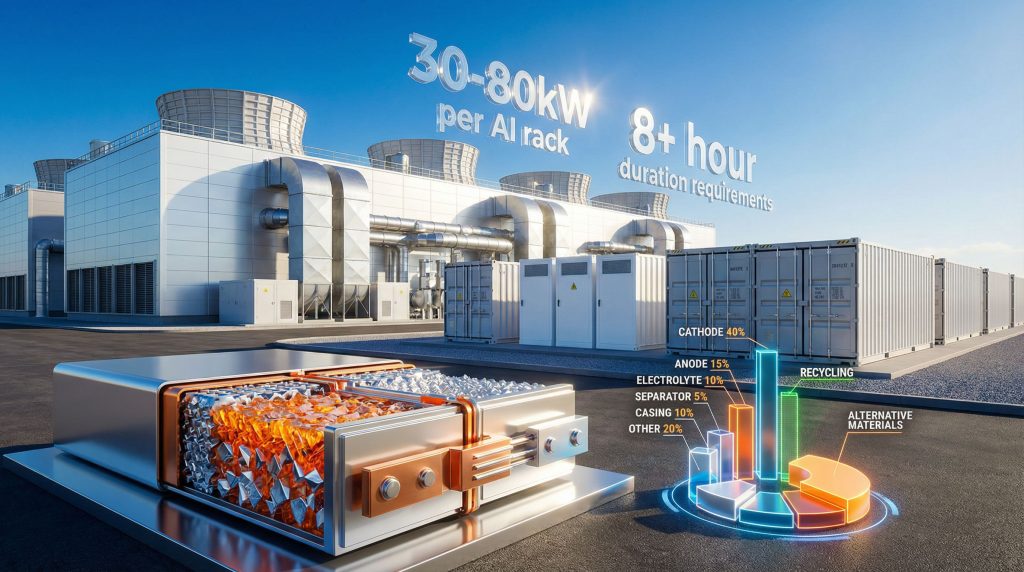
AI data centers represent a fundamental shift in power consumption patterns that traditional infrastructure cannot accommodate. Modern AI facilities operate with rack-level power densities reaching 30-80 kW per rack, compared to conventional server deployments that typically consume 8-15 kW per rack. This tenfold increase in power density creates cascading effects throughout the electrical distribution system.
Industry analysis reveals that AI racks consume approximately 10 times the power of CPU-based systems, with this multiplier continuing to increase as computational requirements advance. This dramatic escalation in power consumption occurs alongside equally significant increases in heat generation, requiring cooling infrastructure that can operate at elevated capacity factors.
The thermal management implications extend beyond simple cooling capacity. AI facilities generate heat loads that concentrate in specific zones rather than distributing evenly across the facility footprint. This concentration requires:
• Localised cooling systems capable of handling 50-100 kW heat rejection per rack
• Liquid cooling infrastructure for direct chip-level heat removal
• Redundant cooling paths to prevent thermal runaway during equipment failures
• Variable capacity cooling to accommodate dynamic computational loads
Grid connection requirements for hyperscale AI facilities represent another departure from traditional data center design. Single facilities may require 10-50+ MW of grid capacity, creating transmission constraints that force developers to implement alternative power strategies.
Critical Power Quality Standards for AI Workloads
GPU cluster operations demand power quality specifications that exceed traditional IT equipment tolerances. Voltage stability requirements for AI workloads typically specify voltage variation limits of ±3-5% compared to ±10% for conventional servers. These tighter specifications reflect the sensitivity of parallel processing operations to power fluctuations.
Millisecond-level response time specifications become critical when supporting distributed GPU arrays. Power system disruptions that would be imperceptible to traditional workloads can cause:
• Computational synchronisation failures across GPU clusters
• Memory state corruption during voltage transients
• Model training interruptions requiring restart from checkpoint data
• Data integrity issues during parallel processing operations
Power factor correction and harmonic distortion management gain heightened importance in high-density AI environments. The concentration of switching power supplies and variable-frequency drives creates harmonic content that can exceed IEEE 519 standards without active mitigation. This requires sophisticated power conditioning equipment integrated into the facility design rather than added as aftermarket solutions.
When big ASX news breaks, our subscribers know first
Why Traditional Backup Systems Fall Short for AI Data Centers
UPS Limitations in High-Density Environments
Conventional uninterruptible power supply systems encounter fundamental limitations when scaled to support multi-megawatt AI facilities. Traditional UPS architectures designed for 15-30 minutes of runtime become economically impractical and technically challenging at AI facility power levels.
Runtime constraints during extended outages create operational vulnerabilities that conventional UPS systems cannot address. AI workloads often require hours rather than minutes for graceful shutdown and restart procedures. Complex computational tasks may need to:
• Complete in-progress calculations before shutdown
• Save intermediate computational states to persistent storage
• Synchronise distributed processing elements across multiple systems
• Verify data integrity before allowing restart procedures
Thermal management challenges with traditional UPS systems compound at high power densities. UPS equipment generates significant heat during operation, typically 3-5% of rated capacity as waste heat. In multi-megawatt installations, this heat generation can overwhelm cooling systems and create cascading thermal failures.
Scalability issues for multi-megawatt AI facilities make traditional UPS approaches prohibitively expensive. Scaling conventional UPS technology to support 20-50 MW loads would require:
Table: UPS Scaling Challenges for AI Facilities
| Requirement | Traditional UPS | Scaled AI Application | Economic Impact |
|---|---|---|---|
| Capital Cost | $100-200/kW | $2-10 million for 50MW | Prohibitively expensive |
| Space Requirements | 10-20 sq ft/MW | 500-1000 sq ft | Facility space constraints |
| Maintenance Complexity | Standard protocols | Specialised expertise required | Operational cost increase |
| Heat Generation | 3-5% of capacity | 1.5-2.5 MW heat load | Additional cooling infrastructure |
Diesel Generator Integration Challenges
Diesel generator systems face technical limitations that prevent seamless integration with AI facility requirements. Cold start delays of 30-90 seconds create a coverage gap that traditional UPS systems cannot economically bridge at AI power levels.
Load acceptance ramping represents another critical limitation. Most diesel generators can accept load increases of 10-20% per second, requiring 5-10 seconds to reach full capacity. This ramping limitation creates instability during the transition from utility power to generator operation.
Furthermore, emissions compliance in urban data center locations increasingly restricts diesel generator operation. Many metropolitan areas implement air quality regulations that limit:
• Operating hours per year for diesel generators (typically 100-500 hours)
• Emissions levels during operation (NOx, particulate matter)
• Testing frequency and duration limitations
• Fuel storage requirements with environmental containment
Fuel supply chain vulnerabilities for extended operations create additional risk factors. AI facilities requiring multi-day generator operation face logistical challenges including:
• Fuel delivery coordination during emergency conditions
• Storage capacity limitations for extended runtime requirements
• Fuel degradation issues for long-term storage
• Supply chain disruption during widespread outage events
How Battery Energy Storage Systems Address AI Data Center Challenges
Grid Stability and Peak Demand Management
AI data centers and battery energy storage systems provide capabilities that align specifically with facility operational requirements. Load balancing during computational surge events represents a primary application where BESS technology excels. AI workloads can experience power demand variations of 30-50 MW within seconds, creating grid stability challenges that conventional generation cannot manage.
The rapid response capability of battery systems enables effective management of these load swings. BESS can respond to demand changes within 50 milliseconds, compared to multi-second response times for conventional generation. This rapid response prevents:
• Voltage sag events during sudden load increases
• Frequency deviation from rapid demand changes
• Power factor disturbances caused by variable loads
• Grid instability from large facility connections
Demand response participation creates revenue optimisation opportunities that improve project economics. Moreover, AI facilities with integrated BESS can participate in grid services markets including:
• Frequency regulation services paying $20-50/MW-hour in competitive markets
• Voltage support services for transmission system stability
• Spinning reserve capacity for grid reliability
• Load reduction programs during peak demand periods
Renewable Energy Integration Strategies
Solar and wind power smoothing capabilities enable AI facilities to integrate renewable generation whilst maintaining operational reliability. However, renewable energy solutions can absorb renewable generation variability and provide consistent power delivery to computational loads.
Time-shifting renewable generation for 24/7 AI operations creates operational flexibility that traditional power arrangements cannot provide. BESS enables facilities to:
• Capture excess solar generation during peak production hours
• Dispatch stored energy during evening and overnight operations
• Balance renewable intermittency with computational demand patterns
• Maximise renewable energy utilisation for carbon footprint reduction
Carbon footprint reduction through clean energy storage supports corporate sustainability commitments whilst providing operational benefits. For instance, AI facilities implementing renewable plus storage configurations can achieve:
Table: Renewable Integration Benefits
| Metric | Traditional Grid Power | Renewable + BESS | Improvement Factor |
|---|---|---|---|
| Carbon Emissions | 400-600 kg CO2/MWh | 50-150 kg CO2/MWh | 75-85% reduction |
| Energy Cost Stability | Variable utility rates | Fixed renewable costs | Predictable pricing |
| Grid Independence | Fully grid-dependent | Partial self-sufficiency | 40-70% independence |
| Sustainability Rating | Standard compliance | Carbon-negative potential | Premium positioning |
What Battery Technologies Are Optimal for AI Data Center Applications?
Lithium-Ion Chemistry Comparison
Lithium iron phosphate (LFP) chemistry has emerged as the preferred technology for AI data center applications, offering safety and cycle life advantages that align with facility operational requirements. LFP systems typically achieve 6,000-10,000 cycles at 80% depth of discharge, compared to 3,000-5,000 cycles for alternative lithium-ion chemistries.
Safety characteristics of LFP technology reduce operational risks in mission-critical environments. LFP cells demonstrate:
• Thermal stability up to 270°C before thermal runaway
• Low thermal propagation between adjacent cells
• Reduced fire risk compared to high-energy density chemistries
• Stable performance across wide temperature ranges
Nickel manganese cobalt (NMC) chemistry offers energy density benefits for space-constrained installations. NMC systems can achieve 150-250 Wh/kg energy density compared to 90-160 Wh/kg for LFP systems. Nevertheless, this energy density advantage comes with tradeoffs including:
• Higher thermal management requirements
• Reduced cycle life (3,000-5,000 cycles typical)
• Increased safety precautions for thermal runaway prevention
• Higher material costs due to cobalt content
Current material cost dynamics significantly impact battery metals investment. Industry analysis indicates that lithium pricing represents the largest cost factor, with battery cells accounting for approximately 60% of total BESS system cost. Recent lithium carbonate pricing has experienced substantial volatility:
• January 2026: $17.50-20.50/kg
• December 2025: $10.50-12.50/kg
• Monthly increase: Approximately 65%
Alternative Storage Technologies for Long-Duration Applications
Sodium-ion batteries are gaining attention for cost-sensitive deployments that eliminate exposure to lithium price volatility. Sodium-ion technology offers several advantages for specific AI data center applications:
• Material cost stability using abundant sodium resources
• Elimination of lithium, cobalt, and nickel supply chain dependencies
• Similar performance characteristics to LFP for stationary applications
• Manufacturing compatibility with existing lithium-ion production lines
However, sodium-ion technology currently faces limitations including reduced energy density and limited commercial availability. Energy density typically ranges from 90-150 Wh/kg, compared to established lithium-ion options.
Flow battery systems provide solutions for 8+ hour duration requirements where energy density is less critical than cost per MWh. Vanadium redox flow batteries offer:
• Unlimited cycling capability without capacity degradation
• Modular scalability for power and energy requirements
• 25+ year operational life with minimal maintenance
• Fire safety advantages using aqueous electrolytes
Implementation challenges for flow batteries include higher capital costs and system complexity compared to lithium-ion alternatives.
How Rising Material Costs Impact BESS Deployment Economics
Commodity Price Sensitivity Analysis
Recent commodity price movements demonstrate the material sensitivity of BESS project economics. Copper pricing has experienced significant volatility with implications for power electronics and interconnection systems:
• January 2026: $70-80/tonne premium
• December 2025: $50-60/tonne premium
• Monthly increase: Approximately 36%
Aluminium pricing has reached historically elevated levels, affecting structural components and electrical infrastructure:
• January 2026: 98.00-100 cents/lb premium
• Historical significance: Highest level since 2003
• Monthly increase: Approximately 9%
Table: Material Cost Impact on BESS Projects
| Component | Material Exposure | Price Volatility Impact | Cost Mitigation Strategies |
|---|---|---|---|
| Battery Cells | Lithium (60% of system cost) | High sensitivity to lithium pricing | Long-term supply contracts, alternative chemistries |
| Power Electronics | Copper, aluminium conductors | Moderate sensitivity | Design optimisation, material substitution |
| Structural Components | Steel, aluminium framing | Low-moderate sensitivity | Alternative materials, optimised designs |
| Thermal Management | Copper heat exchangers | Moderate sensitivity | Efficiency improvements, system integration |
Supply Chain Risk Management
Geographic concentration risks in lithium supply create project vulnerability to regional supply disruptions. Current lithium production concentrates in:
• Australia: Approximately 50% of global hard rock production
• Chile: Approximately 25% of global brine production
• China: Approximately 60% of lithium processing capacity
• Argentina: Growing brine production capacity
Transportation and logistics cost factors add additional variability to material pricing. Ocean freight costs for battery materials have experienced significant volatility, ranging from $2,000-8,000 per container on major trade routes.
Consequently, battery-grade lithium refinery strategies for price volatility include:
• Volume purchase agreements for price stability
• Strategic inventory positioning for material security
• Financial hedging instruments for commodity exposure
• Alternative sourcing development for supply diversification
Which AI Data Center Operators Are Leading BESS Adoption?
Hyperscale Cloud Provider Strategies
Microsoft has implemented comprehensive renewable energy plus storage initiatives across its global data center portfolio. The company has committed to carbon negativity by 2030, driving integration of renewable generation with battery storage systems for grid balancing and backup power.
Google's carbon-free energy goals have led to innovative BESS deployment strategies that extend beyond traditional backup applications. The company aims to operate on 24/7 carbon-free energy by 2030, requiring sophisticated energy storage systems to bridge renewable generation gaps.
Amazon's sustainability commitments include massive renewable energy procurement coupled with strategic BESS deployment. The company has announced plans for carbon neutrality by 2040, driving investment in energy storage systems for both operational resilience and renewable energy integration.
Specialised AI Infrastructure Companies
CoreWeave's GPU-focused data center design incorporates BESS as core infrastructure rather than supplementary backup systems. The company's facilities are specifically optimised for AI workloads, requiring power architecture that can support rapid computational scaling.
Lambda Labs operates high-performance computing facilities that demonstrate the integration challenges and solutions for AI-specific infrastructure. Their deployment experience provides insights into optimal BESS sizing and configuration for GPU-intensive workloads.
Emerging colocation providers targeting AI workloads are implementing standardised BESS solutions that can support multiple customer requirements. These providers recognise that BESS capability has become a competitive differentiator for AI infrastructure services.
The next major ASX story will hit our subscribers first
What Grid Integration Challenges Drive BESS Requirements?
Interconnection Queue Delays and Solutions
Grid interconnection processes currently experience average wait times of 2-5 years for new connections, creating project timeline pressures that drive alternative solutions. These delays result from transmission capacity constraints and regulatory approval processes that cannot keep pace with AI infrastructure development.
Interruptible service agreements with BESS backup provide one solution pathway. Facilities can accept lower-priority grid connections with the understanding that battery systems will provide backup power during curtailment events.
Behind-the-meter deployment strategies have become essential for project advancement. Industry analysis indicates that approximately 25-33% of new AI data center projects are implementing behind-the-meter systems including batteries, generators, and solar generation to circumvent grid connection delays.
Regional Grid Reliability Variations
Texas ERCOT market dynamics create unique opportunities and challenges for energy storage deployment. The market's energy-only design and lack of capacity payments create price volatility that BESS can monetise through energy arbitrage and ancillary services.
California renewable integration challenges drive storage requirements for grid stability. The state's high renewable penetration creates duck curve effects that require energy storage for load balancing and grid services.
Northeast corridor transmission constraints limit grid capacity expansion, making behind-the-meter BESS essential for new AI facility development. These constraints are particularly acute in metropolitan areas where AI facilities seek proximity to network infrastructure and skilled workforce.
How to Optimise BESS Sizing for AI Data Center Applications
Duration Requirements by Use Case
Table: BESS Duration Optimisation
| Application | Typical Duration | Key Considerations | Cost-Benefit Analysis |
|---|---|---|---|
| UPS Bridging | 15-30 minutes | Generator start time, load transfer | High ROI for reliability improvement |
| Peak Shaving | 2-4 hours | Utility rate structures, demand charges | Moderate ROI, rate-dependent |
| Renewable Shifting | 4-8 hours | Solar/wind generation patterns | Variable ROI by location and rates |
| Grid Outage Backup | 8-24 hours | Historical outage duration/frequency | Risk-based assessment required |
| Extended Autonomy | 24+ hours | Extreme weather, multiple contingencies | Low ROI, insurance-based justification |
Duration optimisation requires analysis of specific operational requirements and risk tolerance. Facilities supporting critical AI research or commercial services may justify extended duration requirements based on revenue protection rather than pure economic optimisation.
Modular Scaling Strategies
Phased deployment aligned with AI capacity growth enables capital efficiency whilst maintaining expansion flexibility. Initial BESS installations can focus on grid integration and basic backup requirements, with subsequent phases adding capacity for renewable integration and extended autonomy.
Standardised container-based BESS solutions provide deployment flexibility and reduced installation complexity. Modular designs enable:
• Rapid deployment with factory-integrated systems
• Standardised maintenance procedures and spare parts inventory
• Scalable capacity addition without system redesign
• Technology refresh capabilities for component upgrades
Future expansion planning requires infrastructure preparation for anticipated growth. Electrical infrastructure, cooling systems, and control integration should accommodate planned expansion phases without major reconstruction.
What Financial Models Support AI Data Center BESS Investment?
Revenue Stacking Opportunities
Energy arbitrage through time-of-use optimisation provides baseline revenue generation for BESS systems. Facilities can charge batteries during off-peak periods and discharge during peak pricing, generating revenue whilst providing operational backup.
Ancillary services market participation creates additional revenue streams that improve project economics. Available services include:
• Frequency regulation for grid stability ($20-50/MW-hour typical pricing)
• Spinning reserve for generation contingencies
• Voltage support for transmission system stability
• Black start capability for grid restoration services
Capacity payments and grid reliability services provide long-term revenue stability. Many markets offer capacity auctions that pay BESS systems for availability during peak demand periods.
Carbon credit monetisation strategies can generate additional revenue whilst supporting sustainability objectives. BESS systems that enable renewable energy integration may qualify for carbon credits under various programmes including Section 45Q federal tax credits and state renewable portfolio standards.
Risk-Adjusted Return Calculations
Technology performance degradation factors must be incorporated into financial models. Lithium-ion battery systems typically experience 2-3% annual capacity degradation, affecting long-term revenue generation and replacement timing.
Regulatory change impact assessment requires ongoing monitoring of market rules and incentive programmes. Changes to interconnection requirements, safety standards, or incentive programmes can significantly affect project economics.
Insurance and warranty considerations affect both capital costs and operational risks. BESS systems require specialised insurance coverage for:
• Fire and explosion risks specific to battery technology
• Performance guarantees for energy storage capability
• Business interruption coverage for facility downtime
• Technology warranty coverage for component replacement
How Will Future AI Workloads Shape BESS Requirements?
Next-Generation AI Computing Demands
Quantum-AI hybrid systems represent an emerging computational paradigm that will create new power infrastructure requirements. These systems may require ultra-stable power delivery with specifications that exceed current AI facility requirements.
Edge AI deployment and distributed storage needs are driving smaller-scale BESS requirements across multiple geographic locations. Edge computing infrastructure requires:
• Smaller capacity systems (100 kW – 5 MW) for local resilience
• Distributed storage networks for computational load balancing
• Rapid deployment capabilities for dynamic infrastructure needs
• Remote monitoring and control systems for distributed operations
Real-time inference versus batch training creates different power profiles that affect BESS sizing and operation. Inference workloads typically require:
• Consistent power delivery with minimal variation
• Low latency power system response
• High availability for service level agreements
• Predictable load patterns for capacity planning
Grid Modernisation and Smart Infrastructure
Vehicle-to-grid integration opportunities may enable AI facilities to access additional distributed storage resources. Electric vehicle fleets could provide supplementary grid services during peak demand periods.
Distributed energy resource orchestration will enable coordinated operation of multiple BESS installations across utility service territories. This coordination can optimise:
• Regional grid stability through distributed response
• Renewable energy integration across multiple facilities
• Load balancing between facilities and grid resources
• Market participation through aggregated capacity offerings
Blockchain-based energy trading platforms may enable peer-to-peer energy transactions between AI facilities and other grid participants. These platforms could facilitate:
• Direct renewable energy purchases from local generators
• Storage capacity sharing between facilities
• Grid services coordination through smart contracts
• Carbon credit tracking and verification
Implementation Roadmap for AI Data Center BESS Projects
Pre-Development Phase Considerations
Site selection criteria must include grid capacity assessment and expansion potential. Critical factors include:
• Available transmission capacity for initial and future loads
• Interconnection queue position and expected timeline
• Local utility infrastructure and upgrade requirements
• Regulatory environment for storage deployment and grid services
Permitting and regulatory approval timelines vary significantly by jurisdiction and project scale. Typical approval processes require:
• Environmental impact assessment for battery system installation
• Fire safety approvals for lithium-ion battery systems
• Electrical permits for high-voltage interconnection
• Grid interconnection agreements with utility companies
Technology vendor evaluation and selection requires assessment of multiple factors including:
• Performance specifications for power and energy requirements
• Safety certifications and testing documentation
• Warranty terms and service support capabilities
• Financial stability of equipment manufacturers
Construction and Commissioning Best Practices
Safety protocols for high-voltage battery systems require specialised expertise and equipment. Installation safety measures include:
• Arc flash protection for high-voltage electrical work
• Fire suppression systems designed for battery applications
• Emergency response procedures for battery system incidents
• Personnel training for safe operation and maintenance
Integration testing with existing power infrastructure ensures system compatibility and performance verification. Testing protocols should validate:
• Power transfer capabilities during normal and emergency conditions
• Control system integration with facility management systems
• Protection coordination with upstream electrical equipment
• Performance verification under various load conditions
Performance monitoring and optimisation systems enable ongoing operational efficiency and issue identification. The battery recycling process should track:
• Energy throughput and efficiency metrics
• System availability and reliability statistics
• Battery performance and degradation trends
• Revenue generation from grid services and arbitrage
Furthermore, innovations in battery recycling are improving the sustainability profile of BESS systems. Additionally, advanced battery systems are essential for ensuring data centre resilience.
The convergence of AI computational demands and grid reliability challenges has transformed battery energy storage systems from optional backup equipment to essential infrastructure components. Projects that integrate BESS considerations from the design phase achieve superior performance and economics compared to retrofitted solutions, whilst providing operational resilience that traditional backup systems cannot match.
The integration of AI data centers and battery energy storage systems represents a fundamental shift in critical infrastructure design. As computational demands continue escalating and grid modernisation accelerates, the symbiotic relationship between AI facilities and energy storage will likely deepen, creating new opportunities for innovation in both sectors whilst addressing the growing challenges of reliable, sustainable power delivery at unprecedented scales.
Disclaimer: This analysis contains forward-looking statements and projections based on current industry trends and available data. Actual results may vary significantly due to technological developments, regulatory changes, market conditions, and other factors. Investment decisions should be based on comprehensive due diligence and professional consultation.
Considering Investing in Battery Metals and Energy Storage Infrastructure?
Discovery Alert's proprietary Discovery IQ model delivers real-time alerts on significant mineral discoveries across battery metals, energy infrastructure, and related sectors, instantly empowering subscribers to identify actionable opportunities ahead of the broader market. Explore Discovery Alert's discoveries page to understand why historic mineral discoveries can generate substantial returns, then begin your 14-day free trial today to position yourself ahead of the market.