June 20, 2026
America's Lithium Blind Spot: Why the Ground Beneath the Carolinas Could Rewrite the Nation's Battery Future
For most of the twentieth century, the story of American mineral dominance was told through coal seams in Appalachia, copper pits in the Southwest, and iron ranges in the Great Lakes. What that story rarely acknowledged was a quieter, less glamorous chapter unfolding in the rolling foothills of North Carolina. That chapter closed in the 1990s, yet a new assessment of USGS lithium in the Carolinas suggests it may be time to reopen it, at a scale that would have been difficult to imagine when the last Carolina lithium mine went dark.
When big ASX news breaks, our subscribers know first
The Geology That Started It All: Understanding Appalachian Pegmatites
Before examining what the USGS has found, it is worth understanding why the southern Appalachians host lithium in the first place. The answer lies in a geological process that unfolded hundreds of millions of years ago during the assembly and subsequent erosion of the ancient supercontinent Pangaea.
As magmatic bodies cooled deep within the crust, the final stages of crystallisation produced highly enriched fluids capable of concentrating elements that do not fit neatly into common rock-forming minerals. Lithium, along with cesium, tantalum, beryllium, and rubidium, was swept into these residual melts and eventually solidified into pegmatites: coarse-grained igneous rocks whose oversized crystal structures are a direct product of slow, volatile-rich cooling.
The Appalachian pegmatite belt runs through the Blue Ridge and Piedmont geological provinces, cutting across both Carolinas in a southwesterly orientation that mirrors the ancient continental collision zones responsible for creating the mountain chain itself. Lithium mineralisation within this belt is primarily hosted in spodumene, a lithium aluminium silicate mineral. Furthermore, spodumene lithium extraction is the same process targeted by the world's largest hard-rock lithium operations in Western Australia's Pilbara and Goldfields regions.
This geological kinship with Western Australian deposits is significant. It suggests that the processing chemistry, metallurgical behaviour, and concentrate quality of Carolina spodumene ore could be broadly comparable to the ore types that global battery supply chains are already equipped to handle — a point that could reduce technical risk for future development programmes.
What the USGS Assessment Actually Measured
The distinction between a USGS mineral resource assessment and a mineable reserve is not merely semantic. It is the difference between a weather forecast and a harvest guarantee, and investors or policymakers who conflate the two risk misreading the significance of this work entirely.
What the USGS produced for the southern Appalachian region is a probabilistic quantitative mineral resource assessment: a scientifically rigorous estimate of how much undiscovered, economically recoverable lithium oxide could plausibly exist within a geologically defined region, based on indirect evidence rather than drill holes.
How the Methodology Was Constructed
The methodology assembled multiple independent data streams:
- Regional geologic mapping to identify terrain favourable for pegmatite formation
- Geochemical sampling data revealing lithium anomalies at surface and near-surface levels
- Geophysical survey integration to model structural controls on pegmatite emplacement at depth
- Catalogued records of known mineral occurrences within the study area
- Global analogue datasets from lithium pegmatite districts worldwide, used to calibrate deposit size and frequency modelling
The output is expressed as a probability distribution rather than a single number, which is the scientifically honest approach when subsurface geology has not been systematically drilled.
Southern Appalachian Lithium Assessment: Probabilistic Output
| Confidence Level | Estimated Recoverable Lithium Oxide |
|---|---|
| 90% probability (minimum floor) | 60,000 metric tons |
| 50% probability (median estimate) | 1.43 million metric tons |
| 10% probability (upside scenario) | 6.9 million metric tons |
The 90% confidence figure represents the floor: the amount of lithium oxide that USGS geologists are highly confident exists, even under conservative assumptions. The median estimate of 1.43 million metric tons is the central case. The 10% upside of 6.9 million metric tons reflects genuine geological uncertainty on the high end, not wishful thinking.
Critical distinction for investors: These are estimates of undiscovered resources. No drilling has confirmed these deposits individually. Significant exploration investment, resource definition work, environmental review, and feasibility analysis would be required before any of this material could be classified as a mineable reserve under internationally recognised reporting standards such as JORC or NI 43-101.
The Northern Appalachian Piece: Building a Continental Picture
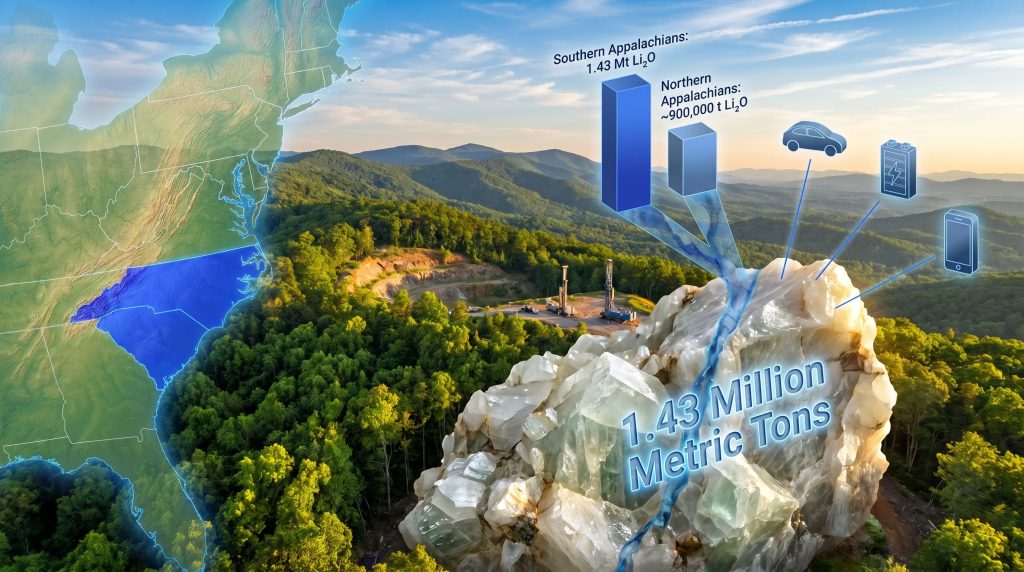
The southern assessment did not emerge in isolation. In April 2026, the USGS released a companion study covering the northern Appalachian region, focused primarily on pegmatite districts in Maine and New Hampshire. That study identified approximately 900,000 metric tons of recoverable lithium oxide in the northern belt.
When combined with the southern assessment, the full Appalachian lithium picture takes shape:
| Region | Estimated Lithium Oxide | Primary States |
|---|---|---|
| Southern Appalachians | 1.43 million metric tons (median) | North Carolina, South Carolina |
| Northern Appalachians | ~900,000 metric tons | Maine, New Hampshire |
| Total Appalachian Region | ~2.3 million metric tons | Eastern U.S. |
At 2025 U.S. import levels, this combined figure represents the theoretical equivalent of more than 328 years of lithium imports replaced by domestic production. Even at the conservative 90% confidence floor for the southern assessment alone, the numbers are strategically significant.
Translating Geology Into Battery Terms: The Real-World Scale of the Carolinas' Lithium Potential
Metric tons of lithium oxide are an abstract unit for most readers. The USGS assessment helpfully translated the median southern Appalachian estimate into application-level equivalents that place the resource in direct economic and technological context.
What 1.43 Million Metric Tons of Lithium Oxide Could Power:
| Application | Implied Supply Capacity |
|---|---|
| Electric vehicle batteries | ~80 million EVs |
| Grid-scale stationary storage systems | ~1 million units |
| Laptop computers | ~110 billion units (approximately a 600-year supply) |
| Smartphones | ~300 billion units (roughly 36 per person alive today) |
These figures require important caveats. Lithium demand per battery varies significantly with chemistry, cell format, and energy density. Battery technology is also evolving rapidly, with solid-state and lithium-sulphur chemistries potentially altering lithium consumption per kilowatt-hour of storage. The USGS equivalents are illustrative benchmarks, not production projections.
That said, the order of magnitude is striking. Even if only a fraction of the probabilistic resource were ultimately confirmed and developed, the contribution to U.S. battery supply chain security could be material.
A Forgotten Industrial Legacy: North Carolina as America's Original Lithium Capital
One of the most underappreciated dimensions of USGS lithium in the Carolinas is its historical depth. The region's identity as a lithium producer is not a speculative future scenario. It is a documented industrial reality that the current generation has simply forgotten.
North Carolina's Kings Mountain district and Hallman-Beam mine were active lithium producers long before the electric vehicle transition created the demand environment that now commands front-page attention. These operations extracted spodumene from the same pegmatite system now subject to USGS probabilistic modelling, supplying lithium for:
- Specialty ceramics and heat-resistant glass formulations
- High-performance lubricating greases used in industrial and aerospace applications
- Chemical synthesis applications requiring lithium compounds
At the time these mines operated, the United States held the position of the world's dominant lithium producer. That status was not lost to geological exhaustion. It was lost to economics.
Why the Carolina Mines Closed: A Structural Shift, Not a Resource Depletion
The closure of Kings Mountain and Hallman-Beam in the 1990s reflected a profound restructuring of global lithium supply, not an absence of ore in the ground. Two competing sources fundamentally altered the cost equation:
-
South American brine operations in Chile and Argentina's Atacama and Puna regions offered lithium at dramatically lower extraction costs. Understanding lithium brines explained helps clarify why evaporation-based brine processing, which requires minimal energy input and leverages free solar evaporation in high-altitude salt flats, simply could not be matched on operating cost by hard-rock spodumene mining in the Carolinas.
-
Australian hard-rock operations, particularly in Western Australia's Greenbushes and subsequent Pilbara districts, delivered large-scale, low-cost spodumene concentrate that further compressed margins available to U.S. producers.
The result was a broader deindustrialisation of domestic critical mineral production, a pattern now being examined with renewed urgency given the concentration of battery supply chains in geopolitically sensitive regions.
The fact that Carolina lithium deposits were not mined out, but rather priced out, is one of the most strategically important details in the entire USGS assessment narrative. The ore is still there. The question is whether evolving economics, policy priorities, and technology can change the viability calculation.
The next major ASX story will hit our subscribers first
From Scientific Baseline to Potential Production: The Development Pathway
Understanding where the USGS assessment sits within a full mine development lifecycle is essential for interpreting its significance accurately. The assessment is the beginning of a long journey, not the end of one.
The Staged Pathway from USGS Assessment to Active Mine:
- Regional exploration targeting: Geophysical surveys, soil geochemistry, and geological mapping focused on narrowing the highest-priority zones within the assessed area
- Resource definition drilling: Systematic diamond core drilling programmes designed to intercept, sample, and characterise individual pegmatite bodies
- Mineral resource estimation: Construction of three-dimensional geological models and resource estimates compliant with JORC, NI 43-101, or equivalent reporting codes
- Metallurgical testwork: Laboratory and pilot-scale processing trials to determine spodumene recovery rates, concentrate grades, and downstream conversion characteristics
- Environmental baseline studies: Multi-year ecological, hydrological, and community impact assessments required to support permitting applications
- Permitting and regulatory review: Federal and state environmental review processes, which in the U.S. can span several years depending on land tenure, environmental sensitivity, and community engagement
- Feasibility studies: Definitive economic modelling incorporating capital cost estimates, operating cost projections, and lithium price sensitivity analysis
- Mine construction and commissioning: Physical development of mine infrastructure, processing facilities, and logistics connections to market
Each stage involves its own capital requirement, timeline, and technical risk. The aggregate timeframe from initial exploration to first production at a new hard-rock lithium operation has historically ranged from ten to twenty years in jurisdictions with complex permitting environments.
The Lithium Supply Chain Vulnerability the Carolinas Assessment Addresses
The strategic backdrop against which the USGS assessment must be read is one of pronounced and well-documented U.S. vulnerability in lithium supply chains. In addition, innovations such as direct lithium extraction technology may eventually alter the economics of domestic production significantly.
U.S. Lithium Supply Chain: Current Position
| Metric | Status |
|---|---|
| Domestic large-scale lithium mines | 1 (Albemarle's Silver Peak, Nevada) |
| Primary import sources | South America (Chile, Argentina), Australia |
| Global lithium production growth (past 30 years) | More than 40-fold increase |
| Projected global production capacity growth by 2029 | Expected to double again |
| Appalachian resource vs. annual U.S. imports | Equivalent to 328+ years of replacement |
The United States currently relies on a single large-scale domestic lithium mine, Albemarle's Silver Peak operation in Nevada, for the entirety of its domestic hard-rock lithium production. Silver Peak is a brine-based operation, not a spodumene mine, and its output represents a small fraction of U.S. lithium consumption.
The broader context is a global lithium market that has undergone a 40-fold production expansion over the past three decades, almost entirely outside U.S. borders. Projected capacity doublings by 2029 will again be dominated by overseas expansions unless domestic programmes accelerate meaningfully.
Benchmarking the Carolinas Against Global Lithium Geography
Placing the USGS estimates in a global context reveals both the opportunity and the challenge. The Appalachian pegmatite system is geologically credible and historically proven. However, whether it can compete commercially with established global producers is a separate question that exploration and feasibility work will ultimately have to answer.
| Region / Resource | Estimated Lithium Endowment | Geology Type |
|---|---|---|
| Southern Appalachians (Carolinas) | 1.43 Mt Li₂O median estimate | Spodumene pegmatite |
| Northern Appalachians (Maine/NH) | ~900,000 t Li₂O | Spodumene pegmatite |
| Total Appalachian Belt | ~2.3 Mt Li₂O combined | Spodumene pegmatite |
| Lithium Triangle (Chile/Argentina/Bolivia) | Largest global brine resource | Salar evaporite brine |
| Southwest Western Australia | Major global hard-rock supply | Spodumene pegmatite |
Note: Direct numerical comparison between brine and hard-rock resources requires lithium carbonate equivalent (LCE) conversion and adjustment for differing processing cost structures. Brine operations typically deliver lower operating costs but require substantial evaporation infrastructure. Hard-rock spodumene requires energy-intensive calcination and conversion but can achieve higher lithium recovery rates from ore.
One dimension that favours the Carolinas over many emerging lithium jurisdictions is infrastructure proximity. The region is served by established road and rail networks, sits within reach of major industrial centres, and has an existing workforce with relevant mining and materials processing experience from historical operations. These are factors that do not appear in geological assessments but materially affect the economics of bringing a resource to production.
What the USGS Assessment Signals for the Broader Mineral Security Agenda
The USGS assessment is explicitly positioned within a larger federal mission to characterise domestic mineral potential as the scientific foundation for subsequent policy action. The assessment itself states that mineral science of this kind is the precursor to permitting reform, investment facilitation, and mining workforce development, though none of these downstream outcomes are guaranteed or project-specific commitments.
What the assessment does provide is credibility: a federal scientific imprimatur on the geological potential of a region that could otherwise be dismissed as historically interesting but commercially irrelevant. For exploration companies evaluating where to direct capital, a USGS quantitative assessment of this scale meaningfully de-risks the geological thesis, even while leaving all technical, economic, and regulatory work ahead.
Furthermore, Australia's lithium industry offers a compelling parallel — demonstrating how policy support, investment incentives, and geological confidence can combine to build world-scale production capacity from a strong resource base. The growing recognition of lithium as a tier-one critical mineral, embedded across electric vehicles, grid storage, consumer electronics, military equipment, and aerospace alloys, ensures that the strategic rationale for domestic production development will only intensify as global demand continues its structural climb. Consequently, the case for USGS lithium in the Carolinas as a long-term national asset is difficult to dismiss.
Disclaimer: This article is intended for informational and educational purposes only. It does not constitute financial, investment, or legal advice. Probabilistic mineral resource assessments contain inherent uncertainty and should not be interpreted as confirmed reserves or production forecasts. Readers considering investment in lithium exploration or mining should conduct independent due diligence and consult qualified professional advisors.
For the full USGS southern Appalachians lithium assessment, visit the U.S. Geological Survey's official publications portal. Related analysis on the broader Appalachian lithium assessment programme is available via Metal Tech News at metaltechnews.com.
Want to Track the Next Major Lithium Discovery Before the Market Does?
Discovery Alert's proprietary Discovery IQ model delivers real-time alerts the moment significant mineral discoveries hit the ASX, transforming complex geological data into clear, actionable insights for both new and experienced investors — explore historic discoveries and their extraordinary returns to understand what's possible, then start your 14-day free trial at Discovery Alert to position yourself ahead of the next major find.