June 19, 2026
The Hidden Bottleneck Inside Every EV Battery
Most conversations about electric vehicle supply chains focus on lithium, cobalt, or nickel. Far less attention lands on the thin strip of aluminium sitting inside every battery cell, quietly conducting electrical current and directly influencing how much energy the pack can store and how long it lasts. This material, known as cathode current collector foil, is one of the most specification-intensive components in modern battery manufacturing. And the qualified supply base capable of producing it remains remarkably limited.
That structural scarcity is precisely why the Bridgnorth Aluminium battery foil supply deal with Lotte Aluminium Materials USA carries weight that extends well beyond two companies signing a commercial contract.
When big ASX news breaks, our subscribers know first
Why Battery Foil Sits at the Centre of the EV Manufacturing Puzzle
The Physics Behind the Foil
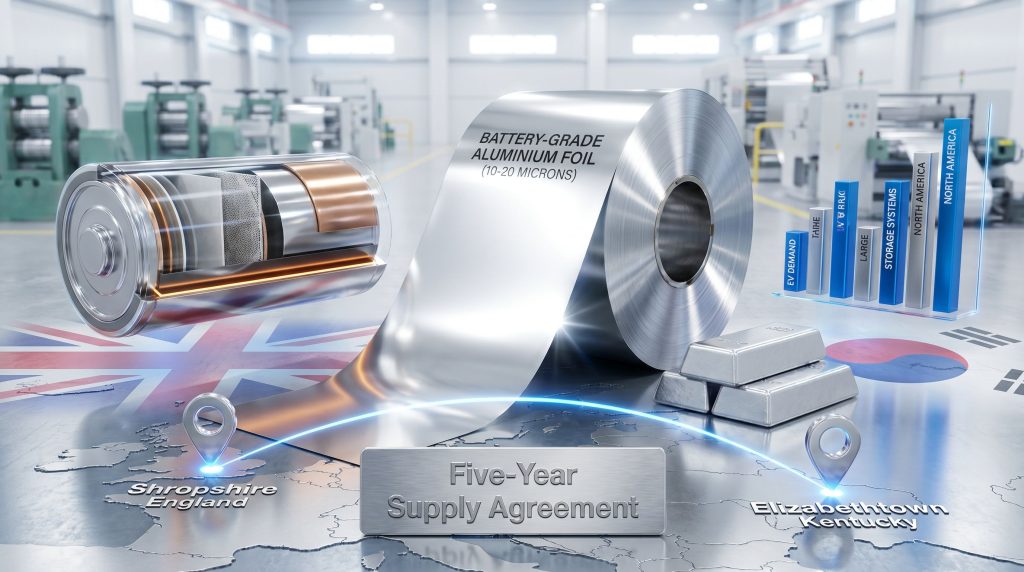
Inside a lithium-ion cell, the cathode current collector is an ultra-thin aluminium sheet, typically ranging from 10 to 20 microns in thickness, that conducts the electrical current generated by the active cathode material coating applied to its surface. Its function sounds straightforward, but the material requirements are anything but.
For foil to perform reliably at this thickness, the underlying aluminium feedstock must meet exacting standards across several dimensions:
- Alloy purity: Even trace-level contamination from elements such as iron or silicon can disrupt electrochemical reactions, accelerate capacity fade, and reduce cycle life.
- Surface quality: Low porosity and controlled surface roughness are essential for uniform electrode coating adhesion, which directly affects energy density and manufacturing yield.
- Rolling tolerance: Thickness consistency must be maintained across the entire coil, since variations of even a few microns can create hotspots or mechanical failure under the stress of battery assembly and cycling.
- Mechanical properties: Tensile strength and elongation characteristics must be compatible with the high-speed slitting and coating operations used in gigafactory production lines.
The distinction between standard aluminium foil and battery-grade foil stock is therefore not a question of degree but of category. Standard foil can tolerate far wider variability in composition and geometry. Battery foil cannot.
The Supply Gap Is Real and Growing
Global EV battery production is expanding at a pace that is outrunning the qualified supply base for cathode foil. According to industry forecasts, total lithium-ion battery capacity is expected to surpass 6,000 GWh annually by 2030, with cathode foil demand growing proportionally. Yet qualifying a new aluminium feedstock supplier for battery foil production typically requires 12 to 24 months of joint development work, technical sampling, electrochemical testing, and qualification runs before commercial volumes can flow.
Critical supply chain insight: The qualification timeline creates a structural lag between rising demand and available supply. Battery manufacturers cannot simply switch suppliers or onboard new ones quickly. Every approved feedstock relationship therefore represents a durable competitive asset for both the supplier and the foil manufacturer.
This dynamic is further complicated by the push to localise North American battery supply chains in the wake of the U.S. Inflation Reduction Act (IRA), which introduced financial incentives tied to domestic content requirements. The result is intensifying pressure on cathode foil producers operating in North America to secure qualified, reliable feedstock from approved suppliers. Furthermore, the broader battery raw materials market is experiencing structural shifts that are reshaping supplier relationships across the entire value chain.
Understanding the Two Companies Behind the Five-Year Agreement
Bridgnorth Aluminium: Britain's Sole Surviving Rolling Mill
Bridgnorth Aluminium (BAL) operates from Shropshire, England, and holds a position in British industrial history that few manufacturers can claim. It is the last remaining aluminium rolling mill in the United Kingdom, a status that reflects both the broader contraction of European aluminium processing capacity over recent decades and BAL's own resilience in navigating a difficult operating environment.
Owned by the Viohalco Group, a diversified European metals and manufacturing conglomerate, BAL has undergone a significant operational transformation in recent years. Notably, aluminium industry investment across Europe has accelerated as manufacturers reposition for electrification demand:
- The company has returned to 24-hour, seven-day production within the last 18 months, signalling a recovery in order volume and customer confidence.
- Its workforce has expanded to 368 employees, reflecting genuine operational growth rather than restructuring.
- Over GBP 2 million (approximately USD 2.6 million) has been invested in manufacturing upgrades, including cast house operational improvements and the installation of a dedicated slitting line.
The slitting line investment is particularly relevant to battery applications. Precision slitting determines the width consistency of aluminium coil supplied to foil manufacturers. Inconsistencies at the slitting stage propagate into the foil conversion process, creating waste, yield losses, and potential quality failures. BAL's infrastructure investment is therefore directly connected to its ability to compete for battery-grade contracts.
Lotte Aluminium Materials USA: Building Domestic Cathode Foil Capacity
Lotte Aluminium Materials USA is the American subsidiary of Lotte Aluminium, a South Korean aluminium manufacturer with an established track record in flat-rolled products. The U.S. operation, located in Elizabethtown, Kentucky, is focused specifically on the domestic production of cathode current collector foil for North American EV battery and energy storage system (ESS) manufacturers.
Kentucky has emerged as a notable hub for battery-related manufacturing investment, with several large-scale cell and pack production facilities either operating or under construction in the region. Lotte's facility positions itself within this emerging cluster as a critical intermediate supplier between raw material producers and cell manufacturers.
| Company | Location | Role in Supply Chain | End Market |
|---|---|---|---|
| Bridgnorth Aluminium (BAL) | Shropshire, UK | Battery-grade aluminium feedstock supplier | Battery foil production |
| Lotte Aluminium Materials USA | Elizabethtown, Kentucky | Cathode foil manufacturer | EV batteries and ESS |
The Structure and Strategic Logic of the Five-Year Deal
Agreement Mechanics
The formal supply agreement was signed at Lotte's Elizabethtown facility and covers a five-year term. Under its terms, BAL will supply battery-grade aluminium feedstock that Lotte will convert into ultra-thin cathode current collector foil for integration into next-generation lithium-ion batteries serving North American EV and energy storage markets.
Critically, the commercial agreement did not emerge from a cold sales process. It was preceded by a structured phase of joint development work, qualification programmes, and product testing, meaning that the material supplied by BAL had already demonstrated performance compliance before tonnage commitments were formalised. This sequencing matters because it means production risk at the point of signing is substantially lower than it would be with an unqualified supplier.
Early-Stage Collaboration as a Competitive Strategy
Adrian Musgrave, Head of Sales at Bridgnorth Aluminium, has described the company's commercial approach as one centred on involvement at the earliest stage of a customer's project development. The logic behind this strategy is technically sound and commercially astute.
By engaging before specifications are locked, BAL is able to help shape material requirements in ways that align with its production strengths. This reduces the risk of specification creep creating performance gaps later, and it creates a form of technical lock-in that is genuinely earned rather than contractually enforced. When a manufacturer's production line is optimised around a specific feedstock profile, switching to an alternative supplier carries real technical and financial costs.
This approach also accelerates qualification timelines, since material properties are being co-designed rather than reverse-engineered against an externally defined target. BAL's battery foil stock capabilities demonstrate how deeply the company has embedded itself in this technically demanding segment.
The Battery Foil Qualification Process: Why It Takes Years
For readers outside the battery materials industry, the multi-year qualification timeline for cathode foil feedstock can seem surprising. Understanding the process explains why long-term supply agreements are structurally necessary rather than simply preferred.
- Initial material sampling and laboratory analysis – Feedstock samples are tested for alloy composition, trace element content, surface quality, and dimensional tolerances.
- Small-scale production trials – The feedstock is processed into foil under controlled conditions to assess rollability, surface finish, and dimensional output.
- Performance testing – Foil samples are coated with cathode active material and assembled into test cells for initial electrochemical evaluation.
- Full qualification runs – Production-scale runs confirm that laboratory performance translates to consistent factory output.
- Battery cell integration testing – Completed cells undergo charge-discharge cycling, thermal testing, and accelerated ageing to validate real-world performance.
- Commercial formalisation – Only after successful completion of all prior stages is a commercial supply agreement executed.
Industry insight: Each stage of this process generates proprietary data about material behaviour that both the supplier and foil manufacturer use to continuously optimise performance. This shared technical knowledge base deepens the partnership and makes the relationship progressively harder to replicate with a new entrant.
North America's Cathode Foil Challenge and the IRA's Indirect Influence
Structural Undersupply in a High-Growth Market
North American cathode foil production capacity is being built out at pace, but it remains structurally undersupplied relative to the demand projected from announced EV and battery storage investments. The Lotte Elizabethtown facility represents exactly the kind of domestic conversion capacity that the North American battery supply chain needs, but converting feedstock into foil requires a qualified source of that feedstock in the first place.
This is where the BAL partnership becomes strategically meaningful at a market level. European specialist producers with proven battery-grade credentials are filling a gap that North American aluminium producers have not yet fully addressed, partly because the investment cycle for rolling mill upgrades capable of meeting battery specifications is long and capital-intensive. In addition, the battery storage expansion driving this demand shows no signs of slowing, with energy storage system deployments accelerating alongside EV adoption.
IRA Policy Context
The U.S. Inflation Reduction Act introduced financial incentives for domestic battery component manufacturing through provisions including the Advanced Manufacturing Production Credit. While these incentives are designed to encourage U.S.-based production, they have also accelerated investment by international players in building U.S.-located manufacturing operations, of which Lotte's Kentucky facility is an example.
The policy framework has created financial pressure to shorten supply chains, but quality and qualification requirements mean that the fastest path to domestic production sometimes runs through internationally sourced, already-qualified feedstock. Consequently, understanding the wider battery metals landscape is increasingly important for manufacturers navigating these policy-driven dynamics.
The next major ASX story will hit our subscribers first
BAL's Broader Transformation: From Commodity Mill to Electrification Supplier
The Bridgnorth Aluminium battery foil supply deal with Lotte Aluminium Materials USA is best understood not as a standalone commercial win but as a visible milestone in a multi-year strategic repositioning.
| Strategic Dimension | Detail |
|---|---|
| Workforce | 368 employees |
| Production Schedule | 24/7 operations restored within last 18 months |
| Capital Investment | GBP 2M+ (approx. USD 2.6M) |
| New Infrastructure | Cast house upgrades and dedicated slitting line |
| Key Growth Sectors | Electrification, energy storage, packaging, construction |
| International Expansion | North American market entry via Lotte partnership |
BAL's order book now spans printing, packaging, construction, energy, and electrification. The diversification across these sectors provides revenue stability while the battery materials segment develops scale. Viohalco Group's backing has enabled the capital investment programme without requiring BAL to compromise on long-term strategic positioning in favour of short-term cost reduction.
The return to 24/7 operations is a particularly meaningful operational signal. Rolling mills are capital-intensive assets with high fixed costs. Full utilisation is not just a production metric but a commercial indicator that order book depth is sufficient to justify continuous operation, which in turn provides the production consistency that battery customers require. Furthermore, innovations in battery recycling breakthrough technologies are beginning to influence upstream material specifications, adding another dimension to BAL's long-term product development roadmap.
FAQ: Bridgnorth Aluminium Battery Foil Deal With Lotte Aluminium Materials USA
What Has Bridgnorth Aluminium Agreed to Supply to Lotte Aluminium Materials USA?
BAL will supply battery-grade aluminium feedstock, specifically material formulated for the production of cathode current collector foil, to Lotte Aluminium Materials USA over a five-year period.
Where Will the Aluminium Be Used?
The material will be processed at Lotte's Elizabethtown, Kentucky facility into ultra-thin cathode foil for use in next-generation lithium-ion batteries serving North American EV and energy storage markets.
What Makes BAL's Aluminium Suitable for Battery Applications?
BAL's battery foil feedstock is characterised by clean alloy composition, low porosity, and tightly controlled rolling tolerances. These properties are essential for reliable foil conversion and consistent battery cell performance.
Why Is Cathode Foil Such a Critical Component?
Cathode foil acts as the electrical current collector within the positive electrode of a lithium-ion cell. Its quality directly influences energy density, charge-discharge efficiency, and cycle life. Poor feedstock quality at the foil stage can degrade battery performance in ways that are difficult to compensate for at later manufacturing stages.
Why Do Supply Agreements in This Sector Typically Run Five Years or Longer?
The multi-year technical qualification process means that once a feedstock supplier is approved, switching costs are high for both parties. Long-term agreements provide supply security for the foil manufacturer and volume certainty for the feedstock supplier, while allowing both parties to continue co-optimising material specifications over time.
What Does This Deal Mean for the UK Aluminium Industry?
As the UK's only remaining aluminium rolling mill, BAL's entry into the North American battery supply chain demonstrates that specialist European producers can compete for high-value electrification contracts on the basis of technical differentiation rather than volume or geographic proximity. Indeed, BAL's landmark deal has drawn significant industry attention as a signal of what technically differentiated UK manufacturers can achieve in global electrification supply chains.
This article contains references to industry forecasts and market projections. These represent forward-looking estimates based on publicly available data and should not be construed as investment advice. Readers seeking detailed market analysis are encouraged to consult specialised industry reports, including AL Circle's publication Aluminium Flat Rolled Products: Insights and Forecast to 2030, available at alcircle.com.
Want to Capitalise on the Next Major Mineral Discovery Before the Broader Market?
Discovery Alert's proprietary Discovery IQ model delivers real-time alerts on significant ASX mineral discoveries, transforming complex data across more than 30 commodities into clear, actionable insights for both short-term traders and long-term investors — explore the historic returns major discoveries have generated and begin your 14-day free trial at Discovery Alert to position yourself ahead of the market.