July 13, 2026
The Ion-Transport Bottleneck Holding Back the Battery Revolution
Every electrochemical system, from a smartphone battery to a grid-scale storage facility, is ultimately constrained by one inconvenient physical reality: ions move slowly. The theoretical capacity of lithium-ion batteries has long outpaced the practical performance that engineers can reliably deliver, and a significant portion of that gap comes down to the sluggish, diffusion-limited movement of lithium ions through electrolytes, separator membranes, and electrode interfaces.
Conventional diffusion theory, rooted in classical electrochemistry, sets a ceiling on how quickly ions can traverse a medium under concentration gradients. For decades, materials scientists have accepted these ceilings as fixed constraints. The result is a persistent trade-off between energy density and charge rate, a compromise that defines nearly every lithium-ion product on the market today.
Closing this gap is not merely an academic exercise. It has direct consequences for electric vehicle range, grid storage economics, and the efficiency of lithium recovery from spent batteries, a supply chain priority as the world scales toward multi-terawatt-hour annual battery deployment. The battery raw materials market faces mounting pressure to deliver both performance and sustainability simultaneously.
What recent research from a multi-institution American collaboration has revealed, however, is that these theoretical ceilings may not be as immovable as the field assumed. The mechanism responsible for shattering prior expectations involves a class of nanomaterials called boron nitride nanotubes (BNNTs), and the performance figures they have produced in laboratory membranes are rewriting what the scientific community thought was possible for boron nitride nanotube lithium ion transport.
When big ASX news breaks, our subscribers know first
What Are Boron Nitride Nanotubes and Why Do They Behave Differently?
Boron nitride is a synthetic crystalline compound composed of alternating boron and nitrogen atoms arranged in a hexagonal lattice. When this material is rolled into hollow cylindrical tubes with interior diameters measured in fractions of a nanometer, it acquires properties that bulk boron nitride simply does not possess. The resulting structures, BNNTs, create confined nanoscale channels where the laws governing ion behaviour diverge dramatically from what classical physics predicts.
To understand why BNNTs outperform other nanomaterials in lithium-selective transport, it helps to compare them directly with carbon nanotubes (CNTs), which have historically received far more attention in battery research.
| Property | Boron Nitride Nanotubes (BNNTs) | Carbon Nanotubes (CNTs) |
|---|---|---|
| Surface chemistry | Polar B-N bonds; Lewis-acid boron sites | Non-polar; largely inert surface |
| Cation selectivity | High; strong Li+ preference | Moderate; less selective |
| Anion suppression | Yes, trapping at defect and surface sites | Limited |
| Electrical conductivity | Electrically insulating | Electrically conductive |
| Thermal stability | Excellent (above 900°C) | Good (approximately 600°C in air) |
| Role in electrolyte composites | Interfacial regulator and ion pathway | Primarily conductivity enhancer |
The electrical insulation of BNNTs is a property that initially seems like a disadvantage in an energy storage context. In reality, for ion-selective membrane applications, it is a significant asset. An electrically conductive nanotube embedded in an electrolyte risks creating short-circuit pathways. An insulating nanotube allows selective ion flow without compromising the electrochemical integrity of the system.
The Dual-Pathway Architecture of BNNT Channels
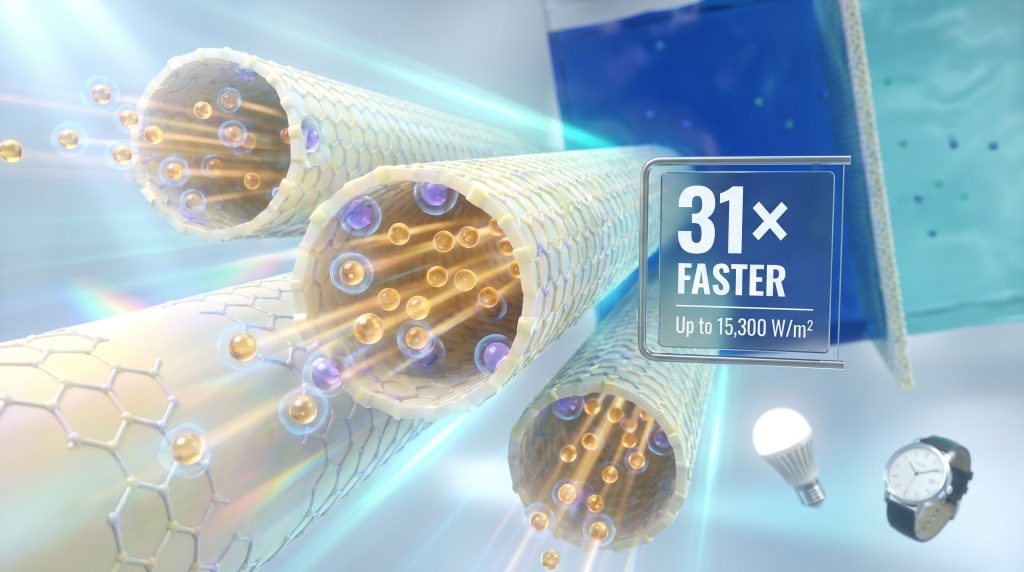
BNNTs create two distinct ion-transport pathways simultaneously. The hollow interior of each nanotube forms a sub-nanometer conduit through which lithium ions can pass in single-file or near-single-file configurations. Simultaneously, the external nanotube surface, decorated with polar B-N bonds and Lewis-acid boron coordination sites, provides a secondary pathway where ion-surface interactions accelerate lithium mobility. This dual-pathway architecture has no clear equivalent among competing nanomaterial additives.
The 31x Discovery: What Researchers at Rutgers, UIC, and Argonne Found
The landmark findings were published in Nature Nanotechnology in a 2026 paper titled Anomalous ultrafast lithium-ion transport through boron nitride nanotube membranes. The research was led by Semih Cetindag of Rutgers University and Aaditya Pendse of the University of Illinois Chicago, with Argonne National Laboratory contributing critical experimental infrastructure.
The experimental design was elegantly simple in concept, though technically demanding in execution. Researchers assembled millions of microscopic BNNT tubes into a testable membrane platform and positioned these membranes between ionic solutions of different salinities. This configuration, known as a salinity-gradient test, measures how selectively and efficiently ions cross the membrane driven purely by concentration differences.
The results were startling. Key performance metrics from the study are summarised below:
| Metric | Observed Value |
|---|---|
| Li-ion transport rate vs. standard diffusion | Up to 31x faster than theoretically expected |
| Per-pore power density | Up to 15,300 W/m² |
| Energy-conversion efficiency | Approaching theoretical limit of ~50% at pH 5.5 |
| Optimal BNNT concentration in composite electrolytes | ~0.9 wt% |
| Ionic conductivity increase at 0.9 wt% loading | ~30% increase (to approximately 0.87 mS/cm) |
| Li-ion transference number achieved | ~0.73 |
To validate that these ion flows translated into usable energy, the team powered functional consumer electronics, including a watch, a calculator, and LED lights, using nothing but the energy harvested from salt-solution concentration gradients across the membrane. This is not a trivial demonstration. Converting a passive chemical gradient into enough electricity to operate real devices represents a meaningful engineering proof of concept.
Understanding the Electric Eel Analogy
Associate Professor Sangil Kim of the University of Illinois Chicago, a corresponding author on the study, drew a compelling parallel between BNNT ion channels and the specialised biological ion channels found in electric eel cells. Electric eels generate powerful electrical discharges through precisely coordinated ion flow across thousands of specialised cells called electrocytes. These biological systems achieve extraordinary current density through selective, directional ion movement driven by concentration gradients.
Kim noted that the transport rates observed in BNNT membranes exceeded both theoretical predictions and all existing experimental benchmarks documented at the time of publication.
The electric eel analogy is scientifically meaningful beyond the surface-level comparison. Both systems exploit the same fundamental thermodynamic principle: the free energy released when ions move from a high-concentration environment to a low-concentration one. In biological systems, evolution has spent hundreds of millions of years optimising this process. In BNNTs, the optimisation arises from precise nanotube geometry and surface chemistry.
Three Mechanisms Behind Anomalous Lithium Selectivity
Understanding why boron nitride nanotube lithium ion transport performs so far beyond classical predictions requires examining the interplay of three distinct physicochemical mechanisms.
Lewis-Acid Coordination and Lithium Desolvation
In aqueous or semi-aqueous electrolytes, lithium ions do not travel as bare ions. They carry a solvation shell of coordinating molecules, typically water or carbonate solvent molecules, that significantly increases their effective size and slows their passage through narrow channels. The Lewis-acid boron sites along BNNT walls actively coordinate with lithium ions, partially or fully stripping this solvation shell.
The desolvated Li+ ion has a much smaller effective radius, allowing it to pass through sub-nanometer channel geometries at dramatically accelerated rates. This process also promotes salt dissociation, liberating free Li+ from ion pairs that would otherwise remain electrochemically inactive.
Anion Trapping and the Transference Number Advantage
In conventional lithium-ion electrolytes, both lithium cations and their counter-anions (such as PF6- or TFSI-) carry current. The lithium transference number, typically around 0.35 to 0.40 in standard liquid electrolytes, reflects what fraction of the total ionic current is carried by Li+ specifically. A low transference number means that anion migration creates concentration gradients within the electrolyte that resist further lithium movement, a phenomenon called concentration polarisation.
BNNT surface defects and edge sites selectively adsorb and immobilise these anions. By trapping the competing charge carriers, the membrane effectively forces a disproportionate share of the current to be carried by lithium ions. The result is a transference number of approximately 0.73, nearly double the conventional benchmark.
This is not merely an incremental improvement. It fundamentally changes the performance ceiling for electrolytes incorporating BNNT additives, enabling faster charge rates and more stable cycling behaviour. Furthermore, this improvement has direct relevance for the battery storage expansion currently underway across grid-scale and transport applications.
Confinement-Driven Transport Enhancement
Perhaps the most counterintuitive finding of the research is that the confined geometry of BNNT channels, which one might expect to hinder ion movement through steric restriction, actually accelerates it. At sub-nanometer length scales, the hydration structure of ions changes fundamentally. Classical hydrodynamic models break down.
Ions interact simultaneously with channel walls across the entire channel diameter, and the electrostatic surface charge of the BNNT walls creates an ordered ion arrangement that moves in a highly coordinated fashion rather than the random walk characteristic of bulk diffusion. This confinement-driven enhancement is the primary reason observed transport rates diverge so dramatically from what standard diffusion theory anticipates.
BNNTs as Interfacial Regulators in Composite Electrolytes
A critical distinction emerging from 2026 literature is that BNNTs in composite electrolyte systems function primarily as interfacial regulators rather than as the direct ion-conducting phase. This reframing has significant practical implications for battery electrolyte design. The three-mechanism model operating in composite systems involves:
- Salt dissociation promotion through Lewis-acid surface interactions that break ion pairs and increase free Li+ concentration.
- Polymer crystallinity reduction in gel-polymer or solid-state matrices, creating amorphous regions with higher Li+ mobility compared to the ordered polymer chains they replace.
- Long-range connectivity enhancement that creates percolating ion-transport pathways across the electrolyte matrix at the relatively modest loading of approximately 0.9 wt%.
Real-World Applications: Where BNNT Technology Could Matter Most
Lithium Recovery From Spent Battery Streams
The global battery industry faces an accelerating recycling challenge. As the first generation of large-scale electric vehicle and grid storage batteries reaches end-of-life, the efficient recovery of lithium from complex multi-ion waste streams becomes both an economic and strategic imperative. Current hydrometallurgical processes involve extensive chemical treatment steps, significant reagent consumption, and substantial energy input. The battery recycling outlook for 2025 and beyond points to urgent need for more selective and efficient recovery methods.
BNNT membranes offer a potentially transformative alternative pathway. Consider a hypothetical scenario: a BNNT membrane module deployed in a battery recycling facility processes black mass leachate containing Li+, Co2+, Mn2+, and Ni2+. The membrane's strong cation selectivity preferentially allows lithium ions to pass while rejecting larger or more strongly hydrated competing ions.
This selectivity could, in principle, reduce the number of downstream purification steps required and lower chemical consumption substantially. The key uncertainty is whether laboratory-scale selectivity ratios can be preserved at the membrane areas required for industrial throughput, and whether BNNT membranes can maintain structural and chemical integrity under the acidic conditions typical of battery leachate processing.
Blue Energy Generation From Salinity Gradients
The convergence of fresh and salt water at river mouths and coastal estuaries represents an enormous, largely untapped renewable energy resource. Estimates of the global theoretical potential from ocean-river salinity gradients exceed 1 terawatt of continuous power. Harvesting this energy using ion-selective membranes, a process broadly termed blue energy or osmotic energy conversion, has attracted research interest for decades. The challenge has been that existing technologies deliver insufficient power density to be economically viable at scale.
The BNNT membrane results place this technology in a completely different performance category compared to current alternatives:
| Technology | Mechanism | Power Density Range | Maturity Level |
|---|---|---|---|
| Pressure-Retarded Osmosis (PRO) | Hydraulic pressure gradient | ~5-10 W/m² | Pilot-scale |
| Reverse Electrodialysis (RED) | Ion-exchange membranes | ~1-5 W/m² | Pilot-scale |
| BNNT Nanofluidic Membranes | Selective ion channels | Up to 15,300 W/m² (per-pore) | Laboratory |
It is essential to understand that the 15,300 W/m² figure is a per-pore laboratory measurement representing an upper-bound potential, not a deployable system output. Scaling from individual nanotube pores to large-area membranes introduces engineering challenges around packing density, membrane defects, and hydraulic resistance that will inevitably reduce system-level power densities.
Nevertheless, even at a fraction of this theoretical ceiling, BNNT-based osmotic energy systems would substantially outperform existing technologies. The identification of pH 5.5 as the efficiency optimum for energy conversion approaching the ~50% theoretical limit also has practical deployment implications, suggesting that natural freshwater sources with mild acidity may be preferred sites for eventual pilot installations.
Next-Generation Battery Electrolyte Enhancement
For near-term commercial applications, the most accessible pathway for BNNT technology may be as an additive in existing electrolyte formulations. At approximately 0.9 wt% loading, BNNTs deliver a ~30% ionic conductivity increase (reaching approximately 0.87 mS/cm) alongside the transference number improvement from ~0.35 to ~0.73. These are measurable, meaningful performance gains that translate directly into faster charge rates, reduced concentration polarisation, and more stable long-term cycling behaviour.
The compatibility of BNNT additives with liquid electrolytes, gel-polymer systems, and solid-state composite architectures gives them unusual versatility across the battery technology landscape, from current-generation lithium-ion cells to next-generation solid-state platforms currently in advanced development.
How BNNTs Compare to Competing Ion-Transport Enhancement Strategies
The materials science community has not been idle in pursuing alternatives to improve lithium-ion transport. Understanding where BNNTs sit within this competitive landscape requires honest benchmarking:
| Approach | Conductivity Gain | Transference Number | Selectivity Mechanism | Key Limitation |
|---|---|---|---|---|
| BNNT composite electrolyte | ~30% increase | ~0.73 | Lewis-acid + anion trapping | Synthesis cost; dispersion |
| Carbon nanotube (CNT) additive | Variable | ~0.4-0.5 | Surface adsorption | Electrical short-circuit risk |
| Ceramic filler (Al2O3, TiO2) | Moderate | ~0.5-0.6 | Lewis-acid interactions | Agglomeration at high loading |
| MOF-based electrolyte | High (selective) | ~0.6-0.8 | Pore-size exclusion | Stability; scalability |
| Ionic liquid additives | High | ~0.5-0.65 | Solvation modification | Cost; viscosity increase |
BNNTs occupy a uniquely favourable position in this comparison. They combine electrical insulation (eliminating short-circuit risk), high lithium selectivity, strong Lewis-acid surface chemistry, and thermal stability above 900°C in a single material. No other additive in the table achieves all of these properties simultaneously. The primary competitive disadvantage remains synthesis cost and the dispersion challenge of achieving uniform BNNT distribution at 0.9 wt% without agglomeration degrading performance.
The next major ASX story will hit our subscribers first
Technical and Commercial Barriers on the Path to Deployment
Synthesis Complexity and Cost
Current BNNT production routes include chemical vapour deposition (CVD), ball milling, and plasma-based synthesis. Each method involves distinct trade-offs between material quality, yield, and cost. CVD produces high-quality, well-aligned BNNTs but at relatively low throughputs and high per-gram costs. Plasma synthesis offers higher throughput but less precise structural control. Ball milling is inexpensive but produces short, defect-rich tubes with inconsistent properties.
The aggregate effect is that BNNT synthesis currently costs significantly more per kilogram than CNT production, a gap that must narrow substantially before commercial battery electrolyte applications become economically competitive with incumbent solutions.
Membrane Engineering at Scale
The per-pore performance metrics reported in Nature Nanotechnology are genuine and impressive, but they describe individual nanotube channels rather than practical membrane systems. Translating these results into large-area membranes requires:
- Achieving uniform nanotube alignment and controlled packing density across membrane areas relevant to industrial processes.
- Maintaining structural integrity under electrochemical cycling, variable pH, and elevated temperatures over extended operational periods.
- Closing the gap between per-pore power density and practical membrane-level output, a scaling challenge common to all nanofluidic energy technologies.
Nanomaterial Safety and Regulatory Frameworks
Regulatory frameworks governing nanomaterial handling in manufacturing and industrial deployment environments are still evolving in most jurisdictions. BNNTs are chemically inert and thermally stable, which distinguishes them favourably from some other nanomaterials of concern. However, long-term inhalation exposure data, environmental fate studies, and biocompatibility assessments for BNNT-containing systems remain areas of active research rather than settled regulatory science. Any commercial deployment pathway will require navigation of these frameworks, adding time and cost to development timelines.
Connecting BNNT Science to the Critical Minerals Supply Chain
The significance of the BNNT research extends beyond battery performance metrics into the broader strategic challenge of lithium supply security. The global lithium market is on a trajectory toward multi-terawatt-hour annual deployment within this decade. Meeting that demand through primary lithium mining alone faces significant geological, geopolitical, and environmental constraints.
Improving the efficiency of lithium recovery from end-of-life batteries through technologies like BNNT selective membranes could meaningfully improve circular economy recovery rates, reducing dependence on virgin lithium supply. Even modest improvements in selective lithium extraction efficiency translate into substantial recovered lithium volumes at the scale the industry is approaching.
The intersection of BNNT membrane technology with direct lithium extraction innovation is also worth noting. DLE technologies, which selectively capture lithium from brines without the evaporation ponds that characterise conventional lithium carbonate production, face a similar selectivity challenge to battery recycling leachate processing. BNNT membrane concepts could consequently complement or enhance DLE sorbent and membrane-based approaches as the technology matures.
Technology Readiness Context: Current BNNT membrane systems sit at approximately Technology Readiness Level (TRL) 3-4, meaning the basic principles have been experimentally demonstrated but significant engineering development is required before pilot-scale validation becomes feasible. The research-to-deployment timeline for membrane technologies of this nature typically spans a decade or more, involving iterative cycles of materials development, system engineering, and field validation.
Frequently Asked Questions: Boron Nitride Nanotube Lithium-Ion Transport
What makes boron nitride nanotubes transport lithium ions faster than expected?
BNNT channels create a confinement environment where Lewis-acid boron surface sites desolvate Li+ ions, anion trapping at defect sites suppresses competing charge carriers, and the sub-nanometer geometry fundamentally alters ion mobility beyond what bulk diffusion models predict. The combined effect produces transport rates up to 31 times higher than standard diffusion theory anticipates.
How does the 15,300 W/m² power density compare to current commercial membranes?
Conventional osmotic energy technologies such as pressure-retarded osmosis typically achieve 5-10 W/m² at the membrane level. The BNNT figure of 15,300 W/m² is a per-pore laboratory measurement and represents an upper-bound potential rather than a deployable system output, but it establishes a compelling theoretical ceiling for the technology. A recent study published in Frontiers in Physics provides further context on nanofluidic ion transport mechanisms that underpin these extraordinary performance figures.
Can BNNT membranes selectively extract lithium from mixed-ion solutions?
Experimental evidence indicates strong cation selectivity in BNNT channels, with lithium ions moving preferentially over larger or more strongly hydrated competing cations. This selectivity is the basis for proposed lithium recovery applications from spent battery leachate streams.
What concentration of BNNTs is optimal for battery electrolyte enhancement?
Current literature points to approximately 0.9 wt% as an effective loading level, yielding roughly a 30% ionic conductivity improvement and a lithium transference number of approximately 0.73. Higher loadings risk agglomeration and diminishing performance returns.
Are BNNTs electrically safe to use in battery electrolytes?
Unlike carbon nanotubes, BNNTs are electrically insulating, which eliminates the short-circuit risk that makes CNT additives problematic in battery electrolyte applications. This insulating property is one of the key reasons BNNTs are considered more suitable for ion-selective membrane and electrolyte applications than their carbon-based counterparts. Furthermore, research published in the Journal of Energy and Environmental Materials has explored how boron nitride-based composites behave under electrochemical cycling conditions, reinforcing confidence in their long-term stability.
What is the current technology readiness level of BNNT membrane systems?
BNNT membrane systems currently sit at approximately TRL 3-4. Substantial materials engineering, cost reduction in synthesis, membrane fabrication scale-up, and regulatory navigation will be required before commercial deployment becomes feasible, likely on a timeline measured in years rather than months.
Disclaimer: This article discusses laboratory-stage research findings and emerging materials science. Nothing in this article constitutes financial or investment advice. Technology readiness assessments and commercialisation timelines involve inherent uncertainty. Readers should consult primary scientific literature and independent professional advice before making decisions based on this content.
Want to Track the ASX Discoveries That Could Benefit From Next-Generation Battery Technology?
As breakthroughs in lithium-ion transport science accelerate demand for critical minerals, Discovery Alert's proprietary Discovery IQ model scans ASX announcements in real time, instantly identifying significant mineral discoveries across lithium, boron, and more than 30 other commodities — explore historic discovery returns on Discovery Alert's discoveries page and begin your 14-day free trial to position yourself ahead of the market.