July 11, 2026
Europe's Lithium Blind Spot and the Geothermal Answer Hiding Underground
Battery supply chain strategists have spent the better part of a decade mapping Europe's critical mineral vulnerabilities, and lithium sits near the top of virtually every risk register. The continent consumes lithium in growing volumes for electric vehicles, grid storage, and consumer electronics, yet produces almost none of it domestically. That structural dependency has triggered policy responses across Brussels, London, and beyond, but policy frameworks alone cannot mine lithium.
What Europe actually needs is geology, and as it turns out, the geology has been there all along, waiting beneath the ancient granite of Cornwall. Europe's green transition depends increasingly on securing exactly these kinds of domestic mineral resources.
The United Downs lithium discovery in Cornwall is not a conventional mining story. It does not involve open pits, cyanide leach pads, or tailings dams. Instead, it represents something genuinely novel in the global critical minerals landscape: a geothermal energy plant that simultaneously produces ultra-low carbon lithium carbonate from the same superheated brines it uses to generate electricity.
Understanding why this matters requires stepping back from the headlines and examining the subsurface mechanics, the market context, and the long-term implications for European battery supply chains.
When big ASX news breaks, our subscribers know first
Cornwall's Ancient Granite and the Lithium It Has Always Contained
The Geology Behind the Discovery
Cornwall sits atop the Cornubian Batholith, a massive granite intrusion formed roughly 300 million years ago during the Variscan orogeny. This geological body is not uniform; it is fractured, hydrothermally active, and characterised by deep fault systems through which rainwater percolates over millennia, heating as it descends and interacting chemically with the surrounding rock.
In doing so, these circulating fluids dissolve trace minerals from the granite matrix, including lithium, which concentrates progressively as the brine matures at depth. This process is fundamentally different from how lithium accumulates in hard-rock deposits like the spodumene pegmatites found in Western Australia, or in the vast evaporitic salar brines of the Atacama Desert in Chile and Argentina.
In those environments, lithium concentration is the product of either magmatic crystallisation or prolonged surface evaporation over geological timescales. At United Downs, however, concentration is driven by deep hydrothermal circulation within a tectonically active granite system, a process that has been occurring continuously since the batholith cooled. This mechanism closely resembles geothermal brine extraction approaches being explored across southern Europe.
The presence of lithium in Cornish geological fluids was actually documented as far back as 1864, when water drawn from a local tin mine was submitted for chemical analysis and returned a positive result for lithium. That observation sat largely dormant for over a century and a half, not because the lithium was insignificant, but because the infrastructure to access and process it at economically relevant depth simply did not exist until Geothermal Engineering Ltd (GEL) began drilling at United Downs for entirely different reasons.
Technical Architecture: What Makes United Downs Globally Distinctive
Key Well and Resource Parameters
The technical specifications of the United Downs geothermal system are extraordinary by any measure, and several parameters are genuinely without precedent in the United Kingdom.
| Parameter | Specification |
|---|---|
| Production Well Depth | 5,275 m (deepest onshore well in the UK) |
| Injection Well Depth | 2,393 m |
| Brine Temperature | >180°C (recorded peaks exceeding 190°C) |
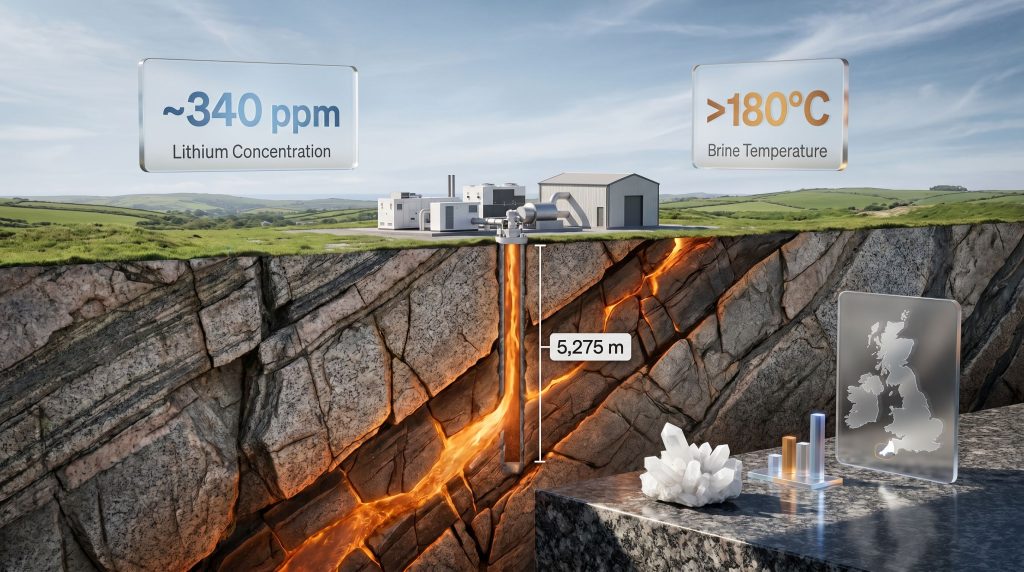
| Lithium Concentration | ~340 ppm (mg/L) |
| Net Power Output | 1.6 MWe net (3 MWe gross) |
| Homes Powered | ~10,000 via 24/7 baseload electricity |
The production well at 5,275 metres makes United Downs the deepest onshore well ever drilled in the United Kingdom. At that depth, the brine temperatures exceeding 180°C are the highest ever recorded in UK subsurface geology, a reflection of the elevated heat flow characteristic of the Cornubian Batholith relative to most of mainland Britain.
The lithium concentration figure of approximately 340 parts per million (ppm) deserves particular attention. Most geothermal lithium projects worldwide operate at significantly lower brine grades, often below 100 ppm, and many projects being developed in Europe and North America are chasing far more diluted resources.
The Salton Sea geothermal field in California, often cited as a benchmark for geothermal lithium globally, contains brines in the range of 200 to 400 ppm, placing United Downs within a genuinely competitive bracket despite its far smaller scale. South American salar brines, which represent the dominant global lithium supply source today, can range from below 100 ppm in marginal operations to over 1,500 ppm in the most concentrated parts of the Atacama.
On a raw concentration basis, United Downs is not in that tier, but the comparison overlooks a critical differentiator: the carbon footprint of extraction.
Why the Sequential Process Architecture Matters
The operational logic at United Downs follows a cascade design that minimises both energy cost and environmental impact. Brine is drawn up the production well, passes through a heat exchange system where the thermal energy is converted to electricity, and the cooled but still lithium-bearing fluid is then directed through a direct lithium extraction unit before being reinjected underground.
This sequence means the energy-intensive step of pumping fluid from depth is already justified by electricity revenue, and the marginal energy cost of lithium extraction is therefore substantially reduced. The step-by-step production pathway operates as follows:
- Geothermal brine is drawn from the 5,275 m production well at temperatures exceeding 180°C
- Thermal energy is converted to electricity through the power generation system, delivering 1.6 MWe net output
- Cooled brine is routed through an adsorption-based DLE unit, where lithium ions are selectively captured
- Captured lithium is processed and refined into lithium carbonate equivalent (LCE)
- Depleted brine is reinjected via the 2,393 m injection well, eliminating surface waste discharge
Process Advantage: Because lithium extraction occurs downstream of power generation, the marginal energy overhead of DLE is substantially offset by the electricity revenue already generated from the same fluid flow. This cost-sharing architecture is a key reason the United Downs model achieves ultra-low carbon credentials that conventional lithium operations structurally cannot replicate.
Direct Lithium Extraction: The Technology Separating United Downs From Conventional Mining
How DLE Works and Why It Represents a Step Change
Direct Lithium Extraction is a broad term covering several selective capture technologies, but the approach deployed at United Downs relies on adsorption-based ion exchange, where a sorbent material binds lithium ions from solution while allowing other dissolved minerals to pass through. The key advantage over conventional evaporation ponds, which dominate South American lithium production, is speed, water efficiency, and selectivity.
Evaporation-based lithium recovery requires months to years of solar concentration in open ponds, consumes vast quantities of water in some of the world's most arid and ecologically sensitive environments, and produces significant volumes of waste salts. DLE, by contrast, operates continuously, requires no open-air evaporation, and can be scaled to match brine flow rates.
Furthermore, the lithium brine production process at United Downs benefits from the fact that the brine volume is determined by geothermal flow rates needed for power generation rather than lithium extraction. The DLE unit is consequently sized to match current flow, currently at 100 tonnes per annum (tpa) of LCE at the demonstration plant.
The carbon credentials of this approach are quantifiable. The integrated system is estimated to generate approximately 6,500 fewer tonnes of CO₂ per year compared to conventional energy and mining equivalents. Full brine reinjection eliminates surface discharge entirely.
| Environmental Metric | Estimated Impact |
|---|---|
| Annual CO₂ savings | ~6,500 tonnes vs conventional alternatives |
| Carbon classification | Ultra-low carbon lithium |
| Brine management | Full reinjection, zero surface discharge |
| Surface footprint | Minimal (industrial brownfield site) |
From Victorian Sample to 21st-Century Production: A 160-Year Arc
The Timeline of a Slow Discovery
The arc from initial identification to commercial output spans more than 160 years and illustrates how mineral resources frequently precede the technological and economic conditions required to exploit them.
- 1864: Lithium is detected in water samples from a Cornish tin mine, the earliest recorded identification of lithium in UK geological fluids
- Early 2000s onwards: Interest in Cornish geothermal energy intensifies, driven by renewable energy targets
- 2010s: GEL commences development of the United Downs geothermal site near Redruth
- Early 2025: Demonstration plant construction completed
- February 2026: Official opening of the UK's first geothermal lithium carbonate production facility
The fact that lithium was a secondary discovery — an unintended consequence of geothermal energy development rather than a targeted mineral exploration campaign — adds an unusual dimension to the project's history. The infrastructure investment was already committed before the commercial lithium potential was fully understood, which changes the economic calculus considerably.
The geothermal plant stands up on electricity revenue alone at sufficient carbon pricing; the lithium is, in the most literal sense, a byproduct that transforms the project's value proposition.
Scaling the Vision: From 100 tpa to 18,000 tpa
Production Trajectory and Site Expansion
The current nameplate capacity of 100 tpa LCE positions United Downs as a demonstration-scale operation. Its significance is principally technical and reputational rather than volumetrically material to European lithium supply. However, GEL's publicly stated ambitions extend far beyond demonstration scale.
- Near-term target: 1,000 to 1,500 tpa LCE at United Downs as the project transitions toward commercial operation
- Decade-scale ambition: 18,000 tpa LCE across Cornwall operations, which would place GEL among Europe's largest lithium producers
- Additional permitted sites: Manhay and Penhallow, both holding planning permission, with forecast outputs of approximately 4.9 MW of geothermal power each with co-located lithium extraction potential
Scale Perspective: If GEL achieves its decade-scale target of 18,000 tpa LCE, the Cornwall geothermal cluster would represent a meaningful domestic contribution to European lithium supply, materially reducing dependence on imports from Australia, Chile, and China.
The infrastructure investment required to move from 100 tpa to 1,500 tpa is non-trivial. Additional DLE capacity, processing infrastructure, and product conditioning equipment will all require capital. The pathway is technically credible but commercially contingent on lithium market conditions.
The next major ASX story will hit our subscribers first
The Commercial Reality: Where Lithium Prices Meet Project Economics
Why Market Conditions Remain the Critical Variable
The United Downs lithium discovery in Cornwall is technically impressive and strategically compelling, but investment-grade commercial viability is inseparable from the lithium price environment. This is the most important consideration for any informed assessment of the project's trajectory.
Lithium carbonate prices peaked above US$80,000 per tonne in late 2022 before collapsing through 2023 and into 2024, settling at levels between US$10,000 and US$15,000 per tonne for much of 2024 and 2025. These are the kinds of price levels at which many lithium projects globally have struggled to justify capital deployment, and geothermal DLE lithium, which carries its own cost structure related to well maintenance, DLE sorbent replacement cycles, and processing infrastructure, is not immune to that pressure.
The cost-sharing architecture of the United Downs model — where pumping and surface infrastructure costs are spread across both electricity and lithium revenues — provides a structural cost advantage over single-purpose lithium operations. However, determining the precise breakeven lithium price for full commercial scale requires detailed economic modelling that is not yet publicly available for the expanded operation.
How United Downs Compares to European Peers
| Project | Country | Resource Type | Current Status |
|---|---|---|---|
| United Downs (GEL) | UK (Cornwall) | Geothermal brine (DLE) | Pilot production, 100 tpa LCE (2026) |
| Cinovec | Czech Republic | Hard rock (lepidolite) | Pre-production |
| Keliber | Finland | Hard rock (spodumene) | Construction phase |
| Savannah Lithium | Portugal | Hard rock (spodumene) | Development |
United Downs holds a notable first-mover advantage in European geothermal lithium specifically, and its ultra-low carbon classification may attract a pricing premium in ESG-sensitive supply chains. The EU Battery Regulation, which came into force in 2023 and introduces mandatory carbon footprint declarations for EV batteries from 2025, creates a structural commercial tailwind for low-carbon lithium sources.
Automotive OEMs increasingly face scope 3 emissions obligations that flow through to their raw material sourcing decisions. In addition, the broader context of critical raw materials policy across Europe reinforces the strategic premium placed on provenance-verified, ultra-low carbon lithium carbonate — a product category where United Downs has few direct competitors in Europe.
Why Domestic UK Lithium Production Matters Beyond the Headlines
Supply Chain Resilience and the Dual-Use Energy Model
The United Kingdom currently imports virtually all of its lithium from overseas, primarily from Australia (hard rock concentrate processed in China), Chile (brine-derived), and increasingly from Chinese-domiciled refining capacity. This creates layered supply chain exposure: geographic concentration, geopolitical risk, and processing dependency simultaneously.
The Faraday Institution, which provides independent research on UK battery technology and supply chains, has consistently highlighted domestic lithium sourcing as a medium-term priority for the UK's EV manufacturing ambitions. Several UK gigafactory projects in various stages of development will require lithium feedstock, and domestically produced, traceable, low-carbon material aligns directly with both procurement preferences and regulatory compliance requirements.
What makes the United Downs model structurally distinctive from a supply chain perspective is its dual-use character. The site simultaneously contributes to energy security through 1.6 MWe of baseload renewable electricity delivered 24 hours a day, and to critical mineral security through domestic lithium carbonate production — all from a single piece of subsurface infrastructure on a brownfield industrial site with minimal additional surface footprint.
This dual-use model also carries implications for community acceptance and planning dynamics. Geothermal lithium projects face a fundamentally different social licence environment than open-pit mining operations, a factor that should not be underestimated in densely populated European geographies.
Strategic Conclusion: The United Downs lithium discovery in Cornwall is not merely a mining story. It is a proof of concept for how legacy industrial regions with favourable subsurface geology can contribute to the energy transition on two fronts simultaneously — generating baseload renewable power while producing domestically sourced critical minerals with a carbon footprint that conventional mining operations cannot match.
Frequently Asked Questions: United Downs Lithium Discovery in Cornwall
What type of deposit is the United Downs lithium discovery in Cornwall?
United Downs is a geothermal brine system, not a conventional hard-rock or evaporitic salar deposit. Lithium-rich hot water is drawn from a depth of over 5 km, processed using adsorption-based Direct Lithium Extraction technology after electricity generation, and the depleted brine is reinjected underground.
How does the ~340 ppm lithium concentration compare globally?
At approximately 340 ppm, the United Downs brine grade is considered globally significant for geothermal lithium systems. It is broadly comparable to the upper end of the Salton Sea geothermal field in California and substantially higher than many geothermal projects under development in Europe and North America. South American salar operations can achieve higher concentrations in premium zones, but the comparison excludes the carbon cost of evaporation-based recovery.
When did lithium production begin at United Downs?
The 100 tpa LCE demonstration plant was completed in early 2025 and officially opened in February 2026, marking the commencement of the UK's first commercial geothermal lithium carbonate production.
Is United Downs lithium classified as low-carbon?
Yes. The integrated system is estimated to avoid approximately 6,500 tonnes of CO₂ per year compared to conventional energy and mining alternatives. Full brine reinjection eliminates surface discharge, and the downstream lithium extraction step is powered in part by the plant's own electricity output.
What is the long-term production target for GEL in Cornwall?
GEL's stated ambition is to reach 18,000 tpa LCE within a decade across its Cornwall geothermal operations, including additional permitted sites at Manhay and Penhallow.
What is the primary commercial risk?
Lithium market pricing is the dominant variable. The project's economics improve materially at higher lithium carbonate prices. The pathway to full commercial scale at 1,000 to 1,500 tpa and beyond depends on sustained price recovery, continued technical performance at demonstration scale, and the ability to secure offtake agreements at acceptable margins.
Disclaimer: This article is intended for informational purposes only and does not constitute financial or investment advice. Statements regarding production targets, cost structures, and commercial viability involve forward-looking assumptions that are subject to change based on market conditions, technical outcomes, and regulatory developments. Readers should conduct their own due diligence before making any investment decisions.
Want to Stay Ahead of the Next Major Mineral Discovery?
Discovery Alert's proprietary Discovery IQ model delivers real-time alerts on significant ASX mineral discoveries — turning complex geological and commodity data into actionable investment insights for both short-term traders and long-term investors. Explore historic discoveries and the returns they generated, then begin your 14-day free trial to position yourself ahead of the broader market.