July 10, 2026
The Battery Storage Economy Is Rewriting the Case for South American Lithium
For much of the past two decades, the investment case for lithium rested almost entirely on one narrative: the electric vehicle revolution. Automakers, battery manufacturers, and capital markets organised their forecasts around passenger EV adoption curves, and when those curves flattened in key markets during 2025 and into 2026, a wave of pessimism swept through lithium equities and commodity desks alike. What that pessimism missed, however, was a structural rotation already underway beneath the surface of demand data. Battery storage expansion was quietly absorbing lithium carbonate equivalent at a pace that consensus models had systematically underestimated, driven not by car sales but by the extraordinary energy demands of artificial intelligence infrastructure. That rotation has now become visible in spot prices, in revised bank forecasts, and most consequentially, in the acceleration of lithium projects in Chile, Argentina, and Peru.
When big ASX news breaks, our subscribers know first
Why Lithium Prices Reached a Multi-Year High in Mid-2026
The commodity price environment that prevailed through most of 2023 and 2024 was defined by oversupply. Australian spodumene producers had ramped aggressively, Chinese lepidolite output had surged, and brine operations across the Lithium Triangle were delivering volumes that exceeded near-term demand growth. Prices collapsed accordingly. By late 2024, lithium carbonate equivalent had fallen to levels that rendered dozens of prospective projects economically marginal.
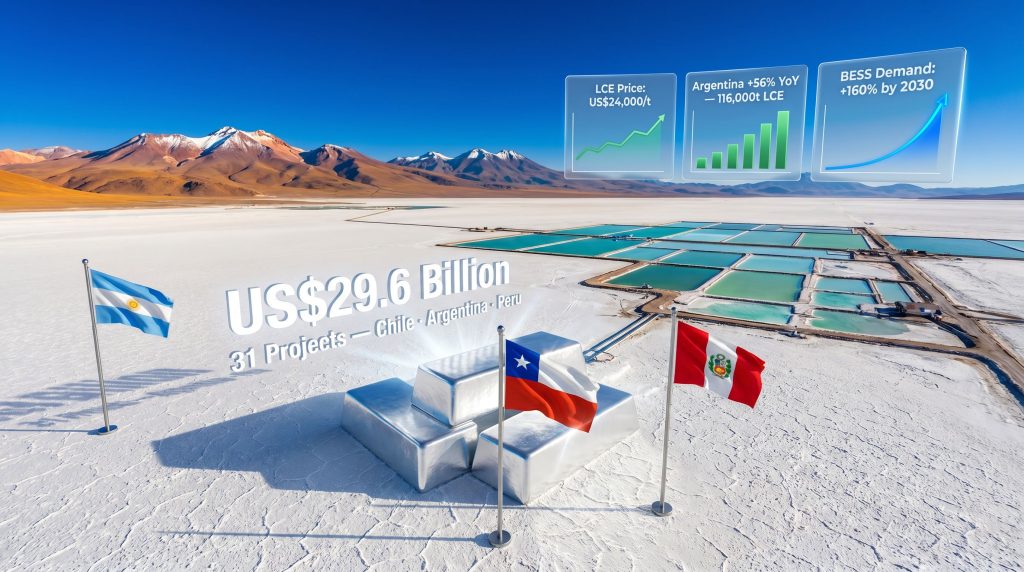
What changed the calculus in 2026 was not a single factor but a convergence of simultaneous disruptions across three continents. Chile's national mining agency, Cochilco, formally characterised the preceding period of historic oversupply as having passed, describing the current market phase as one of equilibrium. That characterisation was validated by LCE spot prices climbing to approximately US$24,000 per tonne by mid-May 2026, the highest recorded level since late 2023, with near-term stabilisation projected around US$17,500 per tonne.
The Three Supply Shocks That Tightened Global LCE Availability
Three concurrent events removed material volumes from global supply simultaneously:
| Disruption Source | Country | Nature of Impact |
|---|---|---|
| Jianxiawo deposit suspension (CATL) | China | One of the world's largest lithium suppliers taken offline |
| National lithium export ban | Zimbabwe | Full restriction on outbound lithium shipments |
| Greenbushes mine production cuts (IGO) | Australia | Technical failure-driven volume reduction |
Each disruption in isolation would have been manageable. Together, they created an asymmetric tightening that amplified the effect of BESS demand acceleration. What makes this price recovery analytically different from prior lithium bull cycles is that it is supply-shock driven rather than demand-speculative, which historically produces more durable price floors.
BESS Versus EVs: Understanding the Demand Rotation
The demand composition shift is critical for investors evaluating the duration of the current price environment. US passenger EV sales declined 33% year-on-year through April 2026, a statistic that initially alarmed lithium markets. However, this figure obscures the accelerating replacement of EV-driven demand by BESS absorption. Battery storage systems deployed alongside solar and wind generation, and increasingly to power AI-driven data centre infrastructure, are consuming lithium at volumes that investment banks had not fully modelled in their prior forecasts.
BESS demand is projected to grow by more than 160% by 2030, a figure that has prompted multiple investment banks to revise their lithium price outlooks upward. The practical implication for project developers is that the addressable market for lithium output from South American operations is now broader, and potentially more stable, than when the pipeline was originally underwritten.
"The lithium demand story has fundamentally shifted. The battery storage economy, not the EV economy, is now the primary growth engine for LCE consumption, and that distinction has significant implications for the urgency of project development across the Lithium Triangle."
The US$29.6 Billion Portfolio: Architecture and Scale
The investment pipeline for lithium projects in Chile, Argentina, and Peru has consolidated around 31 discrete initiatives with a combined capital commitment of US$29.699 billion. This portfolio spans a development horizon from 2026 through to 2035 and is divided between:
- 20 greenfield projects representing entirely new operations, with start-up or maximum capacity targets between 2026 and 2033
- 11 brownfield projects focused on expanding, optimising, or technologically upgrading active operations
Argentina dominates the greenfield pipeline with 14 initiatives, while Chile leads on brownfield capital intensity. Peru contributes a single project, but one with resource characteristics that distinguish it meaningfully from its brine-dominated regional peers.
Chile: Measured Expansion Within a State-Controlled Framework
Chile closed 2025 with LCE production of 282,000 tonnes, representing 3% year-on-year growth anchored entirely at the Salar de Atacama. All commercial output flows through two operators: Albemarle and SQM, which has rebranded as Novandino. The state-controlled model, which requires private operators to partner with CORFO and treats lithium as a strategic mineral, limits the number of active projects but provides a regulatory stability that many investors regard as a premium characteristic. The Chile lithium strategy reflects a deliberate policy of measured expansion over rapid volume growth.
Chile's Greenfield Pipeline: Five High-Value Projects
Chile's five greenfield projects represent a combined investment of US$6.133 billion with potential aggregate output of 140,700 tonnes of LCE. These projects are generally more advanced in feasibility and permitting relative to their Argentine counterparts, a function of Chile's more rigorous pre-approval process. The five initiatives are:
- Laguna Verde
- Maricunga Salts Production
- Maricunga (Proyecto Blanco)
- Alto Andean Salt Flats (Salares Altoandinos)
- Kuska (Ollague)
Chile's Brownfield Focus: DLE and the Atacama Upgrade Cycle
Chile's three brownfield initiatives, totalling US$5.587 billion, are all centred on the Salar de Atacama and include one of the most technically significant transitions in the regional pipeline: the shift from conventional evaporation-based brine processing to direct lithium extraction technology.
| Project Name | Strategic Focus |
|---|---|
| Salar Futuro | Long-term sustainability and resource planning |
| Carmen Plant Capacity Increase | Production volume optimisation |
| Transition to Direct Lithium Extraction (DLE) | Technology upgrade from evaporation to DLE |
Technology Watch: Conventional brine extraction using evaporation ponds consumes approximately 500,000 gallons of water per tonne of lithium produced. The Atacama's salt flat supplies water to surrounding communities, making the shift to DLE not merely a technical preference but an operational and social licence imperative.
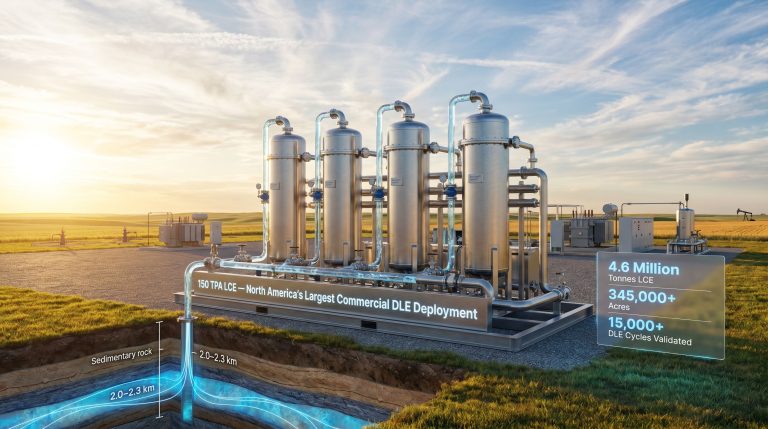
Direct Lithium Extraction works by passing brine through selective sorbent or membrane systems that isolate lithium ions without the multi-year evaporation cycle that conventional operations require. Recovery rates are substantially higher, processing timelines are compressed from years to hours, and the environmental footprint is dramatically reduced. For Chile's Atacama operations, which face intensifying scrutiny over water consumption and freshwater contamination risks, DLE adoption represents the primary pathway to sustaining and expanding production within acceptable environmental boundaries.
Argentina: The Private-Sector Surge and Its 56% Growth Story
Argentina's lithium trajectory stands in sharp contrast to Chile's measured approach. Output reached 116,000 tonnes of LCE in 2025, representing 56% year-on-year growth driven by the simultaneous ramp-up of multiple operations including Cauchari-Olaroz (Phase 1), Fénix, Salar Olaroz, and the newly incorporated Hombre Muerto Oeste and Centenario Ratones. The latter two, along with Sal de Vida, were still in commissioning phases as of mid-2026, with commercial production targets set for late 2026.
Argentina's province-based authorisation model has enabled more than 50 projects to advance concurrently, a structural advantage over Chile's centralised approval framework. Furthermore, this decentralisation accelerates entry but introduces jurisdictional inconsistency across the portfolio, with permitting standards, environmental requirements, and community consultation frameworks varying province by province. The diversity of Argentina lithium brines across Jujuy, Salta, and Catamarca provinces underpins this scale of concurrent development.
Argentina's 14-Project Greenfield Pipeline
The greenfield component of Argentina's pipeline encompasses 14 projects with combined investment of US$11.865 billion and potential aggregate LCE additions of 341,700 tonnes. The development horizon runs from 2026 to 2033.
| Project Name | Status |
|---|---|
| Sal de Vida | Commissioning (2026 commercial production target) |
| Centenario Ratones | Commissioning (2026 commercial production target) |
| PPG (Pozuelos-Pastos Grandes) | Pipeline |
| Río Grande | Pipeline |
| Hombre Muerto West | Pipeline |
| Rincón | Pipeline |
| Kachi | Pipeline |
| Río Grande Salar | Pipeline |
| Río Grande Sur (Pursuit Minerals) | Pipeline |
| Los Ángeles Salt | Pipeline |
| Río Grande Sur | Pipeline |
| Salar de Arizaro | Pipeline |
| Carachi Blanco | Pipeline |
| Salar de Rincón (Rio Tinto) | Pipeline |
Argentina's Eight Brownfield Expansions: US$5.433 Billion in Capacity Growth
The brownfield component targets operational timelines between 2027 and 2035 and focuses on capacity expansion, production optimisation, and technology integration at deposits already in operation:
- Fénix Expansion
- Hombre Muerto West Phase 2
- Cauchari-Olaroz Stage 2
- Fénix Expansion 3
- Tres Quebradas Phase 2 (3Q Expansion)
- Olaroz Salt Flat Phase 2 Expansion
- PPG Phase 2
- PPG Phase 3 (Sal de Puna)
If this pipeline executes on schedule, Argentina is positioned to surpass 450,000 tonnes of LCE annual production by 2030, a figure that would make it the fastest-growing lithium producer in the Lithium Triangle by a significant margin. Indeed, according to Benchmark Minerals, Argentina is actively challenging Chile for the top lithium production spot in South America.
Peru: The Hard-Rock Wildcard in a Brine-Dominated Region
Peru occupies a structurally different position in the regional lithium story. It has no commercial production as of mid-2026, and its sole greenfield project, Falchani, is valued at US$681 million with projected average annual output of 60,500 tonnes of LCE. What distinguishes Peru's lithium opportunity is resource type: where Argentina and Chile operate brine-based salt flat deposits, Peru's lithium is locked in hard-rock formations.
This distinction matters for several reasons. Hard-rock lithium concentrations at Falchani are reportedly seven times higher than typical salt flat brine grades, a geological characteristic that compresses the volume of material requiring processing for equivalent lithium yield. Estimated reserves across approximately 8,000 hectares total roughly 2.5 million tonnes, a resource base that places Peru in a category of strategic significance despite its production immaturity.
Hard-rock processing requires different infrastructure from brine operations, most notably crushing and flotation circuits followed by chemical conversion, and carries its own set of capital intensity and technical risk considerations. Peru's participation in a regional technical cooperation framework alongside Argentina, Bolivia, and Chile — a US$690,000 knowledge-sharing initiative to standardise exploration and environmental practices — is an important signal of the country's intent to compress its development timeline through collective expertise rather than pioneering independently.
The next major ASX story will hit our subscribers first
Comparative Framework: Chile vs. Argentina vs. Peru
| Dimension | Chile | Argentina | Peru |
|---|---|---|---|
| Regulatory Model | State-controlled strategic mineral | Province-led private sector | Emerging exploration-stage |
| Pipeline Projects | 8 (5 greenfield + 3 brownfield) | 22 (14 greenfield + 8 brownfield) | 1 (Falchani) |
| Pipeline Investment | US$11.72bn | US$17.298bn | US$681mn |
| 2025 LCE Output | 282,000t | 116,000t | 0t |
| Resource Type | Brine (salt flat) | Brine (salt flat) | Hard-rock |
| Technology Focus | DLE transition underway | DLE emerging | Hard-rock processing |
| Key Risk | Permitting rigidity | Jurisdictional inconsistency | No production history |
| Key Advantage | Proven, stable production base | Largest active greenfield pipeline | High-grade hard-rock resource |
Critical Risk Factors Across the Regional Pipeline
Permitting: The Structural Bottleneck
Permitting delay is consistently identified as the primary reason greenfield supply from South American salt flats has underperformed projections over multiple development cycles. The problem manifests differently by jurisdiction. In Chile, state-controlled approval processes introduce multi-year regulatory layers that are difficult to compress regardless of project quality. In Argentina, the province-level model accelerates initial entry but creates inconsistency, with approval standards varying significantly across Jujuy, Salta, and Catamarca provinces where most lithium assets are concentrated.
Water Security and Environmental Conflict
The water consumption profile of conventional brine extraction creates direct conflict with regional communities that depend on the same hydrological systems. The Salar de Atacama, which supplies approximately 65% of regional water to surrounding communities in Chile, exemplifies this tension. In Argentine operations, contamination risks to freshwater streams have been documented in proximity to active extraction zones. The operational shift toward lithium brine mining technologies such as DLE is the primary technical mitigation pathway, though its deployment at scale remains a work in progress across most of the pipeline.
Indigenous Rights and Social Licence Deficits
The pace of project acceleration across all three countries has in many cases outrun meaningful community consultation. Human rights analyses have flagged systematic gaps in consent mechanisms for Indigenous communities adjacent to salt flat operations. The Olaroz operation in Argentina's Jujuy province employs 65% Indigenous workers, representing one model of community integration, though analysts note this employment model does not fully substitute for formal prior consent processes or adequate compensation for resource access.
Geopolitical Capital Concentration
Chinese capital has achieved significant structural presence across the Lithium Triangle. A 24% equity stake in SQM (now Novandino) has been secured by Chinese interests, alongside active exploration rights held in partnership with CODELCO. This concentration is generating increasing scrutiny from Western governments and battery manufacturers pursuing critical minerals supply chain independence. For investors, the geopolitical overlay adds a layer of scenario risk that is distinct from operational or commodity price risk, particularly as US, EU, and allied nations intensify their assessment of ownership structures across the South American project pipeline.
What Investors and Industry Participants Should Watch
The US$29.6 billion investment pipeline for lithium projects in Chile, Argentina, and Peru represents one of the largest coordinated resource development programmes in the history of the Lithium Triangle. Consequently, several dynamics are worth monitoring closely:
- DLE commercialisation progress at Chile's Atacama operations, which will determine whether the technology achieves the recovery rates and water efficiency gains that make large-scale brownfield expansion environmentally viable
- Commissioning milestones at Sal de Vida and Centenario Ratones in Argentina, which will serve as real-world validation tests for the broader Argentine greenfield pipeline's execution credibility
- Falchani's development trajectory in Peru, where the absence of a comparable operating hard-rock lithium project in South America means there are no regional precedents to benchmark against
- BESS demand data through 2026 and 2027, which will either confirm or challenge the 160%-plus growth projection that has underpinned the upward revision of bank price forecasts
- Geopolitical developments around critical minerals frameworks in the US, EU, and Asia that could reshape the ownership and offtake structures of projects currently under development
Disclaimer: This article is intended for informational purposes only and does not constitute financial or investment advice. Commodity price forecasts, project timelines, and production estimates are subject to material uncertainty and may differ significantly from actual outcomes. Readers should conduct independent due diligence before making any investment decisions.
Want to Track the Next Big Mineral Discovery Before the Market Moves?
Discovery Alert's proprietary Discovery IQ model delivers real-time alerts on significant ASX mineral discoveries — turning complex mineral data into actionable insights for both short-term traders and long-term investors. Explore Discovery Alert's dedicated discoveries page to see how historic mineral discoveries have generated substantial returns, and begin your 14-day free trial today to position yourself ahead of the market.