July 10, 2026
The Race to Build a Western Lithium Supply Chain Is Running Through the Canadian Prairies
Battery manufacturers and automakers operating across North America and Europe have spent the better part of a decade confronting a structural vulnerability in their supply chains: the overwhelming concentration of lithium refining capacity in China, and the geographic dominance of the Lithium Triangle — Argentina, Bolivia, and Chile — in raw brine-based production. As the energy transition accelerates, the search for geopolitically stable, environmentally responsible, and technically scalable lithium sources has intensified dramatically.
Against this backdrop, a sedimentary basin in southeast Saskatchewan has quietly emerged as one of the most technically interesting lithium plays in the Western Hemisphere. The delivery of the Prairie Lithium DLE unit in Saskatchewan during mid-2026 represents more than a single project milestone. It marks a tangible shift in what commercial-scale direct lithium extraction looks like outside South America, and it raises fundamental questions about how quickly brine-hosted lithium can be industrialised in jurisdictions with stable governance frameworks and pre-existing extraction infrastructure.
When big ASX news breaks, our subscribers know first
How Direct Lithium Extraction Actually Works at Industrial Scale
To understand why the arrival of this DLE unit matters, it helps to first understand what separates Direct Lithium Extraction from the methods that have dominated lithium production for decades.
The Problem With Conventional Methods
Traditional lithium production relies on one of two approaches. Hard-rock mining, primarily targeting spodumene pegmatites, requires open-cut or underground excavation, crushing, and energy-intensive chemical processing. Evaporation pond operations, which dominate production in the Atacama Desert and Salar de Uyuni, pump lithium-rich brines to surface and wait — sometimes 12 to 24 months — for solar evaporation to concentrate the lithium before further processing.
Both methods carry significant environmental costs. Evaporation ponds consume enormous volumes of freshwater in some of the driest ecosystems on Earth, while hard-rock mining generates large tailings footprints and requires substantial surface disturbance.
The DLE Mechanism: A Step-by-Step Breakdown
Sorption-based DLE, the technology class employed at the Prairie Lithium project, operates through a fundamentally different chemical logic:
-
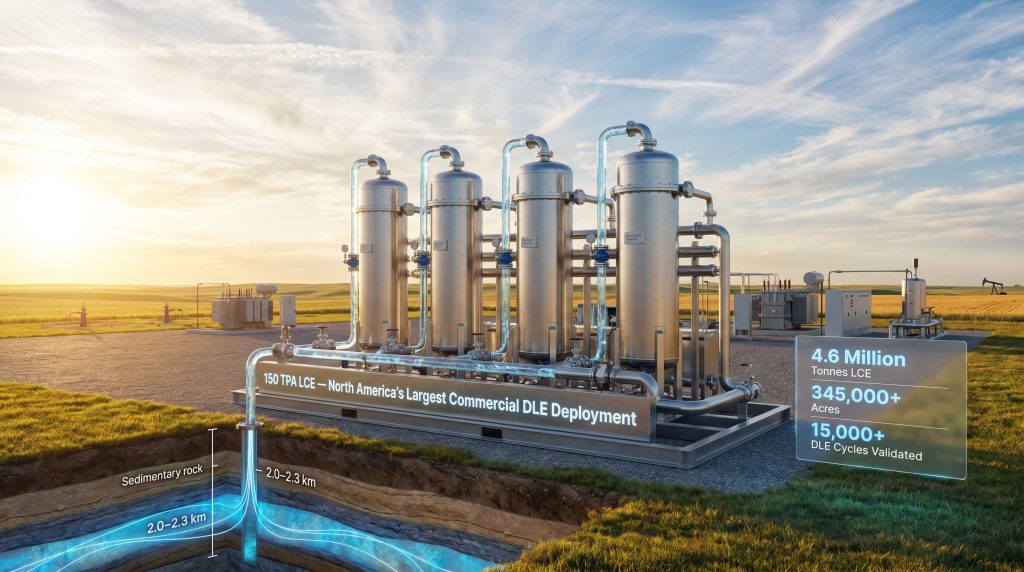
Lithium-bearing brine is pumped from deep subsurface aquifers located 2.0 to 2.3 kilometres below the surface.
-
The brine flows through selective adsorption columns — in this case, Aquatech's Li-Pro™ columns — which capture lithium ions while allowing other dissolved minerals to pass through.
-
The lithium-depleted brine is reinjected into a separate, deeper aquifer, preserving the subsurface hydrological balance rather than releasing spent brine to surface evaporation.
-
The concentrated lithium solution extracted from the adsorption columns advances to downstream processing, ultimately yielding battery-grade lithium carbonate equivalent (LCE).
This closed-loop architecture dramatically reduces surface land disturbance, eliminates the multi-month evaporation cycle, and enables far more selective lithium recovery compared to conventional lithium brine production.
The Quadpod™ Configuration: Why Four Columns Change the Equation
Aquatech's Quadpod™ system deploys four Li-Pro™ sorption columns simultaneously within a single integrated unit. This is not simply a larger version of existing pilot-scale technology — it represents a commercially validated, modular architecture designed specifically for scalable replication.
The Aquatech Li-Pro™ platform has been validated across more than 15,000 DLE cycles, providing an unusually robust dataset for a technology class that many critics have historically dismissed as commercially unproven at scale.
| Feature | Single-Column DLE System | Aquatech Quadpod™ (Four-Column) |
|---|---|---|
| Relative Scale | Baseline | Approximately 4× larger |
| Deployment Flexibility | Limited | High — modular replication by design |
| Cycle Validation | Varies by platform | 15,000+ cycles confirmed |
| Commercial Status | Pilot or early-stage | Full commercial scale |
"The Quadpod™ unit delivered to Saskatchewan is the largest commercial-scale DLE system deployed anywhere in North America as of mid-2026 — a threshold that redefines what brine-based lithium production can look like outside of South America's established production zones."
The Williston Basin: Geology That Happens to Be Ideal for DLE
Why Saskatchewan's Subsurface Is Different
The Prairie Lithium project occupies a land position spanning more than 345,000 acres of subsurface permits within the Williston Basin — a sedimentary structure that petroleum geologists have studied intensively for over half a century. This is not coincidental. The same geological conditions that make sedimentary lithium deposits productive for oil and gas extraction — porous reservoir rock, thick evaporite sequences, and well-understood subsurface geometries — also create ideal environments for lithium-bearing formation brines.
These brines have been trapped in deep aquifer systems over geological timescales, concentrating dissolved lithium through fluid-rock interaction processes. The lithium-bearing zones at Prairie Lithium's project site sit at depths of approximately 2.0 to 2.3 kilometres, accessed using conventional rotary drilling techniques directly transferable from the oil and gas sector.
This geological overlap with petroleum extraction is a commercially underappreciated advantage. Drilling and well-completion contractors familiar with Saskatchewan's subsurface conditions are readily available, consequently reducing both technical risk and well construction costs relative to greenfield geological environments.
Scale of the Resource Base
The project's estimated resource of 4.6 million tonnes of lithium carbonate equivalent positions it among the more substantial brine-hosted lithium inventories in North America. To contextualise that figure: the lithium carbonate market saw global battery-grade demand estimated at approximately 800,000 tonnes of LCE in 2023, with projections pointing to substantial growth through the 2030s — meaning a multi-million tonne brine resource carries genuine long-duration supply relevance.
Regulatory Standing: A Rare Distinction
One of the least-discussed but most commercially significant aspects of the Prairie Lithium project is its regulatory status. The project holds the distinction of being Canada's only fully permitted lithium brine project authorised to advance to production. In a permitting environment where critical mineral projects routinely face multi-year approval timelines, this status removes one of the most common sources of development delay and capital uncertainty in the junior mining sector.
Benchmarking the Prairie Lithium DLE Unit Against North American Peers
The scale comparison that has attracted the most attention from industry observers involves Standard Lithium's single-column DLE unit introduced at its Arkansas project in March 2024. The Prairie Lithium Quadpod™ system is approximately four times the physical scale of that unit — making the Saskatchewan deployment a meaningful step-change rather than an incremental improvement.
| Project | Location | DLE Technology | Phase 1 Output Target | Commercial Status |
|---|---|---|---|---|
| Prairie Lithium | Saskatchewan, Canada | Aquatech Quadpod™ (4-column) | 150 TPA LCE | Commissioning Q4 2026 |
| Standard Lithium | Arkansas, USA | Single-column DLE | Not publicly disclosed | Pilot / early commercial |
Phase 1 at Prairie Lithium is designed to produce 150 tonnes per annum of LCE at Pad #1. While this figure may appear modest in isolation, it needs to be understood within the modular scaling framework that defines the project's long-term architecture. The Quadpod™ design enables additional units to be replicated without requiring full-facility rebuilds, with the long-term production pathway targeting up to 10,000 TPA of LCE through successive modular expansions.
Phase 1 Commissioning Timeline and Infrastructure De-Risking
Key Milestones Already Achieved
The project has executed against a clearly structured development sequence leading to Q4 2026 commissioning:
-
Interior construction work at Pad #1 was completed during Q2 2026.
-
Equipment installation is progressing through Q2 and Q3 2026.
-
Commissioning is targeted for Q4 2026, with first revenue potentially achievable before the end of the calendar year.
What Is Already in the Ground
A factor that materially lowers the Phase 1 execution risk profile is the infrastructure established prior to the DLE unit's delivery:
-
Production wells are operational, capable of drawing brine from the target aquifer.
-
Disposal wells are in place for closed-loop brine reinjection.
-
On-site power supply systems are established, eliminating one of the most common commissioning delays in remote resource projects.
The combination of fully delivered DLE hardware and pre-installed site infrastructure creates a relatively compressed path from current status to first production — a de-risking profile that distinguishes Prairie Lithium from projects still in pre-permitting or infrastructure construction phases. Furthermore, Prairie Lithium's DLE plant has been cited as the largest of its kind moving toward production in North America, reinforcing the project's strategic significance.
The Hydro Lithium Offtake Agreement: Revenue Certainty Before First Production
A 100% Committed Output Structure
All Phase 1 lithium production is secured under a binding offtake agreement with Hydro Lithium, a South Korean company. The agreement covers the entirety of Phase 1 output, providing complete revenue visibility from the moment production commences.
What makes this arrangement structurally significant is the additional commercial dimension: Hydro Lithium is contributing approximately AU$10 million in refining equipment to support Prairie Lithium's downstream processing capability. This transforms the relationship from a simple purchase contract into a genuine commercial partnership with shared infrastructure investment.
Why South Korean Involvement Signals Credible Demand
South Korea's position in the global battery supply chain is frequently underappreciated by investors focused primarily on Chinese and Japanese manufacturers. South Korean conglomerates are among the world's largest producers of lithium-ion battery cells for electric vehicles, with LG Energy Solution, Samsung SDI, and SK On collectively supplying a substantial share of global EV battery capacity.
Hydro Lithium's binding commitment to 100% of Phase 1 output represents a pre-production demand signal from a market that understands both the technical specifications required for battery-grade material and the strategic value of securing supply from non-Chinese, non-Lithium Triangle sources. In the context of the global lithium market, such offtake arrangements signal a broader shift toward supply chain diversification.
"A fully committed offtake agreement at the pre-production stage eliminates the price discovery uncertainty that typically burdens early-stage lithium producers during initial ramp-up phases — one of the most consequential commercial risks in the sector."
The next major ASX story will hit our subscribers first
Environmental Performance: How DLE Compares in Saskatchewan's Context
Footprint Comparison Across Production Methods
The environmental profile of DLE-based brine extraction compares favourably across multiple dimensions relative to legacy production methods:
| Environmental Dimension | Evaporation Pond (Lithium Triangle) | Hard-Rock Spodumene Mining | DLE Brine Extraction |
|---|---|---|---|
| Freshwater Consumption | Very high | Moderate to high | Significantly reduced |
| Surface Land Disturbance | Extensive (pond infrastructure) | Extensive (open cut/underground) | Minimal above-ground footprint |
| Production Cycle Time | 12 to 24 months per cycle | Continuous but energy-intensive | Near-continuous with closed loop |
| Brine Disposal | Evaporation to atmosphere | Not applicable | Reinjection into separate aquifer |
The closed-loop brine reinjection system employed at Prairie Lithium is particularly important from a water governance perspective. Saskatchewan sits within a broader prairie watershed system where subsurface water management carries regulatory and community sensitivity. Reinjecting depleted brine into a separate aquifer rather than disposing of it to surface evaporation ponds represents a meaningful operational distinction.
What This Means for North American Battery-Grade Lithium Supply
Technology Validation at Commercial Scale
Every commercial-scale DLE deployment that successfully transitions from pilot testing to sustained production strengthens the investment and policy case for the entire technology class. The Prairie Lithium DLE unit in Saskatchewan's Phase 1 functions simultaneously as a production operation and as a technology proof-of-concept at a scale that no North American project has previously demonstrated with this particular sorption-based architecture.
For the broader DLE ecosystem, successful commissioning in Saskatchewan would provide a validated operational template that could be referenced by projects in Montana, Nevada, Utah, and across Argentina's emerging brine provinces.
A Speculative but Plausible Scaling Scenario
It is worth noting, as a speculative proposition, that the modular architecture of the Quadpod™ system creates an unusual optionality profile. Unlike conventional lithium operations where scaling requires proportional increases in capital-intensive processing infrastructure, modular DLE systems can theoretically be expanded through unit replication with relatively predictable cost curves.
Whether Prairie Lithium can execute that scaling pathway from 150 TPA toward the long-term 10,000 TPA target depends on Phase 1 operational performance, lithium pricing dynamics, and ongoing capital access — none of which are guaranteed outcomes.
This article contains forward-looking statements and projections based on publicly available information. Readers should conduct independent research and consider their own financial circumstances before making investment decisions. Mineral resource estimates and production targets are subject to technical and economic risks.
Key Statistics Summary: Prairie Lithium Project at a Glance
| Metric | Detail |
|---|---|
| Project Location | Williston Basin, southeast Saskatchewan, Canada |
| Total Permit Area | 345,000+ acres |
| Estimated Lithium Resource | 4.6 million tonnes LCE |
| Brine Aquifer Depth | 2.0 to 2.3 km below surface |
| DLE Technology | Aquatech Quadpod™ (4x Li-Pro™ columns) |
| DLE Cycle Validation | 15,000+ cycles |
| Relative DLE Scale | Approximately 4x larger than Standard Lithium's Arkansas unit |
| Phase 1 Production Target | 150 TPA LCE |
| Long-Term Scaling Target | Up to 10,000 TPA LCE |
| Commissioning Target | Q4 2026 |
| Offtake Partner | Hydro Lithium (South Korea) |
| Offtake Coverage | 100% of Phase 1 output |
| Refining Equipment Contribution | Approximately AU$10 million from Hydro Lithium |
| Regulatory Status | Canada's only fully permitted lithium brine project |
Frequently Asked Questions: Prairie Lithium DLE Unit in Saskatchewan
What is the Prairie Lithium DLE unit in Saskatchewan?
It is a commercial-scale Direct Lithium Extraction system delivered to Prairie Lithium's project site in the Williston Basin, southeast Saskatchewan. The system uses Aquatech's Quadpod™ configuration with four Li-Pro™ sorption columns to selectively extract lithium from deep subsurface formation brines.
How does the size of Prairie Lithium's DLE unit compare to other North American systems?
The Quadpod™ system is approximately four times the physical scale of the single-column DLE unit operating at Standard Lithium's Arkansas project, making it the largest commercial DLE unit deployed in North America as of mid-2026.
When is commissioning expected to be completed?
Commissioning is targeted for Q4 2026, with the potential for first revenue before the end of the 2026 calendar year.
What is the long-term production target for the project?
Phase 1 targets 150 TPA of LCE at Pad #1. Through modular replication of the DLE process across subsequent phases, the project's long-term scaling target is up to 10,000 TPA of LCE.
Who is buying Prairie Lithium's Phase 1 production?
South Korea's Hydro Lithium holds a binding offtake agreement covering 100% of Phase 1 output. Hydro Lithium is also contributing approximately AU$10 million in refining equipment to the project.
Want to Stay Ahead of the Next Major Mineral Discovery on the ASX?
Discovery Alert's proprietary Discovery IQ model scans ASX announcements in real time, instantly identifying significant mineral discoveries — from lithium to gold and beyond — and delivering actionable alerts directly to subscribers before the broader market catches on. Explore historic discoveries and the returns they generated, then start your 14-day free trial at Discovery Alert to position yourself ahead of the market.