July 9, 2026
The Quiet Shift That Could Transform Elevra Lithium's Revenue Picture
Hard-rock lithium pricing operates on rhythms that most investors never fully appreciate. Unlike equity markets where prices reset in milliseconds, Elevra Lithium spodumene concentrate prices move through a layered system of benchmark indices, freight adjustments, and contractual timing windows that can keep a producer's realised returns disconnected from spot reality for months at a time. Understanding this architecture is not just academic. For companies like Elevra Lithium, it is the difference between a distorted quarterly figure and a fundamentally improving revenue trajectory.
The lithium sector has weathered one of its most brutal correction cycles in recent memory. Spodumene SC6 prices collapsed from peaks above US$2,000/t during the 2022-2023 boom, bottoming near ~US$600/t (CIF China) in mid-2025 as oversupply from expanded Australian and Chinese hard-rock projects flooded the market. That trough is now structurally behind the market, and the producers positioned to capture the recovery with clean, spot-aligned contracts will look meaningfully different from those still shackled to legacy pricing arrangements. For further context, the lithium market downturn drove many producers to reassess their contractual structures during this period.
Elevra Lithium (dual-listed on ASX and Nasdaq) crossed that threshold at the end of June 2026, completing the final shipments under a legacy contractual structure that had been suppressing its Elevra Lithium spodumene concentrate prices relative to prevailing market rates. What follows is a detailed examination of what that transition means, why the operational backdrop amplifies its significance, and how the broader lithium pricing cycle frames the opportunity.
When big ASX news breaks, our subscribers know first
Understanding Spodumene Concentrate as a Pricing Instrument
Spodumene concentrate, typically graded at 6% lithium oxide (Li₂O) content and referred to commercially as SC6, is the dominant hard-rock lithium feedstock globally. It sits upstream of lithium hydroxide and lithium carbonate production, making its price a genuine leading indicator for downstream battery chemical markets. Understanding spodumene extraction basics is essential for appreciating how upstream decisions flow through to realised pricing outcomes.
Why Grade Specification Matters
The grade specification matters more than many retail investors realise. SC6 is the benchmark because it represents the minimum economically viable grade for most conversion facilities. Concentrates below this threshold, sometimes described as SC5.5 or SC5, trade at a meaningful discount and are often blended rather than processed directly. Producers who consistently deliver on-spec SC6 material maintain a distinct commercial advantage, particularly when offtake buyers are optimising conversion plant efficiency.
Pricing itself is rarely a single transparent figure. The key reference points used across the industry include:
- SMM Lithium Price (SC6 CIF China): The most widely cited benchmark for spodumene shipped into Chinese conversion facilities, reflecting cost, insurance, and freight
- Fastmarkets spodumene index: An independently assessed price used in various offtake formulas, particularly for non-Chinese buyers
- Benchmark Mineral Intelligence (BMI): A longer-term price forecasting and assessment service used heavily in project financing and strategic offtake negotiations
The gap between CIF China (which includes freight) and FOB pricing (ex-mine or ex-port) is material, typically ranging from US$50-70/t depending on vessel rates and routing. For a North American producer shipping to Asia, this freight component directly affects realised margins and must be stripped out to compare producer economics accurately.
Furthermore, the conversion pathway from concentrate to battery-ready chemicals is a critical commercial step. The process of converting spodumene to lithium salts determines how downstream pricing benchmarks, including the lithium carbonate market, ultimately feed back into producer offtake negotiations.
Lagged pricing mechanisms create a structural timing gap between when spot prices are observed and when those prices flow through to a producer's realised revenue. This gap can span three to six months depending on contract structure, meaning a rising spot market may not show up in reported financials until well after the market has moved.
Decoding Elevra's Q2 2026 Realised Price
The US$919/t average realised price that Elevra recorded for the quarter ended June 30, 2026, covering 33,977 tonnes of spodumene concentrate sold from its North American Lithium (NAL) operations in Québec, requires careful interpretation.
On the surface, it might appear unremarkable relative to spot levels. However, the figure carries a specific contractual explanation. The June quarter shipments were delivered under arrangements that incorporated a lagged pricing mechanism, with the price formula averaging SC6 market values from October 2025 through March 2026. That six-month window captured a period when prices had not yet recovered from their mid-2025 trough, pulling the realised figure well below where spot was trading by the time those tonnes were actually shipped.
This is a known, well-documented feature of spodumene offtake structures, particularly for long-term supply agreements negotiated during periods of price uncertainty. Both buyer and seller accept price averaging windows as a risk management tool. The buyer avoids paying peak spot prices; the seller avoids being caught selling at trough levels on a fixed-price basis. The trade-off is that during periods of rapid price recovery, the seller's realised price lags the market by the length of the averaging window.
Historical Realised Price Comparison
| Period | Realised Price | Context |
|---|---|---|
| FY2024 | Strong mid-cycle pricing | |
| FY2025 | Market softening, cycle trough approached | |
| Q1 2026 | US$1,453/dmt | Spot recovery flowing through earlier contract terms |
| Q2 2026 | US$919/t | Lagged legacy contract, final quarter of this arrangement |
| FY26 Guidance (incl. freight) | US$765-830/t | Conservative mid-cycle estimate |
The Q1 2026 figure of US$1,453/dmt versus Q2 2026's US$919/t illustrates precisely how the lagged mechanism creates volatility in reported revenues that does not necessarily reflect the underlying operational story.
Critically, June 2026 marked the conclusion of this legacy arrangement. From July 2026 onwards, all shipments are expected to price against prevailing spot market benchmarks, removing the structural lag entirely.
The Cost Structure That Makes Pricing Recovery Decisive
Elevra's FY2026 unit operating cost guidance for the NAL operations sits at US$860-880/t, which establishes the critical cost floor against which forward pricing must be assessed. At the Q2 2026 realised price of US$919/t, the margin above operating costs was thin but positive at the mine level, before corporate overhead allocation.
Key Cost and Pricing Metrics
| Metric | Value |
|---|---|
| FY26 Unit Operating Cost Guidance | US$860-880/t |
| FY26 Price Guidance (incl. freight) | US$765-830/t |
| Q2 2026 Realised Price | US$919/t |
| Freight Cost (approx.) | ~US$60/t |
| Spot Price at Mid-2026 | ~US$900/t SC6 CIF China |
| Cycle Trough (mid-2025) | ~US$600/t |
| Cycle Peak (2022-2023) | >US$2,000/t |
The juxtaposition of the FY26 price guidance range (US$765-830/t) against the operating cost guidance (US$860-880/t) highlights why the transition away from lagged legacy pricing is so operationally significant. Under the old contract structure, with pricing reflecting the softer October 2025 to March 2026 window, the company was navigating thin territory. Spot-aligned pricing at or above US$900/t creates a meaningfully different margin profile.
If spot prices stabilise in a range of US$1,000-1,200/t through the second half of 2026, as some market participants anticipate, and Elevra captures these rates under the new spot-aligned contract structure, realised revenue per tonne could improve by approximately 8-30% relative to Q2 2026 levels. This is not guaranteed, and investors should treat forward price assumptions as speculative in the context of the lithium market's demonstrated volatility.
Offtake Architecture: The Mangrove Agreement and Floor-Ceiling Dynamics
Beyond the immediate spot-alignment story, Elevra has a proposed non-binding offtake agreement with Mangrove Lithium covering 144,000 tonnes per annum for the 2028-2033 period. This agreement is structured with market-linked pricing incorporating both floor and ceiling price bands, a structure increasingly common in critical minerals offtake as both producers and processors seek cash flow certainty across what has proven to be an extremely volatile price cycle.
The floor-ceiling construct is worth understanding in detail because it functions differently from a simple fixed-price contract:
- Below the floor price: The buyer pays the floor rate regardless of how far spot has fallen, protecting the producer's revenue in a severe downturn
- Between floor and ceiling: Pricing tracks the relevant spot benchmark, giving both parties exposure to mid-cycle market rates
- Above the ceiling: The buyer pays the ceiling rate, capping the producer's upside in exchange for the downside protection the floor provides
For an operation like NAL where operating costs sit near US$860-880/t, the floor price in such an agreement becomes a critical solvency consideration. A well-structured floor above operating costs provides a genuine buffer against the type of price collapse that characterised 2024-2025.
Record Production Amplifies the Pricing Tailwind
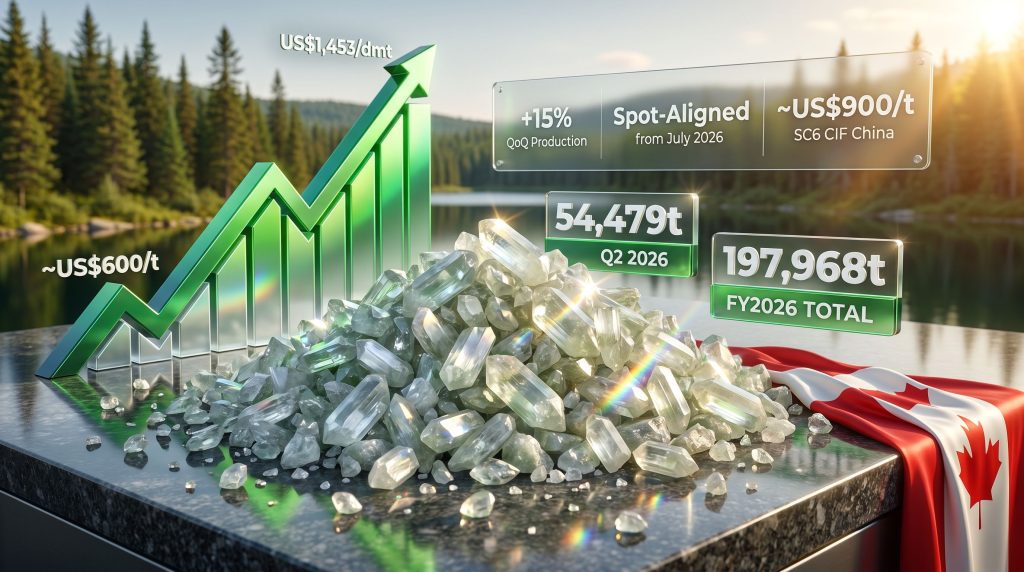
The pricing story does not exist in isolation. Elevra's operational performance at NAL during Q2 2026 provided the strongest possible platform from which to benefit from improved pricing. Total production for the quarter reached 54,479 tonnes, a 15% quarter-on-quarter increase that represented the second-highest quarterly output in the operation's history.
May 2026 alone delivered a single-month record of 22,202 tonnes, demonstrating that the improvement was not a one-month anomaly but a sustained operational step-change. For the full financial year ended June 2026, NAL produced 197,968 tonnes of spodumene concentrate, establishing the asset's credentials as one of the most productive hard-rock lithium operations currently active in North America.
NAL Quarterly Production Trajectory
| Period | Production | Change |
|---|---|---|
| Q3 2025 | ~47,000t (estimated) | Baseline |
| Q4 2025 | ~47,400t (estimated) | Stable |
| Q1 2026 | ~47,400t (estimated) | Stable |
| Q2 2026 | 54,479t | +15% QoQ |
| FY2026 Full Year | 197,968t | Record annual output |
The operational improvement levers Elevra continues to pursue at NAL include plant throughput optimisation, more consistent ore feed grade delivery to the processing circuit, and incremental recovery rate improvements at the metallurgical stage. Each of these has a compounding effect: higher throughput multiplied by improved recovery rates means more saleable tonnes from the same ore volume, directly lowering the cost per tonne of production.
Recovery rate improvement in spodumene processing is a more complex challenge than it might appear. Spodumene mineralisation can be intimately associated with other silicate minerals, particularly feldspar and quartz, and the separation efficiency in dense media separation and froth flotation circuits depends heavily on ore hardness, liberation characteristics, and feed rate consistency. Operations that achieve stable, predictable ore feed deliver better flotation circuit performance and lower dilution from non-lithium gangue minerals.
The next major ASX story will hit our subscribers first
Québec: Why Geography Is a Genuine Competitive Asset
The NAL operation's location in Québec is not merely a logistical detail. It represents a genuine source of structural competitive advantage that becomes increasingly relevant as battery supply chain geopolitics intensify.
Québec's hydroelectric grid delivers some of the lowest-cost and lowest-carbon industrial electricity in North America. For a processing-intensive operation like spodumene concentration, where grinding and separation circuits consume significant power, access to low-cost clean electricity is a direct input cost advantage and an ESG credential that resonates with European and North American battery manufacturers under increasing pressure to demonstrate sustainable sourcing.
Beyond power, the province offers:
- An established mining services and skilled labour ecosystem built over decades of mining activity in the Abitibi and James Bay regions
- Proximity to emerging North American battery manufacturing corridors in Ontario, Michigan, and the US Northeast, reducing logistics costs compared to Australian or African producers shipping to the same customers
- A stable, well-understood provincial regulatory and permitting framework that reduces operational uncertainty relative to some emerging lithium jurisdictions
The North American content dynamics created by the Inflation Reduction Act (IRA) framework are reshaping procurement decisions across the battery supply chain. While no project-specific designation has been confirmed for NAL, the broader policy environment creates commercial incentives for North American battery manufacturers to prioritise domestically sourced critical mineral inputs. Québec-based spodumene sits squarely in that advantaged position relative to Australian or South American material competing for the same customers.
Macro Drivers Supporting a Constructive Pricing Outlook
The medium-term pricing environment for Elevra Lithium spodumene concentrate prices is shaped by several converging forces, though investors should approach forward price assumptions with appropriate caution given the sector's history of sharp and rapid reversals. In addition, ongoing lithium industry innovations are also influencing the competitive landscape across the supply chain.
Supply-side dynamics currently include:
- Disruptions and production cutbacks at Chinese hard-rock spodumene operations through late 2025, which contributed to the price recovery from the mid-2025 trough
- Reduced capital availability for new greenfield lithium projects following the 2024-2025 price collapse, suggesting the next wave of supply will take longer to arrive than previously anticipated
- Inventory destocking across Chinese lithium chemical processors is largely complete, removing a key source of artificial demand suppression that characterised 2024
Demand-side tailwinds include:
- Accelerating electric vehicle adoption in China, Europe, and increasingly North America, driving battery cell production volumes at established and new gigafactories
- Growing lithium iron phosphate (LFP) battery adoption in energy storage systems, which, while less lithium-intensive per kWh than NMC chemistries, contributes meaningfully to aggregate lithium demand at scale
- North American and European content requirements incentivising regional battery manufacturers to secure long-term, non-Chinese lithium supply agreements
Market consensus as of mid-2026 suggests spodumene SC6 prices are likely to consolidate near current levels through the remainder of 2026 before a more sustained structural recovery becomes apparent in 2027-2028, driven by demand growth from committed gigafactory capacity coming online. This remains a forecast, not a certainty, and the lithium market has a track record of confounding consensus views in both directions.
Frequently Asked Questions
What is Elevra Lithium's current spodumene concentrate price?
Elevra does not publish a real-time fixed price. Its most recently reported realised FOB price was US$919/t for Q2 2026, though this reflected a legacy lagged pricing contract that concluded with June 2026 deliveries. From July 2026, pricing is expected to align with prevailing spot market rates, which were approximately ~US$900/t SC6 CIF China at mid-2026. For current benchmark pricing, the SMM spodumene price index for Australian Spodumene Concentrate 6% Li₂O CIF China is the most widely referenced source.
Why was Elevra's Q2 2026 realised price lower than spot?
The Q2 2026 realised price of US$919/t reflected a contractual averaging mechanism that priced shipments against market levels from October 2025 through March 2026, a period when spot prices were materially lower following the mid-2025 trough. The June 2026 shipments were the final deliveries under this legacy arrangement.
What is Elevra's production guidance for FY2026?
Elevra's NAL operations produced 197,968 tonnes of spodumene concentrate across the full financial year ended June 2026, with Q2 2026 alone contributing 54,479 tonnes, the second-highest quarterly output on record. May 2026 established a single-month production record of 22,202 tonnes.
How does Elevra's pricing compare to its operating costs?
FY26 unit operating cost guidance sits at US$860-880/t. With Q2 2026 realised prices at US$919/t and spot prices near US$900/t, mine-level margins are positive but modest. A sustained recovery toward US$1,200/t or above would generate a meaningfully improved profitability profile.
What offtake arrangements does Elevra have in place?
Elevra has a proposed 144,000 tpa offtake agreement with Mangrove Lithium covering 2028-2033, structured with market-linked pricing incorporating floor and ceiling price bands designed to protect cash flow across the lithium price cycle.
Key Data Summary
| Metric | Value |
|---|---|
| Q2 2026 Realised Price | US$919/t |
| Q1 2026 Realised Price | US$1,453/dmt |
| Q2 2026 Production Volume | 54,479t |
| May 2026 Monthly Record | 22,202t |
| FY2026 Total Production | 197,968t |
| QoQ Production Growth (Q2 2026) | +15% |
| FY26 Unit Operating Cost Guidance | US$860-880/t |
| Legacy Contract Status | Concluded June 2026 |
| Forward Pricing Basis | Spot-aligned from July 2026 |
| Spot Price (mid-2026) | ~US$900/t SC6 CIF China |
| Cycle Trough (mid-2025) | ~US$600/t |
| Late 2025 Recovery Level | >US$1,200/t |
| Mangrove Offtake Volume | 144,000 tpa (proposed, 2028-2033) |
The convergence of record-level production, the structural removal of legacy contract pricing drag, and a recovering spodumene spot market creates a materially different revenue environment for Elevra's NAL operations entering the second half of 2026. Whether spot prices consolidate, continue recovering, or face fresh headwinds from Chinese supply responses remains an open question. Consequently, investors should weigh both the structural improvements in Elevra's contract positioning and the inherent unpredictability of lithium market cycles before drawing forward conclusions.
Want to Catch the Next Major Lithium Discovery Before the Market Does?
Discovery Alert's proprietary Discovery IQ model scans ASX announcements in real time, instantly identifying significant mineral discoveries across lithium and more than 30 other commodities — turning complex data into clear, actionable opportunities for investors at every level. Explore historic discoveries and the returns they generated, then begin your 14-day free trial at Discovery Alert to position yourself ahead of the next major find.