August 21, 2026
Underground Mine Portals and the Engineering Logic Behind Brazil's Next Lithium Project
Hard-rock lithium development operates on a procurement clock that most market observers rarely see. By the time a company announces a construction tender, months of geotechnical assessment, basic engineering, contractor pre-qualification, and internal capital allocation have already occurred behind the scenes. The tender itself is not the beginning of the story — it is a visible signal that an extensive technical machine has already been set in motion.
That engineering logic sits at the centre of the Lithium Ionic tender for construction works in Brazil, issued on July 8, 2026, targeting underground mine portal construction at the Bandeira Lithium Project in Minas Gerais. For those who understand how mining projects are sequenced, this tender communicates far more than a single procurement event. It reflects the culmination of engineering readiness, contractor market engagement, and a deliberate strategy to compress the schedule between a Final Investment Decision and first ore production.
When big ASX news breaks, our subscribers know first
The Bandeira Lithium Project: Where Geography Meets Geology
Minas Gerais occupies a singular position in global lithium geology. The state hosts Brazil's so-called Lithium Valley, a pegmatite-rich corridor stretching through the eastern highlands that has attracted sustained exploration investment over the past decade. Pegmatite-hosted lithium deposits in this region differ meaningfully from the brine-hosted resources dominant in Chile and Argentina, where lithium brines can require years of pond infrastructure construction before first lithium output.
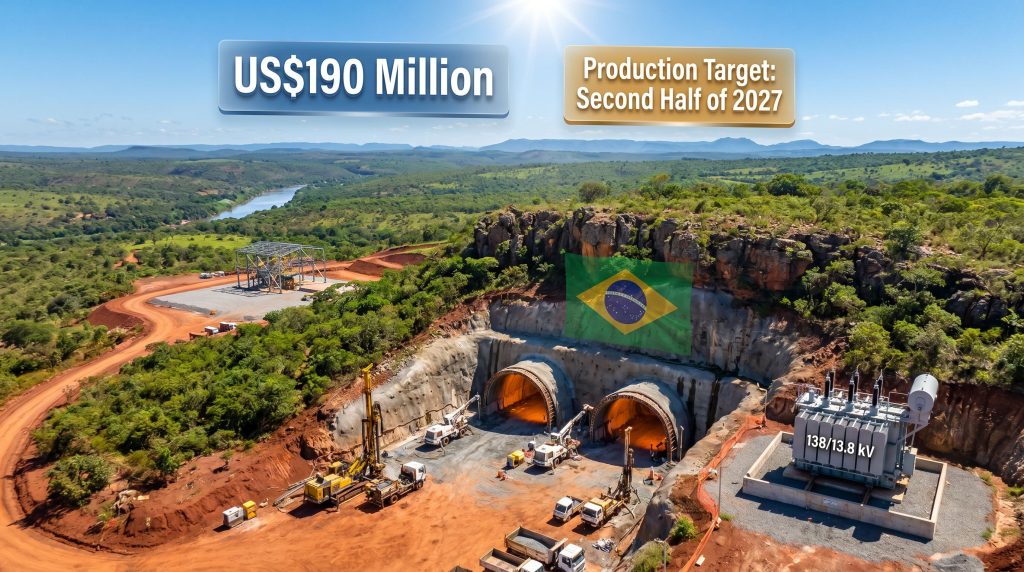
Hard-rock spodumene extraction requires a distinct mining and processing pathway, but it offers one critical advantage: grade consistency and shorter project lead times from resource delineation to production compared to evaporite brine systems. Furthermore, the Bandeira project carries an estimated capital cost of approximately US$190 million and is targeting production commencement in the second half of 2027.
That timeline places it among a narrow group of near-term Latin American lithium supply additions entering the market during a period when battery-grade lithium demand from electric vehicle cathode manufacturers is forecast to intensify significantly.
The end-product targets for Bandeira are lithium hydroxide and lithium carbonate, the two dominant battery-grade lithium chemicals. Lithium hydroxide commands particular commercial attention because it is the preferred feedstock for nickel-rich cathode chemistries such as NMC 811 and NCA, which are increasingly used in high-energy-density EV battery packs. Projects capable of producing hydroxide-grade material carry enhanced offtake negotiating leverage compared to those limited to carbonate output.
Underground Mine Portals: The Gateway That Controls Everything
Why Portal Construction Sits on the Critical Path
An underground mine portal is not simply a hole in a hillside. It is a precision-engineered structure that serves as the sole physical interface between the surface world and all underground operations. Every piece of equipment that enters the mine, every tonne of ore or waste that exits, and every worker who descends into the underground workings must pass through the portal. Its structural integrity, ventilation integration, and drainage management directly determine operational safety and productivity for the life of the mine.
From an engineering standpoint, portal construction involves several interdependent elements:
- Ground support systems including rock bolting, mesh, and steel sets to stabilise the excavation collar
- Shotcrete lining applied in multiple layers with specified compressive strengths matched to local geotechnical conditions
- Portal collaring methodology that accounts for surface weathering profiles, groundwater intersections, and slope stability
- Ventilation duct integration at the portal face to establish fresh air supply for all subsequent underground development
- Surface drainage infrastructure to prevent water ingress from surface runoff during and after construction
The reason portal construction consistently sits on the critical path of underground mining projects is straightforward. No underground development activity can commence until the portal collar is structurally complete and safe for personnel access. Any delay to portal completion creates a direct, day-for-day delay to underground heading advancement, ore access, and ultimately, first production. This is why the Lithium Ionic tender for construction works in Brazil was designed as an early works package rather than waiting for full EPC contract execution. For context, Australia's first underground lithium mine faced similar critical-path portal considerations during its development phase.
Early Works Packages: De-Risking the Schedule Before Full Capital Commitment
In mining project delivery, an early works package allows a project owner to advance critical-path construction activities before a Final Investment Decision commits the full capital envelope. This is a deliberate risk management tool, not an improvised workaround. By tendering the portal works ahead of FID, Lithium Ionic can potentially achieve several months of underground development progress that would otherwise consume post-FID schedule time.
The distinction between an early works package and a full EPC lump-sum contract is significant. Under an EPC model, the contractor assumes design and construction risk for a fixed price, which requires a fully defined scope. Early works packages, however, operate on a narrower, more precisely defined scope where the technical specifications are mature enough for accurate contractor pricing but the full project scope is still being optimised.
Early works tendering of underground portals is a schedule-compression strategy employed by experienced project owners who understand that the gap between FID and first production is itself a financial cost. Every month saved in construction mobilisation translates directly into earlier revenue generation and improved project economics.
Dissecting the July 2026 Portal Tender
Selective RFQ Methodology and What It Signals About Contractor Market Depth
The tender issued on July 8, 2026, took the form of Requests for Quotation sent to seven pre-qualified contractors. The selection of an invitation-only RFQ format over an open tender carries meaningful signals about both the project's maturity and the local contractor market. According to Mining Weekly's coverage of the RFQ process, this selective approach reflects the technical complexity of the scope being procured.
| Procurement Method | Key Characteristics | Suitability for Portal Works |
|---|---|---|
| Open Public Tender | Maximum market participation, longest evaluation cycle | Lower suitability for technically specialised underground scopes |
| Selective RFQ | Pre-qualified field only, faster evaluation, controlled quality | Preferred approach for early-stage underground construction |
| EPC Lump Sum | Full risk transfer, requires fully defined scope | Reserved for later-stage, comprehensively engineered packages |
| EPCM | Owner retains control, contractor manages execution | Common for complex multi-discipline project delivery |
Seven pre-qualified contractors represents a competitive field for underground portal works in Minas Gerais. The pre-qualification process likely assessed each contractor against criteria including demonstrated underground hard-rock mining experience, equipment fleet availability, Brazilian regulatory registrations, and health and safety performance records. The proposals received are currently under technical and commercial evaluation.
Tractebel Engineering: The Technical Foundation Behind the Tender
The portal RFQ was made possible by the prior completion of basic engineering by Tractebel Engineering, a subsidiary operating within the ENGIE Group. Basic engineering is a critical procurement readiness gate that is frequently underappreciated by investors unfamiliar with mining project delivery sequences. Indeed, a robust definitive feasibility study typically underpins the quality of basic engineering deliverables that follow.
Without basic engineering deliverables, contractors cannot produce accurate pricing. The package provides:
- Geotechnical assessment of the portal collar zone, including rock mass classification using systems such as Rock Mass Rating (RMR) or Q-system
- Structural design specifications for ground support, shotcrete application schedules, and steel set requirements
- Portal collar geometry and excavation sequence methodology
- Drainage and water management plans for the portal approach
- Ventilation infrastructure integration requirements
- Access road specifications connecting the surface to the portal face
The involvement of Tractebel Engineering, an entity with institutional engineering credentials operating under the ENGIE Group umbrella, signals that the technical standards being applied to the Bandeira project meet international mining project benchmarks. This matters to project financiers conducting technical due diligence, where the quality of the engineering firm underpinning the procurement process is itself a risk assessment criterion.
A Multi-Stream Procurement Program Running in Parallel
The portal tender is one component of a broader, simultaneously advancing procurement program. The concurrency of multiple procurement streams is itself an indicator of project management sophistication and genuine construction readiness.
Crushing Circuit Procurement
Parallel to the portal tender, Lithium Ionic is evaluating five proposals received from equipment suppliers for the project's primary crushing units. The crushing circuit represents the first stage of the mineral processing chain, receiving run-of-mine ore directly from underground operations and reducing particle size for downstream beneficiation. Equipment selection criteria for a spodumene ore body in Minas Gerais would typically assess:
- Throughput capacity matched to the mine's production rate
- Crushing ratio requirements for the specific ore hardness profile
- Energy consumption per tonne processed, a key operating cost driver
- Maintenance accessibility and spare parts availability in Brazil
- Integration compatibility with the downstream dense media separation and flotation circuit
Long-Lead Equipment: The Power Transformer Order
In June 2026, Lithium Ionic placed its first long-lead equipment order: a main substation power transformer rated at 138/13.8 kV, awarded to Brazilian manufacturer Blutrafos. This procurement decision deserves particular attention from those tracking project execution risk.
High-voltage power transformers are among the most schedule-critical items in any mining project build. Manufacturing lead times for custom-engineered units at this voltage class typically range from 12 to 24 months, and global supply capacity for large power transformers has been constrained by simultaneous demand from renewable energy, grid modernisation, and industrial mining projects across multiple continents. Placing this order in June 2026 consequently positions the transformer to be available for site installation during the construction window targeting a 2027 production start.
Sourcing from a Brazilian domestic manufacturer carries additional strategic logic. It reduces import logistics complexity and customs clearance risk, supports local content considerations relevant to Brazilian regulatory frameworks, and eliminates currency exposure on a critical capital item.
Water Abstraction: Securing Construction-Phase Resources
An 18-month lease agreement for water abstraction rights from the Jequitinhonha River has been secured for the construction phase. This is a detail that receives less investor attention than transformer orders or contractor tenders, yet water availability is a genuine construction-phase risk for large mining projects in semi-arid or seasonally variable catchments.
Construction-phase water demand at a project of Bandeira's scale encompasses concrete batching, shotcrete production for ground support, drilling and blasting operations, dust suppression on haul roads, and workforce amenities. Without a secured water source, any extended dry period could interrupt construction activities and threaten schedule adherence.
The Jequitinhonha River corridor is well-established in the Brazilian mining regulatory framework, and abstraction licensing operates under the state water resources management authority in Minas Gerais. Securing an 18-month lease provides certainty through the critical early construction period encompassing portal development, underground heading advancement, and surface infrastructure installation.
Decoding the Path to Final Investment Decision
Lithium Ionic has indicated that a positive Final Investment Decision is targeted within 2026, contingent on permitting finalisation. The procurement activity described above collectively functions as visible evidence of construction readiness being assembled to satisfy the requirements of project financiers, potential strategic investors, and offtake partners evaluating the project's execution credibility.
| Milestone | Status | Schedule Significance |
|---|---|---|
| Basic Engineering (Tractebel) | Complete | Enables contractor pricing and procurement |
| Portal Construction Tender | Under Evaluation (from July 8, 2026) | Critical-path early works advancement |
| Crushing Unit Procurement | Five Proposals Under Evaluation | Core processing infrastructure decision |
| Power Transformer Order | Placed June 2026 (Blutrafos) | Long-lead risk mitigated |
| Water Abstraction Lease | Secured (18-month term) | Construction-phase resource risk removed |
| Permitting Finalisation | In Progress | Primary remaining FID condition |
| Final Investment Decision | Targeted: 2026 | Full capital commitment trigger |
Projects that reach FID in 2026 occupy a strategically advantageous position. The 2027 to 2028 window represents a period of anticipated acceleration in battery-grade lithium demand from EV manufacturers scaling production volumes, and supply additions from new operations entering the market during this window are likely to benefit from stronger offtake pricing and negotiating leverage than those arriving later in a more competitive supply environment.
The next major ASX story will hit our subscribers first
The Processing Pathway: From Spodumene to Battery-Grade Products
Understanding what happens after ore exits the underground workings provides important context for why the crushing unit procurement and power infrastructure decisions carry the weight they do. Furthermore, technologies such as direct lithium extraction are reshaping how downstream chemical conversion is approached across the industry. The processing chain for spodumene-hosted lithium from a Minas Gerais pegmatite deposit follows a multi-stage sequence:
- Primary crushing reduces run-of-mine ore to manageable particle sizes for downstream processing
- Grinding further reduces particle size to liberate spodumene mineral grains from the host rock matrix
- Dense media separation exploits density differences to separate lithium-bearing spodumene from waste minerals
- Flotation applies chemical reagents to concentrate spodumene further, improving lithium content ahead of conversion
- Calcination at high temperatures converts alpha-spodumene to the beta polymorph, which is reactive to acid leaching
- Chemical conversion through sulphuric acid leaching produces either lithium sulphate solution for carbonate precipitation or lithium hydroxide crystallisation
The electrical load demands of this processing sequence, particularly the grinding mills, flotation cells, and calcination kilns, explain why the 138/13.8 kV substation transformer is classified as a project-critical long-lead item. An undersized or delayed power supply would create a production bottleneck that no amount of efficient underground mining could overcome.
What the Competitive Lithium Landscape Means for Bandeira's Timing
Brazil's positioning within the global hard-rock lithium supply landscape is evolving rapidly. The Bandeira project overview published by Lithium Ionic highlights the Minas Gerais corridor's benefits from established road and port infrastructure connecting to Atlantic export terminals, a deep industrial contractor base with underground mining experience developed across the state's iron ore and gold mining sectors, and a regulatory framework that, while requiring careful navigation, is well-understood by experienced project developers.
Competing hard-rock lithium jurisdictions including Zimbabwe and the Democratic Republic of Congo offer lower-grade ore bodies on average and present more significant infrastructure and sovereign risk challenges. Western Australian spodumene producers, while technically mature, face ongoing cost pressure from labour markets and energy pricing. However, the combination of ore quality, infrastructure access, and proximity to growing South American battery manufacturing investment creates a meaningful competitive position for Brazilian pegmatite producers.
That competitive positioning comes into clearer focus as the Lithium Ionic tender for construction works in Brazil advances through contractor evaluation and the project moves towards a Final Investment Decision. The sequence of milestones achieved to date — basic engineering completion, portal tender issuance, transformer procurement, and water access security — collectively represent a project transitioning from development-stage planning into genuine construction readiness, making Bandeira one of the more credible near-term lithium supply additions in the Latin American pipeline.
Disclaimer: This article contains forward-looking statements and projections regarding project timelines, production targets, market conditions, and financial milestones. These statements involve known and unknown risks and uncertainties. Actual outcomes may differ materially from those expressed or implied. This content is intended for informational purposes only and does not constitute financial advice. Readers should conduct independent due diligence before making any investment decisions.
Want to Catch the Next Major Lithium Discovery Before the Market Does?
Discovery Alert's proprietary Discovery IQ model instantly scans ASX announcements to identify significant mineral discoveries — including lithium — delivering real-time alerts so subscribers can act ahead of the broader market; explore historic examples of major discovery returns to understand the opportunity at stake, and begin a 14-day free trial at Discovery Alert to secure your market-leading advantage.