August 21, 2026
The Architecture of Domestic Battery Sovereignty: Why Federal Capital Flows Matter More Than Policy Headlines
Before a single battery cell rolls off a domestic production line, years of capital allocation decisions, regulatory frameworks, and supply chain engineering must converge. The United States finds itself at a pivotal inflection point in this process, shaped less by individual announcements and more by the cumulative weight of a multi-billion-dollar federal investment architecture designed to reduce vulnerability across the entire battery value chain.
Understanding US DOE battery funding projects requires stepping back from individual grant announcements and examining the structural logic underneath them: why certain technologies are prioritised, how political cycles introduce risk, and what the global competitive landscape demands of American industrial policy. This analysis explores the battery metals investment landscape to understand what is truly at stake.
When big ASX news breaks, our subscribers know first
Why the U.S. Battery Supply Chain Became a National Security Priority
The story of American battery vulnerability did not begin with legislation. It began with decades of offshoring manufacturing capacity and allowing upstream mineral processing to concentrate in foreign jurisdictions, most notably China, which controls an estimated 70-80% of global lithium-ion battery cell manufacturing capacity and dominates the processing of graphite, a critical anode material, with over 90% of global natural graphite anode supply refined within its borders.
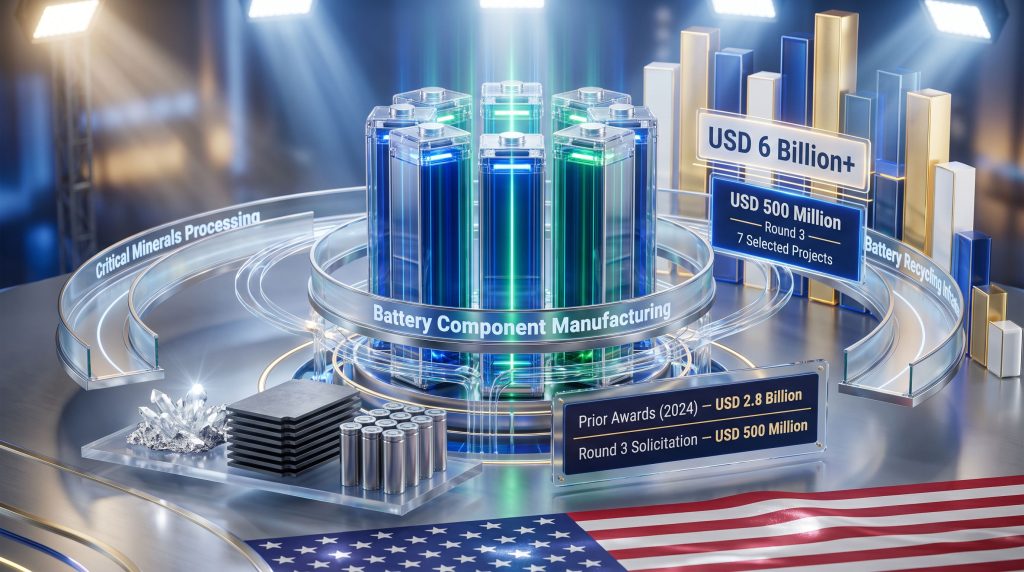
This concentration creates cascading risk. When EV adoption targets accelerate and grid storage demand surges simultaneously, a supply chain anchored offshore becomes a strategic liability rather than a cost optimisation. The legislative response came through the Bipartisan Infrastructure Law, which established the foundational funding mechanism for what has become a USD 6 billion+ federal battery investment framework spanning manufacturing, processing, recycling, and advanced research.
Key vulnerabilities driving the federal intervention include:
- Dependence on Chinese-processed graphite for anode materials in virtually all lithium-ion battery chemistries
- Absence of commercial-scale domestic lithium hydroxide and lithium carbonate refining capacity
- Near-zero domestic production of separator, electrolyte, and cathode active materials outside of niche applications
- Limited closed-loop recycling infrastructure for end-of-life battery material recovery
How the USD 500 Million Round 3 Solicitation Fits Into the Broader Framework
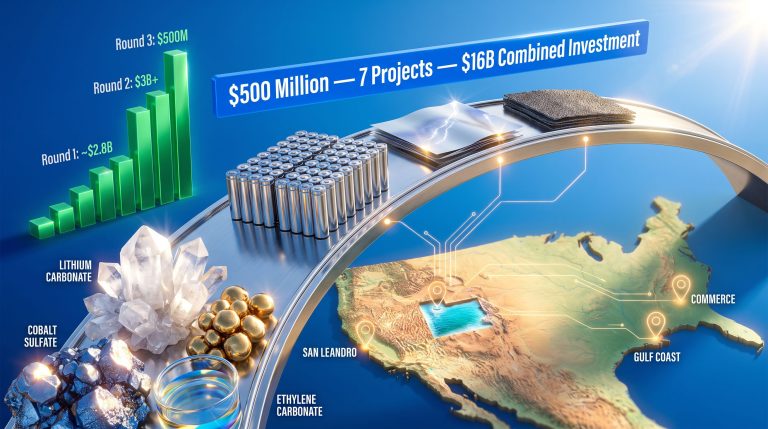
The DOE's Round 3 solicitation, deploying USD 500 million across seven selected projects, represents one deployment layer within a far larger capital architecture. To understand its significance, it must be mapped against the full federal battery funding ecosystem.
| Funding Mechanism | Approximate Capital | Projects/Recipients | Primary Target |
|---|---|---|---|
| Battery Materials Processing Grants | USD 3 billion | Multiple commercial-scale facilities | Critical mineral refining and processing |
| Battery Manufacturing and Recycling Grants | USD 3 billion | Component manufacturing, recycling | Cell assembly, closed-loop recovery |
| EV Battery and Charging R&D | USD 131 million | 27 projects + USABC award | Applied EV research, charging systems |
| Office of Science Innovation Hubs | USD 125 million | 2 multi-institutional teams | Post-lithium-ion chemistry research |
| FY2024 VTO Batteries FOA | USD 43 million | Multiple R&D recipients | Silicon anodes, high-energy cathodes |
| Round 3 Solicitation | USD 500 million | 7 selected projects | Critical minerals, recycling, manufacturing |
What distinguishes Round 3 is not merely its scale but its strategic positioning within the commercialisation pipeline. Earlier rounds targeted demonstration and early commercial-scale facilities. Round 3 reflects a maturing programme that increasingly emphasises projects with near-term production readiness, domestic content alignment, and verifiable private co-investment.
The Policy Logic Behind Selecting Seven Projects
The selection of seven recipients rather than spreading capital across a broader applicant pool reflects a deliberate concentration strategy. Federal battery investment theory has shifted away from thin-spread grant programmes toward high-conviction, high-impact deployments where each dollar is expected to unlock substantial private capital alongside it.
The DOE's project selection criteria for Round 3 evaluates applicants across several weighted dimensions:
- Technical merit and commercial readiness – proximity to production-scale operations
- Domestic job creation potential – direct and indirect employment multipliers
- Supply chain integration – how well the project connects with upstream and downstream partners
- Environmental compliance – alignment with EPA standards and community impact frameworks
- Domestic content thresholds – adherence to Buy American and domestic sourcing requirements
Which Supply Chain Segments Receive the Deepest Capital Commitment
The DOE's technology prioritisation reveals where federal analysts assess the greatest strategic gaps. The distribution of capital across Round 3 and the broader funding architecture suggests a clear hierarchy of urgency.
Critical Minerals Processing
This segment receives disproportionate attention because processing, not mining, is where American supply chain vulnerability is most acute. A lithium deposit in Nevada provides no strategic security if the ore must travel to Asia for conversion into battery-grade lithium hydroxide. Furthermore, the critical minerals demand driven by the energy transition only intensifies this urgency. Priority processing targets include:
- Lithium hydroxide monohydrate (LiOH·H₂O) refining for high-nickel cathode chemistries
- Battery-grade synthetic and natural graphite production for anode applications
- Manganese sulfate, nickel sulfate, and cobalt sulfate production for cathode active material synthesis
Battery Component Manufacturing
Mid-stream manufacturing capacity for separators, electrolytes, and cathode and anode active materials remains almost entirely absent from American industrial geography. Federal capital flowing into this segment targets both pouch and prismatic cell formats for EV applications and cylindrical formats for stationary storage. In addition, emerging technologies such as direct lithium extraction are increasingly relevant to how efficiently these supply chains can be established.
Battery Recycling Infrastructure
Recycling sits at a strategic intersection: it simultaneously reduces import dependency, manages end-of-life waste streams, and provides a domestic feedstock of already-processed critical minerals. The two primary recovery pathways funded under DOE programmes include hydrometallurgical processing (using aqueous chemistry to dissolve and selectively recover metals from black mass) and pyrometallurgical processing (high-temperature smelting to recover metal alloys). Hydrometallurgical routes generally offer higher purity outputs but require more capital-intensive front-end processing.
Notably, a recent battery recycling breakthrough has demonstrated how rapidly the global recovery landscape is evolving, adding competitive pressure on American programmes to accelerate deployment.
Technical Note: Black mass, the powdered mixture of cathode and anode active materials recovered after battery disassembly and shredding, contains lithium, cobalt, nickel, and manganese at concentrations that can exceed those found in primary ore deposits, making recycling economics increasingly competitive as battery chemistries evolve toward higher-value cathode materials.
Advanced Research: The Long Game
The DOE's USD 125 million Energy Innovation Hub investment and the USD 43 million VTO Batteries FOA target battery chemistries that do not yet exist at commercial scale but are expected to reshape the industry within 10-15 years. Key research vectors include solid-state electrolyte development, silicon-dominant anode architectures (which can theoretically store roughly 10 times more lithium per unit volume than conventional graphite), and post-lithium-ion platforms such as sodium-ion and lithium-sulphur.
The Political Risk Dimension: USD 700 Million in Cancelled Awards
Federal battery funding operates within a political environment that can reverse commitments. Reports of more than USD 700 million in previously announced battery and manufacturing awards being suspended or revoked under executive review represent a material data point that private sector participants and project financiers cannot ignore.
Risk Framework: DOE grant awards occupy a structurally different risk position than DOE loan guarantees administered through the Loan Programs Office. Grants carry performance milestone requirements but lack the contractual and collateral protections embedded in loan guarantee structures. This distinction matters significantly when project developers attempt to use a DOE award as a lever for attracting debt financing.
The cancellation episode reveals several dynamics that sophisticated market participants should incorporate into their analytical frameworks:
- Federal battery funding commitments are subject to executive-level review and are not legally equivalent to appropriated funds until disbursement milestones are met
- Projects with diversified capital structures, combining DOE grants with private equity, strategic partnerships, and state-level incentives, carry meaningfully lower binary risk
- The seven newly selected Round 3 projects are entering an environment where prior awardees experienced cancellations, which may affect lender willingness to provide bridge financing ahead of milestone-based disbursements
Global Competitive Context: Where the U.S. Stands Among Peer Programmes
American battery investment does not occur in a vacuum. Competing industrial programmes across allied and rival nations establish the baseline against which U.S. progress must be measured.
| Country / Region | Primary Funding Mechanism | Approximate Scale | Strategic Emphasis |
|---|---|---|---|
| United States | DOE Bipartisan Infrastructure Law | USD 6 billion+ | Mid-stream processing, recycling, manufacturing |
| European Union | European Battery Alliance / IPCEI | EUR 6.1 billion+ | Gigafactory development, cell manufacturing |
| China | State-directed industrial policy | Undisclosed, dominant | Full vertical integration across supply chain |
| United Kingdom | Automotive Transformation Fund | GBP 500 million+ | Gigafactory support, EV supply chain |
| Australia | Critical Minerals Strategy | AUD 4 billion+ | Upstream mining and early-stage processing |
A critical structural difference in the American approach is its mid-stream orientation. While Australia invests heavily in upstream extraction and Europe focuses on downstream gigafactory development, the DOE's framework deliberately targets the processing and component manufacturing layers in between. This reflects an assessment that this is where the U.S. faces its greatest competitive disadvantage and where federal capital can generate the highest strategic return.
The Minerals Security Partnership, a multilateral framework connecting the U.S. with allied mineral-producing nations, complements the domestic DOE programme by addressing upstream supply that federal funding alone cannot create on American soil. Furthermore, understanding shifts in the battery raw materials market is essential for contextualising where these international partnerships will have the most impact.
The next major ASX story will hit our subscribers first
From Award to Operation: The Commercialisation Timeline Reality
One of the most consistently underestimated dimensions of US DOE battery funding projects is the gap between announcement and operational capacity. Based on historical patterns from earlier DOE award cycles, the realistic timeline from grant announcement to commercial production spans three to seven years, depending on project type, permitting complexity, and technology readiness level.
Key milestones between award announcement and first commercial output typically include:
- Negotiation and execution of award agreements with the DOE project management office
- Environmental review and permitting at federal, state, and local levels
- Engineering, procurement, and construction contracting
- Equipment manufacturing lead times, particularly for specialised processing equipment with 18-36 month delivery windows
- Commissioning, testing, and ramp-up to nameplate capacity
The DOE's milestone-based disbursement structure is designed to protect federal capital by releasing tranches only upon verified project progress. This mechanism provides accountability but also creates cash flow challenges for project developers who must bridge funding gaps between disbursements. The DOE's battery manufacturing and recycling grants programme outlines these milestone requirements in detail for prospective applicants.
Frequently Asked Questions: US DOE Battery Funding Projects
What is the total DOE battery funding commitment under current programmes?
The DOE has committed more than USD 6 billion across battery materials processing and manufacturing and recycling grant programmes established under the Bipartisan Infrastructure Law, with the Round 3 solicitation adding another USD 500 million directed at seven selected projects.
Can previously announced DOE battery awards be revoked?
Yes. Reports confirm that more than USD 700 million in prior awards were cancelled or suspended under executive review, demonstrating that federal grant commitments carry political cycle risk that must be factored into project financial modelling.
What is the USABC and why is it significant?
The United States Advanced Battery Consortium is a collaborative pre-competitive research body involving major American automakers. Its USD 60 million DOE award funds advanced battery development targeting next-generation EV performance and cost reduction benchmarks that individual companies would not fund independently.
How does DOE grant funding differ from DOE loan guarantees?
Grants do not require repayment but carry milestone conditions and political risk. Loan guarantees, administered separately through the DOE's Loan Programs Office, provide debt financing with contractual protections and collateral structures that are generally more robust for attracting co-investment from commercial lenders.
What battery chemistries beyond lithium-ion are receiving federal R&D investment?
The DOE's Office of Science Energy Innovation Hubs are funding research into sodium-ion, lithium-sulphur, and lithium-air platforms, alongside solid-state electrolyte development and silicon anode architectures that promise step-change improvements in energy density relative to current graphite-based cells.
Key Takeaways for Investors, Developers, and Policy Analysts
The selection of seven projects under the USD 500 million Round 3 solicitation is best understood not as a discrete event but as one milestone within a multi-year, multi-layered federal battery investment programme with compounding strategic logic.
- The DOE's concentration of capital into seven high-conviction projects reflects a maturation of federal battery investment strategy toward commercial-scale impact rather than broad grant distribution
- Political risk remains a structural feature of federal battery funding, not an anomaly, requiring project developers to build resilient capital structures that do not rely solely on DOE disbursements
- Mid-stream processing and recycling represent the deepest strategic gaps in the domestic battery supply chain and receive disproportionate federal capital accordingly
- The three-to-seven year commercialisation timeline from award to production means that the supply chain benefits of current funding rounds will not be fully visible until the early 2030s
- Private co-investment requirements embedded in DOE grant structures serve as market validation mechanisms, distinguishing commercially viable projects from those dependent entirely on subsidy
For ongoing coverage of US DOE battery funding projects, domestic energy storage policy developments, and global battery supply chain investment trends, Renewables Now at renewablesnow.com provides comprehensive tracking of regulatory announcements, project milestones, and sector developments across U.S. and international markets.
Disclaimer: This article is intended for informational purposes only and does not constitute financial or investment advice. Forecasts, timelines, and scenario projections referenced herein involve inherent uncertainty. Readers should conduct independent due diligence before making any investment decisions related to the battery materials, energy storage, or clean energy sectors.
Want to Identify the Next Major Battery Metals Discovery Before the Market Does?
Discovery Alert's proprietary Discovery IQ model scans ASX announcements in real time, delivering instant alerts on significant mineral discoveries across battery metals and critical minerals — turning complex data into actionable investment opportunities for traders and long-term investors alike. Explore how historic discoveries have generated substantial returns on Discovery Alert's dedicated discoveries page, and begin your 14-day free trial today to position yourself ahead of the market.