August 21, 2026
The Hidden Bottleneck in America's Battery Ambitions
The United States sits atop significant lithium resources, has access to cobalt through allied supply chains, and produces metallurgical silicon in commercial quantities. Yet for years, the country has remained heavily dependent on foreign processors, refiners, and component manufacturers to convert those raw inputs into the battery-grade materials that power electric vehicles, grid storage systems, and defence platforms. The core problem was never simply about mining more; it was about building the industrial infrastructure to transform extracted minerals into specification-grade battery inputs. That processing gap, long underappreciated in public discourse, has now become the explicit target of sustained federal investment through DOE battery supply chain funding programs authorised under the Infrastructure Investment and Jobs Act.
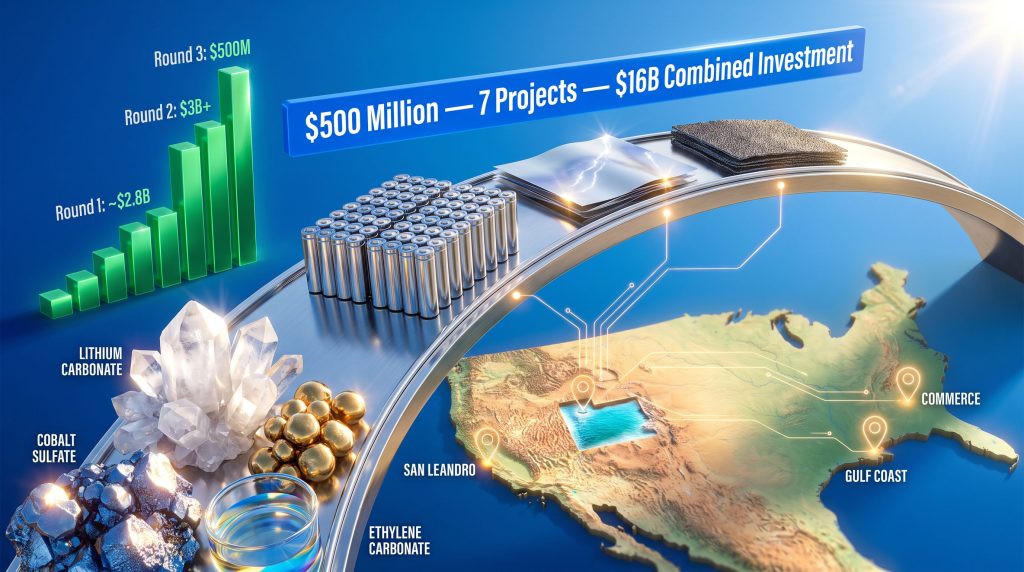
The August 2026 announcement of a third funding round, directing $500 million across seven carefully chosen projects, represents both a continuation of that strategy and a meaningful evolution in its technical ambition.
When big ASX news breaks, our subscribers know first
The Legislative Foundation: Two Programs, One Strategic Goal
The IIJA created two parallel grant programs within the Department of Energy, each authorised at up to $3 billion, that together address the full battery value chain:
- Battery Materials Processing Grants (Section 40207(b)): Targets the conversion of raw critical minerals into battery-grade chemical forms, addressing the processing gap between extraction and manufacturing.
- Battery Manufacturing and Recycling Grants (Section 40207(c)): Focuses on downstream component fabrication and end-of-life material recovery, closing the loop between spent batteries and new production inputs.
"The deliberate separation of these two programs reflects a sophisticated understanding of where domestic capability is weakest. Mining capacity, while underdeveloped, has attracted significant private capital. Processing and component manufacturing have not, and federal grants are structured to correct that market failure."
Furthermore, a critical feature of both programs is the minimum 50% private cost-share requirement. Every company receiving a federal grant must commit at least equivalent private capital, ensuring that taxpayer investment catalyses commercial-scale commitments rather than subsidising projects that cannot attract market interest. This structural discipline is easy to overlook in headline funding figures but fundamentally shapes which projects advance.
Three Rounds of Investment: Cumulative Progress by the Numbers
DOE battery supply chain funding has now deployed across three distinct rounds, each building on the last:
| Funding Round | Date | Projects Selected | Federal Commitment | Combined Investment |
|---|---|---|---|---|
| Round 1 | October 2022 | 20 companies | ~$2.8B selected / $1.82B awarded | Part of ~$16B total |
| Round 2 | September 2024 | 25 projects across 14 states | $3B+ | Part of ~$16B total |
| Round 3 | August 2026 | 7 projects | $500M | To be determined |
| Cumulative | 2022-2026 | 39+ projects | ~$5B in grants | ~$16B combined |
What the numbers above don't fully capture is the qualitative shift across rounds. Round 1 cast a wide net, funding broad capacity across a range of materials and geographies. Round 2 scaled up, distributing investment across 14 states with growing emphasis on recycling. Round 3 is the most targeted yet, concentrating $500 million across just seven projects chosen for their ability to fill specific, identified gaps rather than simply add general capacity.
What "Selected" vs. "Awarded" Means
An important distinction in DOE funding terminology is the difference between selection and award. A project being selected means it has been identified as a potential recipient and enters a due diligence and negotiation phase. An award represents the binding commitment of federal funds following successful completion of that process.
Round 1 illustrates this clearly: whilst 20 companies were selected for $2.8 billion, final awards of $1.82 billion went to 14 projects. Investors and industry watchers should treat Round 3's $500 million as a selection figure, with final award values subject to further negotiation.
The Seven Projects: What They Do and Why They Were Chosen
Battery Materials Processing Selections
Waterleaf P1 HoldCo LLC (Lilac Solutions) – $100M Federal Share
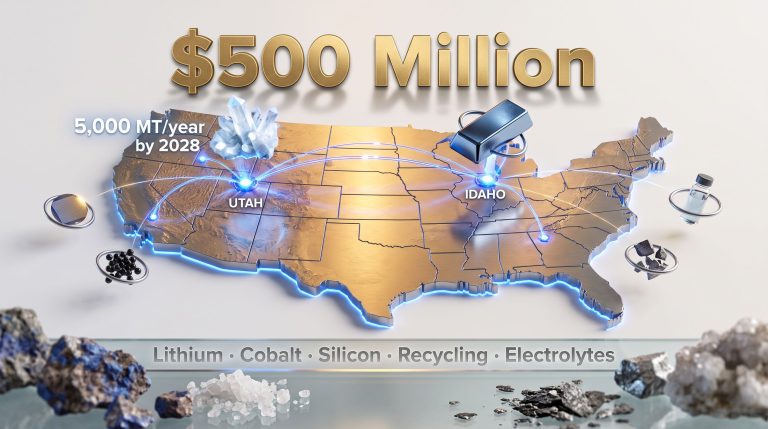
Located at West Promontory on the northeastern shore of the Great Salt Lake in Utah, this project targets commercial-scale lithium extraction and refining using Lilac Solutions' proprietary ion exchange technology. The facility is designed to produce battery-grade lithium carbonate whilst returning processed brine to the lake with no net water loss, addressing both supply and environmental concerns simultaneously.
The strategic significance here extends beyond the single facility. Phase one is explicitly aimed at doubling current U.S. lithium production capacity, which underscores how underdeveloped domestic refining infrastructure remains. The Great Salt Lake brine resource is technically distinct from hard rock lithium deposits: it requires different extraction chemistry, produces different byproduct streams, and can be scaled incrementally in ways that mining operations cannot.
Ion exchange-based direct lithium extraction from brines represents a newer processing pathway compared to conventional evaporation pond methods, offering higher lithium recovery rates and a significantly smaller land footprint.
Formation Holdings US Inc. (Jervois) – $100M Federal Share
This selection addresses cobalt, arguably the most geopolitically concentrated battery metal in commercial use. The majority of global cobalt refining capacity is concentrated in China, with primary cobalt originating predominantly from the Democratic Republic of Congo. The absence of meaningful domestic cobalt refining infrastructure means that even if the U.S. secured cobalt ore through allied supply chains, it would still depend on foreign processors to produce the battery-grade cobalt sulfate that cathode manufacturers require.
The Jervois-linked project targets exactly that gap, using established commercial refining processes to produce battery-grade cobalt sulfate and related materials at a domestic industrial site. The location remains to be determined, but the strategic intent is clear: establish an end-to-end domestic processing pathway for a mineral where foreign dependency creates genuine supply chain vulnerability. Growing critical minerals demand across the energy transition makes this intervention particularly timely.
Battery Manufacturing and Recycling Selections
Nth Cycle Inc. – $100M Federal Share
Black mass processing sits at the technical and economic core of lithium-ion battery recycling. When spent batteries are shredded, the resulting material — a dark mixture of lithium, nickel, cobalt, manganese, and graphite — is called black mass. Converting that heterogeneous mixture back into high-purity, specification-grade battery materials is technically demanding and currently dominated by a small number of facilities, most located outside the United States.
Nth Cycle's OYSTER electroextraction platform uses electrical current to selectively dissolve and recover individual metals from black mass, offering a more targeted recovery approach compared to conventional pyrometallurgical smelting, which requires significant downstream refining and generates substantial emissions. The battery recycling process at this southeastern U.S. facility would establish meaningful domestic black mass processing capacity for the first time at commercial scale.
Princeton NuEnergy Inc. – $50M Federal Share
Battery manufacturing generates substantial quantities of cathode material scrap before a single cell reaches a consumer. During electrode coating, slitting, and cell assembly, off-spec material and trim losses accumulate in volumes that represent real economic and strategic value. Princeton NuEnergy's low-temperature plasma cathode rejuvenation process recovers nickel-containing cathode material from this manufacturing scrap and restores its electrochemical properties for direct reuse in new battery production.
This approach targets a supply stream that is geographically predictable, chemically consistent, and currently underutilised. The demonstration facility in Commerce, Georgia, positions the company near emerging southeastern U.S. battery manufacturing clusters.
Arcanum Ventures LLC – $50M Federal Share
Ethylene carbonate is a critical solvent in the liquid electrolyte systems used in the vast majority of commercial lithium-ion batteries. It is essential for forming stable solid electrolyte interphase layers on graphite anodes, enabling the reversible lithium insertion and extraction that makes rechargeable batteries function. Despite its centrality to battery performance, domestic production of battery-grade ethylene carbonate is extremely limited.
Supply is predominantly sourced from Asian chemical producers, which is precisely the type of dependency that rarely appears in critical mineral policy discussions, focusing as they tend to on metals rather than organic chemical precursors. A Gulf Coast facility producing battery-grade ethylene carbonate using established chemical processing technology would address a supply chain vulnerability that is structural but largely invisible to non-specialist observers.
Elevated Materials LLC – $50M Federal Share
Lithium-metal anodes represent the highest-energy-density pathway for next-generation battery architectures, particularly solid-state and semi-solid cell designs being pursued by multiple automotive and defence programs. Ultra-thin lithium-metal films, typically measured in micrometres, must be produced with exceptional thickness uniformity and surface purity to function reliably in these advanced cells. Scaled domestic manufacturing of such films does not currently exist in commercial volumes.
Elevated Materials targets exactly this gap, scaling pilot-level production processes to gigawatt-hour volumes. The prelithiated materials the company also produces are relevant to a separate but related application: adding lithium to silicon anodes before first charge to compensate for initial lithium loss during the formation cycle, thereby improving energy density and cycle life in conventional lithium-ion cells.
Coreshell Technologies Inc. – $50M Federal Share
Silicon anodes can store approximately ten times more lithium per unit mass than conventional graphite anodes, but they expand and contract dramatically during charging, causing mechanical degradation over repeated cycles. Coreshell's approach applies a protective coating to silicon particles that accommodates this volume change, enabling silicon-anode electrodes to achieve both the high energy density silicon promises and the cycle life commercial batteries require.
The San Leandro facility would produce silicon-anode electrodes and full cells using domestically sourced metallurgical silicon, replacing imported synthetic graphite. Paired with dry-coated cathode technology that eliminates the solvent-intensive processes used in conventional cathode electrode manufacturing, this project is positioned to establish what the DOE describes as the first dedicated silicon-anode gigafactory in the United States.
Round 3 vs. Earlier Rounds: A Strategic Comparison
| Dimension | Round 1 (2022) | Round 2 (2024) | Round 3 (2026) |
|---|---|---|---|
| Projects Selected | 20 | 25 | 7 |
| Federal Funding | ~$2.8B selected | $3B+ | $500M |
| Geographic Spread | Multiple states | 14 states | Multiple regions |
| Technology Focus | Broad capacity | Scale-up | Targeted gaps and next-generation |
| Recycling Emphasis | Limited | Moderate | Explicit ($100M dedicated) |
| Advanced Materials | Minimal | Growing | Central (silicon anodes, lithium-metal) |
The reduction in project count from 25 to 7 is not a sign of reduced ambition. It reflects a deliberate shift toward higher-precision investments that fill identified structural gaps rather than distributing smaller amounts across a broader portfolio. Consequently, fewer, larger, and more strategically targeted commitments characterise Round 3's approach.
What the Critical Minerals Targeted Tell Us About Remaining Vulnerabilities
The minerals and materials addressed across Round 3 selections reveal where domestic capability remains most fragile. In addition, the battery raw materials picture is considerably more complex than headline lithium and cobalt figures suggest:
- Lithium: U.S. refining capacity is so limited that doubling it through a single facility represents a material improvement. Most domestic lithium production currently feeds into foreign processing chains before returning as battery-grade material.
- Cobalt: The entire domestic cobalt sulfate refining sector is essentially non-existent, making even allied cobalt supply chains dependent on foreign processing nodes.
- Nickel: Whilst not targeted through new mining, nickel recovery from manufacturing scrap addresses growing demand for cathode-grade nickel without adding pressure to primary supply chains.
- Silicon: Domestically abundant as metallurgical-grade silicon, but the pathway from metallurgical silicon to battery-grade silicon anode materials involves significant processing steps that are currently performed offshore.
- Ethylene carbonate: A chemical precursor with no domestic battery-grade production at scale, representing a hidden electrolyte supply chain dependency that extends beyond metals entirely.
"The breadth of materials targeted in a single $500 million round underlines how multi-dimensional the domestic battery supply chain deficit actually is. Addressing it requires simultaneous intervention across metals, chemicals, and advanced manufacturing, not sequential investment."
The next major ASX story will hit our subscribers first
Frequently Asked Questions: DOE Battery Supply Chain Funding
What is DOE battery supply chain funding?
Federal grant programs authorised under the Infrastructure Investment and Jobs Act that provide financial support for domestic battery materials processing, component manufacturing, and recycling, with the goal of reducing U.S. reliance on foreign supply chains for energy storage materials.
How much has the DOE committed to battery supply chain development?
Across three rounds of funding, the DOE has selected projects representing approximately $5 billion in federal grants, supporting 39+ projects and catalysing an estimated $16 billion in combined public and private investment. The US battery supply chain momentum generated by this programme has drawn considerable attention from industry analysts globally.
Who is eligible to apply for DOE battery supply chain grants?
Domestic entities including private companies, joint ventures, and project developers working on critical mineral processing, battery component manufacturing, or battery recycling within the United States. A minimum 50% private cost-share is required.
What types of projects qualify?
Eligible projects span raw feedstock processing into battery-grade materials, recycling of end-of-life batteries and manufacturing scrap, and manufacturing of advanced battery components including anodes, cathodes, electrolytes, and full cells. However, projects must demonstrate clear domestic supply chain benefit to qualify for consideration.
What is black mass and why does it matter?
Black mass is the shredded output of spent lithium-ion batteries, containing recoverable lithium, nickel, cobalt, manganese, and graphite. Furthermore, the lithium brine extraction and black mass processing industries both feed into the same closed-loop domestic supply chain vision that reduces long-term dependence on primary mineral imports.
Key Takeaways
- Seven projects selected across lithium refining, cobalt processing, recycling, electrolyte chemistry, and advanced anode manufacturing
- $500 million in federal funding structured across three targeted allocation categories
- Cumulative federal commitment now reaches approximately $5 billion across 39+ projects
- ~$16 billion in combined investment mobilised across the domestic battery supply chain
- Round 3 signals a deliberate shift toward next-generation battery materials alongside conventional capacity expansion
- The 50% cost-share requirement ensures private capital amplifies the federal grant impact
- Projects span the full value chain, from mineral refining through recycling, targeting multiple dependency points simultaneously
- The inclusion of ethylene carbonate production marks a rare acknowledgment that electrolyte chemistry, not just metals, represents a genuine domestic supply chain gap
This article is intended for informational purposes only and does not constitute financial or investment advice. Statements regarding project selections represent DOE designations and are subject to final negotiation and award processes. Readers should conduct independent due diligence before making any investment decisions related to companies or sectors discussed herein.
Want to Identify the Next Major Battery Minerals Discovery Before the Market Does?
Discovery Alert's proprietary Discovery IQ model scans ASX announcements in real time, instantly alerting subscribers to significant mineral discoveries across lithium, cobalt, silicon, and the full suite of battery-critical commodities — turning complex data into actionable investment insights. Explore historic discoveries and their returns to understand the opportunity, then begin your 14-day free trial at Discovery Alert to position yourself ahead of the market.