August 20, 2026
The Gigafactory Illusion: Why India's Battery Ambitions Face a Decade-Long Reality Check
Global energy transitions are rarely derailed by a lack of ambition. They falter at the intersection of industrial capacity, capital deployment, and the unglamorous mechanics of supply chain construction. Nowhere is this tension more visible right now than in India's battery storage sector, where announced capacity targets and ground-level manufacturing reality exist in entirely different dimensions.
Understanding the depth of India's battery manufacturing import dependency requires moving beyond headline gigawatt figures and examining the structural economics underneath. The numbers, when laid out in full, reveal a country that is simultaneously one of the world's most attractive battery manufacturing destinations and one of its most import-reliant battery consumers. Furthermore, the broader battery metals investment landscape provides important context for understanding why this gap has proven so difficult to close.
When big ASX news breaks, our subscribers know first
The Numbers That Define the Problem
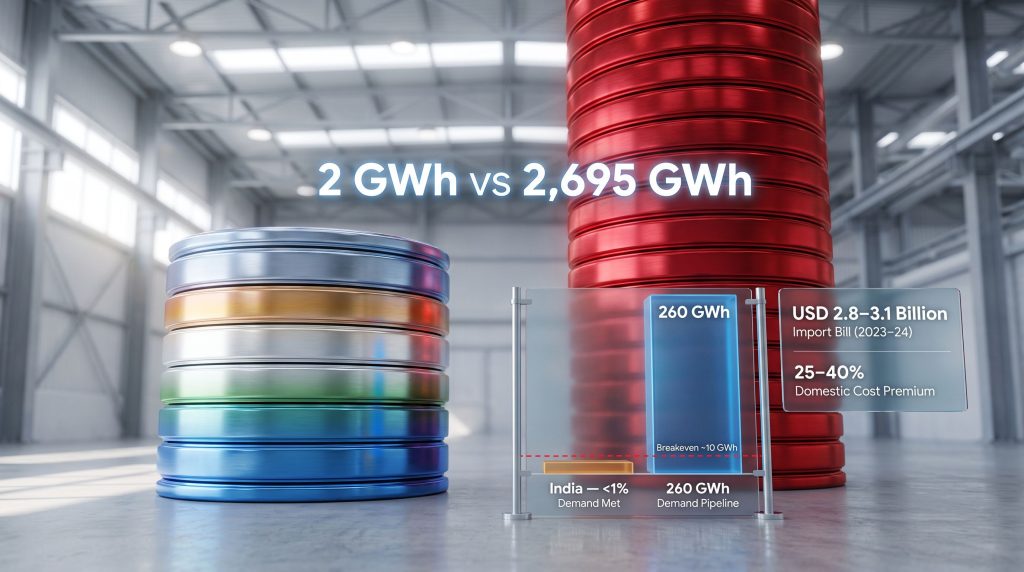
According to a Wood Mackenzie report titled Chasing Self-Sufficiency: Cost of Building an Indigenous Battery Storage Supply Chain in India, India had just 2 GWh of commissioned cell manufacturing capacity as of 2026. Set against a demand pipeline of approximately 260 GWh generated by competitive tenders in the same year, this places domestic supply at less than 1% of near-term requirement.
That gap is not a rounding error. It is a structural exposure that affects energy pricing, grid reliability planning, and the long-term economics of India's renewable buildout.
China, the global benchmark for battery manufacturing scale, held cumulative commissioned capacity of 2,695 GWh in the same period. The ratio between India and China is approximately 1:1,347. Even accounting for the differences in market size and industrial history, that disparity frames the magnitude of the catch-up challenge India faces.
| Metric | India (2026) | China (2026) |
|---|---|---|
| Commissioned Cell Manufacturing Capacity | 2 GWh | 2,695 GWh |
| Share of Global Supply Chain Components | Nascent | 85%–98% across all major nodes |
| Estimated Time to Self-Sufficiency | 10–15 years | Already dominant |
| Domestic Cost Premium vs. Imports | 25–40% higher | Benchmark global price setter |
How Import Dependency Is Embedded Across the Value Chain
India's reliance on overseas battery supply is not concentrated in a single weak point. It runs vertically through the entire value chain, from raw mineral inputs through to finished cell production. Each layer carries its own dependency profile.
The Layered Structure of Battery Import Reliance
-
Lithium-ion cells account for roughly 75%–80% of total battery system cost and represent the primary bottleneck in domestic supply. Almost all cells consumed in India are imported.
-
Critical raw materials including lithium, cobalt, nickel, and graphite are sourced at near-100% import dependency. India has limited domestic reserves of battery-grade lithium and currently lacks the refining infrastructure to process what is available.
-
Upstream chemical components covering cathode active materials, anodes, separators, and electrolytes are sourced almost entirely from Chinese or Korean manufacturers, including for facilities that brand themselves as domestic producers.
-
Battery pack assembly is the one area where India has developed meaningful local activity, but this is analogous to assembling a product from foreign parts and calling it domestic manufacturing.
The distinction between assembly and genuine manufacturing is commercially significant. Pack assembly captures a fraction of the value in the battery supply chain. The high-margin, high-complexity work happens at the cell and component level, where India remains almost entirely dependent on imports. In addition, shifts in the battery raw materials market continue to influence pricing dynamics across these very segments.
China's Structural Lock on India's Supply Chain
Wood Mackenzie's analysis confirms that China controls between 85% and 98% of global capacity across every major battery supply chain component, from cathode to anode, separator to electrolyte. For India specifically:
-
China supplies an estimated 63% to 85%+ of India's lithium-ion cell imports, depending on the measurement period and product category
-
India's total battery and cell import bill reached approximately USD 2.8 to 3.1 billion in 2023–2024, reflecting the sharp acceleration of storage deployment ambitions
-
Technology licences for most Indian gigafactory projects are sourced from Chinese or Korean manufacturers, which means that even as India builds physical infrastructure, the intellectual and process control underpinning that infrastructure remains offshore
This last point is particularly consequential. A gigafactory built under a Chinese technology licence is not a path to supply chain independence. It is a more sophisticated form of the same dependency.
India's Hidden Competitive Strength
The picture is not uniformly negative. India possesses genuine underlying cost competitiveness as a battery manufacturing destination, which becomes increasingly relevant as global supply chains seek to diversify away from single-country concentration risk.
Wood Mackenzie's modelling places India second only to China among major manufacturing destinations on underlying cost metrics:
-
India holds a 154% cost advantage over Japan as a manufacturing location
-
India maintains a 9% cost advantage over South Korea
-
Labour costs, land availability, and engineering talent pools all contribute to a structurally attractive cost base
The complication is that this cost advantage is largely theoretical in the near term. Domestically manufactured cells currently cost 25% to 40% more than equivalent imports, driven by three compounding disadvantages.
Why Domestic Cells Still Carry a 25–40% Cost Premium
-
Insufficient production scale — Gigafactory economics only become viable above certain volume thresholds that most Indian facilities have not reached. Fixed costs spread across lower volumes produce uncompetitive unit economics.
-
Higher financing costs — Indian manufacturers access capital at materially higher rates than Chinese competitors, many of whom benefit from state-backed financing mechanisms that compress their cost of capital.
-
Underdeveloped supplier ecosystems — The absence of a mature domestic supply base for cell inputs forces Indian manufacturers to import precursor materials at spot or contract prices that do not reflect the volume discounts available to vertically integrated Chinese producers.
The Gigafactory Viability Problem
Only four players had commissioned gigafactories in India as of 2026. The broader announced pipeline of 226 GWh of cell manufacturing capacity through 2035 faces substantial execution risk, and the financial logic of why becomes clear when examining the scale economics.
| Production Scale | EBITDA Performance |
|---|---|
| ~5 GWh | Approximately –10% EBITDA (loss-making) |
| ~10 GWh | Breakeven threshold |
| ~20 GWh+ | Positive margin territory |
A 5 GWh facility operating at roughly negative 10% EBITDA is not simply a project in its early ramp-up phase. It is a facility that structurally cannot attract sustained capital unless investors have a clear and credible path to scale. Most announced Indian gigafactory projects have not yet demonstrated that credibility convincingly.
The technology dependency compounds this. Plants operating under Chinese or Korean licences have limited control over input pricing, process improvements, and long-term supply arrangements. This reduces their ability to optimise cost structures independently over time.
Downstream Localisation: The Pragmatic Near-Term Strategy
Recognising the decade-long timeline for upstream self-sufficiency, India's industrial strategy is appropriately prioritising near-term localisation in areas where it is technically and commercially achievable. According to Wood Mackenzie, this means focusing on downstream components over the next two to three years.
The priority localisation targets include:
-
Battery containers and enclosures
-
Energy management systems (EMS)
-
SCADA and monitoring infrastructure
-
Battery pack assembly integration
A 20% domestic content requirement (DCR) applied to grid-scale Battery Energy Storage System (BESS) tenders is the primary policy instrument creating demand for domestically manufactured components in these categories.
However, the cost consequences of scaling DCR requirements aggressively are measurable. Wood Mackenzie modelling shows that moving domestic content requirements from below 20% to 100% would increase total project capital expenditure by approximately 30% for a benchmark 100 MW, 2-hour BESS system.
This 30% CAPEX uplift represents a direct tension within India's energy transition agenda. Accelerating localisation increases the cost of deploying storage capacity, which in turn affects the levelised cost of storage and ultimately electricity tariffs. Policymakers must calibrate the pace of localisation mandates against the risk of undermining the commercial viability of storage projects entirely.
The next major ASX story will hit our subscribers first
A Phased Roadmap to Self-Sufficiency
India's path toward battery manufacturing independence is best understood as a three-phase industrial development programme, each with distinct technical requirements, capital demands, and realistic timelines.
Phase 1 (0–3 Years): Downstream Assembly and Component Localisation
Target areas include containers, EMS, SCADA, and pack assembly. DCR mandates in BESS tenders provide the demand signal. Commercially viable with existing technology and accessible capital structures.
Phase 2 (3–10 Years): Cell Manufacturing Scale-Up
Gigafactory viability requires reaching 10–20 GWh threshold capacity. Technology dependency on Chinese and Korean licensors persists throughout this phase. Imported inputs for cathode, anode, electrolyte, and separator materials remain the norm. Consequently, advances in direct lithium extraction technology may offer India an accelerated route to reducing its upstream material costs during this critical window.
Phase 3 (10–15+ Years): Full Supply Chain Integration
Domestic refining of critical minerals becomes viable. Indigenous cell chemistry development begins reducing licensor dependency. India approaches globally competitive, self-sufficient cell manufacturing at scale.
The Wood Mackenzie report explicitly states that full refining capabilities and upstream self-sufficiency will take more than 10 years to establish. This means India's energy transition over the coming decade will structurally depend on imported battery technology, regardless of the policy ambitions attached to it.
The Competitive Window Is Not Permanent
India is not the only emerging economy attempting to translate cost competitiveness into battery manufacturing scale. The strategic opportunity created by global supply chain diversification is being pursued simultaneously by multiple geographies. Furthermore, India's lithium investment push into overseas assets reflects a growing recognition that securing raw material access is as urgent as building domestic cell capacity.
| Country/Region | Key Advantage | Key Challenge |
|---|---|---|
| India | Second-lowest manufacturing cost base globally; large domestic demand | Execution gap, technology dependency, raw material import reliance |
| Southeast Asia (Vietnam, Indonesia) | Nickel resources (Indonesia); low labour costs | Limited cell manufacturing ecosystem |
| United States | Policy incentives; capital availability | High labour and land costs; nascent supply chain |
| European Union | Regulatory alignment; proximity to OEM demand | High energy costs; limited raw material access |
The window for establishing manufacturing leadership in battery cells is finite. As competing hubs accelerate programmes, the cost of closing India's execution gap compounds. First-mover advantages in battery manufacturing are real: scale economies, technology learning curves, and supplier ecosystem maturity all reward early entrants disproportionately. Efforts focused on securing lithium supply from geopolitically aligned partners, such as Australia, represent one credible avenue for reducing the raw material bottleneck.
Frequently Asked Questions
How much of India's battery demand is currently met by domestic manufacturing?
As of 2026, domestic battery cell manufacturing covers less than 1% of India's approximately 260 GWh demand pipeline from competitive tenders. The overwhelming majority of battery cells consumed in India are imported, primarily from China.
Why do Indian-made battery cells cost more than imports?
Domestically manufactured cells carry a 25–40% cost premium over imported alternatives, driven by insufficient production scale, higher financing costs, and an underdeveloped local supplier ecosystem for cathode materials, anodes, separators, and electrolytes.
How long will it take India to achieve battery manufacturing self-sufficiency?
Industry analysis from Wood Mackenzie suggests India is approximately 10 to 15 years from achieving a globally competitive and self-sufficient battery cell industry. Downstream assembly localisation is achievable within two to three years, but full upstream integration including domestic refining of critical minerals will take more than a decade.
What percentage of India's battery imports come from China?
China accounts for an estimated 63% to 85%+ of India's lithium-ion cell imports and controls 85% to 98% of global capacity across all major battery supply chain components including cathode materials, anodes, separators, and electrolytes.
What policy tools is India using to reduce battery import dependency?
India's primary near-term policy instrument is a 20% domestic content requirement applied to grid-scale BESS tenders. Production Linked Incentive schemes and strategic mineral partnership frameworks are intended to support longer-term upstream development, though Wood Mackenzie notes that the investment required goes well beyond existing incentive structures. For broader context on how India's policy framework fits within global trends, the IEA's Global EV Outlook provides useful reference data on battery demand trajectories worldwide.
Key Statistics at a Glance
| Data Point | Figure |
|---|---|
| India's commissioned cell capacity (2026) | 2 GWh |
| India's 2026 demand pipeline from tenders | ~260 GWh |
| Domestic manufacturing share of demand | Less than 1% |
| Announced capacity through 2035 | 226 GWh |
| Cost premium of domestic vs. imported cells | 25–40% |
| China's share of India's Li-ion cell imports | 63%–85%+ |
| India's annual battery import bill (2023–24) | USD 2.8–3.1 billion |
| India's cost advantage over Japan | 154% |
| India's cost advantage over South Korea | 9% |
| Estimated years to self-sufficiency | 10–15 years |
| BESS CAPEX increase at 100% DCR | ~30% |
India's battery manufacturing import dependency is ultimately an energy security question dressed in industrial policy language. The cost competitiveness is real. The domestic demand is substantial and growing. However, the execution infrastructure, technology sovereignty, and upstream materials processing capability needed to convert that potential into genuine self-sufficiency remain a decade or more away.
Near-term downstream localisation is the right priority given current constraints. But policymakers, investors, and developers should be clear-eyed about what that represents: a foundation-laying phase, not a solution. Transforming India into a self-sufficient battery cell manufacturing powerhouse will require sustained investment on a scale and with a timeframe that extends well beyond any current incentive programme. As BloombergNEF's battery price survey consistently highlights, cost trajectories in global battery markets move quickly — and countries that delay structural investment risk finding themselves permanently priced out of the manufacturing equation.
Disclaimer: This article draws on industry analysis and publicly available data for informational purposes only. It does not constitute financial, investment, or policy advice. Forward-looking statements and projections involve inherent uncertainty and should not be relied upon as guarantees of future outcomes. Readers are encouraged to consult primary sources and professional advisers before making investment or strategic decisions.
Want to Stay Ahead of the Next Major Battery Metals Discovery on the ASX?
As India's battery manufacturing gap widens and global demand for critical minerals accelerates, Discovery Alert's proprietary Discovery IQ model delivers real-time alerts on significant ASX mineral discoveries — instantly identifying actionable opportunities across lithium, cobalt, nickel, and the full spectrum of battery metals before the broader market catches on. Explore historic discovery returns that demonstrate what early positioning can mean for investors, and begin your 14-day free trial today to secure your market-leading advantage.