August 14, 2026
The Industrial Calculus Most EV Discussions Get Wrong
Every major industrial transformation in history has shared one characteristic: the nations that captured lasting economic advantage were not the ones that assembled the final product. They were the ones that controlled the underlying technology. Steel made Carnegie wealthy, not the railways. Semiconductors made Taiwan indispensable, not the laptops. The same logic now applies to electrochemical energy storage, and it poses a fundamental question for India's industrial future.
The debate framed as India should build batteries not EVs is gaining serious traction among industry practitioners, technology experts, and investors who understand where value actually accumulates in the electric vehicle supply chain. The argument is not anti-EV. It is pro-sequencing. Getting the order right determines whether India builds an industry or merely performs a finishing operation on technology owned by someone else.
When big ASX news breaks, our subscribers know first
Where India Actually Sits in the Global Battery Supply Chain
India's electric vehicle sector is growing at a meaningful pace, but beneath the headline sales figures lies a structural vulnerability that is rarely discussed openly. The battery, which accounts for between 35 and 50 percent of a typical EV's total manufacturing cost depending on vehicle class, is largely sourced from outside India. Cells, cathode materials, anodes, electrolytes, and separators all represent significant import dependencies, with China controlling dominant positions across most of these upstream inputs.
This creates a situation where Indian EV manufacturers are, in effect, assembling Chinese battery technology into locally manufactured vehicle bodies. The economic value-add retained domestically is meaningful but structurally limited. Labour, final assembly, and some component fabrication stay in India, but the highest-margin, most technologically intensive portions of the value chain remain offshore.
Furthermore, understanding the broader battery metals investment landscape helps illustrate just how concentrated global supply chains have become, and why India's current position carries genuine long-term risk.
Critical Insight: A country can have a thriving EV assembly sector and still be entirely dependent on foreign battery supply chains. These two outcomes are not mutually exclusive, and conflating EV adoption with battery industry development is one of the most common strategic errors in energy transition planning.
The upstream gap runs deep. Cathode active materials, which determine a battery's energy density and cycle performance, are processed predominantly in China. Anode materials, primarily graphite, face a similar concentration. Even countries with significant lithium reserves often export raw ore that returns as finished cells at multiples of the raw material value, a pattern India risks replicating if upstream investment does not follow.
The Safety Problem That Changes the Technology Calculus
Lithium iron phosphate, commonly known as LFP, has become the default chemistry for mass-market electric vehicles globally. Tesla deploys it in standard-range configurations. BYD has built much of its commercial success on LFP cell production. However, the safety profile of these cells deserves more scrutiny than it typically receives in industry coverage.
The concept of thermal runaway describes a failure mode unique to high-energy-density electrochemical cells. When internal temperature rises beyond a critical threshold, the chemical reactions within the cell become self-sustaining. Heat generation accelerates faster than it can dissipate, and the process cannot be interrupted through conventional cooling. The result ranges from cell venting to fire to, in severe cases, explosive failure.
The figures recorded in 2025 are striking. More than 14,000 LFP battery fire incidents were documented globally in that year alone. What makes this figure particularly instructive is the distribution of those incidents. Battery safety failures are heavily concentrated among smaller, lower-tier manufacturers operating with less rigorous quality control processes.
Tier-one producers such as CATL and BYD command premium pricing precisely because their manufacturing tolerances and quality assurance systems reduce, though do not eliminate, thermal runaway risk. This creates an important market dynamic for India. As Indian buyers increasingly adopt EVs, exposure to lower-cost cells from less rigorous production environments carries genuine safety consequences.
Building a domestic battery industry with strong quality standards from the outset addresses this vulnerability rather than inheriting it through import dependency. In addition, advances in battery recycling breakthrough technology demonstrate how end-of-life management can further reinforce domestic safety and sustainability goals.
| Battery Type | Energy Density | Thermal Safety | Cost Relative to LFP | Best Application |
|---|---|---|---|---|
| Lithium Iron Phosphate (LFP) | High | Moderate risk | Baseline | EVs, grid storage |
| Sodium-Ion | Lower | Improved at current densities | ~10% of lithium cost | Scooters, 3-wheelers, grid |
| Nickel-Water Electrolyte | Low-Medium | High (non-flammable electrolyte) | Higher upfront | Stationary storage only |
| Solid-State (Emerging) | Very High (projected) | Theoretical improvement | Not yet commercial | Future EVs |
Sodium-Ion: The Chemistry That Fits India's Actual Market Structure
Why Does India's Mobility Mix Matter?
Understanding why sodium-ion technology deserves serious consideration in an Indian industrial strategy requires stepping back from the passenger EV market and looking at what India's mobility sector actually consists of at scale.
India operates one of the largest two-wheeler and three-wheeler fleets anywhere on earth. These vehicles operate at energy requirements that are fundamentally different from passenger cars. A typical electric scooter requires a battery pack in the range of 2 to 5 kilowatt-hours. A three-wheeler auto-rickshaw might need 10 to 15 kilowatt-hours. Neither application pushes against sodium-ion's primary limitation, which is lower energy density relative to lithium chemistries.
Sodium-ion technology carries several properties that align unusually well with India's circumstances:
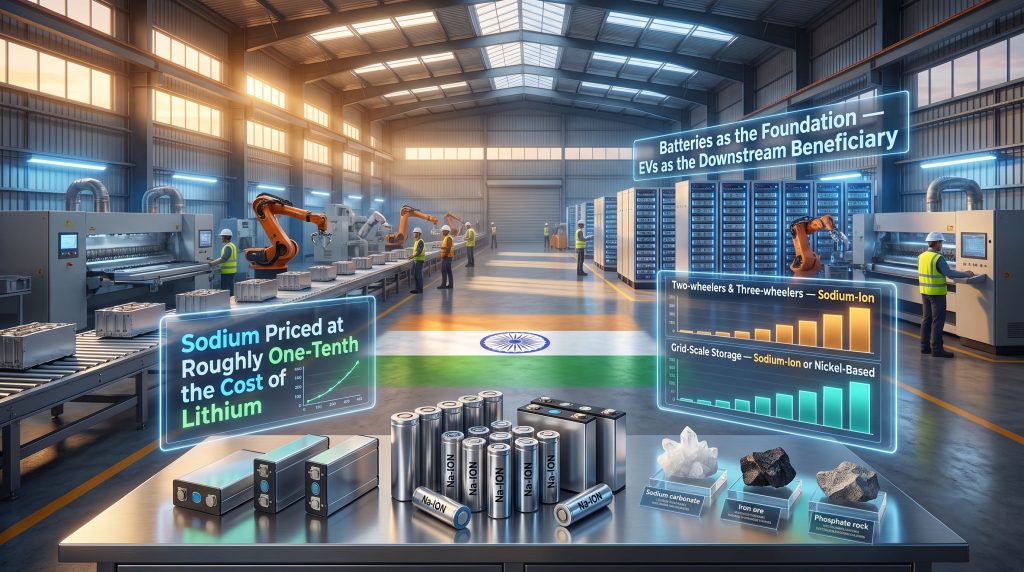
- Sodium costs roughly one-tenth the price of lithium at current market rates, dramatically altering the cost structure for mass-market applications
- The primary input materials for sodium-ion cells, specifically sodium compounds, iron, and phosphate, are available from geographically diverse sources and potentially sourceable domestically
- Sodium-ion chemistry at current energy densities can avoid thermal runaway, improving the safety profile relative to high-energy-density lithium cells
- The world's first 100 megawatt-hour sodium-ion storage project has already been commissioned, demonstrating that the technology is not theoretical but commercially deployable at meaningful scale
Strategic Implication: India's two-wheeler and three-wheeler segment represents a natural launch market for sodium-ion battery manufacturing, one that allows domestic producers to build scale, develop supply chains, and accumulate manufacturing expertise without competing directly against Chinese LFP producers in the passenger EV segment where Chinese cost advantages are most entrenched.
The trade-off is real and should not be minimised. Sodium-ion batteries currently carry lower energy density than LFP, which limits their suitability for long-range passenger vehicles. However, framing this as a disqualifying limitation misreads India's actual market composition. The scooter and three-wheeler market is not a consolation prize. It is one of the highest-volume mobility segments in the world, and sodium-ion chemistry is well-matched to its requirements.
The Nickel-Based Alternative and Its Aerospace Origins
A second alternative chemistry to lithium has emerged from an unexpected direction. EnerVenue, led by CEO Henning Rath, has commercialised a nickel-based battery system that uses a water-based electrolyte. The foundational technology was originally developed for NASA applications, where reliability, longevity, and safety in extreme environments were non-negotiable requirements.
The key safety advantage stems from the electrolyte itself. Unlike liquid organic electrolytes used in lithium cells, which are flammable and contribute directly to thermal runaway severity, a water-based electrolyte does not combust. This fundamentally changes the fire risk profile of the cell.
The longevity figures are equally remarkable. Nickel-water electrolyte batteries are rated for approximately 30,000 charge cycles, a number that dwarfs the cycle life of typical lithium cells by an order of magnitude. When evaluated on a total cost of ownership basis rather than upfront capital cost, the economics can be compelling for applications where the battery is cycled frequently over many years.
The current limitation is application scope. This chemistry is suited to stationary energy storage rather than vehicle propulsion. However, for grid-scale storage, industrial backup power, and critically, AI data centre infrastructure, the combination of extreme cycle life, water-based safety, and independence from lithium inputs represents a genuinely differentiated product.
Solid-State Batteries: Separating Research Milestones From Commercial Reality
No battery technology receives more breathless coverage than solid-state cells. The promise is legitimate. Replacing liquid electrolytes with solid materials theoretically enables higher energy density, improved safety, and longer cycle life simultaneously. The challenge is the gap between theoretical performance and manufacturable reality.
The battery industry uses a technology readiness level scale running from one to nine, where one represents basic research and nine represents full commercial deployment at scale. Solid-state batteries currently sit at approximately level four on this scale. This means the fundamental principles have been demonstrated, and some prototype cells have been produced, but the path from laboratory performance to cost-competitive mass manufacturing remains unresolved.
Policy Warning: Industrial infrastructure designed around solid-state battery technology at its current readiness level would be built for a product that does not yet exist commercially. Nations and companies that have prematurely concentrated resources on solid-state deployment have repeatedly discovered that timelines extend further than projected. A pragmatic strategy prioritises chemistries with demonstrated manufacturing pathways while monitoring solid-state development for integration post-2030.
The more productive framing for India is not to choose between solid-state and conventional chemistries but to recognise that solid-state, if and when it reaches commercial readiness, will represent an upgrade layer within an existing battery industry infrastructure. Countries that build battery manufacturing capability now will be better positioned to adopt advanced chemistries later than countries that wait for the perfect technology before beginning.
The next major ASX story will hit our subscribers first
Three Converging Forces Making Battery Independence Urgent
The case that India should build batteries not EVs is amplified by three large-scale structural shifts converging simultaneously across the global economy.
Electrification of transport, industry, and buildings is accelerating demand for energy storage at rates that consistently outpace supply projections. Every new gigawatt of renewable generation creates demand for corresponding storage capacity. Every electric vehicle sold displaces a fuel tank and installs a battery. The demand trajectory is structural, not cyclical.
Advanced manufacturing is increasingly defined by who controls materials science and electrochemical production processes rather than who operates the most assembly lines. Nations that lead in battery chemistry, materials processing, and cell engineering will define the competitive landscape for multiple downstream industries simultaneously. The battery storage expansion currently underway globally underscores how urgent this repositioning has become.
Artificial intelligence infrastructure is creating a new and rapidly growing demand category for energy storage that operates entirely independently of EV adoption. AI data centres require reliable, high-cycle, scalable backup power. As battery economics improve and environmental pressures mount, stationary battery storage is displacing diesel at data centres globally. A country building battery manufacturing capability today captures this demand category regardless of how quickly its EV market develops.
A critically important inflection point occurred in 2023, when the combined cost of renewable power generation plus battery storage fell below the cost of new fossil fuel generation across significant portions of the global market. This milestone made battery-backed renewables the economically rational default choice for new power capacity, not merely the environmentally preferred one.
What Building an Actual Battery Industry Requires
The distinction between having battery assembly and having a battery industry is not semantic. It determines whether domestic capability is resilient or fragile when supply chains face disruption. Tracking battery raw materials market dynamics is consequently as important as monitoring cell manufacturing progress.
A complete battery value chain encompasses the following layers:
- Mineral sourcing and processing – raw materials including lithium, sodium compounds, iron, and phosphate require refinement before they become battery inputs
- Cathode and anode material production – the electrochemically active materials that determine cell performance, currently dominated by Chinese processors
- Electrolyte manufacturing – critical for both lithium and sodium chemistries, requiring specialised chemical production capability
- Cell casing and separator production – precision manufacturing components that most countries currently import
- Cell assembly at scale – the visible layer of battery manufacturing that receives most policy attention
- Battery management system development – the electronics and software layer that governs cell performance, safety, and longevity
- End-of-life recycling and material recovery – closing the supply loop domestically and creating a secondary source of battery materials
India currently participates meaningfully only at layer five and partially at layer six. The upstream layers, where material and chemical processing create the foundation for everything else, remain underdeveloped. A battery industry built only on assembly is vulnerable to the same import disruptions that a fully import-dependent approach faces, simply with one additional domestic step inserted.
The BYD Model: What China Did and What India Can Learn
BYD's trajectory from mobile phone battery manufacturer to vertically integrated electric vehicle and energy storage giant within roughly a decade offers the clearest template for how a domestic battery champion can be built. The strategic mechanism was not simply government subsidy. It was what might be described as a government venture capital model applied at industrial scale.
China funded dozens of battery and EV companies simultaneously, accepting that most would fail or consolidate, with the expectation that a small number of dominant players would emerge with world-class scale, supply chain control, and manufacturing expertise. BYD and CATL are the most prominent survivors of that selection process. The companies that emerged did so having competed fiercely for domestic market share while being insulated from foreign competition during their formative scaling period.
The vertical integration that BYD now exhibits, spanning lithium mining interests, cathode material production, cell manufacturing, battery pack assembly, and vehicle production, did not happen accidentally. It was the deliberate outcome of a strategy that recognised the battery as the foundational technology rather than a commodity input.
India cannot replicate this model exactly. The starting conditions, market size dynamics, and existing industry structures differ substantially. However, the underlying logic translates. India's domestic EV battery manufacturing ambitions similarly require identifying the battery as the strategic foundation rather than the EV as the primary objective, which changes which investments receive priority and which supply chain relationships require domestic development.
Application-Based Chemistry Segmentation: India's Multi-Technology Path
Perhaps the most sophisticated insight from examining global battery development is that the search for a single universal battery chemistry is the wrong objective. Different applications have fundamentally different requirements, and the battery industry's future almost certainly involves multiple chemistries coexisting and serving distinct markets.
| Application | Recommended Chemistry | Rationale |
|---|---|---|
| Long-range passenger EVs | Lithium Iron Phosphate (LFP) | Highest energy density currently available at scale |
| Two-wheelers and three-wheelers | Sodium-Ion | Sufficient range, lower cost, domestic material potential |
| Grid-scale stationary storage | Sodium-Ion or Nickel-based | Safety, cycle life, cost per kWh at scale |
| AI data centre backup | Nickel-water electrolyte | Extreme cycle life, fire safety in dense infrastructure |
| Future passenger EVs | Solid-State (post-2030) | Pending commercial readiness milestone |
This segmentation approach offers India a practical entry strategy. Rather than attempting to compete immediately in the highest-volume, most competitive global battery market, India could build initial manufacturing capability in sodium-ion chemistry targeting the two-wheeler and three-wheeler segment, develop nickel-based stationary storage capability targeting data centre and grid applications, and position for LFP and eventually solid-state integration as domestic supply chains mature. Innovations in direct lithium extraction technology, furthermore, may eventually support India's domestic lithium processing ambitions as the sector evolves.
Frequently Asked Questions: India's Battery Manufacturing Strategy
Why Should India Prioritise Battery Manufacturing Over EV Assembly?
Battery manufacturing captures the highest-margin, most strategically sensitive portion of the EV value chain. Without domestic cell production, every electric vehicle assembled in India depends on foreign supply chains for its most critical and expensive component, creating persistent vulnerability to price shocks, supply disruptions, and geopolitical risk.
What Is Sodium-Ion Technology and Why Is It Relevant to India Specifically?
Sodium-ion batteries use sodium compounds rather than lithium as the primary electrochemical active material. Sodium costs roughly one-tenth the price of lithium, the input materials are more geographically accessible, and the chemistry at current energy densities improves safety relative to high-energy-density lithium cells. India's massive two-wheeler and three-wheeler market operates at energy requirements where sodium-ion's lower energy density is not a limiting factor.
Is Solid-State Battery Technology a Realistic Near-Term Option for Indian Manufacturers?
Solid-state batteries currently sit at approximately technology readiness level four on a nine-point scale. Commercial production at competitive cost remains unresolved. Building industrial policy around solid-state technology at its current stage would mean designing infrastructure around a product that does not yet exist commercially.
What Raw Materials Does India Have Access to for Domestic Battery Production?
India has identified lithium deposits in Jammu and Kashmir, though the scale and extractable quality of these resources requires further assessment. Sodium compounds, iron, and phosphate, the key inputs for sodium-ion chemistry, are more broadly available and offer a more immediate pathway to reduced import dependency.
How Does Battery Localisation Affect EV Prices for Indian Consumers?
Batteries represent the largest single cost component in any electric vehicle, accounting for 35 to 50 percent of total manufacturing cost depending on vehicle class. Domestic cell production would reduce the currency risk, import duty exposure, and supply chain margin embedded in current battery costs, creating structural downward pressure on EV retail prices over time. The IISD's analysis of electric vehicle battery manufacturing in India similarly highlights localisation as a key lever for consumer affordability.
Key Takeaways: The Battery-First Industrial Logic
- Batteries represent the highest-cost and most strategically sensitive component in the EV value chain, and localising production addresses the most critical structural vulnerability in India's energy transition
- More than 14,000 battery fire incidents were recorded globally in 2025, with failures concentrated among lower-tier manufacturers, underscoring why domestic quality-controlled production matters beyond economics
- Sodium-ion technology, with sodium priced at roughly one-tenth the cost of lithium, offers a viable entry point that avoids direct competition with entrenched Chinese LFP producers
- India's two-wheeler and three-wheeler market provides an immediate, high-volume deployment base for lower-energy-density chemistries where sodium-ion performs adequately
- The world's first 100 MWh sodium-ion storage project has demonstrated commercial deployability at scale, removing the technology-readiness objection for this chemistry
- Grid storage and AI data centre infrastructure represent battery demand that exists independently of EV adoption rates, creating multiple demand pathways for domestic production
- Solid-state batteries at approximately technology readiness level four should be monitored but not anchored to near-term industrial policy
- A multi-chemistry approach aligns with both near-term market realities and long-term application diversity, allowing India to build across sodium, nickel-based, and lithium chemistries in parallel
- The strongest strategic outcome positions batteries as the industrial foundation, with EV manufacturing scaling on top of a domestically secured supply chain rather than remaining dependent on imported cells
Disclaimer: This article presents an analytical perspective on industrial strategy and battery technology development. It does not constitute investment advice. Technology readiness assessments, cost figures, and market projections are based on available information and are subject to change as the industry evolves. Readers should conduct independent research before making investment or business decisions related to the battery or electric vehicle sectors.
Want To Know Which ASX Battery And Critical Minerals Discoveries Are Happening Right Now?
Discovery Alert's proprietary Discovery IQ model scans ASX announcements in real time, instantly identifying significant mineral discoveries across the battery metals and critical minerals sectors — turning complex data into actionable opportunities for investors at every level. Explore historic discoveries and the returns they generated, then begin your 14-day free trial at Discovery Alert to position yourself ahead of the market.