August 13, 2026
The Capital Efficiency Problem Reshaping Junior Lithium Development
Across the junior mining sector, a quiet strategic revolution is underway. Pre-production lithium developers, many of which assembled sprawling multi-asset portfolios during the exploration boom years, are now confronting an uncomfortable truth: equity markets consistently fail to price secondary properties into a company's market capitalisation during bear cycles. The result is a structural inefficiency where genuine geological value sits locked inside corporate balance sheets, invisible to investors and inaccessible as operational capital.
This dynamic has pushed a growing number of junior developers toward selective asset divestiture as a core capital strategy, not as a sign of distress, but as a deliberate mechanism to surface value, sharpen focus, and fund the development of flagship assets without resorting to dilutive equity raises at depressed valuations.
The Lithium Ionic sale of its Salinas asset to Pilbara is one of the clearest recent examples of this approach executed at scale, and the terms of the transaction reveal as much about the strategic logic of asset consolidation in Brazil's Minas Gerais lithium belt as they do about any single company's financial position.
When big ASX news breaks, our subscribers know first
Understanding the Baixa Grande Divestiture Within the Salinas District
The asset in question is the Baixa Grande lithium resource, located within the Salinas region of Minas Gerais state in Brazil. The package comprises ten mineral claims and associated property rights. While the name Salinas has become familiar to followers of the Brazilian lithium sector, the specific importance of Baixa Grande lies in its geological relationship to adjacent ground already held by Pilbara Minerals.
Pilbara had previously entered the Minas Gerais district through its acquisition of Latin Resources, bringing the Salinas project, since renamed Colina, into its portfolio. Baixa Grande sits as a direct geological extension of the same lithium-bearing pegmatite system underlying Colina. This continuity matters enormously from a development economics perspective: fragmented ownership of a geologically continuous ore body creates inefficiencies in mine planning, resource estimation, and infrastructure deployment. Consolidating both packages under a single operator resolves these inefficiencies and improves the overall project economics for both the acquiring company and the broader district.
Lithium Ionic's exploration team had conducted sufficient drilling and resource delineation work at Baixa Grande prior to the transaction to identify approximately 20 million tonnes of lithium mineralisation. This work both justified the asset's value in negotiations and provided Pilbara with geological confidence in the acquisition target.
The decision to classify Baixa Grande as non-core was not geological, it was strategic. Lithium Ionic's primary development focus sits firmly on the Bandeira project, and the company had internally recognised for some time that Baixa Grande would likely eventually form part of Pilbara's consolidated Colina development footprint regardless of which pathway it took to get there.
Full Financial Terms of the Transaction
The structure of the Lithium Ionic and Pilbara Minerals agreement is worth examining in detail, as it incorporates several components that are not immediately visible in headline figures.
| Payment Component | Amount (USD) | Trigger |
|---|---|---|
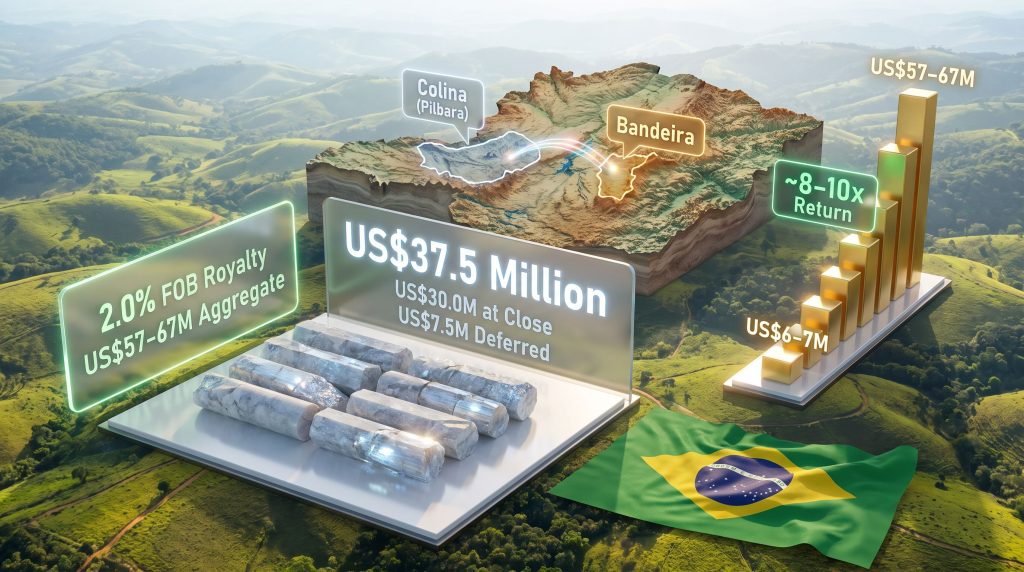
| Upfront closing payment | US$30.0 million | Payable at transaction close (~2 months post-announcement) |
| Deferred payment | US$7.5 million | Earlier of: positive FID on Colina Project or December 31, 2029 |
| Total cash consideration | US$37.5 million | Combined |
| Royalty (2.0% FOB) | US$20-30 million estimated | Ongoing from future spodumene production |
| Implied aggregate value | US$57-67 million | Including royalty optionality |
The royalty component deserves particular attention. A 2.0% royalty on proceeds from future spodumene sales, calculated on a free-on-board basis, is retained by Lithium Ionic regardless of who ultimately develops or operates the Baixa Grande ground. Management's internal valuation framework estimates the royalty at approximately US$10 to US$15 million per percentage point, placing the implied total royalty value at US$20 to US$30 million under reasonable production assumptions.
Furthermore, Lithium Ionic's agreement to consolidate the remaining 15% interest in the Salinas properties prior to the Pilbara transaction added an important layer of strategic completeness to the divestiture package.
Pilbara Minerals does not frequently offer royalty arrangements as part of its acquisition structures. The inclusion of a 2% FOB royalty in this transaction reflects the strategic premium Pilbara placed on consolidating contiguous pegmatite ground and signals the geological conviction behind the deal.
When cash consideration and royalty optionality are aggregated, the transaction approaches Lithium Ionic's entire market capitalisation at the time of announcement, an outcome that underscores how significantly non-core assets can be undervalued within junior mining equity structures.
What Was Originally Paid?
The original consideration for the Baixa Grande ground was approximately 6.5 million shares, which translated to roughly US$6 to US$7 million in implied value at the time of acquisition. On cash consideration alone, the divestiture generates a return multiple of approximately 5 to 6 times the original acquisition cost. When royalty value is included, that multiple extends to 8 to 10 times or greater, a figure that also incorporates the incremental exploration and work programme investment carried out on the property prior to sale.
Why the Geological Logic Drove Pilbara's Acquisition Decision
Brazil's Minas Gerais state hosts one of the world's most significant concentrations of hard-rock spodumene extraction pegmatites, a geological setting that has drawn comparison to Western Australia's lithium belt in terms of both scale and mineralisation quality. The district achieved international credibility as a producing region through Sigma Lithium's Grota do Cirilo operation, which established the benchmark for DMS-based spodumene concentrate production from Brazilian pegmatites.
The broader Salinas sub-district within Minas Gerais has attracted multiple operators precisely because the pegmatite systems are laterally extensive and demonstrate consistent lithium grades across strike lengths that support large-tonnage resource models. The Colina-Baixa Grande geological continuity thesis, the idea that these two adjacent land packages share the same mineralising system, is not speculative. It is supported by structural geology and pegmatite emplacement patterns observable across the district.
For Pilbara Minerals, absorbing Baixa Grande eliminates the operational and strategic risk of a third party holding ground that sits within the natural resource envelope of its flagship Brazilian development project. The consolidation also strengthens Pilbara's resource base ahead of its own feasibility and financing work at Colina, now entering the development pipeline following the Latin Resources acquisition.
District Consolidation Timeline
| Milestone | Detail |
|---|---|
| Pilbara acquires Latin Resources | Establishes Colina project footprint in Salinas region |
| Lithium Ionic consolidates Salinas ground | Completes purchase of remaining 15% interest in June 2024 |
| Lithium Ionic completes Baixa Grande resource work | ~20 million tonnes identified through drilling programme |
| Lithium Ionic-Pilbara transaction announced | 2026: Baixa Grande divested for US$37.5M cash + 2% royalty |
Capital Allocation Roadmap: How the Proceeds Advance Bandeira
The deployment strategy for the US$30 million upfront payment is directly tied to the critical path at the Bandeira project. Several interconnected priorities have been identified:
-
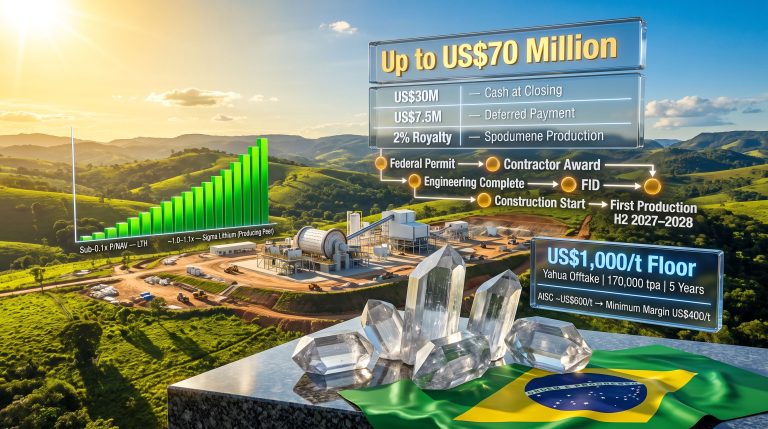
Federal permitting completion: Bandeira is described as near the conclusion of the federal environmental review process, with the operating licence (licença de operação) representing the final formal milestone before construction can commence. Receipt of this permit is the single most important de-risking event for the project's financing and construction timeline.
-
Long-lead capital item procurement: The DMS processing mill and associated concentration plant equipment carry extended manufacturing and delivery lead times. Early ordering secures both pricing and queue position with suppliers, preventing construction delays caused by equipment backlogs.
-
Underground portal contractor selection: A formal tender process for underground portal construction contractors has been conducted, with a shortlist finalised and final selection underway at the time of announcement.
-
Bridge financing reduction: By deploying Salinas proceeds into early construction costs, Lithium Ionic reduces its dependency on external debt and equity markets during the period between permit receipt and full construction financing close.
The transaction also interacts favourably with an existing US$20 million prepayment secured from an off-take partner at FID, meaning the combined liquidity position available to support early construction activity is substantial relative to the company's market capitalisation.
The Salinas divestiture effectively converts a non-producing, market-undervalued geological asset into operational runway capital, enabling Bandeira's development timeline to advance without requiring dilutive equity issuance at depressed share price levels. This is precisely the capital efficiency logic that makes selective divestiture so powerful for junior developers operating in bear-cycle equity markets.
Production targeting points toward the back half of 2027 extending into 2028, though management commentary suggests the internal schedule may be conservative relative to actual execution speed. Comparable DMS processing plant projects have moved from initial ground-breaking to concentrate production in as little as six months, a timeline that reflects the modular, well-understood nature of dense media separation technology compared to more complex processing flowsheets.
The Lithium Market Backdrop: Stability as the Key Variable
The 2022–2024 period inflicted significant damage on the lithium project financing ecosystem. Spodumene concentrate prices surged to record highs, then collapsed with equal velocity, leaving lenders unable to construct reliable debt service models for projects entering feasibility. The lithium market downturn suppressed lender confidence more than any absolute price level could, because financing models require predictable revenue assumptions, not just high ones.
The current pricing environment, while not at peak levels, offers something arguably more valuable for project financing: relative stability. Spodumene prices holding in a range that allows consistent margin modelling is the variable that reopens project debt conversations, and Bandeira's cost structure positions it well within this environment.
Bandeira Project Economics at Current Price Levels
| Metric | Value |
|---|---|
| All-in sustaining cost (AISC) target | ~US$600 per tonne |
| Off-take floor price secured | US$1,000 per tonne |
| Minimum margin at floor price | US$400 per tonne |
| Reference spodumene price (management basis) | ~US$2,000 per tonne |
| Implied margin at reference price | ~US$1,400 per tonne |
The off-take structure secured with Yawah, described as a CATL-linked fully integrated battery materials supplier and one of the largest participants in the global battery supply chain, commits approximately 170,000 tonnes across two off-take partners over a five-year term. The market-linked pricing with a US$1,000 per tonne floor provides lenders with the revenue visibility required to model debt serviceability across a range of price scenarios.
A notable implication of the Yawah relationship is the scale of demand it represents. Chinese battery manufacturers operating at Yawah's tier of the supply chain are reportedly building refining and conversion capacity at multiples of five to ten times current consumption levels. The arithmetic is stark: a single major Chinese battery supplier's planned capacity expansion could require the output of multiple Bandeira-scale projects to support. This supply-demand asymmetry sits largely unrecognised in Western equity market narratives.
The next major ASX story will hit our subscribers first
Brazil's Jurisdictional Positioning in a Fragmented Trade Environment
One structural advantage of Brazilian lithium production that receives insufficient analytical attention is the country's position as a genuinely open trading jurisdiction. Brazil maintains a century-long history as a globally engaged trading partner without binding export restriction frameworks or preferential trade obligations that would channel material flows toward any single market.
This stands in contrast to projects in certain other jurisdictions, particularly those operating under free trade agreement structures or explicit policy mandates that may constrain where material can be sold, or create political pressure around Chinese off-take agreements. Bandeira retains contractual flexibility to supply spodumene concentrate to China, Europe, North America, Southeast Asia, or any emerging battery manufacturing market as the global conversion landscape evolves.
The China Processing Reality
Understanding the current lithium processing landscape requires confronting the scale of China's dominance. In addition, the global lithium market dynamics reinforce why jurisdictional flexibility matters so significantly for near-term producers:
-
China controls an estimated 85% of global lithium refining and conversion capacity
-
This share reflects deliberate, multi-decade industrial policy investment rather than natural resource advantage
-
Europe has emerging conversion infrastructure with early-stage refinery investment and battery manufacturing programmes, but remains years from scale
-
North American conversion capacity is nascent outside Tesla's operations, with meaningful scale a longer-term proposition
For near-term producers like Bandeira, engaging established Chinese off-take partners is not ideologically motivated, it is operationally rational. Placing material with a converter that has 15-plus years of operating experience and confirmed capacity eliminates execution risk at the off-take end of the supply chain. The five-year term structure of current off-take agreements creates an intentional optionality window: by the time these agreements reach renewal, Europe's refining infrastructure may have matured sufficiently to represent a viable alternative destination for Brazilian spodumene.
Three Demand Vectors Reshaping Long-Run Lithium Requirements
The lithium demand narrative is frequently reduced to a single variable: electric vehicle adoption rates. This framing significantly underestimates the breadth of structural demand growth now emerging across multiple industries simultaneously.
1. Electric Vehicle Continued Expansion
Global EV adoption continues to grow at double-digit annual percentage rates, a fact obscured by media narratives focused on the deceleration of percentage growth rather than the continuing acceleration of absolute volume. China's EV market in particular continues expanding at multiples that outpace Western market trajectories, with no evidence of fundamental saturation.
2. Grid-Scale Battery Storage for AI Infrastructure
The global buildout of AI data centre capacity creates exponential growth in stationary energy storage requirements, driven by data centre power reliability needs and the intermittent nature of renewable energy integration. Battery storage expansion is the preferred grid stabilisation technology for this application, and lithium-ion's combination of high cycle life and energy density makes it the dominant chemistry for large-scale deployments.
3. Robotics and Autonomous Systems
Perhaps the least-priced demand vector in current market analysis is the emerging battery requirements of industrial and consumer robotics. Chinese battery manufacturers are reportedly already incorporating robotics battery demand into their capacity planning models, treating it as the third sequential wave of lithium consumption after EVs and stationary storage.
Three industries that collectively did not exist at commercial scale fifteen years ago are now driving simultaneous demand growth for lithium. The combined consumption requirement of EVs, AI data centre storage, and robotics systems represents a structural demand expansion with no historical precedent in the battery metals market.
The supply-demand disconnect implied by this demand convergence is material. Chinese refining and conversion capacity is reportedly being built at five to ten times current consumption levels. Australian producers have historically served as the swing supply source capable of bringing volume online quickly, but even at maximum utilisation, the absolute supply additions available from existing producing regions may prove insufficient to match the demand trajectory across all three application vectors simultaneously.
First-Mover Advantage and the Valuation Re-Rate Pathway
Within the eastern Brazil pegmatite belt, the competitive landscape is relatively clear. Sigma Lithium's Grota do Cirilo operation is the established producing benchmark. Pilbara Minerals is advancing toward production at Colina over the coming years. Bandeira, if it achieves its permitting and construction timeline, positions itself as potentially the second producing hard-rock lithium project from the Minas Gerais belt.
Being first to production in a supply-constrained market carries genuine economic value beyond the obvious revenue timing benefit. Early producers capture off-take relationships before competing projects can offer volume. They build operational track records that attract lender confidence for future expansion financing. They establish infrastructure, power connections, and logistics relationships that create barriers to entry for later-stage projects. In a district where multiple projects are targeting production within overlapping timeframes, even a 12-month advantage in first concentrate delivery can materially influence the off-take and financing landscape available to all subsequent entrants.
Development Milestone Re-Rate Expectations
| Milestone | Expected Market Re-Rate Catalyst |
|---|---|
| Operating permit received | Financing credibility unlocked; lender confidence confirmed |
| Construction financing closed | Equity re-rate toward construction-stage peer multiples |
| First production achieved | Revenue-generating producer valuation applied |
| Peer comparison: Sigma Lithium | Trades at approximately 1.0-1.1x NAV |
| Current implied multiple | Less than 0.1x NAV |
The valuation gap between Bandeira's current implied market multiple and the multiples applied to comparable producing peers in the same district represents a potential re-rate of significant magnitude as development milestones are unlocked sequentially. The operating permit, construction financing close, and first production represent three distinct catalysts, each of which has historically driven meaningful re-rating in peer transactions across the junior-to-producer transition. Innovations in direct lithium extraction technology are, furthermore, adding another layer of longer-term optionality for developers across the region as processing efficiencies continue to improve.
Key Takeaways: What This Transaction Signals for Brazil's Lithium Sector
The Lithium Ionic sale of its Salinas asset to Pilbara carries implications that extend well beyond a single company's balance sheet:
-
District consolidation by major producers is accelerating, confirming that Minas Gerais is transitioning from an exploration district to an active development and production hub attracting tier-one capital
-
Non-core asset monetisation creates a viable alternative capital strategy for junior developers, particularly when geological adjacency creates strategic value for a larger acquiring party willing to pay a premium for consolidation
-
Royalty retention structures offer a powerful value-preservation mechanism, allowing divesting companies to maintain upside exposure to an asset without carrying its development capital burden
-
Price stability rather than price maximisation is the defining variable for project financing in the current lithium market, and Bandeira's cost structure positions it favourably across a wide range of spodumene price scenarios
-
Brazil's open trade jurisdiction remains a durable structural advantage in an increasingly fragmented global commodity trade environment, providing Bandeira with off-take flexibility unavailable to projects in more constrained regulatory jurisdictions
This article contains forward-looking statements and projections based on management commentary and publicly available information. Royalty valuations, production timelines, and financial projections are estimates subject to material change. Readers should conduct their own due diligence and consult a licensed financial adviser before making investment decisions. Past performance of comparable assets is not a reliable indicator of future outcomes.
Want to Identify the Next Major Lithium Discovery Before the Market Does?
Discovery Alert's proprietary Discovery IQ model delivers real-time alerts on significant ASX mineral discoveries — instantly converting complex geological data into actionable investment insights for traders and long-term investors alike. Explore historic examples of exceptional discovery returns or start your 14-day free trial today to position yourself ahead of the next major move in battery metals.