August 13, 2026
When Capital Markets Close the Door, Asset Sales Open a Window
In the junior mining sector, the gap between a compelling resource and a funded construction decision is where most projects stall. Equity markets in 2026 have been unforgiving for lithium developers despite a meaningful stabilisation in physical spodumene pricing, creating a paradox where project economics improve on paper while financing options narrow in practice. This tension has pushed a growing number of advanced-stage lithium developers toward an underappreciated capital strategy: monetising secondary assets accumulated during earlier exploration phases to self-fund flagship project construction without diluting shareholders.
The Lithium Ionic Baixa Grande sale to fund Bandeira construction is a precise illustration of this model in action, and it offers a detailed case study in how junior developers can sequence capital across a multi-asset land package to compress the timeline from feasibility to first production. Furthermore, understanding how lithium mining works at a structural level helps contextualise why this capital sequencing approach is gaining traction across the sector.
When big ASX news breaks, our subscribers know first
Portfolio Pruning as a Capital Strategy, Not Just a Housekeeping Exercise
Why Junior Lithium Companies Accumulate Secondary Assets in the First Place
During early-stage exploration, junior companies typically stake claims broadly across mineralised belts, acquiring ground that extends well beyond any single deposit. This approach maximises geological optionality and protects against the risk that the most prospective target turns out to be a different part of the system than originally anticipated. The result is a multi-project land package in which one deposit eventually emerges as the clear flagship, while the remaining claims become secondary assets.
In Brazil's Minas Gerais Lithium Valley, this dynamic played out precisely as described. Lithium Ionic Corp (TSXV: LTH) assembled a broader Salinas and Itinga land package, with the Bandeira project emerging as the flagship and Baixa Grande as a secondary holding that nonetheless attracted meaningful resource definition work over the three-year hold period.
What Separates a Non-Core Asset from One Worth Retaining
The classification of an asset as non-core is rarely straightforward. The critical variables that inform this judgment include:
- Geological proximity to a motivated buyer whose existing ground would benefit from consolidation with the adjacent deposit
- Stage of the flagship project and whether the capital required to advance secondary assets competes directly with flagship construction funding
- Resource size and grade relative to buyer appetite, particularly in a market where large, well-defined tonnage attracts strategic rather than speculative premiums
- Management bandwidth, since advancing multiple development-stage projects simultaneously is operationally demanding for small teams
In the Baixa Grande case, all four criteria aligned simultaneously. The deposit sits adjacent to ground that PLS Group (ASX: PLS) acquired through its 2025 purchase of Latin Resources, making Baixa Grande a logical tuck-in for a buyer already invested in the same mineralised corridor. Lithium Ionic's team outlined approximately 20 million tonnes of resource during the three-year hold, transforming a speculative claim package into a defined deposit that supported an eight-times return on the original acquisition cost.
How the Transaction Is Structured and What Each Component Funds
Breaking Down the US$70 Million Consideration Stack
| Consideration Component | Amount (USD) | Timing / Trigger |
|---|---|---|
| Cash at closing | US$30 million | Expected within months of announcement (August 2026) |
| Deferred cash payment | US$7.5 million | Payable at buyer's FID or an agreed earlier fixed date |
| Retained 2% royalty (estimated) | US$20–30 million | Ongoing; tied to future spodumene production at Baixa Grande |
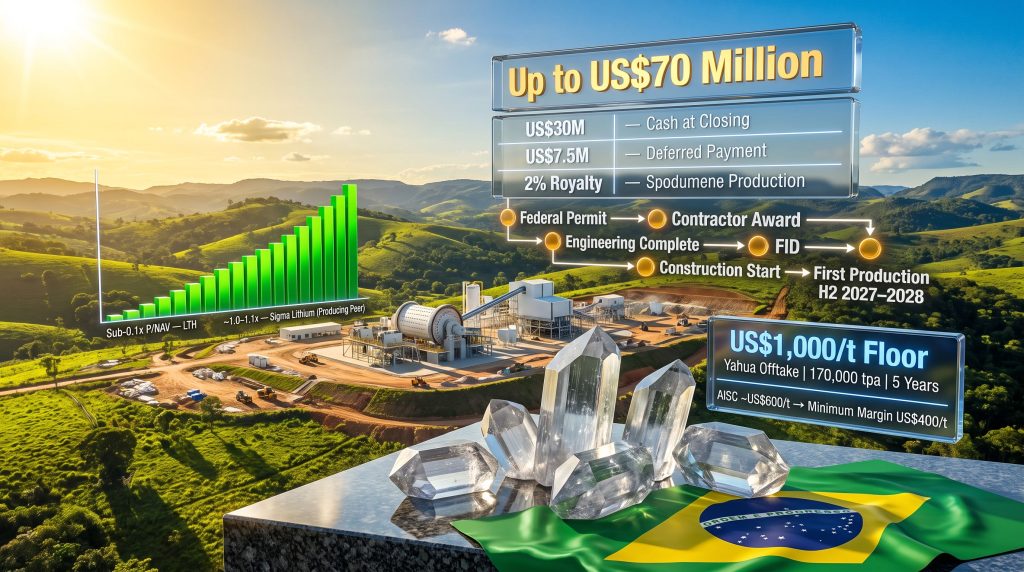
| Total transaction value | Up to US$70 million | Across all tranches |
The cash component alone, at US$37.5 million in aggregate, is approximately equivalent to Lithium Ionic's entire market capitalisation at the time of the announcement. This creates an unusual situation where a single non-core asset divestiture generates cash approaching the full implied equity value of the company, a disconnect that management has acknowledged reflects how poorly the broader land package has been valued by the market.
The Procurement Sequencing Insight Most Investors Miss
One of the least discussed but most operationally significant aspects of the Baixa Grande transaction is how Lithium Ionic intends to use the proceeds relative to construction financing timing. The US$30 million closing payment is earmarked to fund near-term operational expenditure and, critically, long-lead item procurement at Bandeira, most importantly the processing mill.
Why this matters: Processing equipment for hard-rock lithium operations carries delivery lead times that can extend six months to over a year depending on manufacturer backlogs. If a developer waits until construction financing closes before placing equipment orders, the delay gets baked into the overall project schedule. By using divestiture proceeds to begin procurement independently, Lithium Ionic can potentially compress the critical path between a formal Final Investment Decision (FID) and first production by a meaningful margin.
The US$7.5 million deferred tranche, payable at the buyer's own FID or an earlier fixed date, provides a secondary liquidity buffer. The retained 2% royalty on future spodumene extraction from Baixa Grande allows Lithium Ionic to maintain economic exposure to the asset without the operational and capital burden of developing it, a structure that functions as an embedded call option on the buyer's success.
Bandeira's Development Status Across Four Critical Workstreams
Where Each Milestone Stands as of August 2026
1. Federal Environmental Permitting
The permitting process for Bandeira is described as approaching its final stages. This is the single most critical gating item for construction commencement and for lenders who require regulatory clearance before committing construction debt.
2. Underground Portal Contractor Selection
A competitive tender process has been run, and the shortlist for the underground portal contractor has been narrowed to a final group. Contractor award represents the last major procurement decision prior to a formal construction decision.
3. Engineering Programme
Feasibility-level engineering is substantially advanced, providing the technical basis for a construction cost estimate and project schedule that lenders can underwrite.
4. Construction Financing
This workstream remains open but is actively progressing. Binding offtake terms with Chinese converter Yahua covering 170,000 tonnes of spodumene concentrate annually over five years at a floor price of US$1,000 per tonne with no ceiling are the primary instrument underpinning lender discussions. A separately secured US$20 million prepayment facility has also been established as part of the broader financing architecture.
Milestone Dependency Map
Federal Permit Completion (Final Stages)
        ↓
Underground Portal Contractor Award (Shortlist Narrowed)
        ↓
Engineering Complete → FID
        ↓
Construction Financing Close
        ↓
Construction Start → First Production (H2 2027–2028 Target)
The Yahua Offtake Agreement: Why the Floor Structure Matters to Lenders
Asymmetric Protection and Its Role in Project Finance
The Yahua offtake agreement is not simply a sales contract. It is a de-risking instrument designed to satisfy the revenue visibility requirements of project finance lenders. The specific structure, a US$1,000 per tonne floor with no ceiling, creates an asymmetric payoff profile that is particularly attractive from a debt serviceability perspective.
At Bandeira's projected all-in sustaining cost of approximately US$600 per tonne, the US$1,000 floor generates a minimum margin of US$400 per tonne on every contracted tonne. With 170,000 tonnes per annum covered, the floor provides lenders with a minimum contracted revenue floor that comfortably covers operating costs and debt service even in a severe spodumene price downturn. If prices remain above US$1,000, the full upside flows to the producer.
A comparison worth noting: Developers operating under exclusive regional offtake arrangements, particularly those tied to North American buyers or constrained by bilateral trade requirements, face renegotiation risk if the trade environment shifts. Brazil's open global trading position means Lithium Ionic can direct production toward the most competitive buyers, a structural advantage as trade relationships between major economies remain in flux.
China's Converter Capacity Expansion and What It Implies for Supply
China currently accounts for approximately 85% of global lithium conversion capacity, and capacity additions within that system are being sized at multiples of current consumption levels. If that capacity is to be kept operational, the structural supply requirement for raw spodumene feedstock is substantially larger than current mine supply can support. This dynamic is one reason why Chinese converters like Yahua are willing to sign multi-year offtake agreements with floor price protections: securing feedstock supply is a strategic priority, not merely a commercial preference. In addition, shifts in lithium supply-demand dynamics globally are reinforcing the urgency of these long-term procurement strategies.
Demand Beyond EVs: The Emerging Battery Consumption Categories Shaping the Long-Term Case
A Three-Layer Demand Framework
The conventional narrative frames lithium demand as an electric vehicle story. That framing is increasingly incomplete. Three distinct demand layers are now identifiable in the market:
- Electric vehicles remain the dominant and best-understood driver, with adoption curves across China, Europe, and emerging markets providing relatively predictable volume growth
- Grid-scale battery storage linked to AI data centre power infrastructure has already entered the planning assumptions of Chinese battery supply chain participants, representing a demand source that scales with the data centre buildout rather than vehicle sales cycles
- Robotics is identified as the next incremental demand category, with Chinese counterparties already incorporating it into forward procurement conversations, an earlier stage of market recognition than most Western analysts have priced in
This multi-layer demand picture is particularly relevant for Brazilian spodumene producers because Chinese converters, who are the primary buyers of raw concentrate, are the market participants most directly exposed to all three demand sources simultaneously. Consequently, innovations such as direct lithium extraction technology are also reshaping how quickly supply can be brought online to meet these converging demand signals.
The next major ASX story will hit our subscribers first
Valuation Analysis: The Developer-to-Producer Re-Rating Model
P/NAV Multiple Comparison
| Company | Development Stage | Approximate P/NAV Multiple |
|---|---|---|
| Lithium Ionic Corp (TSXV: LTH) | Advanced developer, pre-construction | Below 0.1x |
| Sigma Lithium (regional producing peer) | Producing | Approximately 1.0–1.1x |
| Implied re-rating potential | At production-stage multiple | Approximately 10x from current levels |
The roughly ten-fold multiple gap between Lithium Ionic and Sigma Lithium reflects the standard developer discount embedded in junior mining equities. This discount is not arbitrary; it encapsulates real execution risk across permitting, financing, and construction. The key insight is that this discount collapses systematically as milestones are completed, not as a function of commodity price movements alone.
Why Cost Position Accelerates the Re-Rating
A projected AISC of approximately US$600 per tonne at Bandeira places it in the lower cost quartile of global hard-rock lithium producers. With spodumene pricing currently above US$2,000 per tonne, the margin profile is highly accretive. More importantly, the low cost position reduces the probability of production shortfall or margin compression scenarios that most severely penalise developer multiples. This allows the stock to converge toward producer-equivalent valuations faster once construction milestones are confirmed. The broader global lithium market context further supports the case for projects with strong cost positions weathering volatility better than higher-cost peers.
Scenario Analysis: Three Paths to First Production
Scenario A: Base Case (H2 2027 to 2028 First Production)
Federal permitting completes on schedule, contractor is awarded in Q4 2026, and construction financing closes in Q1 2027. Baixa Grande proceeds fund long-lead procurement during the financing gap, preserving schedule. Re-rating begins as construction milestones are publicly confirmed and the developer discount begins to compress.
Scenario B: Moderate Delay (2028 to 2029 First Production)
Permitting or financing close extends by two to three quarters. Divestiture proceeds partially limit but do not eliminate schedule impact. The valuation discount persists longer; additional capital bridging may be required, potentially introducing modest dilution risk.
Scenario C: Adverse Case (Financing Disruption)
Sustained spodumene price weakness below the US$1,000 per tonne offtake floor triggers lender reassessment and construction financing terms deteriorate materially. The royalty income stream and deferred cash from Baixa Grande provide a partial buffer, but an equity raise becomes more probable. This scenario is considered low probability given current pricing, but represents the tail risk investors should have modelled. The Salinas Baixa Grande sale to PLS was, however, structured precisely to mitigate the severity of this scenario.
Key Risk Factors to Monitor
- Federal permitting timeline and any procedural complexity in Brazil's environmental licensing framework
- Spodumene spot price trajectory relative to the US$1,000 per tonne offtake floor and lender coverage requirements
- Construction financing terms and lender appetite in the current credit environment
- Contractor execution risk during underground portal development
- Concentration of global lithium conversion capacity in China and associated geopolitical sensitivity for offtake counterparty risk
- Timing and magnitude of the deferred US$7.5 million cash tranche relative to Bandeira's financing requirements
Key Takeaways for Investors Evaluating the Bandeira Construction Case
- Non-dilutive capital generation at scale: US$37.5 million in combined cash consideration from a single non-core asset divestiture provides a meaningful funding runway without equity issuance at a depressed share price
- Royalty retention preserves asymmetric upside: The 2% royalty on Baixa Grande spodumene production adds an estimated US$20 to US$30 million in contingent value while eliminating the operational and capital burden of development
- Procurement sequencing is the underappreciated schedule lever: Funding long-lead items ahead of construction financing close compresses the critical path between FID and first production in ways that equity market participants rarely price in advance
- Offtake floor structure de-risks the entire financing architecture: The US$1,000 per tonne floor on 170,000 tonnes per annum with no ceiling gives lenders contracted minimum revenue visibility while preserving full upside participation
- The re-rating is milestone-driven, not commodity-driven: Permitting completion, contractor award, and financing close are the specific catalysts that systematically reduce the developer discount, independent of spodumene price movements
- Demand diversification beyond EVs strengthens the long-term structural case: Battery storage and robotics applications are already being incorporated into forward procurement planning by Chinese counterparties, with secured offtake agreements at Bandeira demonstrating the tangible commercial confidence underpinning the Lithium Ionic Baixa Grande sale to fund Bandeira construction
This article is for informational purposes only and does not constitute financial advice. Investors should conduct their own due diligence and consider their individual risk tolerance before making investment decisions. All financial projections, scenario analyses, and valuation comparisons involve forward-looking assumptions that may differ materially from actual outcomes.
Want to Know Which ASX Lithium Discoveries Could Deliver the Next Major Re-Rating?
Discovery Alert's proprietary Discovery IQ model scans ASX announcements in real time, instantly identifying significant mineral discoveries — including lithium — and translating complex data into actionable insights for traders and investors at every experience level. Explore how historic discoveries have generated substantial returns on Discovery Alert's dedicated discoveries page, then start your 14-day free trial to position yourself ahead of the broader market.