August 12, 2026
When Equilibrium Becomes the Most Uncertain Outcome
In commodity markets, the most disorienting condition is not a crash or a rally. It is balance. When supply and demand forces converge at roughly equal strength, price signals lose their directional clarity, participants adopt a wait-and-see posture, and the market enters what analysts sometimes call an inflection zone. This is precisely the environment China's spodumene market awaits supply-demand signals to navigate in mid-2026.
Understanding why requires looking beyond headline price levels. The stability visible in current spodumene assessments is not the result of an absence of forces. It reflects the simultaneous expansion of both supply and demand, with neither side yet establishing clear dominance. Furthermore, this dynamic makes China's spodumene market awaits supply-demand signals one of the most closely watched narratives in the global battery materials complex right now.
When big ASX news breaks, our subscribers know first
The Price Picture: Stability as a Signal in Itself
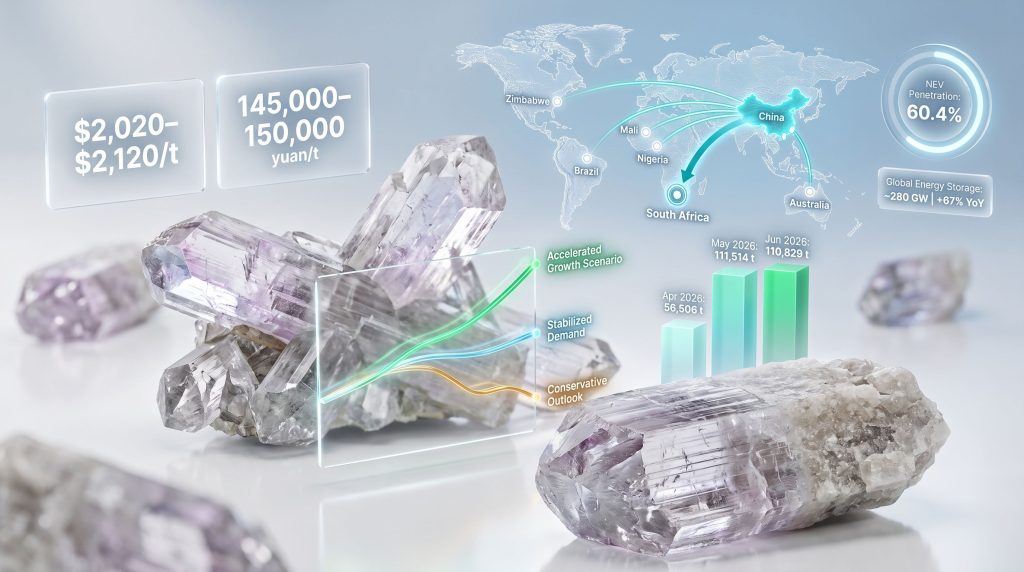
As of mid-August 2026, Argus assessed standard 6% spodumene concentrate (CIF China) at $2,020 to $2,120 per tonne, while the lower-grade 5 to 5.5% material was assessed at $1,820 to $1,970/t over the same period. Both benchmarks were unchanged week-on-week, a reflection of offsetting pressures rather than market inertia.
The existence of a dedicated 5 to 5.5% price benchmark is itself a significant development. Argus introduced this assessment in December 2025, becoming the first to publish such a grade-specific reference. The rationale is rooted in geology rather than market fashion. Years of intensive hard-rock mining have progressively eroded average ore grades at many established operations, compressing the industry norm from a historical range of roughly 5.5 to 6.2% Li₂O down to 5 to 5.5% or below at several active sites. A price benchmark that does not reflect this grade shift would misrepresent actual market conditions.
The downstream reference point reinforcing the broader picture is the lithium carbonate market, which Argus assessed at 145,000 to 150,000 yuan per tonne ex-works China in mid-August, representing an increase of approximately 20% from the start of 2026. This upward trajectory in lithium salt prices functions as a margin signal for Chinese spodumene converters, improving their willingness to pay for upstream feedstock and providing a floor under spodumene prices even as supply volumes increase.
How Global Spodumene Supply Is Reshaping in 2026
Zimbabwe's Export Recovery: More Than a Headline Number
One of the more consequential supply-side events of 2026 was Zimbabwe's imposition of a spodumene export ban in February, followed by its reversal in April. The resumption set in motion a recovery trajectory that has been tracked through South African customs data, since a substantial portion of Zimbabwean spodumene shipments is routed through South African ports before reaching Chinese converters.
The export recovery has been sharp and sustained:
| Month | South African Spodumene Exports |
|---|---|
| April 2026 | 56,506 tonnes |
| May 2026 | 111,514 tonnes |
| June 2026 | 110,829 tonnes |
The near-doubling of monthly export volumes between April and May represents a structurally meaningful supply injection. South Africa's role as a routing corridor rather than a primary producer adds an important layer of analytical complexity. Trade flow monitoring must account for this transit function to avoid misattributing South African export data to domestic South African production.
What is less frequently discussed is the policy risk embedded in this supply channel. Zimbabwe's decision to reinstate and then reverse the export ban within a matter of weeks illustrates the regulatory unpredictability that characterises some emerging lithium-producing jurisdictions. Any recurrence of export restrictions would immediately register as a supply shock in the China CIF market. According to recent reporting on lithium markets, permit revocations and regulatory shifts are increasingly shaping global supply dynamics.
The Diversification of China's Supplier Base
Australia remains China's largest and most reliable spodumene supplier, but the origin profile of Chinese imports has broadened considerably. Nigeria, Brazil, Mali, Zimbabwe, and South Africa have each established meaningful roles as feedstock sources. The strategic implications extend beyond simple supply volume:
- A multi-origin supply base reduces Chinese converters' leverage exposure to any single producer's pricing power or operational disruptions
- It introduces greater complexity into supply monitoring, as each origin carries distinct regulatory, logistical, and geological risk profiles
- It creates a more competitive pricing environment, particularly at the spot procurement level, which benefits converters' input cost management
- It raises the analytical bar for market participants, who must now track customs data, shipping flows, and policy developments across multiple jurisdictions simultaneously
Grade Degradation: The Slow-Moving Supply Constraint
Perhaps the least visible but most structurally significant supply-side trend is the progressive decline in ore grades at mature mining operations. This is not a cyclical development. It is a geological reality that accumulates over time as high-grade zones are mined out and processing must shift to lower-grade material. Understanding spodumene extraction basics helps contextualise why this grade decline carries such significant downstream consequences.
The economic consequences compound as grades fall:
- Processing costs per unit of lithium output rise, since more ore must be handled and refined to extract equivalent lithium content
- Effective lithium yield per tonne of ore declines, meaning that volumetric supply growth does not translate linearly into chemical output growth
- High-grade reserves at established operations deplete faster when lower-grade material is blended through, creating long-term mine-life pressures
- Beneficiation (the process of upgrading ore grade before sale) becomes increasingly important and cost-intensive
The introduction of a standalone 5 to 5.5% spodumene benchmark by Argus in late 2025 is best understood not as a niche market adjustment, but as formal recognition that the structural centre of gravity in hard-rock lithium supply has shifted permanently downward in grade terms.
Downstream Demand: Two Engines Running Hot
China's NEV Market Hits a Record Milestone
China's new energy vehicle sector continued its extraordinary expansion in July 2026, with NEV penetration reaching 60.4% of total new vehicle sales. This milestone reflects the convergence of several forces, not all of which are purely demand-driven. Elevated global oil prices, linked to ongoing geopolitical tensions in the Middle East, have improved the cost competitiveness of electric vehicles relative to internal combustion alternatives.
The lithium demand chain flowing from this penetration rate operates through a series of lags. Vehicle sales data leads battery production by weeks to months. Battery production leads lithium chemical procurement by additional weeks. And lithium chemical procurement drives spodumene spot buying decisions. Consequently, the price impact of July's record NEV penetration may not fully register in spodumene procurement patterns until Q4 2026.
A less commonly appreciated dimension is that Chinese NEV export demand has become a meaningful secondary driver. Chinese-manufactured EVs are increasingly competitive in international markets, adding an export-linked layer to domestic battery production requirements that does not fluctuate in lockstep with the Chinese domestic vehicle market cycle.
Energy Storage: A Structurally Different Demand Source
The energy storage sector is contributing to lithium demand through a pathway that differs in important ways from the EV supply chain. Global cumulative energy storage capacity reached approximately 280 GW by the end of 2025, representing a year-on-year expansion of roughly 67% according to industry estimates. This growth is being driven by the convergence of accelerating project commissioning timelines, expanding international partnerships among Chinese battery manufacturers, and intensifying competition across battery chemistries.
What distinguishes storage demand from EV demand is its structural predictability. Energy storage installations are predominantly project-based and often underwritten by long-term offtake agreements, creating a more durable and less sentiment-sensitive demand profile. Lithium iron phosphate (LFP) chemistry dominates stationary storage applications, partly because its thermal stability and cycle life characteristics are well-suited to grid-scale installations. LFP is lithium-intensive relative to alternative chemistries, which amplifies the storage sector's contribution to upstream feedstock requirements.
Lithium Chemical Output: Reading the Production Signal
China's combined output of lithium carbonate and lithium hydroxide reached 724,000 tonnes LCE in H1 2026, a 26% year-on-year increase, according to data published by the Lithium Branch of the China Nonferrous Metals Industry Association. This production surge has direct implications for spodumene feedstock consumption volumes, since hard-rock ore processed through China's converter network constitutes the primary input pathway.
A 26% production increase at the chemical output level implies a proportionally substantial uplift in spodumene procurement requirements, though the exact volume relationship depends on the input mix. It also introduces a nuanced risk: if chemical output growth outpaces end-use battery consumption growth, downstream inventory can build, eventually compressing converter margins and reducing willingness to pay for spodumene feedstock. Indeed, lithium oversupply risks remain a concern that market participants continue to monitor closely.
Three Price Scenarios for Spodumene Through Q3 2026
The central analytical question for market participants is not whether supply or demand will grow. Both clearly are. The question is which force accelerates faster.
Scenario 1: Supply Outpaces Demand (Bearish)
Trigger conditions: Zimbabwean shipments through South Africa sustain above 100,000 tonnes per month; Brazilian, Nigerian, and Malian supply ramps ahead of schedule; Chinese lithium chemical inventories build as output growth temporarily exceeds battery demand.
Price implication: Downward pressure pushing 6% spodumene concentrate below the $2,000/t CIF threshold.
Key indicators to monitor: South African customs export data on a monthly basis; GFEX warehouse receipt activity; converter inventory drawdown rates.
Scenario 2: Demand Outpaces Supply (Bullish)
Trigger conditions: NEV penetration holds above 60%; energy storage project commissioning accelerates through H2 2026; ore grade degradation constrains effective supply growth despite volume increases; new project ramp timelines slip.
Price implication: Upward pressure toward and potentially through the $2,120/t ceiling, with some structural analysis suggesting potential deficit conditions could emerge in 2026 if demand-side growth maintains its current trajectory. Spot spodumene prices have already reflected lingering supply concerns in recent months.
Key indicators to monitor: Monthly NEV and energy storage installation data; new mine commissioning announcements; beneficiation plant throughput metrics at major Australian operations.
Scenario 3: Continued Equilibrium (Base Case)
Trigger conditions: Zimbabwe's supply recovery broadly offsets demand growth; lithium carbonate prices stabilise in their current range; converter margins remain workable but not exceptional; no significant supply disruptions from policy or operational factors.
Price implication: 6% spodumene concentrate trades within a $2,000 to $2,150/t band through Q3 2026, with seasonal restocking cycles generating short-term volatility within that range.
Market behaviour: Spot inquiry volumes remain measured; traders favour shorter-duration contracts; the market waits for decisive directional data before committing to extended positioning.
The Upstream-Downstream Price Transmission Mechanism
Lithium carbonate prices are not merely an end-market metric. They function as a real-time margin signal that directly governs spodumene procurement economics. When carbonate prices rise, converter margins improve, incentivising higher plant utilisation and more aggressive spot buying of spodumene feedstock. When carbonate prices fall, however, converter margins compress, procurement slows, and spot spodumene prices come under pressure from reduced demand.
The current carbonate price level of 145,000 to 150,000 yuan/t is viewed by market participants as sufficient to justify not only ongoing operations but also new project approvals and capacity expansions. This creates a self-correcting mechanism that is characteristic of commodity markets: attractive economics stimulate investment, investment eventually adds supply, and supply growth moderates the price appreciation that originally triggered the investment cycle. The time lag in this mechanism, typically 18 to 36 months for greenfield hard-rock projects from investment decision to first production, means current price incentives will shape the supply landscape in 2027 and 2028 more than the remainder of 2026.
The next major ASX story will hit our subscribers first
Supplier Landscape: A Strategic Comparison
| Supply Source | Current Status | Strategic Role | Primary Risk |
|---|---|---|---|
| Australia | Dominant, stable | Baseline supply anchor | Grade degradation at mature mines |
| Zimbabwe | Recovering post-ban | High-volume growth source | Export ban re-imposition risk |
| Brazil | Growing | Emerging diversification source | Infrastructure and logistics constraints |
| Nigeria | Active | Supplementary supply | Regulatory and operational consistency |
| Mali | Active | Supplementary supply | Geopolitical stability |
| South Africa | Transit hub and domestic | Routing corridor for Zimbabwe | Dependent on Zimbabwean policy continuity |
The Four Indicators That Will Determine Q3 2026 Price Direction
Traders, analysts, and procurement teams watching China's spodumene market awaits supply-demand signals should anchor their monitoring frameworks around four core data points:
- South African monthly spodumene export volumes as the most reliable near-term proxy for Zimbabwean supply continuity
- China's NEV sales penetration rate as the primary demand-side leading indicator for battery production requirements
- Chinese lithium chemical plant operating rates as the direct link between downstream demand and upstream feedstock purchasing behaviour
- Lithium carbonate spot prices as the margin signal governing converter willingness to pay for spodumene
GFEX warehouse receipt data provides an additional real-time lens on inventory positioning. Rising warehouse receipts suggest material is being stored rather than consumed, indicating a loosening market. Accelerating cancellations of warehouse receipts signal that material is being drawn out for processing, pointing toward tightening conditions.
Frequently Asked Questions
What is spodumene concentrate and why does China's market matter?
Spodumene is a lithium-bearing pyroxene mineral that serves as the primary hard-rock feedstock for lithium chemical production. When mined and processed into concentrate, it is shipped to Chinese converters who roast and chemically treat it to produce battery-grade lithium carbonate or lithium hydroxide. China's import market sets the effective global price benchmark for spodumene because Chinese converters collectively represent the largest and most price-transparent buyer pool. Understanding how lithium mining works provides essential context for appreciating this supply chain dynamic.
Why did spodumene prices remain stable despite rising supply from Zimbabwe?
The recovery in Zimbabwean shipments coincided with improving lithium carbonate prices and sustained downstream demand, creating a roughly offsetting dynamic. Supply increased, but so did converter economics and feedstock appetite, producing price equilibrium rather than a directional move.
What does the 5 to 5.5% spodumene benchmark reveal about the market's structural direction?
It formalises what was already observable at the operational level. Grade degradation at mature mining operations is a geological inevitability, not a temporary aberration. The benchmark ensures market pricing reflects actual supply quality rather than an idealised historical average. In addition, technologies such as direct lithium extraction are gaining attention as the industry looks for ways to offset the impact of declining ore grades.
Could the spodumene market move into deficit in 2026?
Some structural analysis points to this possibility if demand growth from EVs and energy storage continues at its current pace while mine supply additions are constrained by grade degradation and project timeline slippage. However, the base case remains broadly balanced supply and demand, with the direction of any deviation dependent on which force accelerates faster through H2 2026. Readers should treat deficit projections as one scenario among several rather than a consensus view.
How does the energy storage sector differ from EVs as a lithium demand driver?
Energy storage installations are typically project-based with long lead times, creating a more predictable and sustained demand profile compared to consumer EV purchasing cycles. LFP chemistry dominates stationary storage, and its relatively high lithium content per kWh of storage capacity means that the 67% year-on-year growth in global installed capacity carries significant upstream feedstock implications.
Strategic Takeaways for Market Participants
- Price stability is not the same as price safety. The current equilibrium is maintained by competing forces of roughly equal strength. A material shift in either supply recovery pace or demand momentum could break the range quickly.
- Grade degradation deserves more attention than it typically receives. Volume increases from recovering producers may not translate proportionally into effective lithium supply if ore grades are declining simultaneously. Effective supply growth is a grade-adjusted concept.
- South African customs data is a leading proxy for Zimbabwean supply, not a measure of South African domestic production. Analysts conflating the two will systematically misread the supply side of the China CIF market.
- The carbonate-spodumene price relationship is the most important real-time signal for understanding converter procurement behaviour. Watching carbonate margins closely provides advance notice of likely shifts in upstream buying appetite.
- The 18 to 36 month lag between investment decisions and greenfield supply additions means current price levels are shaping 2027 and 2028 supply, not 2026. Near-term price direction will be determined by demand momentum and the pace of brownfield and restart capacity additions, not by new project decisions made today.
This article is intended for informational purposes only and does not constitute financial, investment, or commodity trading advice. Commodity markets are inherently volatile, and forward-looking statements involve assumptions and uncertainties that may differ materially from actual outcomes. Readers are encouraged to conduct independent research and consult qualified advisors before making any investment or procurement decisions. For ongoing price assessments and market analysis, Argus Media's battery materials coverage is available at argusmedia.com.
Want to Track the Next Major Lithium or Battery Materials Discovery Before the Market Moves?
Discovery Alert's proprietary Discovery IQ model delivers real-time alerts on significant ASX mineral discoveries — instantly cutting through the complexity of commodity markets to surface actionable opportunities for both short-term traders and long-term investors. Explore how major mineral discoveries have historically generated substantial returns on Discovery Alert's dedicated discoveries page, and begin your 14-day free trial today to position yourself ahead of the broader market.