August 9, 2026
The Race to Lock Up the Lithium Triangle: Why Timing Is Everything for Resource-Hungry Nations
Across the global energy transition, a quiet but intensifying scramble is underway for the raw materials that make electrification possible. Lithium sits at the centre of this contest, not because it is the rarest element on Earth, but because the gap between where it is found, where it is processed, and where it is ultimately needed has become one of the defining vulnerabilities of the 21st century industrial economy. For India, that gap is particularly acute, and the strategic logic driving Coal India buying Wealth Minerals unit for Chile lithium assets reflects a country racing to close a structural deficit before the window narrows further.
When big ASX news breaks, our subscribers know first
India's Critical Minerals Deficit and the Supply Chain Vulnerability It Creates
India's domestic lithium story is, at its core, a story of promise unrealised. While exploratory surveys have identified lithium-bearing formations in states including Rajasthan and Jammu and Kashmir, none of these deposits have advanced to commercially viable production. Meanwhile, demand for battery-grade lithium is accelerating rapidly as India's electric vehicle sector expands and grid-scale energy storage becomes central to absorbing the output of the country's growing renewable energy base.
The deeper problem lies not just in raw material scarcity but in the processing chokepoint. China controls an estimated 60 to 70 percent of global lithium refining capacity, meaning that even lithium extracted in South America or Australia frequently passes through Chinese processing facilities before reaching battery manufacturers elsewhere. For India, which is simultaneously trying to build a domestic EV manufacturing ecosystem while reducing economic dependence on Beijing, this creates an uncomfortably circular vulnerability.
How China's Refining Dominance Shapes Upstream Acquisition Strategy
The standard policy response to this kind of supply chain exposure is upstream diversification, securing raw material positions in jurisdictions outside China's sphere of influence before those assets are locked up by competing buyers. India's challenge is that this strategic realisation arrived relatively late compared to peers like Japan and South Korea, both of which began building overseas mineral portfolios years earlier.
New Delhi has responded by directing state-owned enterprises to lead overseas critical mineral acquisitions, using the balance sheets and risk tolerance of government-backed entities to pursue deals that the private sector would find too capital-intensive or geopolitically complex. The logic is straightforward: sovereign-to-sovereign or state-enterprise-led transactions can absorb political risk in ways that private companies cannot. Furthermore, India's lithium supply strategy reveals how urgently New Delhi is treating this diversification imperative.
The EV Battery Supply Chain Gap India Cannot Afford to Ignore
India's EV ambitions are substantial. The country's policy framework targets dramatic increases in electric vehicle penetration across two-wheelers, three-wheelers, and passenger vehicles through the latter half of this decade. Each of those vehicles requires a lithium-ion battery pack, and each battery pack requires lithium carbonate or lithium hydroxide as a core input. Without a secure upstream supply position, domestic battery cell manufacturers remain price-takers in a market where the sellers increasingly hold structural leverage.
Battery-grade lithium demand is projected to grow materially through 2030 as global EV adoption accelerates. Nations that secure upstream positions now, before the demand curve steepens further, gain a structural cost advantage in domestic battery manufacturing that latecomers will struggle to replicate.
What Is the Coal India Buying Wealth Minerals Unit for Chile Lithium Assets Transaction?
The core of this story involves Coal India, the world's largest coal miner by volume, pursuing the acquisition of Kuska Minerals, the Chilean operating subsidiary of Canada-headquartered Wealth Minerals. The transaction is being evaluated under two distinct structural frameworks, and the choice between them remains unresolved.
| Structure | Description | Key Variable |
|---|---|---|
| Full Acquisition | Coal India purchases the Kuska Minerals subsidiary outright from Wealth Minerals | Asset valuation and Chilean licence approval |
| Joint Venture | Shared ownership and operational control between Coal India and Wealth Minerals | Ownership split, governance, capital commitments |
| Current Status | Neither structure finalised | Conditional on Chilean mining licence being granted |
What makes this transaction structurally unusual is the sequencing. The acquisition decision itself has been explicitly deferred until after Chilean authorities grant a lithium extraction licence. This creates a deal architecture where the most consequential variable, regulatory approval in a foreign jurisdiction undergoing a governance transition, sits entirely outside the control of either commercial party.
Understanding Kuska Minerals and the Assets at Stake
Kuska Minerals is the vehicle through which Wealth Minerals holds its primary Chilean lithium project positions. As a Canadian-listed explorer focused on Latin American lithium, Wealth Minerals holds at least three lithium project positions in Chile, with assets spread across different zones of the country's lithium-bearing geology.
Critically, Coal India and Kuska Minerals have already taken the first concrete step toward formalising this relationship. The two entities jointly submitted a lithium extraction licence application to Chilean authorities in October 2025. The fact that this application was lodged jointly, rather than by Wealth Minerals alone, signals that Coal India's involvement has already moved well beyond preliminary interest into active operational partnership.
The processing of that licence application has been slowed by a change in Chile's national government, introducing procedural delays that have extended the timeline beyond initial expectations.
Why the Mining Licence Is the Pivotal Gating Factor
In the context of Chilean mining law, a lithium extraction licence is not merely an administrative formality. It is the foundational legal instrument that grants the right to extract a mineral classified as a strategic national resource. Without it, no commercially viable lithium operation can proceed, and no transaction involving those extraction rights carries meaningful value.
The circular dependency this creates is worth unpacking. The asset's value depends on the licence being granted. The deal structure depends on the asset's value. And the licence timeline depends on a foreign government's regulatory processes. Consequently, this stacked dependency chain means that even parties described as being in final negotiation stages cannot close a transaction until the external gating factor resolves.
Chile's Lithium Endowment: Geography, Geology, and Geopolitics
Understanding why Chile specifically matters requires looking at both the resource base and the extraction economics that distinguish its lithium from competing sources. In addition, Chile's lithium strategy provides important context for how the country is managing foreign interest in its resources.
Chile's Position in the Global Lithium Resource Hierarchy
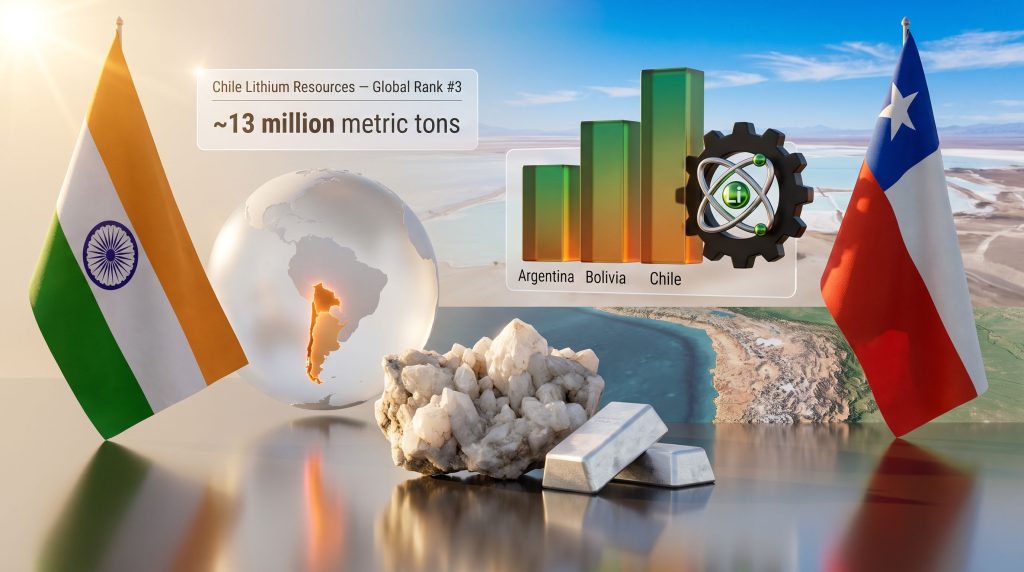
| Country | Estimated Lithium Resources | Global Rank |
|---|---|---|
| Argentina | Largest globally | #1 |
| Bolivia | Second largest | #2 |
| Chile | ~13 million metric tons | #3 |
| Australia | Significant hard-rock resources | #4 |
Source: U.S. Geological Survey
While Chile ranks third by absolute resource volume, its actual competitive advantage lies in extraction economics rather than raw tonnage. The Atacama brine system, which hosts Chile's primary lithium deposits, produces lithium at some of the lowest per-unit costs of any production environment globally. This is because brine-based extraction, which involves pumping lithium-rich subsurface waters into large evaporation ponds, requires significantly less energy and processing intensity than hard-rock spodumene mining of the type common in Australia.
What Brine-Based Lithium Extraction Actually Involves
This distinction between brine and hard-rock lithium is more consequential than it might initially appear, and it has direct implications for Coal India's operational capability gap. The mechanics of lithium brine extraction are highly specialised, requiring expertise Coal India does not currently possess.
-
Brine extraction involves pumping lithium-rich brines from subsurface aquifer systems to surface evaporation ponds, concentrating the lithium through solar evaporation over periods of 12 to 24 months, then processing the concentrate through chemical refinement to produce lithium carbonate or lithium hydroxide.
-
Hard-rock mining extracts spodumene ore through conventional drilling and blasting, then processes the concentrate through high-temperature roasting and chemical leaching, a more energy-intensive but faster cycle.
-
Key brine advantage: Atacama brines carry among the highest lithium concentrations of any known brine system globally, with some zones exceeding 1,500 milligrams per litre of lithium, compared to typical brine concentrations elsewhere in the range of 200 to 800 milligrams per litre.
-
Key brine complexity: Brine extraction is highly sensitive to hydrological management. Over-extraction from subsurface aquifers can reduce lithium concentrations over time and affect water tables in surrounding ecosystems, an increasingly scrutinised environmental dimension in Chilean regulatory frameworks.
Coal India has no prior operational experience in brine-based lithium environments. Its institutional expertise is in large-scale open-cut and underground coal mining, disciplines with limited transferability to hydrogeological lithium extraction systems. This capability gap is a material execution risk that any deal structure must address, likely through retention of Wealth Minerals' technical knowledge base or external operational partnerships.
How Chile's Government Transition Is Reshaping the Regulatory Landscape
Chile's lithium sector has been undergoing a significant governance evolution. The country has been progressively moving toward a model that requires greater state participation in lithium extraction, reflecting a broader regional trend toward resource nationalism across Latin America's lithium-endowed jurisdictions.
This evolution creates a layered risk for foreign state-owned enterprise acquirers. On one hand, Chile's existing regulatory framework has historically accommodated foreign mining participation. On the other hand, the specific conditions attached to new lithium extraction licences, including potential local processing requirements, state equity participation mandates, or community benefit obligations, remain subject to ongoing policy development.
India's Overseas Mineral Acquisition Track Record
To contextualise the Coal India move, it helps to map what India has actually achieved in overseas critical mineral acquisition to date, rather than what it has announced or aspired to.
| Agreement | Partner Country | Asset Type | Year |
|---|---|---|---|
| Lithium exploration and mining | Argentina | Five exploration blocks | 2024 |
| Critical minerals cooperation | Australia | Broad minerals framework | Active |
| Critical minerals cooperation | Japan | Technology and supply chain | Active |
| Minerals partnership discussions | Peru | Ongoing negotiations | In progress |
| Minerals partnership discussions | Chile | Broader framework | In progress |
| Technology and minerals agreements | Germany, Brazil, Canada | Multi-sector | 2025-2026 |
The table above illustrates a pattern that is as revealing as the individual entries. India has signed numerous cooperation frameworks and partnership discussions, but the only completed operational agreement involving physical lithium asset access prior to the Wealth Minerals discussions was the five-block Argentina lithium brine market exploration agreement in 2024. A successfully closed Chile transaction would represent a qualitatively different outcome, moving from exploration access to potential extraction rights in a producing lithium jurisdiction.
Why State-Owned Enterprises Are India's Primary Instrument
The use of Coal India as the vehicle for this acquisition is not incidental. Indian government policy explicitly designates state-owned companies as the primary instruments for overseas critical mineral asset acquisition, for several interconnected reasons.
-
State enterprises can absorb sovereign risk and regulatory uncertainty that private sector balance sheets would not tolerate.
-
Government-to-government diplomatic frameworks can be leveraged to support state enterprise commercial negotiations in ways unavailable to private buyers.
-
The transformation mandate assigned to Coal India, diversifying its revenue base beyond thermal coal in anticipation of long-term demand shifts, aligns with the national interest in securing critical mineral supply chains.
-
Parliamentary and public accountability requirements for state enterprises provide a governance framework that host country regulators may view more favourably than opaque private acquisitions.
Coal India's Strategic Repositioning: Structural Mechanisms and Chilean Blueprint
Coal India's board has approved the establishment of an intermediate holding company specifically domiciled in Chile to manage the company's critical mineral investment positions in that country. This structural decision is more strategically significant than it might initially appear.
By creating a Chile-based holding entity rather than managing acquisitions directly from India, Coal India gains the ability to:
-
Hold multiple asset positions under a single locally incorporated vehicle, simplifying regulatory interactions with Chilean authorities.
-
Pursue both lithium and copper opportunities through the same structural platform, since Chile is simultaneously the world's largest copper producer and a leading lithium jurisdiction.
-
Execute deal-by-deal transactions without requiring full central government approval for each individual acquisition.
-
Position the holding company as a potential partner for Chilean state entities, potentially reducing the foreign ownership friction that has affected other overseas mining acquisitions.
Why Copper Is Also Part of the Chile Equation
The dual-commodity dimension of Coal India's Chilean strategy is underappreciated in most coverage of this transaction. Chile produces approximately 25 to 27 percent of global copper output annually, making it structurally indispensable to global electrification regardless of lithium dynamics. Copper demand for EV motors, charging infrastructure, and grid upgrades is projected to create significant supply deficits by the late 2020s and early 2030s.
A Chile-based holding structure that can pursue both battery metals simultaneously offers Coal India a more resilient portfolio than a single-metal strategy.
The next major ASX story will hit our subscribers first
Geopolitical Dimensions: Supply Chain De-Risking as National Strategy
The framing of Coal India buying Wealth Minerals unit for Chile lithium assets as a purely commercial transaction misses the deeper geopolitical architecture it reflects. This deal is one node in a deliberately constructed supply chain diversification strategy aimed at reducing India's structural dependence on China-controlled processing pathways.
India's existing Argentina lithium agreement combined with a potential Chilean acquisition would give New Delhi a two-node presence within the Lithium Triangle, the Argentina-Bolivia-Chile belt that collectively hosts the world's largest concentration of lithium brine resources. Bolivia remains the most resource-rich jurisdiction but also the most operationally and politically complex, making Chile and Argentina the more accessible entry points for foreign state enterprises. Furthermore, technologies such as direct lithium extraction could significantly enhance the commercial viability of assets secured through deals like this one.
The Lithium Triangle dynamic creates an interesting strategic calculus. Securing positions in two of the three triangle jurisdictions does not guarantee supply security, but it substantially reduces the risk of being entirely locked out of the world's most cost-advantaged lithium production geography.
The bilateral agreement architecture India has constructed, spanning Argentina, Australia, Japan, Germany, Brazil, and Canada, reflects a deliberate strategy of building redundancy into the supply chain across multiple resource types, processing technologies, and geographic regions.
Risk Framework: What Could Prevent This Deal From Closing?
Investors and analysts tracking this transaction should apply a multi-dimensional risk lens rather than treating licence approval as the only variable. Several distinct risk categories interact in this deal.
Regulatory Risk
-
The October 2025 licence application has already experienced delays attributable to Chile's government transition.
-
Chile's evolving lithium sector policy may impose local content requirements, state equity participation obligations, or processing mandates that alter the economics of the transaction.
-
New licence conditions could require that a specified proportion of extracted lithium be processed within Chile before export, adding capital expenditure requirements not initially anticipated.
Deal Structure and Valuation Risk
-
The ownership split in a joint venture scenario, the valuation of Kuska Minerals' assets, and the capital commitment thresholds have none of them been publicly disclosed.
-
Asset valuation in pre-licence lithium projects is inherently speculative, since the resource cannot be legally extracted without the licence, creating a circular dependency between valuation and approval.
-
Any deterioration in lithium market pricing between now and licence approval would affect the commercial rationale for the transaction.
Execution and Capability Risk
-
Coal India's institutional knowledge base is built around coal extraction, not brine hydrogeology or lithium chemical processing.
-
Dependence on Wealth Minerals for technical execution introduces counterparty risk if the relationship deteriorates post-acquisition.
-
Brine management errors, including over-extraction from subsurface aquifer systems, can permanently impair resource concentrations, a risk that requires specialised operational discipline that Coal India does not currently possess.
Geopolitical and Bilateral Risk
-
Chile's trend toward resource nationalism could affect licence conditions for state-owned enterprise acquirers from non-Western nations.
-
Any deterioration in India-Chile bilateral relations could affect regulatory processing timelines, as analysts tracking the India-Chile lithium supply chain have noted in recent assessments.
-
Competing bids or partnerships from Chinese state enterprises, which have historically been aggressive acquirers in Latin American lithium assets, could complicate the negotiating environment.
What a Completed Deal Would Mean for India's Energy Transition
A successfully closed Coal India buying Wealth Minerals unit for Chile lithium assets transaction would carry significance that extends well beyond the specific assets involved.
For India's battery manufacturing sector: Domestic cell manufacturers would gain access to more predictably priced lithium feedstock outside China-controlled supply chains, reducing both cost volatility and geopolitical exposure.
For grid-scale energy storage: India's renewable energy integration targets require substantial battery storage deployment. Lithium supply security directly affects the economics of that storage buildout.
For the state enterprise acquisition model: A completed transaction would validate the use of Coal India as a critical mineral acquisition vehicle and create a replicable template for future deals, potentially accelerating India's overseas mineral acquisition pace.
For the Lithium Triangle strategy: Two confirmed positions within the Argentina-Bolivia-Chile belt would meaningfully strengthen India's negotiating posture in future bilateral discussions across the region.
Key Milestones to Watch
For those tracking whether this transaction ultimately closes, the following sequence of observable events provides a practical monitoring framework:
-
Chilean government decision on the jointly submitted October 2025 lithium extraction licence application.
-
Formal public announcement of the chosen deal structure, whether full acquisition or joint venture.
-
Disclosure of ownership split and capital commitment terms between Coal India and Wealth Minerals.
-
Activation and registration of Coal India's Chile-based intermediate holding company.
-
First operational activity at the Kuska Minerals project site following licence grant.
Each of these milestones carries its own informational value. The licence decision alone will signal whether Chile's evolving regulatory framework is accommodating or restrictive toward foreign state enterprise participation. The deal structure announcement will reveal how much operational control Coal India is willing to cede in exchange for reduced execution risk.
This article is intended for informational purposes only and does not constitute financial, investment, or legal advice. All information regarding deal negotiations, timelines, and valuations is based on publicly reported sources and is subject to change. Readers should conduct independent due diligence before making any investment decisions. Forward-looking statements and projections involve inherent uncertainty and should not be treated as confirmed outcomes.
Want to Stay Ahead of the Next Major Mineral Discovery on the ASX?
Discovery Alert's proprietary Discovery IQ model delivers real-time alerts on significant ASX mineral discoveries — instantly translating complex resource data into actionable opportunities across lithium, copper, and over 30 other commodities — so subscribers can act before the broader market catches on. Explore how major mineral discoveries have historically generated substantial returns on Discovery Alert's dedicated discoveries page, and begin your 14-day free trial today to secure your market-leading edge.