August 8, 2026
When the Ground Beneath the Farm Becomes a Mineral Frontier
The global shift toward electrification has redefined how nations value their land. Regions once assessed purely through the lens of agricultural productivity are now being measured against a different metric: the concentration of battery-critical minerals sitting beneath the soil. Lithium mining in KwaZulu-Natal and farming sustainability have become inseparable concerns as this revaluation creates a new category of land use conflict — one that does not pit conservation against development, but instead places two legitimate economic pillars directly against each other.
KwaZulu-Natal's south-eastern coastline is the latest arena for this confrontation. The stakes, measured in livelihoods, water security, and long-term food production capacity, are far higher than a single mineral rush might suggest.
When big ASX news breaks, our subscribers know first
The Scale of the Prospecting Footprint in KwaZulu-Natal
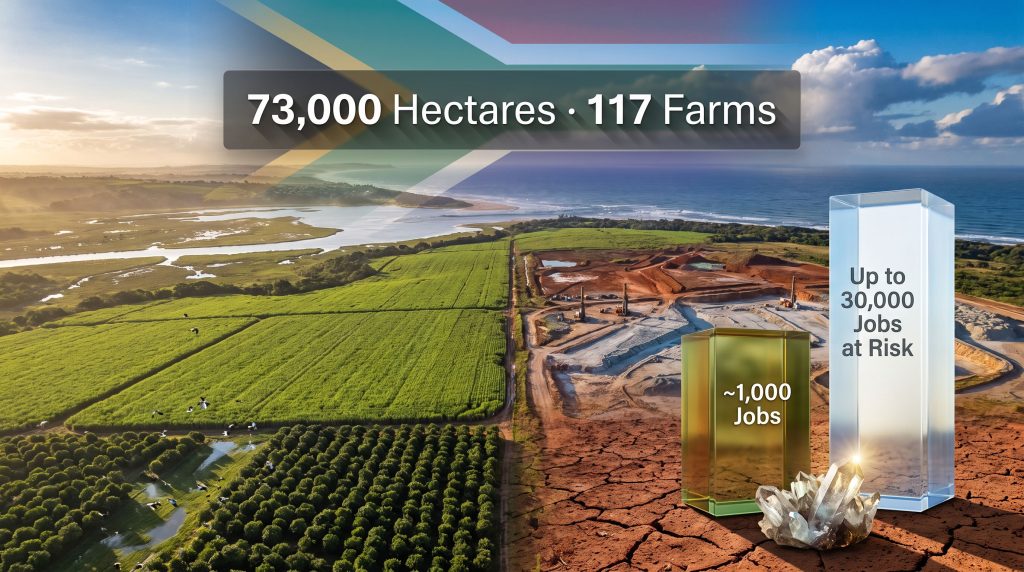
Since 2023, lithium prospecting licences have been issued across an estimated 73,000 hectares spanning 117 farms in KwaZulu-Natal's south-eastern coastal zone. That figure alone reframes the conversation. This is not a localised exploration programme targeting a discrete geological anomaly. It is a prospecting footprint that overlaps with one of South Africa's most productive agricultural belts — a region sustaining commercial sugar cane operations, macadamia orchards, smallholder subsistence plots, and a rural tourism economy built around the area's coastal and biodiversity assets.
The sheer breadth of the licenced area introduces a systemic land use question that local communities and environmental groups have been raising with increasing urgency: at what point does a prospecting phase become an irreversible commitment to large-scale extraction?
KwaZulu-Natal's Dual Economic Identity
What makes the KwaZulu-Natal situation particularly complex is the region's layered economic function. Unlike many mining frontiers that sit in sparsely populated or economically marginal land, the coastal zone targeted by lithium prospectors supports multiple overlapping productive systems:
- Commercial sugar cane farming with established processing and supply chain infrastructure
- Macadamia production integrated into export-oriented agricultural networks
- Subsistence and smallholder farming that anchors food security for rural households
- Agri-tourism and rural hospitality underpinned by landscape and ecological amenity
- Wetland and estuary systems that provide hydrological services to downstream farms and communities
Each of these systems is sensitive to the kind of surface disturbance, groundwater drawdown, and land access disruption that large-scale mining can generate. Furthermore, understanding how lithium mining works helps clarify why these concerns are grounded in practical operational realities, not speculation.
What Agricultural Assets Are Actually at Risk?
The specific vulnerabilities facing KwaZulu-Natal's farming communities from lithium mining in KwaZulu-Natal and farming sustainability debates are not abstract. They map directly onto the physical infrastructure of agricultural production in the region.
| Agricultural Asset | Primary Threat Mechanism | Long-Term Risk Profile |
|---|---|---|
| Coastal aquifers and groundwater | Water abstraction competition and contamination pathways | Reduced irrigation capacity, crop failure risk |
| River systems and wetland corridors | Runoff, sedimentation, and chemical leaching from operations | Ecosystem degradation, downstream productivity loss |
| Fertile coastal soils | Blasting disturbance, topsoil compaction, and displacement | Yield reduction, high rehabilitation cost burden |
| Land tenure across 117 farms | Prospecting-to-mining licence conversion affecting access | Displacement of both commercial and subsistence operators |
The table above reflects a pattern seen across multiple African mining jurisdictions: early-stage prospecting appears relatively benign, but the cumulative effect of conversion to full operational status reshapes the agricultural landscape in ways that are difficult to reverse.
Water Security: The Underappreciated Agricultural Lifeline
Of all the risks associated with expanded lithium extraction in the region, groundwater vulnerability carries the most far-reaching implications for farming sustainability. KwaZulu-Natal's coastal agricultural zone relies on a network of aquifers, rivers, and wetland systems that are structurally connected. Drawdown at one point in the system can affect irrigation capacity kilometres away.
Communities in the Umzumbe and Highbury areas have already raised formal objections citing potential disruption to aquifers, estuarine systems, and biodiversity corridors that anchor agricultural productivity across the broader region. Environmental organisations have echoed these concerns, arguing that comprehensive hydrological assessments should precede any expansion of mining approvals rather than follow them. Africa Sustainability Matters has reported extensively on how this tension between green energy ambitions and food security is playing out across the region.
Groundwater contamination in agricultural zones does not require a catastrophic event. Incremental changes to pH levels, mineral concentrations, or water table depth can progressively degrade irrigation water quality over years, creating losses that are difficult to attribute and nearly impossible to remediate without substantial public investment.
Mining operators in the region have noted that mine water is managed on-site for processing and dust suppression rather than discharged into waterways. However, critics argue that this assurance, while meaningful at the operational level, does not fully address the risks posed by groundwater interference during blasting, tunnelling, or open-cut extraction phases.
The Human Dimension: Displacement, Livelihoods, and the Employment Trade-Off
Beyond the environmental concerns, the human geography of the prospecting zone introduces a dimension that is difficult to resolve through regulatory compliance alone. Reports indicate that more than 800 residents could face relocation as mining expansion proceeds, with affected land including cane fields, subsistence farming plots, and areas of cultural and ancestral significance to local communities.
Mining proponents have argued that relocations have been conducted voluntarily and that affected households have received improved living conditions. Communities and advocacy groups, however, have contested the substance of these claims, raising questions about whether replacement land offers equivalent agricultural productivity and whether the consultation process adequately represented the interests of all affected parties.
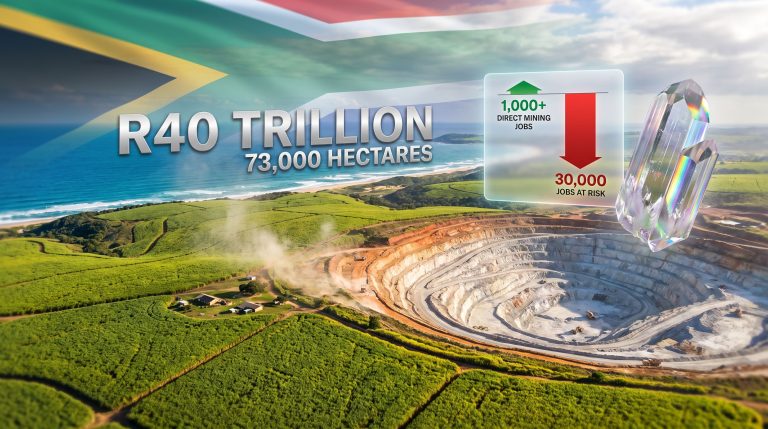
The employment arithmetic presents a further tension. Current mining operations are credited with generating more than 1,000 direct employment opportunities in the region. Community groups have countered that full conversion of the prospecting footprint to active mining could place up to 30,000 jobs at risk across agriculture, agricultural services, and rural tourism.
| Employment Category | Estimated Jobs | Risk Level Under Full Mining Expansion |
|---|---|---|
| Direct mining employment | ~1,000+ | Stable under expansion |
| Agricultural sector (farming and services) | Significant regional share | High, land fragmentation and displacement risk |
| Rural tourism and hospitality | Regionally material | High, landscape and amenity degradation risk |
| Agricultural supply chains | Broad downstream exposure | Medium-to-high, dependent on farm viability |
| Total at-risk estimate (community groups) | Up to 30,000 | Conditional on full prospecting-to-mining conversion |
The asymmetry here is striking. Even accepting the 30,000 figure as an upper-bound estimate rather than a certainty, the ratio of jobs potentially at risk to jobs generated by mining suggests that a straightforward employment argument in favour of expansion requires considerably more scrutiny than it typically receives.
Regulatory Architecture: Where Compliance Ends and Governance Begins
South Africa's mining regulatory framework requires environmental impact assessments and stakeholder consultation processes before mining rights are formally granted. In principle, these mechanisms exist precisely to identify and mitigate the kind of agricultural and hydrological risks being raised in KwaZulu-Natal.
In practice, community organisations have consistently argued that the current framework falls short of what is needed to protect long-term agricultural sustainability. The core criticism is not that regulations do not exist, but that:
- Environmental assessments are often initiated after significant prospecting activity has already occurred
- Consultation processes do not always reach subsistence farmers, smallholders, or communities with limited formal organisational capacity
- The cumulative impact of multiple prospecting licences across 73,000 hectares is rarely assessed as a system-level risk
- Rehabilitation obligations are difficult to enforce across the multi-decade timeframes of large mining operations
Regulatory compliance and community confidence are not interchangeable outcomes. A project can satisfy every legal requirement and still generate legitimate grievances if affected communities feel excluded from decisions that fundamentally reshape their economic and physical environment.
This distinction matters increasingly to institutional investors, ESG-focused capital allocators, and international mining partners who are becoming more attuned to social licence risk as a material financial consideration. In addition, mine reclamation challenges in comparable jurisdictions demonstrate just how costly and contested post-extraction rehabilitation can become when governance frameworks are inadequate from the outset.
The Green Minerals Paradox: Clean Energy Demand and Agricultural Displacement
There is an uncomfortable irony embedded in the KwaZulu-Natal situation that deserves direct acknowledgement. Lithium is, in a very real sense, extracted in service of reducing carbon emissions. The electric vehicles and grid-scale battery storage systems that lithium enables are central to decarbonisation strategies across major economies. The critical minerals energy transition dynamic driving prospecting activity in KZN is ultimately a demand signal generated by climate policy.
Yet the extraction process itself carries land, water, and community costs that fall disproportionately on agricultural communities who bear little responsibility for the emissions the technology is designed to address.
Research across multiple energy transition studies has found that clean energy systems require significantly less ongoing raw material throughput than fossil fuel energy infrastructure across comparable operational lifetimes. However, the upfront land and water footprint of battery mineral extraction, particularly at the scale envisaged across KwaZulu-Natal's coastal zone, represents a front-loaded environmental cost that affected communities are being asked to absorb now in exchange for diffuse global benefits materialising over decades.
South Africa's broader critical minerals demand — which includes not only lithium but also graphite, cobalt, manganese, and rare earth elements — positions the country as a potentially significant contributor to global battery supply chains. However, this strategic positioning creates internal distributional pressures that governance frameworks have not yet been designed to resolve equitably.
The next major ASX story will hit our subscribers first
Long-Term Scenarios for Farming Sustainability in KwaZulu-Natal
Three plausible futures exist for the agricultural communities sitting within the prospecting footprint, depending on how regulatory, community, and industry dynamics evolve:
| Scenario | Agricultural Outcome | Water Security | Community Displacement | Economic Balance |
|---|---|---|---|---|
| Full mining conversion | High land loss, fragmented farms | Elevated contamination risk | Large-scale, 800+ affected | Mining-dominant, agriculture weakened |
| Selective development with buffers | Moderate land impact | Manageable with oversight | Limited, targeted | Dual-sector balance possible |
| Community-integrated land planning | Agricultural land preserved | Strongest protection | Minimal | Sustainable long-term model |
The third scenario — community-integrated land planning that formally recognises agricultural productivity zones as constraints on mining footprint — has precedent in other resource-rich African nations, though implementation has been inconsistent. Zambia's efforts to integrate smallholder interests into copper belt governance and Botswana's community-based natural resource management frameworks offer partial models, though neither translates directly to KZN's specific agricultural and hydrological profile.
What these precedents do suggest is that the most durable outcomes emerge when communities are positioned as stakeholders in land use decision-making from the earliest stages, not consulted after the framework has already been defined by prospecting licence boundaries. Furthermore, the role of natural capital in mining governance is increasingly recognised as a critical factor in determining whether extraction delivers genuine long-term value or simply transfers costs onto communities and ecosystems.
Frequently Asked Questions: Lithium Mining in KwaZulu-Natal and Farming Sustainability
How many hectares of farmland are covered by lithium prospecting licences in KwaZulu-Natal?
Approximately 73,000 hectares across 117 farms in the south-eastern coastal region have been identified as falling within active lithium prospecting licence areas, covering commercial agricultural operations and smallholder farming land simultaneously.
What farming activities face the greatest exposure to lithium mining expansion?
Sugar cane cultivation, macadamia orchards, subsistence food production, and rural agri-tourism face the highest vulnerability, particularly where prospecting rights overlap with irrigated land dependent on groundwater and coastal river systems.
How does lithium mining threaten water security for KZN farmers?
Mining operations can draw down aquifer levels, alter surface water flows, and introduce contamination pathways through runoff and tailings management processes, directly reducing the water availability that coastal agriculture depends on for both irrigation and livestock.
What is the estimated number of jobs at risk if prospecting licences fully convert to mining operations?
Community and advocacy organisations have estimated that up to 30,000 jobs across farming, agricultural services, and tourism could be placed at risk if the full prospecting footprint progresses to active large-scale mining operations.
What environmental protections currently apply to lithium mining projects in South Africa?
South African law mandates environmental impact assessments and stakeholder consultation before mining rights are formally granted. However, community groups have consistently argued these processes have not been sufficiently rigorous or transparent to adequately protect agricultural and water security interests in KwaZulu-Natal. The Japan Times has reported on how this opposition from farming communities is attracting international attention as similar tensions emerge globally.
Key Takeaways
- Lithium mining in KwaZulu-Natal and farming sustainability represent a conflict of provincial significance, with prospecting covering 73,000 hectares across 117 farms — far beyond a localised project footprint
- Water security is the central agricultural vulnerability, with aquifer drawdown and contamination risk capable of undermining crop production across the region independent of direct land displacement
- The employment trade-off is fundamentally asymmetric: approximately 1,000 direct mining jobs measured against a community estimate of up to 30,000 agricultural and tourism jobs at risk under full expansion
- Regulatory compliance and community confidence are not the same outcome — transparent environmental governance and meaningful engagement are prerequisites for sustainable critical mineral development, not optional additions to it
- South Africa's positioning within global battery supply chains will ultimately depend on its capacity to resolve, rather than bypass, the legitimate land and water concerns raised by farming communities in KwaZulu-Natal
This article draws on publicly reported information and community stakeholder submissions. Estimates relating to jobs at risk, displacement numbers, and environmental impacts are based on figures circulated by community organisations and advocacy groups. These represent projected scenarios under full mining conversion rather than confirmed outcomes, and readers should treat forward-looking estimates accordingly. Independent environmental and economic assessments should be consulted for investment or policy decisions.
Want to Track the Critical Minerals Driving the Global Energy Transition?
Discovery Alert's proprietary Discovery IQ model delivers real-time alerts the moment significant ASX mineral discoveries — including lithium and other battery-critical commodities — are announced, translating complex geological data into clear, actionable investment insights. Explore Discovery Alert's dedicated discoveries page to understand how historic mineral discoveries have generated substantial market returns, and begin your 14-day free trial to position yourself ahead of the broader market.