August 7, 2026
The Value-Chain Trap: Why Mining Lithium Is No Longer Enough
For decades, the dominant logic of resource economies held that extraction was the prize. Dig it up, ship it out, and let downstream markets handle the complexity. That model created enormous wealth for Australia in iron ore and coal, but it is now being systematically challenged in the lithium sector, where the real economic value sits not in the ground but in the chemical conversion that follows.
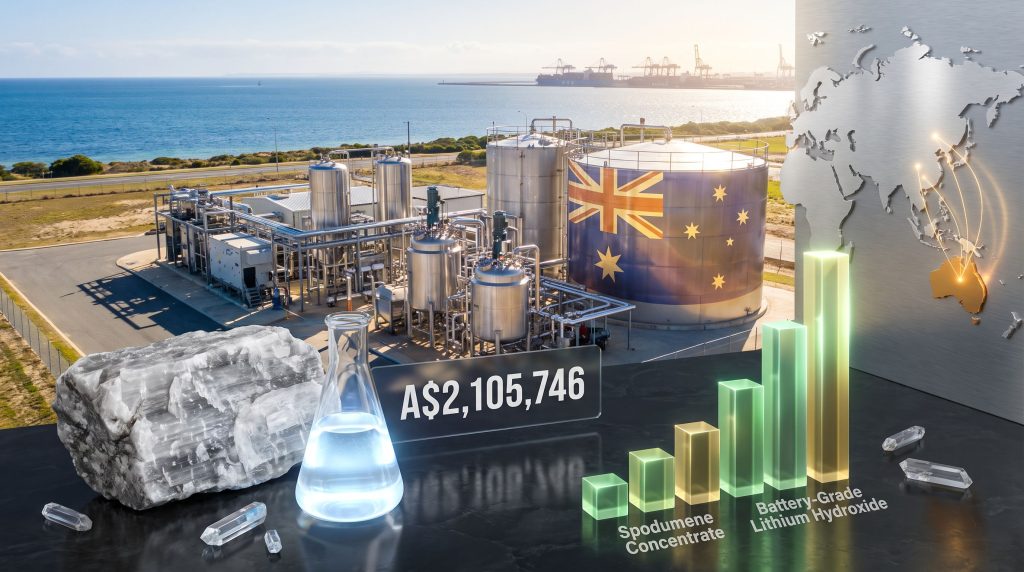
Battery-grade lithium hydroxide monohydrate, the refined product that feeds cathode production in lithium-ion cells, commands a price per tonne that is roughly ten to fifteen times higher than the spodumene concentrate from which it is derived. Australia currently exports the overwhelming majority of its lithium output in that lower-value, minimally processed form. Closing that gap has become one of the more consequential industrial policy challenges the country faces as the global energy transition accelerates.
The Australian government's decision to allocate A$2,105,746 (approximately USD 2 million) to ElectraLith through the federal Industry Growth Program, supporting a pilot-scale sustainable lithium extraction and refining test site in Kwinana, Western Australia, is best understood not as a standalone grant but as a deliberate policy instrument within a broader sovereign capability agenda. This is what the Australian government backing a lithium refining pilot with USD 2M actually looks like in practice.
When big ASX news breaks, our subscribers know first
Understanding the Industry Growth Program as a Policy Architecture
The Industry Growth Program is a competitive federal grant mechanism designed to accelerate commercialisation in advanced manufacturing and critical minerals processing. It targets the most stubborn gap in Australian industrial development: the distance between a technically viable process and a bankable commercial operation.
Grant recipients must meet eligibility criteria related to innovation, commercial potential, and the capacity to generate skilled employment. Funding is typically disbursed against project milestones rather than as a lump sum, which imposes a performance discipline on recipients and reduces the government's exposure to technology failure. Co-investment expectations are generally built into the program architecture, meaning the public dollar is designed to attract, not replace, private capital.
Within this framework, lithium refining sits at an intersection of several policy priorities simultaneously: critical minerals sovereignty, advanced manufacturing expansion, clean energy supply chain development, and regional industrial diversification in Western Australia. Furthermore, Australia's critical minerals strategy reinforces these priorities at a national level, providing the overarching framework within which individual grant programs operate.
How Does the ElectraLith Grant Compare to Other Australian Pilot Investments?
To contextualise the grant amount, it is useful to place it alongside comparable public investments in Australian lithium processing at similar development stages.
| Program / Recipient | Funding Amount | Technology Focus | Location |
|---|---|---|---|
| ElectraLith (Industry Growth Program) | A$2,105,746 (~USD 2M) | Sustainable extraction and battery-grade refining pilot | Kwinana, Western Australia |
| Core Lithium Pilot Processing Facility | A$6,000,000 | Lithium processing pilot | Northern Territory |
| ARENA-backed Refining Pilot | A$2,900,000+ | Lithium chemical refining | Various |
The ElectraLith allocation is consistent with the funding envelope typically applied to pilot-stage projects, where the primary objective is technical validation rather than commercial throughput. Larger grants tend to follow once pilot data has de-risked the process sufficiently to attract private investment at scale.
What ElectraLith's Kwinana Pilot Actually Involves
Kwinana's selection as the pilot site reflects a sophisticated understanding of industrial geography. The Kwinana Industrial Area, located approximately 40 kilometres south of Perth, hosts one of Australia's most concentrated clusters of heavy chemical processing infrastructure, including existing acid production, industrial water treatment, and port export facilities. For a lithium refining pilot, this matters enormously because the input requirements of the process are substantial.
Conventional spodumene extraction into lithium hydroxide involves several distinct chemical conversion stages:
- Calcination of spodumene to convert alpha-spodumene to the more chemically reactive beta form
- Acid roasting using sulphuric acid to produce lithium sulphate
- Purification steps to remove impurities including iron, calcium, magnesium, and aluminium
- Causticisation to convert lithium sulphate to lithium hydroxide
- Crystallisation and drying to achieve battery-grade purity specifications
What distinguishes ElectraLith's approach is its focus on sustainable extraction pathways, which implies a process designed to reduce energy intensity, minimise chemical waste streams, or improve yield efficiency compared to conventional hydrometallurgical routes. The pilot programme's core objective is to validate these process parameters under real operating conditions using actual feedstock rather than laboratory-scale quantities.
What Does Pilot Scale Really Mean in This Context?
A lithium refining pilot plant operates at dramatically reduced throughput compared to a commercial facility, typically processing tonnes rather than thousands of tonnes of feedstock annually. Its primary function is not revenue generation but data generation. Specifically, a well-designed pilot produces:
- Yield rate benchmarks across multiple feedstock batches
- Energy consumption data per tonne of product
- Product quality assays demonstrating compliance with battery-grade specifications
- Process stability metrics over extended operating periods
- Environmental performance data covering water use, reagent consumption, and waste characterisation
Pilot data serves a critical function beyond technical proof of concept. It provides the structured evidence base that lenders, offtake partners, and equity investors require before committing capital to a commercial-scale facility. Without credible pilot data, the financing of a full-scale lithium refinery remains structurally difficult regardless of lithium market conditions.
Battery-grade lithium hydroxide specifications typically require a minimum purity of 56.5% LiOH·H₂O with tightly controlled limits on impurities such as sodium, potassium, calcium, and sulphate. Meeting these thresholds consistently across production batches is the central technical challenge that a pilot programme must resolve.
Australia's Policy Position Against a Competitive Global Backdrop
The geopolitical context surrounding Australia's downstream lithium ambitions cannot be separated from the investment logic underpinning programmes like the IGP. Global competitors are deploying substantial policy frameworks to capture refining and processing value. In addition, the lithium market downturn has heightened the urgency for Australia to establish downstream processing capabilities before market conditions shift further.
| Country | Policy Instrument | Domestic Processing Ambition | Primary Funding Mechanism |
|---|---|---|---|
| Australia | Industry Growth Program, ARENA, National Reconstruction Fund | Expand downstream critical minerals processing capacity | Competitive grants, co-investment |
| United States | Inflation Reduction Act | Reduce battery material import dependency | Tax credits, Department of Energy loan guarantees |
| European Union | Critical Raw Materials Act | 40% domestic processing of strategic minerals by 2030 | Strategic Projects designation, member state co-investment |
| Canada | Critical Minerals Strategy | Build integrated battery supply chain | Federal co-investment, royalty framework adjustments |
| China | State industrial policy | Maintain vertically integrated supply chain dominance | State-directed investment across the full value chain |
China's position is the most structurally relevant comparison. Chinese entities currently control a dominant share of global lithium chemical refining capacity, built over two decades through patient state-directed capital allocation. Australia is attempting to diversify this concentration through pilot programmes, but the scale asymmetry remains stark. China's annual lithium hydroxide and carbonate production capacity is measured in hundreds of thousands of tonnes; Australia's current refined output is a fraction of that.
The European Union's Critical Raw Materials Act target of achieving 40% domestic processing of strategic minerals by 2030 creates a potentially significant future demand signal for Australian refined product, particularly given Australia's political alignment with European supply chain diversification priorities. ARENA's support for lithium refining trials in Western Australia further demonstrates how multiple funding bodies are coordinating to address this strategic gap.
The Economics of Moving Up the Value Chain
The financial argument for domestic refining is not subtle. Spodumene concentrate has historically traded in a range of approximately USD 800 to USD 1,000 per tonne during moderate market conditions, though prices have shown extreme volatility, rising above USD 8,000/t during the 2022 peak before correcting sharply. Battery-grade lithium hydroxide has traded at market peaks above USD 70,000 per tonne, with more normalised mid-cycle pricing in the USD 10,000 to USD 20,000 per tonne range.
Even at conservative mid-cycle pricing differentials, the value-add argument for domestic refining is compelling:
- Raw spodumene (6% Li₂O concentrate): approximately USD 800 to 1,000 per tonne
- Battery-grade lithium hydroxide monohydrate: approximately USD 10,000 to 20,000 per tonne at mid-cycle pricing
- Implied conversion value uplift: roughly 10x to 20x, minus processing costs
If Australia were to domestically refine even 30% of its annual lithium output rather than exporting raw concentrate, the incremental export revenue could represent several billion dollars annually at mid-cycle prices, fundamentally altering royalty receipts, employment multipliers, and the trade balance contribution of the sector. This scenario remains speculative and is highly sensitive to both refining costs and prevailing lithium market conditions, but it illustrates the structural economic logic driving policy.
Disclaimer: All price ranges cited are indicative and based on historical market data. Lithium commodity prices are subject to significant volatility. Nothing in this article constitutes financial advice.
Why Kwinana's Industrial Infrastructure Creates Competitive Advantage
One frequently underappreciated aspect of the Kwinana site selection is the embedded cost advantage it provides relative to greenfield refining locations. Building lithium refining capacity in a location without existing industrial utilities, acid supply, and port infrastructure would require substantially higher capital expenditure, extending the timeline to commercial viability.
Kwinana's existing infrastructure includes:
- Sulphuric acid production facilities critical for the acid-roast step in spodumene processing
- Industrial water supply and treatment systems capable of supporting the water-intensive purification stages
- Deep-water port access at the Port of Fremantle and the associated bulk export terminals
- Skilled chemical processing workforce with experience from the existing fertiliser and industrial chemical sector
- Grid-connected power infrastructure with growing renewable energy integration options
The proximity to Pilbara spodumene operations, roughly 1,200 to 1,600 kilometres to the north, means that feedstock logistics represent an additional cost that Kwinana-based refiners must absorb. However, the savings from shared infrastructure and the availability of process expertise are generally considered to outweigh this disadvantage at commercial scale.
The next major ASX story will hit our subscribers first
Investment Signals and Private Capital Dynamics
From a capital markets perspective, government pilot funding performs a specific and often undervalued function. It does not primarily finance commercialisation directly; rather, it reduces the perceived technology risk that institutional investors and project finance lenders apply to early-stage processing ventures.
When a government agency competitively selects a technology for co-investment, it implicitly signals a technical and commercial credibility assessment that private investors would otherwise need to conduct independently and at their own expense. This de-risking function can materially lower the cost of follow-on capital.
The pathway from pilot success to commercial financing typically involves several sequential steps:
- Pilot completion and data package compilation
- Prefeasibility study incorporating pilot-derived process parameters
- Definitive feasibility study with capital cost estimates and operating cost models
- Offtake agreement negotiations with battery manufacturers or chemical traders
- Project finance mandate and debt term sheet from infrastructure or commodity lenders
- Final Investment Decision and construction commencement
At each stage, the quality of the preceding pilot data either accelerates or constrains the process. Furthermore, Australian lithium tax breaks available to eligible downstream processors can meaningfully improve project economics at the feasibility stage. This is precisely why the A$2.1 million IGP grant, modest in isolation, functions as a critical enabler within a much larger capital mobilisation sequence. Notably, the National Reconstruction Fund's $50 million investment in Western Australian lithium mining and refining demonstrates how pilot-stage successes can unlock significantly larger follow-on commitments.
Frequently Asked Questions: Australian Lithium Refining Policy
What is the Australian Government's Industry Growth Program?
The Industry Growth Program is a federal competitive grant initiative designed to support Australian businesses in commercialising advanced manufacturing and critical minerals processing technologies. It targets the commercialisation gap between laboratory or pilot-stage development and market-ready operations.
How much did ElectraLith receive for its lithium refining pilot?
ElectraLith received A$2,105,746 (approximately USD 2 million) from the Industry Growth Program to establish a pilot test site for sustainable lithium extraction and battery-grade refining in Kwinana, Western Australia. The Australian government backing a lithium refining pilot with USD 2M signals continued federal commitment to expanding domestic processing capabilities.
Why does battery-grade purity matter so much for lithium?
Lithium-ion battery cathode manufacturers operate to extremely tight chemical specifications. Even trace impurities can degrade cell performance, cycle life, and safety characteristics. Producing consistently on-spec battery-grade lithium hydroxide is the primary technical challenge in refining, and it is the benchmark against which every pilot programme is ultimately judged.
What risks could slow Australia's domestic refining ambitions?
- Sustained low lithium prices reducing commercial incentive for refinery investment
- Permitting and environmental approval timelines extending project schedules
- Global technology competition from alternative direct lithium extraction processes
- Workforce and skills gaps in specialised chemical process engineering
- Coordination gaps between federal and state-level critical minerals programmes
From Pilot Data to Policy Outcome: The Long Road Ahead
The ElectraLith pilot represents one data point in what needs to be a sustained, multi-decade industrial policy commitment if Australia is to meaningfully shift its position in the lithium value chain. Pilot programmes produce knowledge; they do not by themselves produce commercial refineries. The translation from technically validated process to operating facility requires capital at a scale that exceeds anything the IGP or comparable grant programmes can provide directly.
What grant programmes can do, however, is create the conditions under which private capital finds the risk-reward profile acceptable. That function, repeated across multiple pilot projects and technology approaches, gradually builds the evidence base and investor confidence needed to attract the hundreds of millions of dollars that a single commercial-scale lithium refinery requires.
Australia's window to act is real but not indefinite. Global refining capacity is expanding, and the competitive advantage of proximity to Pilbara feedstock diminishes as alternative lithium sources mature technologically. The strategic question is whether the current policy investment trajectory is sufficient in scale and coordination to convert Australia's extraordinary raw material endowment into genuine industrial sovereignty across the battery supply chain.
The A$2.1 million allocated to ElectraLith's Kwinana pilot — representing the Australian government backing a lithium refining pilot with USD 2M — is a small but structurally important step in that direction. Its significance lies not in its absolute size but in what it enables next.
Want to Stay Ahead of the Next Major ASX Mineral Discovery?
Discovery Alert's proprietary Discovery IQ model delivers real-time alerts on significant ASX mineral discoveries — including critical minerals like lithium — instantly translating complex data into actionable investment insights for traders and long-term investors alike. Explore historic examples of exceptional discovery returns and begin your 14-day free trial today to position yourself ahead of the broader market.