August 7, 2026
The Manufacturing Credential That Could Reshape Global Battery Trade
When trade barriers shift from tariffs to carbon intensity thresholds, the factory floor becomes the frontline of export competitiveness. Across global manufacturing, the ability to prove what emissions were embedded during production is rapidly becoming as important as the product itself. For the battery industry, this structural transformation is arriving faster than most anticipated, and China battery makers zero-carbon industrial estates are already repositioning entire production architectures around it.
The logic is straightforward: if access to the world's most lucrative EV markets depends on verified lifecycle emissions data, then low-carbon manufacturing infrastructure is no longer optional. It is the entry ticket.
When big ASX news breaks, our subscribers know first
Why Carbon Intensity Has Become the New Trade Barrier
For decades, battery competitiveness was measured through energy density, cycle life, cost per kilowatt-hour, and supply chain reliability. Those metrics still matter. However, a new dimension has entered the equation, one that originates not in the laboratory but in the regulatory architecture being constructed in Brussels.
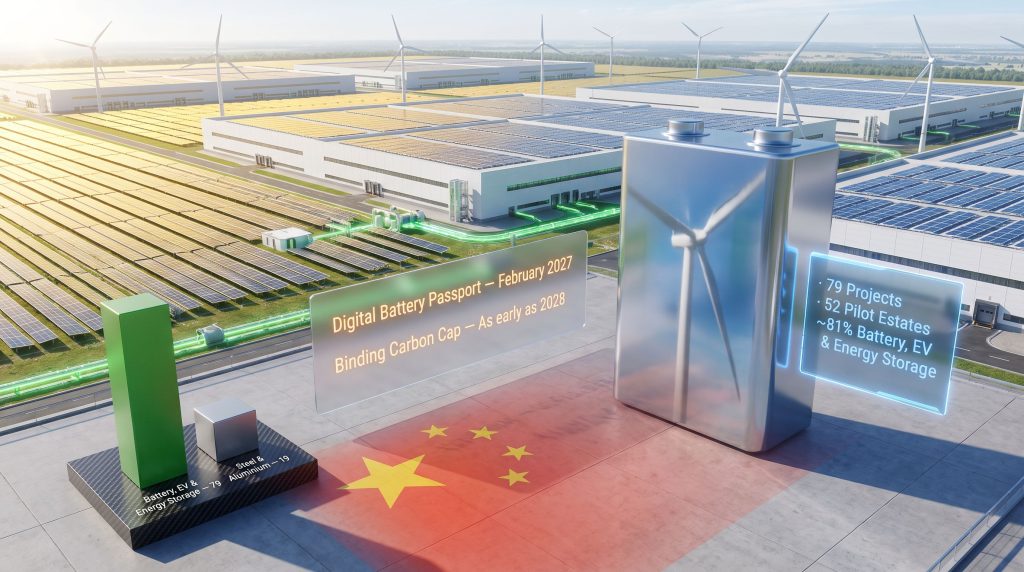
The EU Battery Regulation is progressively raising the emissions bar for every battery sold within the European Union. Beginning in February 2027, electric vehicle and industrial batteries entering the EU market must carry a digital battery passport containing verified lifecycle emissions data from raw material extraction through to cell manufacturing. This is not a voluntary disclosure framework; it is a mandatory compliance condition.
The more consequential deadline follows shortly after. A binding carbon intensity cap is expected to take effect as early as 2028, establishing a hard ceiling on the embedded emissions permissible in batteries sold across all EU member states.
Batteries that cannot demonstrate verified low embedded carbon intensity will face restricted market access across Europe, regardless of how competitive they are on price or performance metrics.
This regulatory sequence effectively converts manufacturing carbon intensity into a market access condition. For Chinese battery exporters, which collectively supply a dominant share of global EV battery capacity, navigating this transition is not peripheral to their business strategy. It is central to it. Furthermore, the critical minerals demand underpinning this transition adds another layer of complexity to supply chain planning.
The Digital Battery Passport Explained
The digital battery passport is a concept that deserves closer examination, particularly because its implications extend well beyond simple disclosure.
Each passport must contain verified data covering:
- The carbon footprint of raw material sourcing and processing
- Emissions generated at each stage of cell manufacturing
- Energy sources used throughout the production process
- Recyclability data and end-of-life management information
For battery makers operating in carbon-intensive grid environments or using conventional energy sourcing, assembling compliant passport data will expose vulnerabilities that cannot be papered over. The passport infrastructure, in this sense, is a compliance forcing function that reaches deep into manufacturing operations.
Zero-Carbon Industrial Estates: Architecture and Mechanics
China's response to this regulatory pressure has taken a distinctive form. Rather than attempting to decarbonise individual factories in isolation, Chinese industrial planners and battery manufacturers have converged on the zero-carbon industrial estate as the preferred structural solution. These purpose-built manufacturing zones operate under a unified low-carbon governance framework, and their defining characteristics distinguish them sharply from conventional industrial parks.
| Component | Function | Role in Emissions Reduction |
|---|---|---|
| Direct-connected renewable power | Wind and solar paired with on-site storage | Eliminates grid-sourced carbon from production |
| Site-wide CO₂ caps | Regulatory ceiling applied across all tenants | Enforces embedded emissions discipline |
| Integrated energy storage systems | Smooths intermittent renewable supply | Enables continuous low-carbon manufacturing |
| Digital carbon governance | Real-time monitoring and data reporting | Supports lifecycle emissions verification |
The practical mechanics of achieving near-zero embedded emissions within these estates follow a defined sequence:
- Renewable power sourcing – Factories connect directly to on-site wind and solar generation, bypassing carbon-intensive grid electricity entirely
- Energy storage buffering – Battery storage systems stabilise power supply, removing reliance on fossil-fuel backup generation
- Digital emissions tracking – Site-wide monitoring platforms record CO₂ data at each stage of the production process
- Lifecycle carbon reporting – Verified emissions records are compiled into battery digital passports formatted for export compliance
- Continuous optimisation – Energy and carbon management systems adjust operations in real time to maintain compliance thresholds
The estate model's core advantage is systemic. Rather than retrofitting individual factories, it embeds decarbonisation into the physical and regulatory infrastructure of the entire site, making compliance a default condition rather than a continuous operational challenge.
Policy Architecture Behind the Estates
China's National Development and Reform Commission has formally embedded adaptation to green trade regulations as one of five core objectives within its zero-carbon industrial estate initiative. This policy framing is significant because it signals that decarbonisation within these estates is being explicitly linked to export competitiveness, not simply treated as a domestic environmental target.
This alignment between industrial estate design and trade policy adaptation reflects a broader recognition within Chinese industrial planning that the EU's carbon rules have moved from a distant regulatory possibility to an imminent commercial reality. In addition, shifts in the battery raw materials market are intensifying pressure on manufacturers to act quickly.
The Battery Sector's Overwhelming Dominance in the Estate Pipeline
Among all industries participating in China's zero-carbon estate programme, the battery sector's concentration is striking. Across 52 pilot zero-carbon industrial estates, battery, electric vehicle, and energy storage projects account for 79 announced projects, representing approximately 81% of the total pipeline.
By comparison, steel and aluminium, industries that face their own carbon trade pressures through the EU's Carbon Border Adjustment Mechanism, collectively account for only 19 projects across the same pilot programme.
| Sector | Announced Projects in Pilot Estates | Approximate Share |
|---|---|---|
| Battery, EV and Energy Storage | 79 | ~81% |
| Steel and Aluminium | 19 | ~19% |
This concentration is not accidental. Battery manufacturing faces a uniquely direct regulatory forcing function in the form of the EU Battery Regulation's carbon cap, which creates a sharper and more imminent compliance deadline than the mechanisms affecting other industries. The result is a sector-specific acceleration that has no parallel in traditional heavy industry.
China's national ambition in this space points toward approximately 100 national-level zero-carbon industrial parks by 2030, indicating that the current 52-estate pilot phase represents an early stage of a much larger industrial transformation.
Leading Manufacturers and Their Approaches
The three dominant models emerging from China's zero-carbon estate transition reflect different strategic approaches, each with its own implications for scalability and export positioning.
CATL has pursued a lighthouse factory certification model, developing zero-carbon battery manufacturing bases designed explicitly to demonstrate verified low-carbon credentials to international buyers. The Dongying project in Shandong province, described as China's first fully zero-carbon industrial park, is anchored by a 40 GWh battery project directly connected to on-site wind and solar generation paired with storage systems. This export-oriented demonstration model is designed to build buyer confidence in supply chain decarbonisation claims.
SVOLT has taken a greenfield approach in Sichuan, developing a zero-carbon lithium battery industrial park that integrates battery recycling, pack assembly, and key materials production within a single closed-loop facility built from the ground up around renewable power infrastructure. The closed-loop design offers potential carbon accounting advantages by reducing the emissions footprint of materials handling and logistics within the production cycle.
Sunwoda has demonstrated that the zero-carbon estate framework is not limited to greenfield developments. Its near-zero-carbon park transformation model has been applied across multiple existing production bases, combining on-site energy generation, storage systems, digital control platforms, and carbon data governance. This legacy facility adaptation pathway is arguably the most scalable element of China's decarbonisation push, given the volume of existing manufacturing capacity that cannot simply be demolished and rebuilt.
Compliance Infrastructure as a Long-Term Competitive Asset
The more strategically interesting question is what happens to this compliance infrastructure after the initial EU regulatory thresholds are cleared. The answer may lie in markets well beyond Europe. Furthermore, advances in lithium-ion battery recycling are enhancing the closed-loop credentials that underpin these estates' carbon accounting frameworks.
Emerging markets already embedded in Chinese clean energy supply chains represent natural adoption pathways for the zero-carbon estate model. Countries building domestic battery or EV manufacturing capacity may import the estate concept alongside the technology, creating a template replication effect that extends China's industrial decarbonisation influence into Southeast Asia, the Middle East, and Africa.
Consider the supply chain dynamics at work:
- A Vietnamese EV manufacturer procuring battery cells for European export requires verified lifecycle emissions documentation
- A Chinese battery producer operating within a certified zero-carbon estate can supply compliant passport data that satisfies EU digital passport requirements
- This creates a procurement preference for zero-carbon estate suppliers over conventional manufacturers
- Early estate adopters gain a supply chain lock-in effect that compounds over time as downstream manufacturers build their own compliance obligations around trusted low-carbon suppliers
The strongest export potential for this model is likely to materialise in emerging markets that already import significant volumes of Chinese solar, energy storage, and grid technology, where existing infrastructure relationships and policy compatibility are highest. Consequently, the global reach of these zero-carbon parks is increasingly being evaluated as a long-term strategic lever rather than a localised industrial initiative.
The next major ASX story will hit our subscribers first
Risks and Structural Limitations
The zero-carbon estate model carries real implementation challenges that should not be underestimated.
| Dimension | Zero-Carbon Estate | Conventional Facility |
|---|---|---|
| Power sourcing | Direct renewable connection | Mixed grid, coal-heavy in some regions |
| Embedded carbon intensity | Near-zero to low | Moderate to high |
| EU market access post-2028 | Compliant | At risk of cap breach |
| Capital expenditure | Higher upfront | Lower upfront |
| Long-term export positioning | Strengthened | Vulnerable to regulatory exclusion |
Verification integrity is a legitimate concern. Lifecycle emissions data that cannot be independently audited creates compliance risk for both producers and downstream buyers. The credibility of digital battery passports depends entirely on the robustness of the carbon accounting frameworks sitting beneath them.
Grid dependency remains an issue in regions of China where renewable capacity is insufficient to fully power manufacturing operations through direct connection, requiring workarounds that may complicate clean emissions claims.
Cost premiums associated with zero-carbon estate operations have implications for price competitiveness, particularly in markets where buyers are not yet willing to pay for verified low-carbon credentials. This tension is likely to ease as EU regulatory deadlines arrive and carbon compliance becomes a procurement baseline rather than a premium feature. However, China's export restrictions on key materials add further uncertainty to the cost outlook for manufacturers operating within and beyond these estates.
Key Takeaways for Understanding the Strategic Shift
- The EU's binding carbon cap, expected as early as 2028, has transformed China battery makers zero-carbon industrial estates investment from a domestic climate initiative into a core export compliance and market access strategy
- Battery, EV, and energy storage projects represent approximately 81% of announced projects across China's 52 pilot estates, reflecting a sector-specific urgency with no equivalent in traditional heavy industries
- Leading manufacturers including CATL, SVOLT, and Sunwoda have each developed distinct estate models, from greenfield parks to legacy facility transformation, suggesting the framework is adaptable across different manufacturing contexts
- China's national target of approximately 100 zero-carbon industrial parks by 2030 signals policy commitment that extends well beyond short-term EU compliance
- The compliance infrastructure built to satisfy EU market access requirements creates a dual-use competitive asset with long-term export potential in emerging markets already integrated into Chinese clean energy supply chains. In addition, the broader Chinese battery recycling breakthrough occurring in parallel further strengthens the closed-loop credentials of these manufacturing zones
This article contains forward-looking analysis related to regulatory timelines, market access conditions, and strategic projections. Readers should note that regulatory frameworks, compliance deadlines, and competitive outcomes remain subject to change. Nothing in this article constitutes financial or investment advice.
Want to Capitalise on the Next Major Resource Discovery Driving the Clean Energy Transition?
Discovery Alert's proprietary Discovery IQ model scans ASX announcements in real time, instantly identifying significant mineral discoveries — including the critical minerals and battery materials underpinning the global shift to zero-carbon manufacturing — and delivers actionable alerts directly to subscribers. Explore historic discoveries and their market returns to understand the opportunity, then begin your 14-day free trial at Discovery Alert to position yourself ahead of the broader market.