August 6, 2026
When Commodity Cycles Turn: Reading the Signals Before the Headlines
Commodity markets rarely announce their turning points in advance. The transition from a prolonged oversupply environment to a recovery cycle is almost never visible in real time. It materialises gradually in quarterly earnings reports, in the narrowing gap between realised prices and breakeven costs, and eventually in the headline profit numbers that confirm what forward-looking indicators had been whispering for months. The lithium sector, after enduring one of the most severe corrections in its modern history, is now delivering exactly those confirmation signals, and Albemarle quarterly profit beats expectations on rising lithium prices — the clearest evidence of that shift.
When big ASX news breaks, our subscribers know first
Understanding the Scale of the 2024-2025 Lithium Downturn
What Oversupply Does to a Critical Minerals Producer
To fully appreciate the significance of the current recovery, it is necessary to understand the depth of the preceding contraction. The lithium market downturn entered a structurally oversupplied phase in 2024, driven by a combination of aggressive capacity expansion from producers across Australia, Chile, and China, alongside a temporary deceleration in electric vehicle uptake in key markets. Spot prices for lithium carbonate and lithium hydroxide collapsed from the extraordinary highs of 2022, forcing producers to confront a new and uncomfortable reality.
For major producers, the consequences were swift and painful. Workforce reductions were implemented across multiple operations, capital expenditure programmes for growth projects were deferred or cancelled entirely, and profit margins compressed to near-breakeven levels for even the most cost-efficient operators. Smaller and higher-cost producers faced existential pressure. The industry entered a period of enforced capital discipline that, while painful in the short term, would ultimately lay the groundwork for the recovery now underway.
The lithium price downturn of 2024-2025 was not merely a market correction. It was a structural reset that eliminated marginal supply and forced the entire industry to recalibrate its cost base before any sustainable recovery could occur.
Supply Curtailments as the Catalyst for Price Recovery
One of the less appreciated dynamics in commodity cycles is how the cure for low prices is, ultimately, low prices themselves. When producer margins deteriorate sufficiently, capital investment in new supply dries up, high-cost operations are curtailed or closed, and the market gradually tightens as demand continues to grow. This is precisely the mechanism that played out in lithium between 2024 and early 2026, setting the conditions for the price recovery now confirmed in quarterly earnings data. Furthermore, understanding the lithium carbonate supply dynamics during this period is essential context for interpreting Albemarle's recovery trajectory.
Breaking Down Albemarle's Q2 2026 Financial Performance
The Numbers That Define a Market Turning Point
The Q2 2026 results from Albemarle, the world's largest producer of lithium for batteries, represent a definitive inflection point in the post-downturn recovery narrative. The scale of the improvement compared to the prior corresponding period is remarkable across every key metric.
| Financial Metric | Q2 2026 Result | Q2 2025 Comparison | Analyst Consensus |
|---|---|---|---|
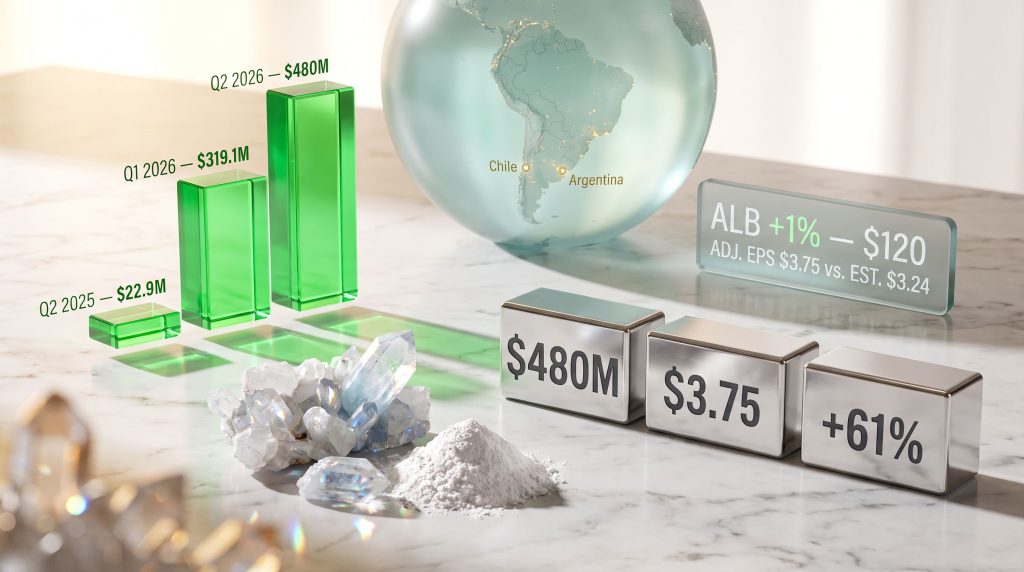
| Net Income | $480 million | $22.9 million | Not specified |
| Adjusted EPS | $3.75 per share | Depressed | $3.24 per share |
| Lithium Price Change (YoY) | +61% | Baseline | Not applicable |
| Sales Volume Growth (YoY) | +11% | Baseline | Not applicable |
| After-Hours Share Price | $120 (+1%) | Not applicable | Not applicable |
The adjusted earnings per share figure of $3.75 exceeded the analyst consensus of $3.24 per share compiled by LSEG IBES, representing a beat of approximately $0.51 per share or roughly 16% above expectations. Net income of $480 million compared to just $22.9 million in the equivalent quarter of 2025 underscores the velocity of the earnings recovery. Albemarle's strong Q2 performance has drawn significant attention from market analysts globally.
Reported vs. Adjusted Earnings: Why the Distinction Matters
In commodity company financial reporting, the distinction between reported and adjusted earnings carries significant analytical weight. Albemarle's reported EPS of $3.52 per share and adjusted EPS of $3.75 per share reflect the exclusion of one-time items from the adjusted figure. Investors and analysts typically assign greater weight to adjusted earnings when assessing underlying operational performance, as one-time charges or gains can obscure the true trajectory of the core business.
The $0.23 gap between the two figures in Q2 2026 is relatively modest, suggesting that the underlying operational recovery is genuine rather than artificially enhanced by accounting adjustments.
The Compounding Effect of Price and Volume Growth
One of the most critical dynamics evident in Albemarle's Q2 2026 performance is the simultaneous occurrence of both price recovery and volume growth. A 61% increase in average realised lithium prices alongside an 11% increase in sales volumes creates a multiplicative revenue effect that is disproportionately larger than either factor would deliver in isolation.
In commodity businesses with high operational leverage, the convergence of rising realised prices and growing sales volumes produces revenue and margin expansion that can appear almost exponential compared to either variable acting independently.
The Earnings Acceleration Trajectory Through 2026
Mapping the Sequential Recovery From Q1 to Q2 2026
The Q2 2026 result does not exist in isolation. Viewed alongside Q1 2026 performance, a clear acceleration pattern emerges that provides important context for second-half expectations.
| Period | Net Income | Adjusted EPS | Key Pricing Dynamic |
|---|---|---|---|
| Q2 2025 | $22.9 million | Severely depressed | Oversupply conditions, collapsed prices |
| Q1 2026 | $319.1 million | $2.95 | ~51% price recovery + ~14% volume growth |
| Q2 2026 | $480 million | $3.75 | 61% price increase + 11% volume growth |
The sequential progression from $2.95 adjusted EPS in Q1 to $3.75 in Q2 represents a 27% quarter-on-quarter improvement in underlying earnings power. More striking is the year-on-year comparison: net income grew from $22.9 million to $480 million in twelve months, an increase of approximately 2,000%. This kind of earnings velocity is characteristic of commodity cycle inflection points, where previously suppressed pricing normalises rapidly against a backdrop of constrained supply.
What Is Driving Lithium Demand in 2026?
Three Pillars of Resilient Consumption
Albemarle's CEO Kent Masters has publicly identified three core end markets as the primary drivers of sustained lithium demand: energy storage systems, electric vehicles, and semiconductors. Each of these markets carries distinct demand characteristics and growth dynamics worth examining separately.
-
Electric vehicles remain the dominant narrative in battery-grade lithium consumption. Global EV adoption continues to accelerate across major markets, with battery pack sizes and energy density requirements directly translating to lithium demand per vehicle. Critically, the chemistry shift in some markets toward lithium iron phosphate (LFP) batteries, which use more lithium carbonate per kilowatt-hour than nickel-based chemistries, has actually increased lithium intensity per vehicle in some segments.
-
Grid-scale energy storage represents an emerging and increasingly significant demand driver that extends well beyond the automotive sector. As renewable energy penetration rises globally, the requirement for large-scale battery storage to manage intermittency is growing rapidly. Utility-scale lithium-ion storage deployments are consuming increasing volumes of battery-grade lithium, diversifying the demand base in ways that reduce the sector's dependence on any single end market.
-
Semiconductor manufacturing is perhaps the least widely understood lithium consumption category. Lithium compounds are used in the production of certain semiconductor materials and, as global chip manufacturing capacity expands, this represents a structurally growing, if modest, source of incremental lithium demand.
The Strategic Significance of Demand Diversification
The convergence of these three demand streams is creating a more structurally resilient lithium consumption profile than existed during the previous price cycle. When lithium demand was overwhelmingly concentrated in the automotive sector, pricing was highly sensitive to fluctuations in EV sales trajectories. The broadening of the demand base to encompass grid storage and industrial applications provides a more stable foundation for sustained price recovery. In addition, the broader battery metals investment landscape reflects this shift toward more diversified consumption dynamics.
Albemarle's Global Operational Footprint
Geographic Scale as a Competitive Advantage
Albemarle operates across four continents, with significant production assets in the Americas, Australia, Asia, and Europe. This geographic breadth serves multiple strategic functions. It provides proximity to demand centres across different regions, offers exposure to different lithium source types including hard rock spodumene in Australia and lithium brine in South America, and reduces concentration risk relative to single-jurisdiction producers.
The South American lithium brine market operations are particularly noteworthy from a geological and cost perspective. Lithium brine extraction from salt flats in Chile and Argentina typically carries lower production costs than hard rock mining operations, as the lithium is dissolved in underground brines that can be pumped to the surface and processed through evaporation ponds. This geological characteristic gives brine operators a structural cost advantage at the lower end of the industry cost curve, providing meaningful margin protection during price downturns.
Operational Leverage in a Rising Price Environment
The combination of low-cost brine production with global distribution infrastructure means that Albemarle captures a disproportionately high share of incremental revenue as prices rise. This operational leverage is a defining feature of the world's largest lithium producer's financial model and explains much of the dramatic earnings improvement visible in the Q2 2026 results.
The next major ASX story will hit our subscribers first
What Do These Results Signal for the Broader Lithium Sector?
Implications for Producers, Developers, and Supply Chain Participants
Albemarle quarterly profit beats expectations on rising lithium prices, and this pricing data consequently functions as a critical reference point for the broader industry. When the world's largest producer confirms a 61% year-on-year increase in average realised prices, this has implications for every participant in the lithium value chain.
-
Junior lithium explorers and developers are likely to see renewed investor interest as the profitability of lithium production becomes visible again at scale.
-
Mid-tier producers in Australia and South America that survived the downturn with operations intact are now positioned to benefit from improved pricing without having incurred the full capital cost of new mine construction.
-
Battery manufacturers and original equipment manufacturers face higher input costs, which may accelerate investment in alternative battery chemistries or recycling programmes as a strategic hedge.
-
Lithium recycling operations, which were marginal businesses during the price downturn, become increasingly economically viable as primary lithium prices recover.
The Risk of New Supply Triggering the Next Cycle
One of the most important questions for investors is whether the current price recovery will trigger a new wave of supply expansion that ultimately sows the seeds of the next oversupply cycle. This is the fundamental paradox of commodity investing: high prices incentivise the investment decisions that eventually suppress those same prices.
Commodity cycles are self-correcting systems. The 2024-2025 oversupply that collapsed lithium prices was itself a product of the investment decisions made during the 2022 price peak. The question investors must now ask is whether the 2026 recovery is creating similar incentives for overcapacity in 2028-2030.
Given that major lithium projects typically require three to seven years from investment decision to first production, any supply response to current pricing would likely be felt in the late 2020s rather than imminently. This timeline provides some runway for the current price environment to persist, however investors should monitor capital expenditure announcements from major producers as a leading indicator of the next supply wave.
Investor and Market Response
Reading the After-Hours Price Movement
Albemarle's shares gained approximately 1% to $120 in after-hours trading following the Q2 2026 results announcement. For a result that beat analyst consensus by roughly 16%, this relatively modest share price reaction warrants examination. Several explanations are plausible.
Markets may have already partially priced in a strong result given the publicly observable improvement in lithium spot prices during the quarter. Alternatively, investors may be applying a degree of caution about the sustainability of the recovery, discounting future earnings at rates that reflect uncertainty about whether the 61% price increase represents a new equilibrium or a temporary overshoot. The muted after-hours reaction could also reflect institutional repositioning rather than any fundamental negative signal. Morningstar's analysis of Albemarle's earnings notes the result came in well above consensus estimates, reinforcing the scale of the beat.
Key Variables to Monitor for the Second Half of 2026
Investors and industry observers should track the following indicators to assess whether the lithium recovery is sustainable:
-
Lithium carbonate and hydroxide spot prices on key indices, particularly Chinese domestic pricing which often leads global benchmarks.
-
EV sales data from major markets including China, Europe, and the United States, as the single largest driver of battery-grade lithium demand.
-
Capital expenditure announcements from major producers, which signal confidence in sustained pricing and provide advance warning of future supply additions.
-
Battery storage project commissioning data, as utility-scale deployments translate directly to lithium demand outside the automotive channel.
-
Inventory levels at battery manufacturers, which can dampen spot demand even during periods of strong end-market growth if supply chains are temporarily overstocked.
FAQ: Albemarle Quarterly Profit and the Lithium Market Recovery
Why Did Albemarle Beat Profit Expectations in Q2 2026?
Albemarle quarterly profit beats expectations on rising lithium prices primarily because average realised lithium prices rose approximately 61% year-on-year while sales volumes grew 11% simultaneously. The combination produced net income of $480 million, compared to just $22.9 million in Q2 2025.
What Was Albemarle's Adjusted EPS in Q2 2026?
Excluding one-time items, Albemarle reported adjusted earnings of $3.75 per share, compared to analyst consensus of approximately $3.24 per share according to LSEG IBES data.
How Does Q2 2026 Compare to Q1 2026?
Q1 2026 produced net income of $319.1 million and adjusted EPS of $2.95. The Q2 acceleration to $480 million net income and $3.75 adjusted EPS indicates a strengthening earnings trajectory through the first half of 2026.
What Caused Albemarle to Cut Staff and Curtail Projects in 2024?
A global lithium supply glut in 2024 drove prices sharply lower, compressing margins across the entire industry and forcing producers, including the world's largest, to reduce headcount and scale back capital expenditure on growth initiatives.
Is the Lithium Price Recovery Sustainable?
While Q2 2026 results confirm a meaningful recovery in realised prices, sustainability depends on several variables including the pace of new supply entering the market, EV adoption trajectories, grid storage deployment rates, and macroeconomic conditions affecting battery manufacturing investment. The recovery appears structurally grounded rather than speculative, however commodity markets are inherently cyclical and investor caution remains warranted.
Five Strategic Conclusions for Investors and Industry Observers
-
The earnings reversal is extraordinary in scale: Moving from $22.9 million to $480 million net income in four quarters reflects the speed and severity of commodity cycle reversals, both downward and upward.
-
Price and volume growth are compounding: The simultaneous occurrence of 61% realised price improvement and 11% volume growth creates multiplicative revenue effects that analysts can underestimate when modelling earnings separately.
-
Demand diversification is structurally important: Energy storage and semiconductor applications are broadening lithium's consumption base beyond automotive, reducing dependence on any single demand driver.
-
Supply discipline created the recovery: The curtailments of 2024-2025 were painful but necessary to rebalance the market. Investors should treat this dynamic as a template for understanding future cycle behaviour.
-
The next risk is the supply response: High prices historically trigger the investment decisions that create the next oversupply. Monitoring capex announcements from major producers over the next 12-18 months is essential for positioning ahead of the next potential inflection point.
Disclaimer: This article contains forward-looking statements and analysis based on publicly available financial data. Commodity markets are inherently volatile and past performance does not guarantee future results. Nothing in this article constitutes financial advice. Readers should conduct independent research and consult qualified financial advisors before making investment decisions.
Want to Capitalise on the Next Major Mineral Discovery Before the Headlines Catch Up?
Discovery Alert's proprietary Discovery IQ model delivers real-time alerts on significant ASX mineral discoveries — turning complex mineral data into actionable insights for both short-term traders and long-term investors. Explore how historic discoveries have generated substantial returns on Discovery Alert's dedicated discoveries page, and begin your 14-day free trial today to position yourself ahead of the broader market.