
August 6, 2026
When Exploration Assets Become Liabilities: The New Calculus for ASX Lithium Producers
Across the global mining landscape, a quiet but meaningful transformation is reshaping how lithium companies allocate capital. The rush to accumulate exploration ground that characterised the 2021 to 2023 lithium supercycle has given way to a more disciplined era, one in which producers with operational cash flows are shedding peripheral assets to concentrate firepower on their highest-returning projects. In Western Australia's Pilbara region, this dynamic is playing out in real time, as evidenced by the decision of Elevra Lithium (ASX: ELV) to divest its pegmatite rights over exploration licence E45/2364 to Wildcat Resources — a transaction that reveals as much about the current lithium market downturn as it does about either company individually.
Understanding why Elevra Lithium sells WA pegmatite rights to Wildcat Resources requires stepping back from the headline figures and examining the deeper strategic forces at work.
When big ASX news breaks, our subscribers know first
The Geology Behind the Deal: Why Pilbara Pegmatites Remain Coveted
Not all lithium deposits are created equal, and Western Australia's hard-rock pegmatite systems represent the upper tier of the global lithium supply chain in terms of resource quality and processing predictability. Pegmatites are igneous intrusions that crystallise slowly, concentrating lithium, caesium, tantalum, and related elements into coarse-grained mineral assemblages. The Pilbara pegmatite corridor, which hosts Tabba Tabba among other projects, is geologically distinct from the spodumene-dominant Greenbushes-Pilgangoora belt further south, carrying a stronger tantalum signature alongside its lithium mineralisation.
Understanding spodumene extraction basics helps contextualise why lithium-caesium-tantalum (LCT) pegmatites like those at Tabba Tabba are notable for a reason that goes beyond lithium alone. Tantalum, used in electronic capacitors and aerospace components, adds a meaningful co-product revenue dimension to any future mine economics. This multi-commodity characteristic can improve project economics substantially, particularly in periods when lithium prices are subdued, because tantalum offtake provides a revenue floor that pure spodumene projects lack.
The proximity of Tabba Tabba to Port Hedland amplifies this appeal. Port Hedland is one of the world's highest-throughput bulk export ports, and its infrastructure accessibility reduces the capital intensity of any future export pathway for spodumene concentrate or tantalite product. For junior developers, proximity to established port infrastructure is a genuine de-risking factor, particularly when project financing discussions begin and logistics costs become scrutinised by lenders.
What the Elevra-Wildcat Transaction Actually Involves
The mechanics of this deal deserve careful examination, because the structure is more sophisticated than a straightforward asset sale.
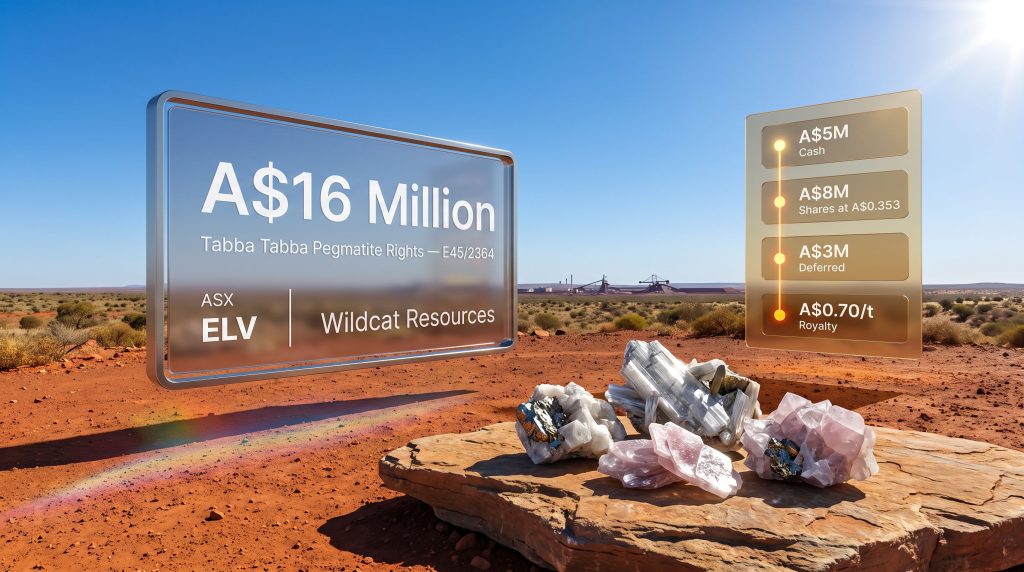
Elevra Lithium has transferred all rights, interests, and obligations associated with exploration licence E45/2364 to Wildcat Resources for total consideration of A$16 million, structured across the following components:
| Consideration Component | Amount | Timing or Condition |
|---|---|---|
| Upfront cash payment | A$5 million | Payable on completion |
| Wildcat ordinary shares | A$8 million | Issued at A$0.353 per share |
| Deferred cash payment | A$3 million | Six months after Wildcat completes feasibility study |
| Contingent royalty | A$0.70 per tonne | Per tonne of JORC pegmatite resource announced within E45/2364 |
| Total guaranteed consideration | A$16 million | Plus ongoing royalty |
A critical piece of context that elevates this transaction beyond a routine asset sale: Wildcat had previously acquired the broader E45/2364 tenement from Northern Star Pilbara, but that earlier deal specifically excluded lithium-caesium-tantalum mineral rights. This created an unusual situation in which Wildcat held surface tenure over a pegmatite-bearing licence without owning the rights to the pegmatite minerals themselves.
Elevra's holding of those LCT rights represented a structural gap in Wildcat's project control — the kind of encumbrance that can complicate resource definition drilling programmes, create ambiguity in future feasibility studies, and make project financing discussions materially more difficult.
By acquiring Elevra's pegmatite rights, Wildcat closes this gap and moves to a clean 100% ownership position over a project with granted mining leases in place. That distinction between having granted mining leases versus still requiring leases to be granted is significant in the WA regulatory environment, where the approvals process can introduce multi-year delays. Projects with granted tenure are inherently more de-risked from a development timeline perspective.
Decoding the Hybrid Payment Architecture
Why Structure a Deal This Way?
The blend of cash, equity, deferred cash, and royalty consideration in this deal reflects a sophisticated approach to bridging the valuation gap between buyer and seller in an uncertain commodity price environment.
Each component serves a distinct purpose:
-
Upfront cash (A$5 million): Provides Elevra with immediate deployable capital, reducing the execution risk of the transaction and enabling near-term reinvestment into the North American Lithium brownfield expansion.
-
Equity component (A$8 million in Wildcat shares at A$0.353): Retains Elevra as a stakeholder in the Tabba Tabba project's future success. If Wildcat's exploration programmes yield significant resource announcements, the value of these shares could appreciate materially, giving Elevra upside participation without carrying operational responsibility.
-
Deferred cash (A$3 million): Tied to the completion of a feasibility study, this component creates a natural performance trigger. It incentivises Wildcat to advance the project toward development whilst ensuring Elevra receives additional cash without needing to monitor or participate in that development process.
-
Contingent royalty (A$0.70 per tonne): This is the most structurally interesting element. A per-tonne JORC resource royalty converts Elevra into a passive beneficiary of any exploration success Wildcat achieves on E45/2364. This instrument is more typically associated with specialist royalty streaming companies than junior-to-junior mineral rights transactions.
The per-tonne JORC resource royalty embedded in this deal functions almost like a royalty streaming arrangement, a financial instrument far more commonly deployed by dedicated royalty companies. Its inclusion in a junior miner-to-junior miner transaction signals growing financial sophistication in how ASX small-cap companies structure asset transfers.
Furthermore, this structure reflects how mining project economics are increasingly being shaped by creative deal architecture rather than simple upfront payments.
Elevra's North American Pivot: The Logic of Concentration
How Does the Portfolio Compare?
To understand the full strategic rationale, it helps to view Elevra's portfolio through the lens of capital efficiency rather than geographic diversification.
| Asset | Location | Ownership |
|---|---|---|
| North American Lithium (NAL) | Québec, Canada | 100% |
| Moblan Lithium Project | Central Québec, Canada | 60% |
| Carolina Lithium Project | United States | 100% |
NAL is not an exploration project. It is an operating lithium producer, and its quarterly ore mining volumes of approximately 372,938 wet metric tonnes reflect a processing plant running at stable throughput levels aligned with its design requirements. The establishment of monthly production records at NAL signals a facility operating at or near its optimised steady-state capacity, which is the prerequisite condition for any credible brownfield expansion business case.
The reinvestment logic here is straightforward: capital directed into brownfield expansion at an operating asset with proven geology, permitted infrastructure, and established offtake relationships generates returns on a materially shorter timeline than capital deployed into a greenfield exploration licence in WA. Elevra's management has consistently communicated a North American growth thesis, and the Tabba Tabba divestiture is the capital allocation decision that operationalises that thesis.
Managing Director Lucan Dow articulated the company's position clearly, noting that the transaction delivers value from a non-core asset through a cash payment that can be redirected toward near-term growth initiatives, whilst the deal structure simultaneously allows Elevra to benefit from any future pegmatite mineralisation discovered on E45/2364. The portfolio simplification further allows management to concentrate on executing the North American strategy, including the NAL brownfield expansion.
Retaining a royalty tail on the divested asset whilst eliminating the administrative, regulatory, and capital burden of maintaining a non-producing WA exploration licence represents a clean expression of capital efficiency discipline.
What Wildcat Resources Gains: A Consolidated Pilbara Platform
From Wildcat's perspective, this transaction completes a tenure consolidation strategy that has been in progress since the original Northern Star Pilbara acquisition. The removal of the LCT rights encumbrance transforms Tabba Tabba from a project with a structural ownership complexity into a straightforward 100%-owned development asset.
For Wildcat's development pathway, the implications are practical and significant:
-
Resource definition drilling on E45/2364 can now proceed without questions about who owns the mineralisation being targeted.
-
Any JORC mineral resource estimate derived from pegmatite intersections within the tenement can be reported in Wildcat's name without legal ambiguity.
-
Project financing discussions — whether with banks, streaming companies, or strategic partners — can proceed on the basis of unencumbered title, which is a standard precondition for project-level debt facilities.
-
The feasibility study process, the completion of which triggers the A$3 million deferred payment to Elevra, provides a natural development milestone framework that imposes productive discipline on the project advancement timeline.
The A$0.70 per tonne royalty payable on any JORC resource announcements within E45/2364 is worth contextualising. If Wildcat's drilling programmes ultimately define, for example, a 50 million tonne JORC resource within the licence, the royalty liability to Elevra would amount to A$35 million on that resource alone. This creates a meaningful incentive alignment: Wildcat is motivated to define a large resource because a large resource supports a viable mining operation, whilst Elevra participates financially in that success through the royalty mechanism.
In addition, Australia's lithium mining evolution has demonstrated time and again that clean project ownership structures are a fundamental prerequisite for attracting institutional capital at scale.
The next major ASX story will hit our subscribers first
Portfolio Rationalisation as a Market Signal: What 2026 Is Teaching ASX Lithium Investors
The broader pattern visible across the ASX lithium sector in 2026 is one of divergence. Companies with production-stage assets generating operating cash flows are increasingly shedding exploration-stage holdings accumulated during the boom years. This divergence creates a secondary market for quality exploration assets, with well-located, geologically credible licences finding buyers even in a subdued spot price environment.
| Feature | Elevra-Wildcat Deal | Typical Junior Asset Sale |
|---|---|---|
| Upfront cash component | A$5 million (31% of total) | Varies widely |
| Equity component | A$8 million in acquirer shares | Less common |
| Deferred cash trigger | Feasibility study completion | Milestone-based |
| Ongoing royalty mechanism | A$0.70/tonne JORC resource | Rare in junior transactions |
| Total consideration | A$16 million plus royalty | Project-dependent |
What Should Investors Watch For?
Several dynamics are worth noting for investors watching this space. Advances in lithium extraction technologies are, furthermore, reshaping how the market values different asset types, adding another layer of complexity to capital allocation decisions across the sector.
-
Non-core asset divestiture by producers can be a positive signal, indicating management discipline around capital allocation rather than an admission that the underlying asset lacks value.
-
Hybrid deal structures protect sellers from leaving upside on the table in a commodity cycle trough, because royalty and equity components provide participation in future price recovery without requiring continued capital deployment.
-
The acquirer in a royalty-inclusive deal assumes a contingent liability that grows with exploration success, which means the deal terms effectively self-calibrate to the value of what is ultimately discovered.
With Elevra Lithium carrying a market capitalisation of approximately A$1.524 billion as of 7 August 2026, and shares trading at A$7.86 ahead of market open, investor sentiment clearly reflects confidence in the North American production platform rather than concerns about the WA divestiture. If anything, the transaction reinforces the investment thesis by demonstrating management's willingness to act decisively on portfolio simplification and capital redeployment. The ASX lithium sector more broadly continues to reward producers that demonstrate this kind of capital discipline during periods of price weakness.
Frequently Asked Questions
What did Elevra Lithium sell to Wildcat Resources?
Elevra Lithium transferred all rights, interests, and obligations over exploration licence E45/2364, covering the Tabba Tabba pegmatite project in Western Australia, to Wildcat Resources for total consideration of A$16 million plus a contingent royalty of A$0.70 per tonne for each tonne of JORC pegmatite mineral resource announced within the tenement.
Why did Elevra Lithium divest the Tabba Tabba pegmatite rights?
The decision reflects Elevra's strategic focus on its North American operational platform, specifically NAL in Québec, the Moblan project, and the Carolina Lithium project in the United States. Maintaining a non-producing WA exploration licence consumed administrative and regulatory bandwidth without contributing to the company's production growth objectives.
How is the A$16 million consideration structured?
The total comprises A$5 million in upfront cash, A$8 million in Wildcat ordinary shares issued at A$0.353 per share, and A$3 million in deferred cash payable six months after Wildcat completes a feasibility study for Tabba Tabba.
What does the A$0.70 per tonne royalty mean in practice?
Elevra receives A$0.70 for every tonne of JORC-compliant pegmatite mineral resource that Wildcat announces within E45/2364. This allows Elevra to benefit financially from future exploration success on the tenement without bearing any of the exploration cost or operational risk. The Minerals Council of Australia has noted that royalty mechanisms of this kind are becoming increasingly common in junior mining transactions as the sector matures.
Why was consolidating the LCT rights so important for Wildcat?
Wildcat had previously acquired the broader E45/2364 tenement from Northern Star Pilbara, but that transaction excluded lithium-caesium-tantalum mineral rights. Without those rights, Wildcat could not fully advance resource definition or project financing. The Elevra acquisition removes that structural complexity and delivers clean 100% ownership of the complete project.
What is Elevra Lithium's current market capitalisation?
As of 7 August 2026, Elevra Lithium (ASX: ELV) carried a market capitalisation of approximately A$1.524 billion, with shares trading at A$7.86 prior to market open.
The material in this article is provided for informational purposes only and should not be treated as investment advice. Readers are encouraged to conduct independent research and consult a licensed financial adviser before making any investment decisions. Forward-looking statements and projections involve risk and uncertainty, and actual outcomes may differ materially from those discussed.
Want to Track the Next Major ASX Lithium Discovery Before the Market Catches On?
Discovery Alert's proprietary Discovery IQ model scans ASX announcements in real time, instantly identifying significant mineral discoveries across lithium and more than 30 other commodities — giving subscribers the actionable edge needed to move ahead of the broader market. Explore historic discoveries and their returns to see what early discovery alerts have meant for investors, then start your 14-day free trial at Discovery Alert to position yourself at the forefront of the next major find.