August 7, 2026
The Hidden Cost of Shipping Rocks: Why Australia's Battery Paradox Is Finally Being Challenged
The global energy transition has created one of the most striking economic contradictions of the modern era. Nations sitting atop the very minerals that power electric vehicles, grid storage systems, and consumer electronics have watched the value-added manufacturing opportunity pass entirely to countries with far fewer natural resources. This is not a minor inefficiency — it represents the difference between being a commodity exporter and being an advanced economy participant in one of the fastest-growing industrial sectors on the planet.
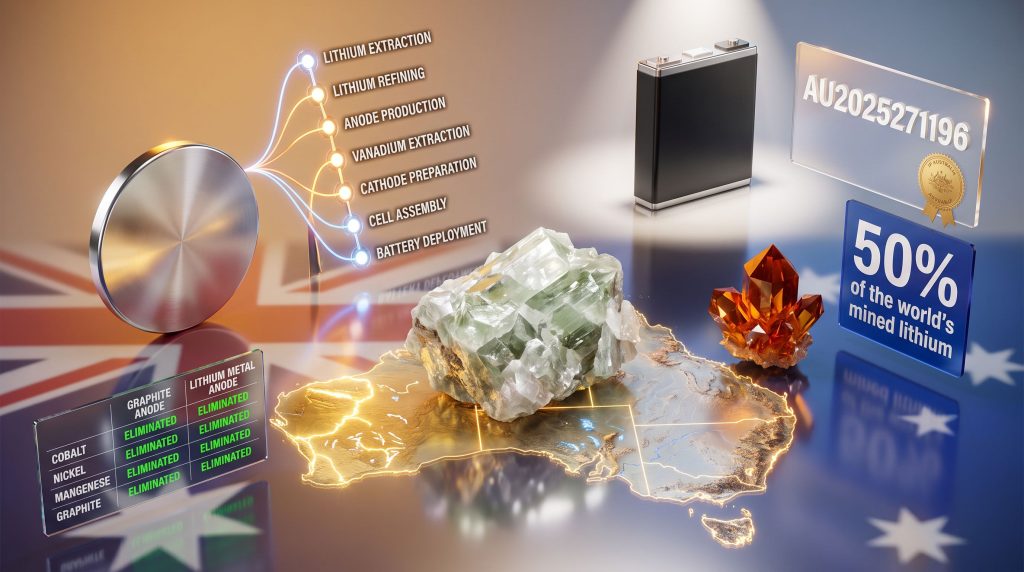
For Australia, this contradiction is sharper than almost anywhere else on Earth. The continent supplies roughly half of the world's mined lithium, yet operates no domestic battery manufacturing capacity whatsoever. Every battery deployed across Australian transport networks, energy infrastructure, and consumer devices is imported, typically from supply chains anchored in China. The economic logic of this arrangement, where Australia exports raw lithium and then buys back the finished product at many multiples of the input cost, is increasingly difficult to defend as the Pure Lithium Australian patent lithium metal anode battery begins reshaping what domestic production could actually look like.
Understanding why this gap has persisted, and what conditions might finally close it, requires examining both the technological barriers that made domestic manufacturing impractical and the intellectual property developments now creating a credible alternative path.
When big ASX news breaks, our subscribers know first
Why Conventional Battery Chemistry Was Never Australia's Friend
The Graphite Problem and China's Structural Advantage
Lithium-ion battery manufacturing has never been a natural fit for Australia's resource base, and the reason comes down to a single material most investors overlook: graphite. The anode in every conventional lithium-ion cell is made from graphite, and the overwhelming majority of battery-grade graphite processing capacity sits in China. Australia's lithium advantage essentially stops at the mine gate when the battery chemistry still requires a critical anode input it cannot readily supply.
This structural reality helps explain why lithium-ion manufacturing consolidated so thoroughly in East Asia. The combination of graphite processing, cobalt refining (predominantly from the Democratic Republic of Congo but processed largely in China), nickel sulphate production, cathode manufacturing, and cell assembly created an integrated supply chain that non-Chinese producers found almost impossible to replicate from scratch. The capital requirements were enormous, the supply chain dependencies were deeply embedded, and the learning curve spanned decades.
Australia attempted to enter this ecosystem at the refining stage, with various hydroxide and carbonate processing projects progressing through development, but never achieved the downstream integration needed to produce finished battery cells. The result was a nation that remained structurally locked into raw material exports regardless of how much lithium it produced.
Technology Leapfrogging as a Strategic Framework
The concept of technology leapfrogging offers a more interesting path. When developing economies bypassed fixed-line telecommunications infrastructure entirely and moved directly to mobile networks, they did not simply catch up with incumbents — they restructured the competitive landscape altogether. The analogy for battery manufacturing is instructive: rather than attempting to build lithium-ion capacity that China already dominates, countries with the right resources and intellectual property could potentially establish next-generation production that sidesteps the incumbent supply chain entirely.
Lithium metal anode technology represents precisely this kind of generational inflection point. It does not improve upon lithium-ion manufacturing. It replaces the foundational architecture, and in doing so, it eliminates the material dependencies that made Australian battery manufacturing so structurally difficult in the first place. Furthermore, the global lithium market is evolving rapidly, with new entrants and investment patterns creating additional momentum for this transition.
Understanding Lithium Metal Anode Technology: The Science Behind the Strategic Shift
How Lithium Metal Anodes Differ From Graphite Anodes in Conventional Lithium-Ion Batteries
The performance and supply chain implications of switching from graphite to lithium metal at the anode level are substantial. The table below summarises the key distinctions:
| Feature | Graphite Anode (Li-ion) | Lithium Metal Anode |
|---|---|---|
| Energy Density | Moderate | Significantly higher |
| Anode Material Source | Predominantly China-refined | Can be locally sourced |
| Cobalt/Nickel Dependency | High in many chemistries | Eliminated |
| Manganese Dependency | Present in some chemistries | Eliminated |
| Supply Chain Independence | Low | High potential |
| Cycle Life Potential | Established | Advancing rapidly |
The energy density improvement alone is strategically significant. Higher energy density means more power stored per unit of weight and volume, which translates directly into longer electric vehicle range, extended drone flight times, thinner consumer electronics, and reduced land footprint for grid-scale storage installations. These are not marginal gains; they represent step-change improvements that alter the economics of every application the battery serves.
What Is Electrodeposition and Why Does It Matter for Anode Production?
Electrodeposition is the manufacturing process at the core of lithium metal anode production. The technique involves depositing lithium metal onto a substrate through an electrochemical process, enabling precise control over anode thickness, purity, and surface uniformity. This level of manufacturing precision matters enormously because anode quality is a primary determinant of overall battery performance, cycle longevity, and safety characteristics.
From a strategic standpoint, electrodeposition is also what makes vertical integration viable. The process can be integrated directly with battery cell assembly, meaning a single production facility can theoretically take battery-grade lithium input and produce finished anodes without outsourcing to a separate manufacturer. This closed-loop production model eliminates one of the most significant value leakage points in conventional battery supply chains. In addition, advances in direct lithium extraction technology are further improving the efficiency of upstream lithium processing, strengthening the overall production equation.
The Vertical Integration Advantage: Capturing Margin Across the Entire Value Chain
Vertical integration in battery manufacturing means controlling multiple production stages under a single operational framework, from raw material processing through to finished cell output. The financial logic is compelling:
- Each intermediary in a fragmented supply chain extracts margin, increasing the total cost of the finished battery
- Integrated producers capture this margin internally, reducing effective materials costs
- Quality control improves when anode production and cell assembly share the same facility and operational standards
- Supply chain disruption risk falls when fewer external dependencies exist
For Pure Lithium Corporation, this vertically integrated model connects lithium metal anode production directly with battery manufacturing, capturing value at every production stage. In cost-sensitive energy storage markets where battery price per kilowatt-hour remains a critical competitive metric, this structural advantage compounds over time.
What the Pure Lithium Australian Patent Grant Actually Means
Patent AU2025271196: What Is Actually Protected?
The patent granted to Pure Lithium Corporation by IP Australia covers the company's lithium metal anode technology and its integration into a complete lithium metal battery system. This is a dual-scope protection: it secures not just the anode component in isolation but the broader battery architecture into which that anode integrates. A separately filed US patent covers equivalent technology in the American market, while a second Australian filing addresses the vertically integrated production methodology specifically, covering both lithium metal production and battery manufacturing as a unified process.
This distinction matters. Protecting only the anode material would leave the production method and full system architecture open to challenge or replication. By extending IP coverage to the integrated battery and the manufacturing process itself, Pure Lithium creates a substantially higher barrier to competitive entry.
How This Patent Fits Within a Portfolio of 160+ Filings Across Multiple Jurisdictions
The Australian grant strengthens a portfolio exceeding 160 patents and patent applications spanning multiple countries. Multi-jurisdictional patent strategy in battery technology serves several distinct functions:
- It establishes protected positions in markets where manufacturing hubs are being planned
- It creates licensing leverage with potential manufacturing partners or sovereign investors
- It prevents competitor entry into specific geographies without licensing agreements
- It signals technological maturity to institutional capital evaluating manufacturing investment decisions
"Patent grants function as the foundational infrastructure for manufacturing investment decisions in next-generation battery technology. Without protected IP in a target jurisdiction, no institutional partner will commit capital to a domestic production facility, regardless of how attractive the resource base appears."
The Australian grant is particularly meaningful because it secures IP in a jurisdiction that is simultaneously one of the world's largest lithium resource suppliers and a prospective manufacturing location. That combination is rare, and the patent creates the legally defensible basis needed before any serious manufacturing investment conversation can advance.
Australia's Dual Resource Advantage: Lithium and Vanadium on the Same Continent
Why the Cathode Material Is as Important as the Anode
Battery manufacturing requires two electrode inputs, and securing domestic supply for only one of them still leaves a critical external dependency. Pure Lithium's second-generation battery architecture uses vanadium as the cathode material, which introduces a strategically important second dimension to Australia's resource position. Australia holds substantial vanadium deposits, meaning both primary inputs for the Gen-2 battery chemistry could theoretically be sourced within the same national territory.
This dual-resource configuration is genuinely uncommon among candidate battery manufacturing nations. The United States has lithium but limited high-grade vanadium. Canada has both but faces different infrastructure challenges. Australia's combination of accessible hard-rock lithium deposits concentrated in Western Australia and known vanadium mineralisation creates a foundation that few other jurisdictions can match for this specific battery chemistry.
From Mine to Finished Battery: What a Complete Domestic Supply Chain Could Look Like
A hypothetical fully integrated Australian battery supply chain, built around lithium metal and vanadium chemistry, would operate through the following stages:
- Lithium extraction from hard-rock spodumene deposits, primarily in Western Australia — with spodumene lithium extraction representing the critical first step in the value chain
- Lithium refining to battery-grade lithium metal purity levels
- Anode production via electrodeposition of high-purity lithium metal anodes
- Vanadium extraction from domestic ore deposits with processing to battery-grade cathode material
- Cathode preparation integrating vanadium into the required electrochemical form
- Cell assembly combining anode, cathode, and electrolyte into finished battery units
- Battery deployment across domestic EV, grid storage, defence, and industrial applications
Each stage in this chain represents a value-addition opportunity that currently flows to overseas processors and manufacturers. Capturing even a portion of these stages domestically would fundamentally alter the economic return Australia receives from its lithium endowment.
The China Dependency Problem: Battery Sovereignty as a National Security Consideration
Which Critical Materials Does Lithium Metal Battery Chemistry Eliminate?
China's control over the global lithium-ion battery supply chain extends well beyond cell assembly. It encompasses graphite anode processing, cobalt and nickel refining, cathode manufacturing, and the integrated logistics networks connecting these stages. Countries pursuing energy transition goals without addressing this structural dependency are essentially transferring the geopolitical risk of fossil fuel supply chains to a new set of concentrated inputs.
The material substitution that lithium metal battery chemistry enables is therefore strategically significant, not just technically interesting:
| Material | Role in Li-ion | Status in Lithium Metal Architecture |
|---|---|---|
| Graphite | Anode material | Eliminated |
| Cobalt | Cathode stabiliser | Eliminated |
| Nickel | Cathode energy density | Eliminated |
| Manganese | Cathode stability | Eliminated |
| Lithium | Anode/electrolyte | Retained (domestically available) |
| Vanadium | Cathode (Gen-2) | Retained (domestically available in Australia) |
Eliminating graphite, cobalt, nickel, and manganese in a single chemistry shift removes the four most China-concentrated material inputs in the conventional battery supply chain. The retained materials — lithium and vanadium — are both domestically available in Australia at meaningful scale, making this chemistry uniquely aligned with Australian resource geography.
What Battery Supply Chain Independence Actually Requires in Practice
Material substitution is a necessary but insufficient condition for genuine supply chain independence. True sovereignty in battery manufacturing requires:
- Domestic processing capacity for each retained input material at battery-grade purity
- Protected intellectual property covering the manufacturing processes involved
- Cell assembly facilities operating at commercially relevant scale
- A domestic demand base or export market large enough to sustain production economics
- Workforce capability in electrochemical manufacturing, a specialised technical discipline
The Pure Lithium Australian patent addresses the intellectual property prerequisite directly. It does not by itself create manufacturing capacity, but it establishes the protected position from which manufacturing investment can be attracted and structured.
The next major ASX story will hit our subscribers first
Application Landscape: Where Lithium Metal Batteries Could Displace Lithium-Ion
Pure Lithium Corporation considers its Pure Lithium Australian patent lithium metal anode battery suitable for substantially all applications currently served by lithium-ion technology. The higher energy density that lithium metal architecture delivers creates differentiated value across several sectors:
- Electric vehicles: Extended driving range without proportional increases in battery weight or pack volume, addressing one of the primary consumer objections to EV adoption
- Drones and unmanned aerial systems: Flight duration is directly constrained by battery energy density, making lithium metal architecture particularly compelling for both commercial logistics and defence applications
- Consumer electronics: Thinner, lighter devices with equivalent or improved battery life, enabling design innovations not possible with graphite anode cells
- Electric micromobility: Lighter battery packs in e-bikes and scooters improve handling characteristics and extend operational range
- Grid-scale energy storage: Higher energy density reduces the physical footprint and infrastructure cost of large-scale installations
It is important to note that lithium metal battery technology is still advancing through commercial development stages. Key engineering challenges including dendrite formation management at the anode surface, electrolyte compatibility optimisation, and cycle life performance at manufacturing scale remain active areas of technical work. The vertically integrated production model that Pure Lithium pursues may accelerate resolution of some manufacturing-level challenges by enabling tighter feedback loops between anode production quality and cell performance data.
Regulatory and Policy Environment: What Australia Needs to Activate Domestic Battery Manufacturing
Does Australia's Current Policy Framework Support Next-Generation Battery Production?
Australia's Critical Minerals Strategy identifies battery materials as priority outputs, but the policy framework has historically been oriented toward extraction and early processing rather than downstream manufacturing. The gap between resource policy and manufacturing incentive design is substantial, and comparable jurisdictions have demonstrated more integrated approaches.
The United States Inflation Reduction Act created direct manufacturing incentives for domestic battery production, including tax credits tied to cell assembly within American borders. The European Union's Critical Raw Materials Act similarly structures frameworks around downstream processing as well as extraction. Australia's equivalent policy architecture has not yet replicated this manufacturing-stage incentive design at comparable scale. However, the introduction of tax breaks for lithium producers signals a growing recognition within government that the value-add opportunity must be actively incentivised.
What Regulatory Conditions Would Attract Battery Manufacturing Investment?
For the patent grant to translate into actual manufacturing capacity, several additional enabling conditions are needed:
- Manufacturing incentives structured around cell production rather than resource extraction alone, including tax treatment mechanisms comparable to those deployed in competing jurisdictions
- Offtake certainty through government procurement commitments for domestically produced batteries in defence, public transport, and grid infrastructure applications
- Workforce development targeting the electrochemical manufacturing skill sets that do not currently exist at scale in Australia
- Export frameworks positioning Australian-manufactured batteries as a premium, supply-chain-secure product in markets seeking alternatives to Chinese-origin supply chains
The intellectual property foundation is now in place with the Australian patent grant. The manufacturing investment conversation can credibly begin. Whether Australia's policy environment moves quickly enough to capture the opportunity that next-generation battery chemistry has created remains the open question that investors, policymakers, and industry participants will be watching closely over the coming years. Consequently, the broader battery raw materials market will play a decisive role in shaping the economics of any domestic manufacturing push.
Frequently Asked Questions: Pure Lithium Australian Patent and Lithium Metal Battery Technology
What Is the Pure Lithium Australian Patent AU2025271196?
Patent AU2025271196 is an intellectual property grant issued by IP Australia covering Pure Lithium Corporation's lithium metal anode technology and its integration into a complete lithium metal battery system. Granted in August 2026, it forms part of a broader multi-jurisdictional portfolio exceeding 160 patents and applications, with a separate US patent covering equivalent technology and a second Australian filing addressing the vertically integrated production methodology.
How Is a Lithium Metal Battery Different From a Lithium-Ion Battery?
A lithium metal battery replaces the graphite anode used in conventional lithium-ion cells with a lithium metal anode. This substitution delivers meaningfully higher energy density, eliminates graphite as a required input, and removes cobalt, nickel, and manganese from the battery's material requirements. The result is a simpler, more geographically diversified supply chain with superior performance potential across multiple application categories.
Why Is Australia Considered a Strong Location for Lithium Metal Battery Manufacturing?
Australia produces approximately half of the world's mined lithium and holds substantial vanadium deposits — the cathode material used in Pure Lithium's second-generation battery architecture. Both primary input materials for this battery chemistry could theoretically be sourced domestically, creating the foundation for a fully integrated supply chain that no other jurisdiction currently replicates for this specific technology.
What Applications Are Suited to Lithium Metal Batteries?
Lithium metal batteries are considered applicable across substantially all use cases currently served by lithium-ion technology, including electric vehicles, drones, smartphones, electric micromobility devices, and grid-scale energy storage, with potential performance advantages in each category owing to higher energy density.
How Does Pure Lithium's Vertical Integration Model Work?
Pure Lithium integrates lithium metal anode production directly with battery cell manufacturing. This approach captures margin at multiple production stages — from raw material processing through to finished battery output — while enabling tighter quality control over anode characteristics that directly influence cell performance and longevity.
Key Takeaways
- Australia produces roughly half the world's mined lithium yet currently imports every battery it consumes, representing one of the most significant value-capture gaps in any resource-rich economy
- The Pure Lithium Australian patent lithium metal anode battery establishes protected intellectual property in a jurisdiction uniquely positioned to host a complete domestic battery supply chain across both anode and cathode input materials
- Lithium metal battery chemistry eliminates graphite, cobalt, nickel, and manganese from the material requirements, removing four of the most China-concentrated inputs in conventional battery manufacturing
- Australia's vanadium resource base adds a second domestically available critical mineral to the Gen-2 battery production equation — a dual-resource advantage that is genuinely rare among candidate manufacturing nations
- The patent grant establishes the foundational IP prerequisite for attracting manufacturing investment, but realising the full supply chain opportunity requires complementary policy frameworks, workforce development, and offtake structures that remain works in progress
This article contains forward-looking statements and speculative analysis regarding technology development timelines, policy frameworks, and manufacturing investment outcomes. These represent potential scenarios rather than confirmed outcomes and should not be construed as financial or investment advice. Readers should conduct their own due diligence before making investment decisions related to any companies or technologies mentioned.
Further coverage of Australia's critical minerals strategy and next-generation battery technology developments is available through Mining Weekly and the International Energy Agency's battery technology research.
Want to Track the Next Major ASX Mineral Discovery Before the Market Moves?
Discovery Alert's proprietary Discovery IQ model delivers real-time alerts on significant ASX mineral discoveries — instantly turning complex mineral data into actionable insights for investors at every level, from short-term traders to long-term strategic positions in critical minerals like lithium and vanadium. Explore historic discoveries and their exceptional market returns, then begin your 14-day free trial to position yourself ahead of the broader market.