August 7, 2026
The Green Energy Paradox: When Battery Minerals Collide With the Land That Feeds You
Every major industrial transition in history has created winners and losers distributed unevenly across geography and social class. The shift from coal to renewables is no different, except that this time, the raw materials powering the clean energy revolution are buried beneath some of the world's most productive agricultural land. Nowhere is this tension more visible, or more politically charged, than along South Africa's southeast coast, where the lithium mining backlash from South African farmers is reshaping the conversation about what responsible mineral development actually looks like in practice.
The conflict is not simply about one mine or one community. It is a preview of the governance challenges that will define critical minerals and energy transition across the African continent for the next two decades.
When big ASX news breaks, our subscribers know first
South Africa's R40 Trillion Minerals Moment: The Stakes Could Not Be Higher
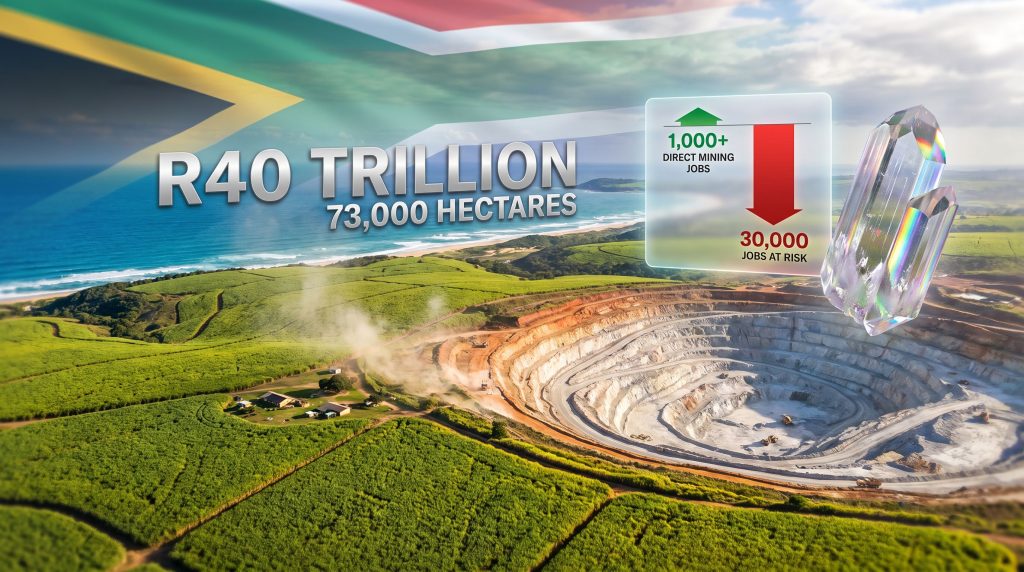
President Cyril Ramaphosa has publicly valued South Africa's critical minerals endowment at an estimated R40 trillion, framing lithium and related battery materials as central to the country's participation in the global clean energy transition. The government has characterised lithium specifically as a sunrise industry, signalling a deliberate strategic pivot toward supplying the battery materials that electric vehicle manufacturers and grid-scale energy storage operators in Europe, North America, and Asia urgently need.
This framing matters because it shapes how regulatory agencies prioritise licence issuance, how quickly environmental processes move, and how much political capital is invested in clearing obstacles to extraction.
Critical minerals demand is projected to grow substantially through 2030 and beyond as EV adoption accelerates. Africa's lithium deposits, spanning South Africa, Zimbabwe, and the Democratic Republic of Congo, are increasingly viewed by investors and policymakers in Western markets as strategically important alternatives to supply chains heavily influenced by Chinese processing capacity. South Africa's southeast coastal lithium deposits are geologically distinct from the high-altitude brine systems of South America's Lithium Triangle, representing a hard-rock and mineral sands source that requires entirely different extraction and processing methods. Understanding how lithium mining works helps contextualise why these geological differences significantly affect the environmental footprint of proposed operations.
The speed of licence issuance along the KwaZulu-Natal south coast has materially outrun the community consultation and cumulative environmental planning frameworks designed to manage exactly this kind of large-scale land-use transition.
The Licence Footprint: What 73,000 Hectares Actually Means on the Ground
The scale of lithium prospecting activity on South Africa's southeast coast is not widely understood outside of the affected communities and the mining sector itself. Mines department data reviewed by Reuters reveals a prospecting footprint that is genuinely substantial.
| Metric | Detail |
|---|---|
| Total prospecting licence area | Approximately 73,000 hectares |
| Comparable land area | Slightly larger than the City of Pretoria |
| Number of farms affected | 117 individual farming properties |
| Coastal zones included | Stretches of southeast coast beach |
| Existing mine operational footprint | 150 hectares of active pits |
| Waste dump area | 180 hectares |
| Prospecting licences issued since 2023 | More than 12 permits |
A prospecting licence does not authorise extraction, but it is the gateway to a mining right. Understanding how that pathway works helps explain why affected communities are alarmed by the current pace of licence issuance even before any new mines have been approved.
From Exploration to Extraction: The Regulatory Pathway Explained
- Prospecting Licence grants rights to explore and assess deposits without extracting commercially
- Environmental Impact Assessment must be completed with mandatory public participation before a mining right can be sought
- Mining Right Application is lodged with the Department of Mineral and Petroleum Resources and is subject to objection periods
- Social and Labour Plan requires mining companies to demonstrate community benefit commitments
- Mining Right Approval constitutes formal authorisation to begin extraction
The concern among civil society groups is that the volume of prospecting licences already issued has created a pipeline of potential mining right applications that existing regulatory frameworks are not equipped to assess on a cumulative basis.
Who Is Opposing the Expansion and What Specifically Do They Fear?
The South Coast Guardians Association represents a coalition that extends well beyond individual landowners. It includes commercial and smallholder farmers, sugar industry stakeholders, tourism operators, and rural service economy workers whose livelihoods depend on agricultural activity remaining viable. The association's general manager, Heather McLeod, has stated that if all existing prospecting licences were converted to full mining rights, the consequences for the region would be catastrophic, with particular concern for small-scale farmers, surrounding communities, and the local sugar mill that processes approximately two million tonnes of cane annually.
The association estimates that full conversion of the prospecting footprint to active mining could place as many as 30,000 jobs at risk across farming, sugar processing, labour services, and tourism. That figure is not solely about direct agricultural employment. It encompasses the entire economic ecosystem that depends on productive land remaining in agricultural use. Furthermore, as reported by Reuters, community groups have raised serious concerns about the pace at which land-use decisions are being made without adequate consultation.
Four Structural Objections That Go Beyond NIMBY Politics
1. Permanent Agricultural Land Conversion
Open-pit lithium mining involves the irreversible removal of topsoil and subsoil profiles. Agricultural land converted to pit mining cannot be returned to productive use within any economically meaningful timeframe. The region's sugarcane infrastructure represents multi-generational capital that cannot simply be relocated.
2. Physical Damage to Adjacent Properties
Residents living in proximity to the existing operational mine have reported structural damage to dwellings attributed to blasting vibrations, along with dust dispersion from pit operations that they say negatively affects both crop quality and residential amenity.
3. Hydrological and Soil Integrity Risks
The southeast coast's geography, characterised by proximity to river systems and coastal aquifers, amplifies the risk profile of open-pit extraction. Community submissions have raised concerns about groundwater contamination and degradation of soil profiles that underpin agricultural productivity across the wider region. Considering natural capital in mining decisions would provide a more rigorous framework for assessing these long-term environmental costs.
4. Regional Employment at Scale
The 30,000 jobs figure is the most contested number in the entire debate, but it reflects a real analytical point. A mine that creates 1,000 direct positions does not automatically offset the loss of agricultural employment and downstream service economy activity across 117 farming properties.
The Industry's Counter-Position: Compliance, Consent, and Job Creation
SA Lithium director Ian Harebottle has maintained publicly that the company's existing operation not only complies with applicable environmental regulations but exceeds them. The company reports having relocated approximately 150 farming households, asserting that all transitions occurred through negotiated and consensual processes. The operation has generated over 1,000 direct employment positions, which the company presents as a net positive economic contribution to the region. Harebottle has also disputed water contamination allegations, stating that mine effluent does not reach river systems.
Community representatives contest the framing of relocations as fully consensual, arguing that economic pressure and significant information asymmetry between mining companies and smallholder farmers fundamentally compromise the meaning of voluntary consent in this context.
The credibility gap between industry assurances and community experience is not unique to this project. It is a structural feature of extractive industry social licence debates globally, and it points to the need for independently verified data rather than self-reported compliance metrics.
The Global Pattern: South Africa Is Not Alone in This Dilemma
The lithium mining backlash from South African farmers mirrors conflicts playing out across multiple continents wherever battery mineral extraction intersects with established land use.
| Country/Region | Conflict Type | Core Tension |
|---|---|---|
| South Africa (KZN South Coast) | Agricultural land vs. open-pit mining | Food security vs. battery minerals |
| Chile (Atacama Desert) | Indigenous water rights vs. brine extraction | Cultural heritage vs. EV supply chain |
| Portugal (Barroso) | Rural community displacement | European lithium self-sufficiency vs. local opposition |
| Nevada, USA (Thacker Pass) | Tribal sacred lands vs. mine development | Domestic clean energy vs. Indigenous rights |
| Serbia (Jadar Project) | Environmental protest | EU battery supply chain vs. agricultural communities |
The structural pattern is consistent across jurisdictions: the communities bearing the direct costs of extraction are rarely the primary beneficiaries of the clean energy products those minerals enable. For instance, the Thacker Pass lithium mine in Nevada has similarly faced opposition from Indigenous groups who contest the adequacy of consultation processes, demonstrating that this is a global governance challenge rather than a localised one. Electric vehicles sold in European and North American markets generate economic value that does not flow back to KwaZulu-Natal sugarcane farmers.
International frameworks including the UN Guiding Principles on Business and Human Rights and the International Finance Corporation Performance Standards establish community consent and livelihood restoration as non-negotiable conditions for responsible extractive development. South Africa's own Mineral and Petroleum Resources Development Act includes consultation requirements, though enforcement consistency has been questioned by civil society organisations over many years.
The next major ASX story will hit our subscribers first
Three Futures for the KZN South Coast: A Scenario Analysis
Scenario A: Full Mining Conversion
All 73,000 hectares transition to active extraction. The regional sugar industry faces structural collapse as cane supply falls below mill viability thresholds. Coastal tourism contracts as landscape integrity deteriorates. Up to 30,000 regional jobs are affected. South Africa gains lithium export revenue and critical minerals positioning, but at significant social and food security cost.
Scenario B: Spatially Managed Transition
A zoning framework designates no-go areas for mining on prime agricultural land and within buffer zones around watercourses. Lower-productivity or brownfield sites progress to mining rights. Community benefit agreements become mandatory conditions of approval. Regional employment impact is moderated and lithium production proceeds at reduced but sustainable scale.
Scenario C: Moratorium and Policy Review
Civil society legal challenges suspend further licence conversions pending a cumulative environmental impact assessment. Government commissions an independent land-use compatibility study. Mining activity is limited to the existing operational footprint while policy frameworks are updated. This preserves optionality but delays South Africa's critical minerals contribution.
Note: These scenarios are analytical frameworks based on available public information and should not be interpreted as predictions of regulatory outcomes.
Five Policy Reforms That Could Break the Deadlock
- Cumulative Impact Assessment Mandate: A single integrated environmental and socio-economic assessment covering the entire licence block rather than fragmented project-by-project evaluations
- Agricultural Land Classification: A formal protection system identifying high-value agricultural land as a constrained zone requiring ministerial-level override before mining is permitted
- Independent Water Quality Monitoring: Mandatory third-party hydrological monitoring with publicly accessible real-time data, removing the information asymmetry that currently fuels dispute
- Community Benefit Sharing: Statutory revenue-sharing arrangements directing a defined percentage of mining royalties to affected municipalities and farming communities
- Livelihood Restoration Standards: Demonstrated equivalent livelihood opportunities for displaced farmers and workers as a precondition of mining right approval, not a post-approval commitment
International comparators are instructive here. Canada's Impact Assessment Act requires binding community consultation outcomes at the federal level. Australia's Native Title Act provides a legal mechanism for affected communities to negotiate binding agreements before operations commence. The EU's Critical Raw Materials Act incorporates social sustainability criteria that must be met before European offtake agreements are secured, creating a market-based incentive for responsible sourcing that extends all the way back to the mine gate.
The Deeper Question: Can South Africa Build a Social Licence for Lithium?
South Africa possesses both the regulatory architecture and an increasingly organised civil society capable of contributing to a world-class responsible mining framework for lithium. The critical variable is whether the pace of prospecting licence issuance will allow that framework to develop before irreversible land-use decisions foreclose agricultural futures across 117 farming properties.
The binary framing of mining versus farming obscures a more sophisticated possibility: spatially intelligent, community-inclusive mineral development that recognises the long-term value of maintaining food-productive land alongside extracting battery minerals from areas where the trade-offs are genuinely manageable.
South Africa's long-term competitiveness in the critical minerals space will not be determined solely by the volume of lithium it can extract. It will depend equally on the social licence it can credibly demonstrate, particularly as European and North American buyers increasingly apply responsible sourcing criteria to their battery mineral supply chains. A mining sector that generates sustained community opposition is a supply chain risk, not just a regulatory inconvenience. Consequently, the lithium mining backlash from South African farmers represents not merely a domestic policy challenge but a signal to the global battery minerals industry about what communities worldwide will increasingly demand.
The communities on South Africa's southeast coast are not asking for mining to stop. They are asking for the pace and scale of land conversion to be proportionate to the frameworks that exist to protect them. That is a reasonable ask, and one that the global battery minerals industry cannot afford to dismiss.
Readers seeking further independent reporting on African battery minerals developments and the intersection of critical minerals policy with community land rights can access coverage from Africa Sustainability Matters, which provides in-depth analysis of how green energy ambitions are colliding with food security concerns across the continent.
Want to Track the Next Major Mineral Discovery Before the Market Does?
Discovery Alert's proprietary Discovery IQ model delivers real-time alerts on significant ASX mineral discoveries — including critical battery minerals — instantly translating complex data into actionable investment insights for traders and long-term investors alike. Explore Discovery Alert's discoveries page to understand how historic mineral finds have generated substantial returns, and begin your 14-day free trial to position yourself ahead of the market.