August 11, 2026
The Battery Diversification Imperative: Why No Single Chemistry Can Power the Energy Transition
Every major technological transition in history has eventually confronted a resource constraint that forces engineering creativity. The electrification of transport and energy storage is no exception. The growing consensus among materials scientists, supply chain analysts, and energy planners is not that lithium-ion will be dethroned, but that relying on a single battery chemistry to power a multi-trillion-dollar transition was never a viable long-term strategy. This is the structural reality driving serious investment into sodium-ion batteries as a lithium alternative, and the reasons go well beyond laboratory curiosity.
When big ASX news breaks, our subscribers know first
The Supply Chain Vulnerability That Changes the Calculus
Lithium's dominance in electrochemical energy storage has created a concentrated dependency that exposes entire national energy strategies to geographic and geopolitical risk. The majority of the world's economically viable lithium reserves are located in a small cluster of countries, and processing capacity is even more concentrated, with China controlling a dominant share of lithium refining and battery cell manufacturing globally.
This concentration matters because energy storage is no longer a peripheral technology. It sits at the core of electricity grid stability, electric vehicle infrastructure, and the backup power systems that keep critical data infrastructure operational. When a single input material is this strategically important and this geographically constrained, the search for alternatives becomes a matter of national energy security rather than simple market competition.
Furthermore, the lithium market downturn has exposed just how volatile price dependency on a single chemistry can be, adding further urgency to diversification efforts. Sodium presents a fundamentally different supply profile. It is one of the most abundant elements on Earth, present in seawater, mineral deposits, and geological formations across virtually every continent. No single nation controls a meaningful share of the world's sodium resources, which is precisely why governments and private investors across the United States, Europe, and Asia are paying close attention to sodium-ion technology.
Sodium-ion batteries as a lithium alternative are gaining traction not purely on performance merits, but because the underlying supply chain logic is structurally compelling in a way that cannot be dismissed as speculative enthusiasm.
How Sodium-Ion Batteries Actually Work
Ion Intercalation and the Physics of Charge Storage
Both sodium-ion and lithium-ion batteries operate on the same fundamental electrochemical principle: ions shuttle between a cathode and an anode through an electrolyte during charge and discharge cycles, storing and releasing electrical energy in the process. The critical difference lies in which ion does the shuttling.
Sodium ions are approximately 55% larger in ionic radius than lithium ions. This size difference has cascading consequences throughout the cell design. When a larger ion moves in and out of electrode materials repeatedly, it places greater mechanical stress on the host crystal lattice. Over thousands of charge cycles, this stress can accelerate structural degradation of electrode materials, contributing to capacity fade over time. This is not a trivial engineering challenge; it is one of the central materials science problems that sodium-ion researchers are working to solve.
Cathode Chemistry, Hard Carbon Anodes, and the Aluminium Advantage
The choice of electrode materials in sodium-ion cells differs meaningfully from lithium-ion architectures. On the cathode side, two primary chemistries have emerged as leading contenders:
- Layered transition metal oxides: analogous to cathode materials used in lithium-ion cells, these offer relatively high energy density but can be sensitive to air and moisture during manufacturing
- Prussian blue analogues (PBAs): iron-based compounds with an open framework structure that accommodates sodium's larger ionic radius more gracefully, offering good cycle stability and lower material costs
On the anode side, the most commercially significant development is the use of hard carbon, a disordered form of carbon produced by pyrolysing organic precursors at temperatures below graphitisation thresholds. Hard carbon's turbostratic, non-crystalline structure provides sufficient interlayer spacing and defect sites to accommodate sodium ions, whereas conventional graphite, the standard lithium-ion anode material, is poorly suited to sodium intercalation.
One underappreciated manufacturing advantage is that sodium-ion cells can use aluminium current collectors on both the anode and cathode sides, whereas lithium-ion anodes require copper current collectors. Since aluminium is cheaper and lighter than copper, this substitution contributes to both cost reduction and energy density improvement on a per-kilogram basis, partially offsetting the raw electrochemical limitations of sodium.
Sodium-Ion vs. Lithium-Ion: A Performance Comparison
| Performance Metric | Sodium-Ion Batteries | Lithium-Ion Batteries |
|---|---|---|
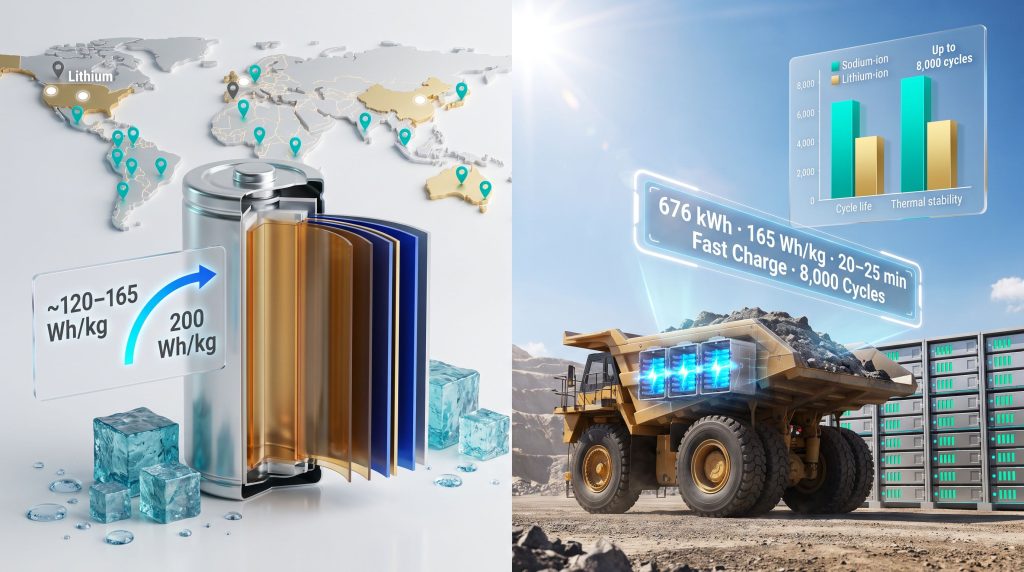
| Energy Density | ~120-165 Wh/kg (advancing toward 200 Wh/kg) | ~200-300 Wh/kg |
| Energy Density Gap | Approximately 30% lower than lithium-ion | Benchmark standard |
| Cycle Life | Up to 8,000 cycles in demonstrated applications | Typically 1,000-4,000 cycles depending on chemistry |
| Thermal Runaway Risk | Lower in select chemistries | Elevated risk under abuse conditions |
| Low-Temperature Performance | Superior capacity retention in cold climates | Performance degradation at sub-zero temperatures |
| Fast Charging Capability | 20-25 minutes in demonstrated applications | Typically 30-60+ minutes depending on chemistry |
| Raw Material Abundance | Extremely high (globally distributed) | Geographically concentrated supply |
| Current Collector (Anode) | Aluminium (lower cost) | Copper (higher cost) |
The approximately 30% energy density deficit relative to lithium-ion is the headline constraint, but the comparison is more nuanced than that single figure suggests. In applications where weight and volume are not the binding constraints, sodium-ion's advantages in thermal stability, low-temperature performance, and potentially lower long-term material costs become highly relevant decision factors.
Where Sodium-Ion Has the Strongest Competitive Advantage
Grid-Scale and Stationary Storage
Fixed energy storage installations do not carry their batteries down a highway or into orbit. Weight penalties are essentially irrelevant, which means energy density per kilogram matters far less than cost per kilowatt-hour, cycle life, and safety profile. These are precisely the metrics where sodium-ion is most competitive.
Grid operators evaluating battery chemistry for utility-scale projects increasingly incorporate total cost of ownership models rather than upfront cell cost comparisons. When cycle life reaches 8,000 charge-discharge cycles, the annualised cost per unit of energy stored improves dramatically, even if the initial cell cost is comparable to lithium-ion alternatives. In addition, shifts in the broader battery raw materials market are making sodium-ion's cost profile increasingly attractive for long-duration grid projects.
Data Center Power Infrastructure
The convergence of artificial intelligence-driven compute demand and the physical constraints of grid connection is creating a specific and fast-growing opportunity for sodium-ion batteries. Data center operators facing grid interconnection delays measured in years rather than months are increasingly turning to on-site solar combined with battery storage to secure reliable power faster than grid connection timelines allow.
In this context, sodium-ion's lower thermal runaway risk relative to conventional lithium-ion chemistries becomes an operational safety argument rather than an abstract performance metric. Batteries installed inside or adjacent to high-density server infrastructure in populated areas carry different risk tolerances than batteries installed in remote grid storage facilities. Operators in safety-sensitive built environments are paying close attention to this distinction.
Heavy Industrial Equipment: The Mining Truck Benchmark
The commercial deployment of the world's first sodium-ion-powered mining truck represents a meaningful proof-of-concept for demanding industrial duty cycles. The system specifications are worth examining in detail:
- Battery capacity: 676 kWh
- Energy density: 165 Wh/kg
- Fast charge window: 20-25 minutes
- Projected cycle life: 8,000 charge-discharge cycles
- Manufacturer: Hina Battery (China)
The 8,000-cycle projection is particularly significant. Mining equipment operates in punishing conditions with frequent, deep discharge cycles. The fact that this cycle life figure is described as comparable to the operational lifespan of conventional mining equipment suggests that sodium-ion has cleared a critical commercial viability threshold for this application segment, even before energy density improvements materialise.
Urban Mobility and Short-Range Transport
In urban logistics and short-range transport, the calculus shifts further in sodium-ion's favour. A delivery vehicle operating within a metropolitan area, returning to depot for overnight or opportunity charging, has fundamentally different energy requirements than a long-range passenger vehicle. The range deficit imposed by lower energy density becomes far less consequential, while procurement cost and battery longevity move to the forefront of fleet purchasing decisions.
Where Lithium-Ion Retains a Decisive Advantage
Intellectual honesty requires acknowledging where sodium-ion cannot currently compete:
- Long-range electric vehicles: A 30% energy density deficit translates directly into reduced range per unit of battery mass. For passenger vehicles where 400-500km ranges are becoming consumer expectations, this gap is not bridgeable through system optimisation alone
- Consumer electronics: Smartphones, laptops, and wearables are engineered around volumetric energy density measured in Wh/litre as much as gravimetric density. Sodium-ion does not offer a credible path to replacing lithium in compact form factor devices
- Aerospace and defence: Every gram of battery mass carries operational consequences in weight-critical platforms, making the energy density gap an insurmountable barrier in current configurations
The next major ASX story will hit our subscribers first
The 200 Wh/kg Threshold: Why It Matters
Advanced sodium-ion prototype cells have been reported approaching 200 Wh/kg in near-commercial configurations, according to PV Magazine's August 2026 coverage of progress in the field. This figure is not arbitrary. It represents the approximate lower boundary of lithium-iron-phosphate (LFP) battery performance, the chemistry currently used in lower-cost electric vehicles and many grid storage systems.
If sodium-ion cells achieve 200 Wh/kg at commercial scale, the competitive landscape shifts substantially. The technology would no longer be confined to applications where energy density is irrelevant; it would begin competing directly with LFP in entry-level EVs and mainstream grid storage, the two largest volume markets in the battery industry.
The ionic radius problem remains the fundamental materials science barrier to reaching and sustaining this threshold through cycling. Research directions targeting this constraint include:
- Engineering electrode host materials with larger, more stable interstitial sites that accommodate sodium's size without lattice distortion
- Developing electrolyte formulations that reduce mechanical stress at the electrode-electrolyte interface during cycling
- Exploring composite anode structures that distribute ionic stress across a larger material volume
The Global Competitive Landscape
China's Integrated Approach
China's battery manufacturing ecosystem has demonstrated a capacity to compress the timeline from laboratory research to commercial deployment that no other national industry has matched. The sodium-ion mining truck delivery reflects this integrated approach, combining cell chemistry development, pack engineering, and industrial vehicle integration under a coordinated industrial strategy.
Chinese manufacturers are not treating sodium-ion as a replacement for their dominant lithium-ion business; they are treating it as a complementary technology to deploy across a broader application portfolio. Consequently, the recent battery recycling breakthrough emerging from China further underscores how deeply the country is investing across the full battery technology value chain.
U.S. Startups and the Domestic Supply Chain Argument
American sodium-ion developers are competing on a different value proposition. Companies like Peak Energy are positioning their technology around safety, domestic material sourcing, and supply chain resilience, targeting the utility-scale storage market where Tesla currently holds a significant commercial position. The argument is less about raw performance superiority and more about eliminating single points of failure in a supply chain that runs through Chinese processing facilities for most of its critical inputs.
European Research Positioning
European research institutions and industrial groups are advancing sodium-ion cathode and electrolyte chemistry within a broader critical minerals strategy that frames battery technology independence as an economic security issue. EU funding frameworks for battery research have increasingly included sodium-ion alongside lithium-ion and solid-state development programs. This is directly tied to the growing critical minerals demand driven by the global energy transition, which is reshaping how governments prioritise research investment.
Application Migration: A Scenario Framework
| Application Segment | Near-Term (2025-2028) | Medium-Term (2028-2033) | Long-Term (2033+) |
|---|---|---|---|
| Grid-Scale Storage | Early commercial adoption | Broad deployment | Mature market |
| Data Center Backup | Pilot deployments | Growing market share | Established segment |
| Heavy Industrial Equipment | First commercial units | Expanding fleet adoption | Significant penetration |
| Urban/Short-Range EVs | Limited pilots | Commercial availability | Competitive with LFP |
| Long-Range EVs | Minimal relevance | Dependent on energy density gains | Conditional on 200+ Wh/kg |
| Consumer Electronics | Not applicable | Not applicable | Unlikely without major breakthroughs |
Supply Chain Implications Beyond the Lithium Question
Sodium-ion adoption at scale would structurally dampen lithium demand growth, with implications for lithium carbonate price trajectories and the economics of new lithium projects currently in development. However, sodium-ion introduces its own supply chain considerations that deserve scrutiny.
Prussian blue analogue cathodes rely on iron and nitrogen-based precursors, which are genuinely low-cost and widely available. Layered oxide cathodes used in some sodium-ion designs contain manganese, copper, or nickel, introducing their own supply concentration questions. Hard carbon anode production requires specific organic precursors and controlled pyrolysis conditions, and the supply chain for high-quality hard carbon at battery manufacturing scale is still developing.
Importantly, sodium-ion cell manufacturing is largely compatible with existing lithium-ion gigafactory equipment and processes. This significantly reduces the capital expenditure barrier for established battery manufacturers looking to add sodium-ion capacity without building entirely new production infrastructure. Technologies such as direct lithium extraction may, however, continue to improve lithium's own supply economics, meaning sodium-ion must remain competitive on multiple fronts simultaneously.
Frequently Asked Questions: Sodium-Ion Batteries as a Lithium Alternative
Are sodium-ion batteries cheaper than lithium-ion batteries?
Sodium-ion cells carry genuine structural cost advantages, including cheaper current collectors and more abundant raw materials. However, at current production volumes, mature lithium-ion supply chains have cost efficiencies that sodium-ion manufacturing has not yet replicated at scale. Cost parity and potential cost advantage will depend on achieving sufficient production volume.
Can sodium-ion batteries be used in electric vehicles?
They are viable for urban and short-range applications where the energy density deficit is manageable. Long-range passenger vehicles remain outside the current competitive window unless prototype improvements approaching 200 Wh/kg are successfully scaled to commercial production. For a broader comparison of these two chemistries in transport contexts, this detailed analysis provides useful additional perspective.
What is the demonstrated cycle life of sodium-ion batteries?
The commercially deployed mining truck system demonstrates up to 8,000 charge-discharge cycles, which is competitive with and in some cases superior to lithium-ion chemistries in comparable heavy-duty applications.
Is sodium-ion inherently safer than lithium-ion?
Certain sodium-ion chemistries, particularly those using Prussian blue analogue cathodes, exhibit meaningfully lower thermal runaway risk than conventional lithium-ion formulations. This is particularly relevant for safety-sensitive installations in built environments.
Why is China currently ahead in sodium-ion commercialisation?
China's battery industry operates across the full value chain simultaneously, from raw material processing through cell manufacturing to vehicle and systems integration. This vertical integration enables faster iteration and commercial validation than ecosystems where these functions are distributed across multiple companies and countries.
Key Takeaways
- Sodium-ion batteries represent a commercially advancing complement to lithium-ion technology, not an imminent wholesale replacement
- The strongest near-term opportunities are in grid storage, data centre infrastructure, and heavy industrial equipment where safety, cycle life, and material availability carry more weight than peak energy density
- The approximately 30% energy density gap remains the primary technical barrier to broader adoption, with prototype systems approaching the 200 Wh/kg threshold that would unlock competitive positioning against LFP chemistries
- Supply chain independence from geographically concentrated lithium sources is a structural advantage whose strategic value will increase as global energy storage demand scales
- A dual-chemistry energy storage ecosystem, where sodium-ion and lithium-ion coexist across differentiated application segments, represents the most probable medium-term market structure rather than a winner-take-all outcome
This article is intended for informational and educational purposes only and does not constitute investment advice. Forecasts and projections regarding technology development timelines and market adoption represent analytical scenarios rather than guaranteed outcomes. Readers should conduct independent research before making any investment decisions related to battery technology or associated industries.
Want to Capitalise on the Next Major Battery Minerals Discovery Before the Broader Market?
Discovery Alert's proprietary Discovery IQ model delivers real-time ASX alerts the moment significant mineral discoveries are announced — instantly translating complex geological data into actionable investment insights across sodium, lithium, and the full spectrum of battery-critical commodities. Explore how historic mineral discoveries have generated substantial market returns and begin your 14-day free trial today to position yourself ahead of the market.