August 13, 2026
The Battery Chemistry Shift That Could Redefine Australia's Export Economy
For decades, the global mining industry has wrestled with a persistent tension: the nations richest in raw materials are rarely the ones that capture the most economic value from them. Lithium is now forcing Australia to confront this reality at speed. As battery chemistry preferences shift dramatically toward lithium iron phosphate (LFP) technology, a structural mismatch is emerging between what Australia produces and what the world's fastest-growing battery market actually needs.
The Australia pivot to lithium carbonate refining is no longer a theoretical policy discussion. It is becoming an economic imperative, shaped by chemistry, cost structures, geopolitical disruption, and a market that is evolving faster than most infrastructure investment cycles can follow.
When big ASX news breaks, our subscribers know first
Why the Raw Material Model Is Under Pressure
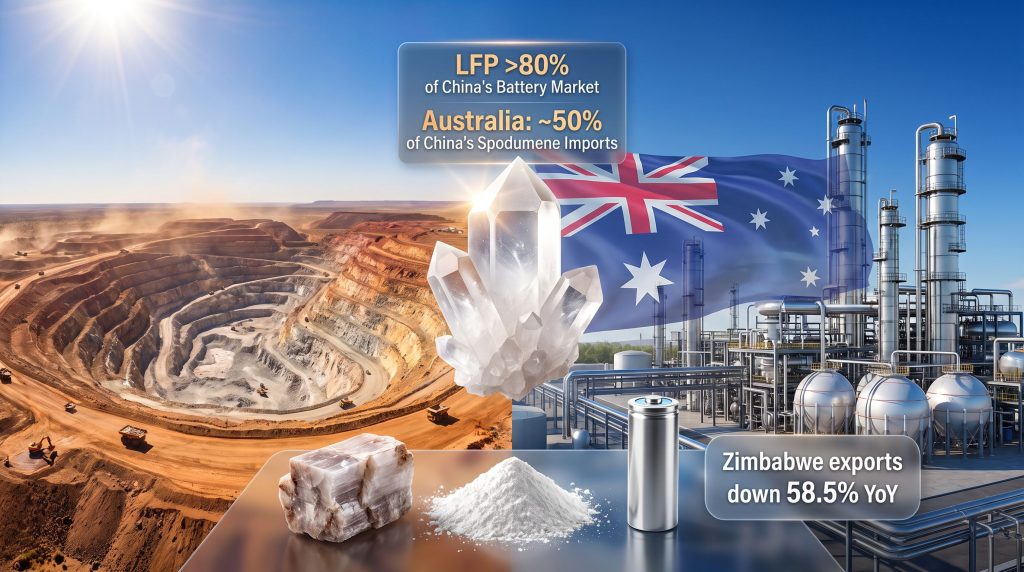
Australia has long been the world's dominant spodumene exporter, supplying roughly 50% of China's total spodumene imports as recently as June 2026, when it contributed 370,964 metric tons of the 768,411mt imported that month. That market penetration reflects genuine geological strength. The scale and grade of Western Australia's spodumene deposits, concentrated across the Pilbara and Goldfields regions, remain unmatched globally in terms of both volume and consistency.
Yet geological dominance and economic dominance are not the same thing. Spodumene extraction, typically grading around 6% lithium oxide (Li₂O), sits at the lowest-margin point in the lithium value chain. The transformation of that raw material into battery-grade lithium chemicals, whether carbonate or hydroxide, multiplies per-tonne revenue substantially. China's vertically integrated refining ecosystem has systematically captured this downstream margin, while Australian producers have largely remained upstream.
The economic logic of change is clear. The harder question is whether the structural, logistical, and financial conditions exist to make that change viable.
LFP's Dominance and the Carbonate Premium
Understanding why the Australia pivot to lithium carbonate refining matters requires understanding what has happened inside China's battery manufacturing sector. Lithium iron phosphate batteries have now captured more than 80% of China's battery production market as of June 2026, driven by cost efficiency, thermal safety, long cycle life, and strong suitability for stationary energy storage and commercial vehicle applications.
The critical chemical distinction is this: LFP batteries require lithium carbonate as their primary feedstock, not lithium hydroxide. This creates a direct structural problem for Australia's existing refining investments, which have been almost entirely oriented toward hydroxide production. Furthermore, the lithium carbonate market dynamics are shifting rapidly, compounding the urgency for strategic reorientation.
| Battery Chemistry | Primary Lithium Input | China Market Share (June 2026) | Australia's Refining Position |
|---|---|---|---|
| Lithium Iron Phosphate (LFP) | Lithium Carbonate | Over 80% | No domestic carbonate refining at scale |
| Nickel Manganese Cobalt (NMC) | Lithium Hydroxide | Under 20% | Existing hydroxide infrastructure, operating below capacity |
The consequence of this mismatch is measurable in pricing: lithium carbonate has developed a meaningful price premium over lithium hydroxide, directly reflecting the market's preference for LFP-compatible supply. Australia is producing the wrong refined product for the dominant chemistry, and the gap is widening rather than narrowing.
As one senior mine economics analyst observed at an S&P Global Energy conference in Perth, the NMC market is not collapsing, the problem is that Australia cannot participate in the LFP growth wave without a fundamental shift in its midstream strategy.
Australia's Existing Refining Infrastructure: A Cautionary Picture
Mapping Australia's current lithium refining landscape reveals a sector under significant strain:
- Kemerton Lithium Hydroxide Refinery (WA): Developed by Albemarle, idled in February 2026 amid weak pricing and uncompetitive operating costs relative to Chinese facilities.
- Kwinana Lithium Hydroxide Refinery (WA): Continuing to operate but below nameplate capacity, illustrating the persistent cost-competitiveness gap with Chinese equivalents.
- Mt Holland Integrated Project (WA): A mine-to-refinery hydroxide model designed to reduce raw export dependency, representing the integrated processing approach Australia is attempting to scale.
- Proposed Carbonate Facilities: Largely at feasibility or early concept stage, with the domestic carbonate refining pipeline remaining thin relative to the scale of market opportunity.
The operating cost differential underpinning these challenges is substantial. A roughly three-fold cost gap exists between Australian hydroxide refining at Kwinana and comparable Chinese operations. This gap is not driven by a single factor but by a compound disadvantage across multiple input categories:
- Labour costs significantly higher than Chinese processing equivalents.
- Industrial energy pricing in Western Australia adding materially to per-tonne operating expenses.
- Reagent access constraints, particularly for sulphuric acid, which hydrometallurgical lithium processing requires in large volumes and which Australia does not produce domestically at the scale needed.
- Infrastructure gaps in logistics, port proximity, and chemical supply chain connectivity compared to established Chinese processing hubs.
This three-fold operating cost disadvantage is not a marginal gap that improved management or incremental efficiency gains can close. It is a structural challenge that requires either a fundamental rethinking of the processing model, a different product strategy, or significant policy intervention to bridge.
The Supply Disruptions Reshaping Near-Term Market Dynamics
Lithium prices roughly doubled from their 2025 lows, driven by a convergence of supply-side disruptions rather than demand acceleration alone. Mining licence cancellations within China, the suspension of CATL's Jianxiawo lepidolite operation, and Zimbabwe's export ban on unprocessed lithium all contributed to tightening conditions.
More recently, maintenance shutdowns across China's lithium salt processing sector have reduced near-term supply availability, while lithium carbonate inventories have continued to decline and downstream demand from new energy applications has remained robust. Market participants nonetheless remain cautious, with rising inventories and a bearish outlook for 2027 creating uncertainty about the medium-term price trajectory.
Zimbabwe's situation deserves particular attention. The country's export ban has reduced its spodumene shipments to China by 58.5% year-on-year, and its lithium miners face a January 1, 2027 deadline to establish on-site processing capacity. Industry analysts with specialist mine economics expertise have characterised this deadline as effectively unachievable within the available timeframe. Several China-backed operators have already sought deadline extensions. The practical effect is that Australian spodumene is actively filling supply gaps created by Zimbabwe's policy-driven disruption, reinforcing Australia's structural position in the near term.
June 2026 also marked the first-ever recorded spodumene export from the Democratic Republic of Congo to China, a signal that new supply corridors are beginning to open. Volumes remain negligible at this stage, but the directional shift is worth monitoring as a potential long-term competitive factor.
Demand Beyond EVs: Why the Surplus Narrative Is Fragile
Forecasts pointing to a lithium surplus beyond 2029 are increasingly questioned by analysts who track the full breadth of demand growth. Electric vehicles remain the primary demand driver, but three additional vectors are materially expanding the lithium consumption base:
| Demand Sector | Preferred Lithium Chemistry | Growth Trajectory |
|---|---|---|
| Battery Energy Storage Systems (BESS) | LFP (carbonate) | Rapid, with grid-scale deployments accelerating globally |
| AI Data Centre Backup Power | LFP (carbonate) | Emerging, replacing diesel UPS systems at significant scale |
| Electric Commercial Trucks | LFP (carbonate) | High-growth, fleet electrification accelerating across China and Europe |
| Consumer EVs | LFP dominant; NMC for premium segment | Maturing in China, growing in Western markets |
Each of these demand vectors favours lithium carbonate over hydroxide, compounding the strategic case for Australia to reorient its midstream ambitions. The Middle East conflict has simultaneously created fuel supply uncertainty for fossil fuel-dependent industries while accelerating EV adoption as an energy security consideration, adding further unpredictability to demand forecasting.
The supply side is equally complex. Junior lithium explorers faced severe financing constraints throughout 2025, materially reducing exploration activity globally. Major producers have been focused on acquiring existing assets rather than developing greenfield supply, compressing future production pipelines. Given the average 16-year timeline from mineral discovery to first commercial production in lithium, the industry decisions made, or avoided, in the 2024 to 2026 period will shape supply availability into the early 2040s.
The margin for error in surplus forecasts is genuinely thin. Any combination of project delays, policy disruptions, or demand acceleration across the BESS, data centre, or commercial transport sectors could flip projected surpluses into deficit conditions with limited warning.
The next major ASX story will hit our subscribers first
The Strategic Case for a Carbonate Pivot
The convergence of LFP's dominance at over 80% market share, the established price premium for lithium carbonate over hydroxide, and Australia's unrivalled raw material base creates a logical foundation for redirecting midstream investment toward carbonate production.
A deliberate pivot to carbonate refining would allow Australia to:
- Participate directly in the LFP supply chain rather than remaining a feedstock supplier to it.
- Capture a larger proportion of per-tonne value before export, shifting the revenue mix in favour of processed goods.
- Reduce exposure to the specific cost disadvantages of hydroxide refining by targeting a product with different processing economics and chemistry.
- Position itself as a credible alternative carbonate source for Western buyers seeking to reduce supply chain dependence on China.
What would a carbonate pivot actually require in practical terms? Several interconnected conditions would need to be met:
- Process technology investment: Lithium carbonate production from spodumene uses distinct hydrometallurgical routes compared to hydroxide production. New or converted facilities would require dedicated capital. Advances in lithium extraction technologies are, however, beginning to improve processing economics and offer additional pathways worth exploring.
- Domestic acid supply chain development: Securing reliable, cost-competitive sulphuric acid supply, whether through domestic production or structured import infrastructure, is a prerequisite for viable carbonate refining at scale.
- Policy co-investment frameworks: At current cost structures, Australian carbonate refining economics likely require production tax credits, concessional finance, or long-term offtake guarantees to reach commercial viability. Analogous mechanisms have been deployed in the United States under Inflation Reduction Act frameworks.
- Integrated project design: Mine-to-carbonate models, analogous to the Mt Holland hydroxide approach, would reduce logistics costs and improve overall margin capture relative to standalone refinery concepts.
The Geopolitical Dimension: Supply Chain Security as a Market
There is a demand-side argument for Australian carbonate refining that goes beyond pure chemistry economics. Western governments, across the United States, European Union, Japan, and South Korea, are actively seeking to diversify lithium chemical supply chains away from Chinese-controlled refining capacity. Australia, as a politically stable, geologically proven, and trade-aligned supplier, is the most credible candidate to serve this demand.
Battery-grade lithium carbonate with verifiable ESG credentials and transparent chain-of-custody documentation commands a meaningful price premium from buyers in regulated markets. This premium, sometimes described informally as a supply chain security premium, could partially offset the inherent cost disadvantage Australian refiners face relative to Chinese competitors.
The risk of inaction is real. Australia's lithium industry must act decisively during the current investment window, or face the prospect of the LFP supply chain becoming permanently anchored in China, with Australia locked into the lowest-margin segment for the long term. Emerging carbonate supply from South American producers in Chile and Argentina, alongside developing African producers, will increase competition for downstream investment and premium Western offtake agreements over the coming decade.
Furthermore, shifts in the global lithium market are already attracting new entrants and alternative investment flows, reinforcing the urgency for Australia to consolidate its strategic position before that window narrows further. According to Benchmark Minerals, Australia is already exploring a $676 million fund to boost domestic mineral processing, a signal that policy momentum is building, however the pace of implementation will be critical.
Frequently Asked Questions
What is the difference between lithium carbonate and lithium hydroxide?
Both are refined lithium chemicals central to battery manufacturing, but they serve different chemistries and command different market pricing. Lithium carbonate is the primary feedstock for LFP batteries, which now dominate China's market. Lithium hydroxide is preferred for high-energy-density NMC batteries used in premium electric vehicles and certain aerospace applications. The two products require different processing routes and have diverged meaningfully in price, with carbonate currently at a premium reflecting LFP demand growth.
Why has Australia historically focused on hydroxide refining rather than carbonate?
Australia's refining buildout was designed during a period when NMC batteries dominated global demand and hydroxide was the faster-growing lithium chemical product. The LFP chemistry's rise beyond 80% market share in China has occurred faster than the infrastructure investment cycle could anticipate or adapt to, creating the current strategic mismatch.
How competitive could Australian lithium carbonate refining realistically become?
The cost gap with Chinese refining is real and significant. Carbonate processing faces similar structural input cost challenges to hydroxide production, including labour, energy, and reagent access. However, competitiveness is achievable through integrated project scale, government co-investment, and premium pricing from Western buyers willing to pay for supply chain security and ESG-credentialed product. The pathway is narrow but not closed.
What is the realistic timeline for meaningful carbonate refining capacity in Australia?
Given the 16-year average discovery-to-production timeline in lithium, refinery projects commencing feasibility work now could realistically reach commercial production in the early-to-mid 2030s. Conversion of existing hydroxide infrastructure to carbonate production, where technically and economically feasible, could compress that timeline for some assets.
What does Zimbabwe's export ban mean for Australia's competitive position?
Zimbabwe's policy-driven disruption has reduced competing spodumene supply to China by 58.5% year-on-year, creating near-term demand that Australian producers are filling. The January 2027 on-site processing deadline, widely considered unachievable by specialist analysts, extends this supply advantage into the medium term and reinforces Australia's structural market position.
Key Takeaways
- Australia's geological dominance in spodumene supply is structural and unmatched at current scale and grade, but raw material leadership does not automatically translate into value chain leadership.
- The LFP battery revolution has created a carbonate-first demand environment that Australia's existing refining infrastructure is not positioned to serve at meaningful scale.
- A roughly three-fold operating cost gap between Australian hydroxide refining and Chinese equivalents represents a fundamental competitiveness challenge, not a marginal one.
- The post-2029 surplus narrative rests on assumptions about demand breadth and supply delivery that are increasingly fragile given exploration underinvestment and multi-vector demand growth.
- A deliberate Australia pivot to lithium carbonate refining represents the highest-value strategic opportunity available in the lithium supply chain, but requires integrated project design, policy co-investment, and a credible plan to address input cost structures rather than policy support alone.
- The window for establishing Australian carbonate refining as a credible Western supply chain alternative is present but not permanent, and competitive pressure from South American and African producers will increase over the coming decade.
This article is intended for informational purposes only and does not constitute financial or investment advice. Lithium market forecasts, price projections, and supply-demand scenarios involve significant uncertainty and should not be relied upon as the basis for investment decisions. Past market dynamics are not indicative of future outcomes.
Want to Capitalise on the Next Major Mineral Discovery Before the Broader Market?
Discovery Alert's proprietary Discovery IQ model delivers real-time alerts on significant ASX mineral discoveries — instantly translating complex data across 30+ commodities into clear, actionable insights for both traders and long-term investors. Explore historic examples of major discovery returns and start your 14-day free trial at Discovery Alert to position yourself ahead of the market.