August 20, 2026
The Battery Supply Chain Gap That Federal Policy Is Now Racing to Close
For decades, the architecture of the global battery supply chain has been shaped less by geology and more by industrial policy. China's decision to invest heavily in mineral processing infrastructure long before electric vehicles became mainstream gave it a structural advantage that Western nations are only now beginning to fully reckon with. The result is a supply chain where raw materials are mined in one country, refined in another, and assembled into battery cells in a third, with Chinese processing facilities sitting at the centre of almost every critical step. Addressing this imbalance requires capital at scale, deployed into precisely the weakest links of the domestic mineral ecosystem.
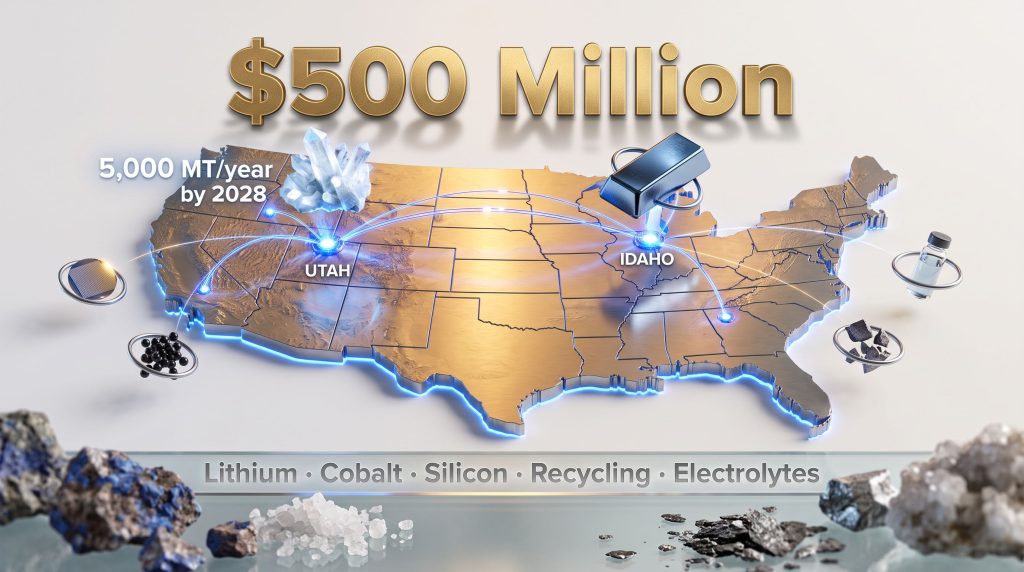
That is exactly what the U.S. Department of Energy's latest grant round represents. Seven companies have been selected to share $500 million in non-repayable funding through the Battery Materials Processing and Battery Manufacturing programs, each targeting a distinct bottleneck in the American battery supply chain. The Trump administration minerals grants for US battery projects address a structural weakness that has been decades in the making. To understand why this matters, and what it can realistically achieve, investors and industry observers need to look beyond the headline number.
When big ASX news breaks, our subscribers know first
Breaking Down the $500 Million: Who Gets What and Why It Matters
The third round of DOE Battery Materials Processing and Battery Manufacturing program funding was oversubscribed by a significant margin, with hundreds of applications competing for allocations. The selection criteria prioritised projects addressing the most acute domestic capability gaps, particularly in lithium extraction, cobalt refining, and battery recycling. Each of the seven recipients targets a specific weak point in the supply chain rather than duplicating existing capacity.
Lilac Solutions: Rethinking Lithium Recovery at the Great Salt Lake
Lilac Solutions secured $100 million to develop a direct lithium extraction facility on Utah's Great Salt Lake, with a target operational date of 2028 and projected annual output of 5,000 metric tons of lithium carbonate. BMW is among the company's existing backers, a signal of automotive sector confidence in the technology's commercial viability.
DLE is technically distinct from conventional evaporation pond methods in ways that matter enormously for U.S. deployment timelines. Traditional lithium brine operations require multi-year evaporation cycles across vast surface areas, making them poorly suited to the geographic and regulatory environment of the American West. DLE systems extract lithium chemically from brine, dramatically compressing production timelines and reducing land requirements. For a market desperate to shorten the gap between project announcement and first commercial output, this distinction is not merely technical; it is strategic.
The DOE has stated that its scientific teams are confident in Lilac Solutions' capacity to deliver lithium carbonate as a domestically processed resource for the national battery supply chain.
Jervois Global: Building America's Missing Cobalt Refinery
Perhaps the most strategically significant grant of the entire round is the $100 million awarded to Jervois Global for the construction of what would be the United States' only domestic cobalt refinery, located in Idaho near one of North America's largest cobalt deposits. The strategic importance of this project is difficult to overstate. Without this facility, the U.S. has no domestic refining pathway for cobalt, a metal used not only in consumer electronics and electric vehicle batteries but also in a range of military weapons systems.
Furthermore, the cobalt supply outlook adds additional urgency to this investment. Jervois's corporate history adds an unusual dimension to this story. The company underwent a pre-packaged bankruptcy restructuring driven by depressed cobalt market prices before being taken private, illustrating precisely the kind of market price volatility that can undermine critical mineral projects before federal capital intervenes.
The Idaho refinery's design also incorporates forward-looking feedstock flexibility; the facility is being built with the potential to eventually process deep-sea polymetallic nodules, a nascent but increasingly discussed alternative mineral source that could extend its strategic utility well beyond its initial Idaho ore base.
Nth Cycle: Turning Battery Scrap Into a Strategic Asset
Battery recycling company Nth Cycle, backed by global commodity trading giant Trafigura, received $100 million to process black mass, the mineral-dense residue recovered from end-of-life lithium-ion batteries. Black mass typically contains recoverable concentrations of cobalt, lithium, nickel, and manganese, making it a genuinely valuable secondary feedstock rather than simply a waste management challenge.
The battery recycling process is gaining renewed strategic focus as export controls tighten. The Trump administration recently restricted exports of black mass from the United States, creating a domestic processing mandate that facilities like Nth Cycle's are now positioned to fulfil. While the DOE has stated the grant was not formally tied to the export restriction, the two measures are clearly complementary elements of a broader effort to retain mineral value within U.S. borders.
The Remaining Four: Cathodes, Electrolytes, and the Silicon Anode Bet
Three companies received $50 million each targeting less-discussed but equally important components of the battery manufacturing ecosystem:
- Princeton NuEnergy focuses on regenerating and reprocessing cathode active materials from spent battery cells. Cathode materials represent the single highest-cost component in lithium-ion battery production, making domestic reprocessing capacity a meaningful cost lever.
- Arcanum Ventures produces specialty chemicals used in battery electrolyte formulations, addressing a supply chain dependency that rarely attracts public attention but represents a genuine vulnerability in U.S. battery manufacturing.
- Coreshell Technologies is developing silicon-based battery anodes as a direct alternative to graphite, the current industry standard. The strategic dimension here is significant: graphite is predominantly sourced and processed in China, and silicon anode technology could reduce this dependency at the cell chemistry level itself.
Summary of DOE Battery Materials Grant Recipients
| Company | Grant Amount | Technology Focus | Key Output |
|---|---|---|---|
| Lilac Solutions | $100M | Direct lithium extraction | 5,000 MT/year lithium carbonate by 2028 |
| Jervois Global | $100M | Cobalt refining | Only domestic U.S. cobalt refinery |
| Nth Cycle | $100M | Black mass recycling | Battery metal scrap processing |
| Princeton NuEnergy | $50M | Cathode reprocessing | Cathode active material regeneration |
| Arcanum Ventures | $50M | Electrolyte chemicals | Domestic battery electrolyte supply |
| Coreshell Technologies | $50M | Silicon anodes | Graphite dependency reduction |
| Total | $500M | Full battery ecosystem | 7 recipients across multiple states |
The Broader Federal Minerals Financing Architecture
The $500 million grant program is one instrument within a substantially larger federal toolkit. In August 2026, the administration deployed more than $2 billion in additional commitments through conditional loans and equity instruments, targeting different segments of the same supply chain. According to the White House fact sheet, these investments represent a deliberate effort to rebuild domestic mineral capacity at scale.
| Financing Type | Recipient | Amount | Focus Area |
|---|---|---|---|
| Conditional Loan | Sila Nanotechnologies | $1.4B | Silicon-carbon battery anodes and cell manufacturing |
| Conditional Loan | Sunrise Energy Metals | $400M | Critical minerals supply chain |
| Conditional Loan | Niron Magnetics | $150M | Rare earth-free permanent magnets |
| Ex-Im Bank Loan | Westwater Resources | $25M | Graphite mining and processing (Alabama) |
| DOE Grants (Round 3) | Multiple recipients | $500M | Lithium, cobalt, recycling, anodes, electrolytes |
The distinction between grant funding and conditional loan structures matters to investors analysing these programs. Grants are non-repayable and carry no balance sheet obligation for recipients. Conditional loans must be repaid and typically release funds in tranches tied to verified milestones, meaning recipient companies bear ongoing performance obligations throughout the project lifecycle.
Importantly, the current administration has simultaneously cancelled more than $700 million in battery and manufacturing awards that were originally committed under the prior administration. This is not simply an expansion of existing policy; it represents a deliberate reorientation of federal industrial priorities, with new capital directed toward upstream mineral processing and midstream refining rather than downstream manufacturing incentives that defined earlier programs.
The Minerals at the Heart of U.S. Battery Supply Chain Vulnerability
Understanding why the Trump administration minerals grants for US battery projects are structured the way they are requires a clear-eyed look at where the actual supply chain vulnerabilities sit. In addition, the broader picture of critical minerals demand reinforces just how urgent these investments have become.
Lithium
The United States holds meaningful lithium resources, including brine deposits in Nevada, California, and Utah, but has historically lacked the domestic processing infrastructure to convert those resources into battery-grade lithium carbonate or lithium hydroxide at commercial scale. Lilac Solutions' DLE approach is specifically calibrated to address this midstream processing gap rather than simply adding more resource exploration.
Cobalt
The U.S. cobalt situation is arguably the most acute of all battery metals. The country has no operational domestic cobalt refinery, meaning that even if cobalt is mined domestically, it must currently be sent abroad for processing before it can re-enter the supply chain as a battery-grade material. Jervois's Idaho project directly targets this gap and, if completed, would represent a genuine structural change in U.S. cobalt supply chain architecture.
Graphite and the Silicon Alternative
Graphite is the overlooked dependency sitting at the core of every conventional lithium-ion battery. The global graphite shortage is a risk that runs far deeper than most mainstream analysis acknowledges. Coreshell Technologies' silicon anode program and Sila Nanotechnologies' larger silicon-carbon anode conditional loan together represent a federal bet that next-generation anode chemistry can reduce this dependency before it becomes a crisis-level vulnerability.
Black Mass as a Strategic Resource
One of the less widely understood dynamics in battery recycling is that black mass is not a uniform material. Its composition and therefore its economic value varies significantly depending on the battery chemistry of the source cells. NMC (nickel manganese cobalt) batteries produce black mass with higher cobalt and nickel content, while LFP (lithium iron phosphate) batteries yield black mass with no cobalt at all.
This variation creates a genuinely complex processing challenge and means that black mass recycling facilities need to be designed with feedstock flexibility in mind, an engineering consideration that adds cost and complexity compared to processing virgin ore.
How Federal Grant Funding Reaches Battery Projects: A Step-by-Step Breakdown
- Application Submission: Companies submit detailed project proposals to the DOE's Battery Materials Processing and Battery Manufacturing programs, including technical feasibility studies and supply chain impact assessments.
- Technical Review: DOE scientists and program officers evaluate commercial readiness, domestic supply chain contribution, and technological credibility.
- Selection Against Priority Criteria: Projects are ranked based on their potential to address the most critical gaps in the U.S. battery ecosystem and deliver the highest strategic return.
- Conditional Award Notification: Selected applicants receive conditional award letters outlining performance milestones, reporting requirements, and any applicable matching fund obligations.
- Agreement Negotiation and Execution: Final grant agreements are negotiated before funds are committed, including compliance frameworks and disbursement conditions.
- Milestone-Based Disbursement: Funds are released in tranches tied to verified project progress rather than as lump-sum payments, maintaining accountability throughout the project lifecycle.
Risks That Capital Alone Cannot Solve
Federal grant funding removes one of the most significant barriers facing early-stage mineral processing projects, namely access to non-dilutive capital during the pre-revenue phase. However, it does not resolve several other structural challenges that will determine whether these projects actually deliver on their strategic promise.
Market price volatility remains a genuine risk. Jervois's pre-bankruptcy experience demonstrates exactly what low commodity prices can do to mineral processing projects even when the underlying resource and technology are sound. Grant funding provides a capital cushion but does not insulate projects from sustained price weakness.
Technology readiness gaps are particularly relevant for newer approaches like DLE and silicon anodes. The gap between pilot-scale demonstration and commercial-scale production reliability is historically where many advanced mineral processing technologies have stumbled. Investors and policymakers should track operational commissioning milestones carefully rather than treating award announcements as equivalent to production certainty.
Permitting timelines and workforce availability present further constraints. Building a cobalt refinery or a DLE facility in the United States requires navigating federal and state environmental permitting processes that can extend project timelines significantly, regardless of available capital. Skilled metallurgical and chemical processing workforces are also in short supply domestically, a constraint that grant funding cannot directly address.
Capital solves the financing problem. It does not solve the permitting calendar, the workforce pipeline, or the years-long gap between project announcement and first commercial shipment.
The next major ASX story will hit our subscribers first
How U.S. Minerals Grant Strategy Compares Globally
| Country/Region | Primary Policy Tool | Key Focus Areas | Scale of Commitment |
|---|---|---|---|
| United States | Grants + Conditional Loans + Ex-Im Financing | Lithium, cobalt, graphite alternatives, recycling | $2B+ deployed in 2026 alone |
| European Union | Critical Raw Materials Act + Strategic Projects | Lithium, nickel, rare earths | Over €1B in strategic project designations |
| China | State-directed investment + export controls | Full vertical battery supply chain integration | Multi-decade, multi-hundred-billion investment |
| Australia | Critical Minerals Facility + NAIF Loans | Lithium, rare earths, cobalt, nickel | AUD $4B+ in financing commitments |
| Canada | Critical Minerals Strategy + Investment Tax Credits | Lithium, nickel, cobalt, graphite | CAD $3.8B allocated over five years |
China's advantage in this comparison is not merely financial. Decades of state-coordinated investment have produced processing facilities, skilled workforces, logistics networks, and established customer relationships that cannot be replicated quickly regardless of how much capital Western governments deploy. The realistic near-term goal for U.S. policy is not parity with Chinese processing capacity but rather a meaningful reduction in single-source dependency for the most critical battery materials.
As CNBC's coverage of the administration's minerals push has noted, the scale of federal commitment reflects a recognition that market forces alone are insufficient to close the gap with China within the timeframes that strategic competition demands.
What the 2028 Horizon Looks Like for U.S. Battery Supply Chains
If funded projects proceed on schedule, the most visible near-term milestone will be Lilac Solutions' Great Salt Lake DLE facility reaching commercial production by 2028, adding domestically processed lithium carbonate to a U.S. market currently reliant almost entirely on imported feedstock. Jervois's Idaho cobalt refinery, if commissioned on a comparable timeline, would close what is currently a total gap in domestic cobalt refining capacity.
Longer term, the silicon anode investments represent a more structurally transformative bet. If silicon or silicon-carbon anode chemistry achieves commercial reliability at scale, it could fundamentally alter the graphite dependency that currently runs through the entire lithium-ion battery industry, reducing one of the most difficult Chinese supply chain concentrations to address through conventional mining and processing investment alone.
The simultaneous use of grants, conditional loans, equity investments, export controls on black mass, and prior-era award cancellations signals that the current administration views battery supply chain development as a comprehensive industrial policy challenge requiring multiple simultaneous interventions. The Trump administration minerals grants for US battery projects are, consequently, best understood not as standalone funding announcements but as one layer within a deliberate and multi-instrument strategy. Whether this approach proves sufficient in scale and speed relative to the competitive and geopolitical pressures driving it remains one of the defining industrial policy questions of the decade.
This article is for informational purposes only and does not constitute financial or investment advice. Forecasts, timelines, and project outcomes referenced herein are subject to change based on market conditions, regulatory decisions, and technological development. Readers should conduct their own due diligence before making investment decisions.
Want to Spot the Next Major ASX Mineral Discovery Before the Broader Market Does?
Discovery Alert's proprietary Discovery IQ model delivers real-time alerts on significant ASX mineral discoveries across lithium, cobalt, graphite, and more than 30 other commodities — instantly turning complex mineral data into actionable investment insights for traders and long-term investors alike. Explore historic discoveries and their returns to see what early positioning can mean, then begin your 14-day free trial at Discovery Alert to secure your market-leading advantage.