August 21, 2026
The Hidden Architecture of Lithium Supply Deals and Why Floor Pricing Changes Everything
When commodity markets oscillate violently enough to bankrupt otherwise viable mining operations, the industry eventually responds by redesigning its commercial architecture. Lithium is now at precisely that inflection point. After the lithium market downturn that wiped out billions in projected project value between 2022 and 2024, the upstream lithium sector is quietly engineering a new contractual standard — one where the downside is contractually eliminated before a single tonne of spodumene concentrate leaves the ground.
The Elevra lithium price floor supply deal struck with Mangrove Lithium represents more than a single bilateral commercial arrangement. It signals a structural shift in how hard-rock lithium assets will be monetised across the western world, and why producers holding permitted, operating spodumene assets are now in a position to dictate terms that would have been unthinkable during the 2022 boom.
When big ASX news breaks, our subscribers know first
Why Lithium's Boom-Bust Cycle Created a Structural Financing Problem
Between late 2021 and late 2022, lithium carbonate supply dynamics pushed prices to surge by more than 400%, driven by electric vehicle demand projections and supply scarcity narratives. By mid-2024, prices had collapsed by roughly 80% from their peaks, leaving projects that had seemed economically robust suddenly underwater on a cash-cost basis.
The severity of this correction exposed a fundamental mismatch at the heart of hard-rock lithium economics:
- Mine development cycles typically span 7 to 12 years from discovery through permitting, construction, and production ramp-up.
- Commodity price cycles can complete a full boom-to-bust rotation in 18 to 36 months.
- Capital repayment schedules are built around price assumptions established at the time of project financing, not at the time of production.
- Lenders and equity investors require revenue certainty that spot markets simply cannot provide.
This structural mismatch is particularly acute for spodumene concentrate producers, who sit at the upstream end of a complex processing chain. Unlike integrated lithium producers who control their own conversion capacity, pure spodumene miners are price-takers in a market where downstream refiners — predominantly Chinese — have historically held significant negotiating leverage.
Furthermore, the spodumene concentrate market remains heavily influenced by Asian processing hubs, which compounds the pricing uncertainty that western producers face during downturns.
"A price floor set above a producer's cost of production fundamentally transforms the risk profile of an upstream lithium project. It converts commodity price exposure into something closer to a structured revenue stream, which lenders can model, debt service can be calculated against, and equity investors can value with greater precision."
Breaking Down the Elevra Lithium Price Floor Supply Deal
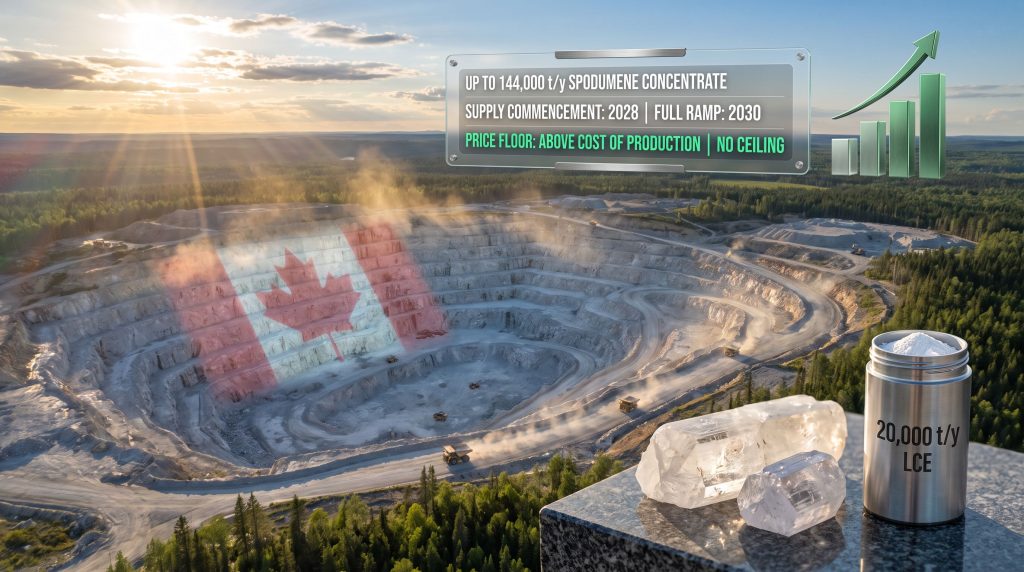
The commercial structure of the Elevra-Mangrove agreement is notable precisely for what it includes and what it deliberately excludes. Elevra Lithium, listed on the ASX and operating the North American Lithium mine in Québec, has agreed to supply spodumene concentrate to Mangrove Lithium's planned Canadian conversion facility under terms that protect the producer's margin without capping its upside.
Core Commercial Parameters
| Deal Parameter | Detail |
|---|---|
| Supply Volume | Up to 144,000 tonnes per year of spodumene concentrate |
| Proposed Start Date | 2028 |
| Full Volume Ramp | By 2030 |
| Processing Output | 20,000 tonnes per year of lithium carbonate equivalent |
| Price Floor | Confirmed above expected cost of production |
| Price Ceiling | None — Elevra retains full market upside |
| Binding Status | Advanced supply agreement, evolved from February 2026 MoU |
| Final Investment Decision Deadline | June 2027 |
The progression from a non-binding memorandum of understanding in February 2026 to an advanced supply agreement with confirmed price floor terms reflects how the commercial relationship has matured. Notably, the initial MoU had reportedly included both floor and ceiling price parameters. The removal of the ceiling in the evolved structure is not incidental — it reflects Elevra's strengthened negotiating position as a holder of a producing, permitted hard-rock asset in a supply-constrained market.
The Mechanics of a Price Floor Without a Ceiling
For readers less familiar with commodity contract structures, it is worth understanding how these pricing mechanisms function in practice:
- A fixed-price offtake locks both parties into a predetermined price regardless of market movements, offering certainty but eliminating any benefit from market recovery.
- An index-linked offtake ties the sale price to a published benchmark, passing full market risk to the producer without any downside protection.
- A floor-and-ceiling structure (also called a collar) protects the buyer from price spikes while protecting the producer from price collapses, but it caps the producer's upside.
- A floor-only structure, as in the Elevra-Mangrove agreement, protects the producer's margin in down markets while preserving full exposure to any price recovery — representing the most commercially favourable arrangement for the selling party.
The floor being set above the cost of production is the critical detail. It means Elevra is contractually guaranteed a positive margin irrespective of where lithium prices trade, eliminating the scenario where continued operation becomes economically irrational.
The Strategic Geography: Why Québec Matters
The North American Lithium mine in Québec is not simply a source of spodumene concentrate. Its location carries strategic significance that extends well beyond the bilateral terms of this agreement.
Québec combines several characteristics that make it uniquely attractive as a hard-rock lithium production hub:
- Access to hydroelectric power, providing one of the lowest-carbon mining energy profiles in the world and aligning with the sustainability requirements of North American battery manufacturers.
- Established mining services infrastructure, reducing operational complexity and capital requirements compared to greenfield locations.
- Relative proximity to North American EV manufacturing clusters, shortening the supply chain between mine output and battery cell production.
- A permitting environment with established regulatory precedent for hard-rock mining operations.
These characteristics also partially explain why Mangrove Lithium has chosen to site its planned conversion facility in Canada. The strategic logic of keeping both the mine and the conversion step within a single jurisdiction minimises cross-border trade risk and maintains the integrity of a North American supply chain for battery-grade lithium products. In addition, advances in lithium extraction technologies are making domestic processing increasingly viable for facilities like Mangrove's planned Canadian operation.
Benchmarking Against the PLS-Canmax Precedent
The Elevra-Mangrove structure does not exist in isolation. In February 2026, Australia's Pilbara Minerals signed a spodumene concentrate offtake agreement with Canmax Technologies that incorporated a floor-price mechanism, marking the first major publicly disclosed floor-price offtake in the post-downturn lithium market.
Comparing Floor-Price Deal Structures
| Agreement | Producer | Buyer | Floor Price | Ceiling | Volume | Announced |
|---|---|---|---|---|---|---|
| PLS-Canmax | Pilbara Minerals (ASX) | Canmax Technologies | Yes | Not disclosed | Not disclosed | February 2026 |
| Elevra-Mangrove | Elevra Lithium (ASX) | Mangrove Lithium | Yes, above CoP | No | Up to 144,000 t/y | 2026 |
The key differentiator between the two arrangements is the explicit absence of a ceiling in the Elevra deal. Mangrove Lithium's chief commercial and strategy officer has noted publicly that this type of pricing structure is expected to become the standard moving forward, citing both the scarcity of producing hard-rock assets and the long development timelines required to bring new operations into production.
This perspective carries weight. New lithium mine development from discovery to first production currently requires a minimum of seven years under optimistic assumptions, and frequently longer. In a market where western nations are actively seeking to reduce dependence on Chinese lithium processing, the supply gap that producing assets fill cannot be easily replicated on short notice.
The China Processing Dependency and Why It Shapes This Deal
Understanding the geopolitical dimension of the Elevra lithium price floor supply deal requires appreciating the degree to which global lithium refining remains concentrated in Chinese hands. China processes an estimated 60 to 70 percent of the world's lithium hydroxide and carbonate, even when the raw material originates in Australia, Chile, or Argentina.
This processing dependency creates a specific vulnerability in western battery supply chains:
- Raw spodumene extracted in Canada or Australia is shipped to China for conversion into battery-grade lithium carbonate or hydroxide.
- The refined material is then shipped back to North American or European battery cell manufacturers.
- Each cross-border transaction introduces tariff risk, geopolitical disruption risk, and supply chain opacity.
- Any deterioration in trade relations can simultaneously affect both the cost and availability of the refined product.
Mangrove Lithium's planned Canadian conversion facility represents a deliberate attempt to break this loop. By sourcing spodumene from Elevra's Québec operation and converting it domestically into lithium carbonate equivalent, the arrangement creates a vertically integrated North American supply chain segment that bypasses the Chinese refining step entirely.
"The mine-to-converter logic of the Elevra-Mangrove arrangement follows a straightforward supply chain architecture: NAL mine in Québec produces spodumene concentrate, which feeds Mangrove's Canadian conversion facility, which outputs battery-grade lithium carbonate equivalent for North American cell manufacturers. Each step remains within Canadian jurisdiction, preserving value-add processing domestically."
The next major ASX story will hit our subscribers first
What This Means for Investors Watching Elevra Lithium
Markets responded immediately to the news. Elevra Lithium shares rose by as much as 6.1% on the day the Bloomberg report confirmed the advanced supply agreement's terms. Over the preceding 12 months, the stock had already more than doubled, reflecting investor anticipation of precisely this kind of structured commercial arrangement.
The investor logic is straightforward but worth articulating explicitly:
- A price floor above cost of production eliminates the scenario where the company generates negative operating margins, removing the most damaging tail risk from the investment thesis.
- The absence of a price ceiling preserves the full benefit of any lithium price recovery, maintaining the upside optionality that commodity investors require as compensation for sector risk.
- The structure improves the project's bankability, making it significantly easier to secure project financing from institutions that require modellable debt service coverage.
Key Milestones and Remaining Execution Risks
Despite the commercial progress, important conditions remain outstanding:
- Mangrove's final investment decision by June 2027 is the critical binary event. Without FID, the supply agreement cannot progress to binding execution.
- Project financing for the Mangrove conversion facility — with Export Development Canada and the Canada Growth Fund identified as potential contributors — remains subject to separate negotiation and approval processes.
- The transition from an advanced supply agreement to a fully binding offtake document requires completion of due diligence, legal documentation, and alignment of final commercial terms.
- Lithium price movements between now and the proposed 2028 commencement date will determine the practical relevance of the floor, whether it functions as an active protection mechanism or simply as a contractual backstop against an unlikely price scenario.
However, analysts tracking the sector have noted that the Elevra lithium price floor supply deal nonetheless represents a meaningful de-risking milestone, regardless of where prices ultimately settle at the time production commences. For further analysis on Elevra's revenue alignment strategy, the Motley Fool's coverage of the announcement provides useful additional context on market sentiment.
Disclaimer: This article contains forward-looking statements and analysis based on publicly available information. It does not constitute financial advice. Investors should conduct their own due diligence and consider their personal financial circumstances before making investment decisions. Commodity markets are inherently volatile, and past price performance is not indicative of future results.
Frequently Asked Questions: Elevra Lithium Price Floor Supply Deal
What is a price floor in a lithium supply agreement?
A price floor is a contractually agreed minimum sale price that applies regardless of where spot market prices are trading. In the Elevra-Mangrove arrangement, this floor is positioned above Elevra's expected cost of production, guaranteeing a positive operating margin under all realistic market scenarios.
What volumes are covered under the deal?
The agreement covers up to 144,000 tonnes per year of spodumene concentrate, with supply proposed to commence in 2028 and scale to full contracted volume by 2030.
Is the deal currently binding?
As of August 2026, the arrangement is an advanced supply agreement that has evolved from a non-binding MoU signed in February 2026. A fully binding offtake agreement is contingent on Mangrove reaching a final investment decision by June 2027.
Why does the deal have no price ceiling?
The absence of a ceiling reflects Elevra's negotiating strength as the holder of a producing, permitted spodumene asset in Québec. In a western supply chain environment where such assets are scarce and alternatives take many years to develop, producers can negotiate asymmetric price protection that preserves full market upside.
What will Mangrove's facility produce?
Mangrove's planned Canadian conversion facility is designed to produce 20,000 tonnes per year of lithium carbonate equivalent, using Elevra's spodumene concentrate as its primary feedstock.
Want to Track the Next Major ASX Lithium Discovery Before the Market Does?
As the lithium sector restructures around floor-price supply agreements and western supply chains tighten, the commercial landscape is shifting rapidly — and significant ASX mineral discoveries can move quickly. Discovery Alert's proprietary Discovery IQ model delivers real-time alerts on significant ASX mineral discoveries, including lithium and battery metals, ensuring subscribers are positioned ahead of the broader market; explore Discovery Alert's discoveries page to see how historic discoveries have generated substantial returns, and begin your 14-day free trial today.