August 21, 2026
The Hidden Bottleneck Strangling America's Battery Recycling Ambitions
Most discussions about electric vehicle adoption focus on what goes into a battery before it powers a vehicle. Far less attention has been paid to what happens at the other end of that battery's life, specifically the industrial infrastructure required to recover and reprocess the critical minerals locked inside spent cells. This downstream gap, quiet for years, has now become one of the most consequential vulnerabilities in the U.S. industrial supply chain, and federal capital is beginning to flow toward Nth Cycle black mass refinery funding and solutions that can close it.
The concept of black mass sits at the centre of this challenge. When a lithium-ion battery reaches the end of its usable life, mechanical shredding or crushing produces a fine, dark powder containing recoverable concentrations of nickel, cobalt, lithium, manganese, and graphite. This material cannot simply be fed back into battery manufacturing without undergoing sophisticated downstream refining. It is a raw intermediate, not a finished product, and the industrial infrastructure required to transform it into battery-grade outputs has been conspicuously absent from American soil at any meaningful scale.
That absence is no longer a theoretical concern. With U.S. EV registrations climbing and consumer electronics generating ever-larger volumes of spent cells, the domestic black mass market is growing faster than the refining capacity designed to process it.
When big ASX news breaks, our subscribers know first
Why Black Mass Refining Became a National Security Conversation
For roughly two decades, China built out the hydrometallurgical processing infrastructure required to refine black mass into usable critical mineral outputs. This was not accidental. Sustained industrial policy investment in refining capacity, combined with an abundant domestic supply of spent battery materials, allowed Chinese processors to develop cost and scale advantages that most Western competitors could not easily replicate.
The result is a structural dependency that mirrors, in important ways, the rare earth processing bottleneck that alarmed policymakers in the early 2010s. The U.S. could mine or collect raw materials, but the conversion of those materials into high-value, specification-grade outputs happened predominantly offshore. Furthermore, China battery recycling infrastructure has continued to expand, deepening this competitive gap.
In 2026, the U.S. Department of Commerce moved to interrupt this dynamic by issuing a one-year export ban on black mass. The logic was straightforward: preventing domestic battery scrap from being shipped to overseas refiners, primarily in China, would retain critical mineral value within U.S. borders. However, this policy created an immediate practical problem. If black mass cannot be exported and there is insufficient domestic refining capacity to process it, the material simply accumulates, stranded and unusable, inside U.S. warehouses and collection facilities.
"The export ban functions as a forcing mechanism. It creates urgency for domestic refining infrastructure to scale rapidly, but that urgency only translates into outcomes if the capital, technology, and regulatory conditions align to make new facilities viable within a compressed timeframe."
This is precisely the context in which Nth Cycle's Project SHIELD and its associated federal funding negotiation have become significant.
What Is Project SHIELD and What Does It Actually Do?
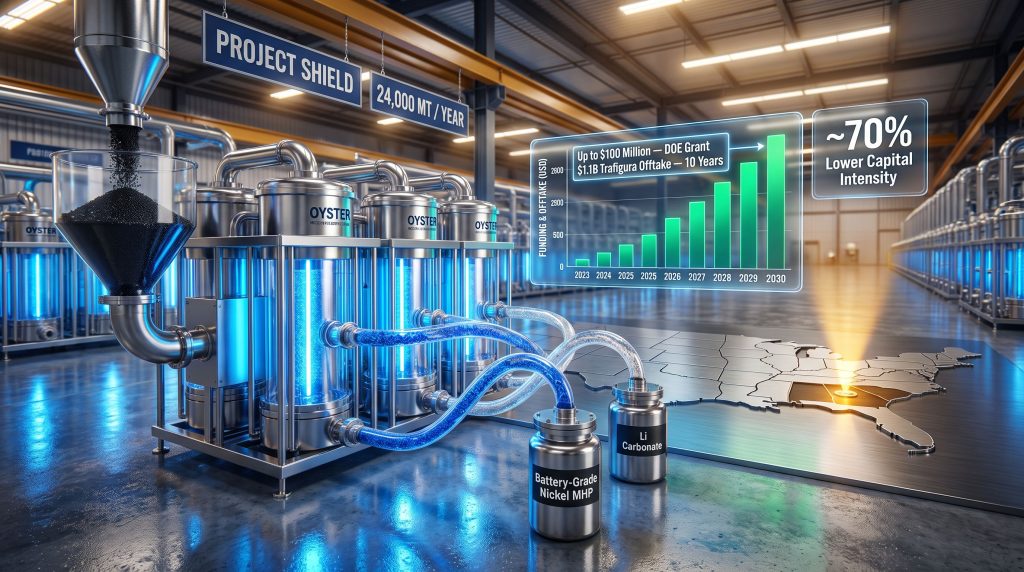
Project SHIELD, an acronym for Strategic Hub for Industrial Electroextraction and Logistics Defence, is a planned commercial-scale black mass refining facility targeted for development in the Southeastern United States. Nth Cycle has been selected by the U.S. Department of Energy to enter formal award negotiations for a federal grant of up to $100 million to support the project's construction and commissioning.
It is important to be precise about what this selection means. A DOE selection initiates a structured negotiation phase rather than confirming a disbursement. During this phase, DOE and the applicant align on technical milestones, compliance requirements, disbursement schedules, and reporting obligations. Final approval depends on satisfactory completion of that process, and projects can be withdrawn if terms cannot be agreed upon.
When operational, Project SHIELD is designed to process up to 24,000 metric tons of domestic black mass annually, converting that feedstock into two primary outputs:
- High-purity nickel mixed hydroxide precipitate (MHP), a refined intermediate used in the production of nickel-rich battery cathodes
- Battery-grade lithium carbonate, suitable for use in battery cell manufacturing as well as grid-scale storage and defence applications
The facility's target end markets span military energy systems, AI data centre backup power infrastructure, electric transportation, and utility-scale grid storage, reflecting the broadening critical minerals demand beyond the passenger vehicle sector alone.
| Project SHIELD Key Parameters | Detail |
|---|---|
| DOE grant ceiling (under negotiation) | Up to $100 million |
| Facility location | Southeastern United States |
| Annual black mass processing capacity | 24,000 metric tons |
| Primary output one | High-purity nickel MHP |
| Primary output two | Battery-grade lithium carbonate |
| Target operational date | 2029 |
| Capital cost vs. traditional refineries | Approximately 70% lower |
The OYSTER System: How Electroextraction Changes the Economics of Refining
What Makes Conventional Refining So Expensive?
Understanding why Nth Cycle's approach is structurally differentiated from conventional recycling operations requires a brief look at the technology underpinning Project SHIELD.
Traditional black mass refining relies on either pyrometallurgy (high-temperature smelting) or hydrometallurgy (acid leaching followed by solvent extraction and precipitation). Both approaches require purpose-built facilities with significant civil engineering, large chemical handling infrastructure, environmental containment systems, and multi-year construction timelines. Capital requirements for a greenfield hydromet refinery of meaningful scale typically run into hundreds of millions of dollars, with build timelines stretching four to seven years before first production.
How Does the OYSTER System Work?
Nth Cycle's proprietary electroextraction platform, delivered through its modular OYSTER system, uses electrochemical processes to selectively recover critical minerals from black mass without the thermal intensity of smelting or the extensive chemical reagent systems required by hydromet. Several characteristics of this approach carry meaningful commercial implications:
- The OYSTER system is modular, meaning individual processing units can be installed within existing industrial buildings rather than requiring purpose-built greenfield construction
- Full installation from commissioning to operation takes approximately two years per module
- Capital intensity is roughly 70% lower than conventional refinery builds, reducing the financing burden and shortening the payback timeline
- The modular design allows capacity to scale incrementally as feedstock availability grows, rather than requiring upfront commitment to maximum capacity
"The ability to retrofit existing industrial real estate is more than a cost consideration. It compresses the regulatory surface area of a new facility, leverages available grid connections, and reduces the community opposition risks that can delay purpose-built industrial construction."
This combination of lower capital intensity, faster deployment, and output purity competitive with conventional refinery products positions Nth Cycle's technology as a genuinely differentiated proposition in the domestic battery recycling landscape. Furthermore, the use of advanced lithium extraction technology continues to reshape what is commercially achievable in this space.
The Commercial Track Record That Preceded Federal Validation
One of the more instructive dimensions of Nth Cycle's positioning is the sequence in which commercial validation and federal interest developed. The company did not build its credibility on the basis of government funding; it built it through private capital markets and operational proof points, and the federal interest followed.
The key milestones in that progression are worth examining in order:
- 2023 – Nth Cycle closed a $44 million combined Series B and non-dilutive funding round, providing capital to scale operations and validate the OYSTER system beyond laboratory conditions
- 2024 – The company began commercial production of high-purity nickel MHP from scrap at its Ohio facility, demonstrating that electroextraction could produce specification-grade outputs at commercial scale
- 2026 – Nth Cycle announced a $1.1 billion, 10-year offtake agreement with Trafigura, one of the world's largest commodity trading and logistics firms
- 2026 – The DOE selected Nth Cycle to negotiate a $100 million federal grant for Project SHIELD
Why Does the Trafigura Agreement Matter?
The Trafigura agreement deserves particular attention. Trafigura is not a speculative investor or an ideologically motivated partner. It is a global commodity trader with deep expertise in metals markets and offtake assessment. Trafigura's recycling commitment calls for the purchase of 2,000 metric tons of nickel contained in MHP and 1,500 metric tons of battery-grade lithium carbonate annually over a 10-year period, with the total contract value estimated at $1.1 billion.
The fact that a counterparty of Trafigura's sophistication committed to a decade-long purchase agreement before the DOE grant was confirmed provides an independent signal about Project SHIELD's commercial viability that carries weight beyond the federal selection itself.
Comparing Nth Cycle to the Broader Domestic Battery Recycling Landscape
The U.S. battery recycling sector has attracted significant capital and attention over the past several years, but the competitive dynamics are more nuanced than headline investment figures suggest. Most first-generation battery recyclers either collect and export black mass (now constrained by the export ban), operate pyrometallurgical smelters that produce lower-purity intermediate alloys, or are building hydromet refineries that will take years and hundreds of millions of dollars to complete.
| Dimension | Nth Cycle / Project SHIELD | Conventional Recycling Approaches |
|---|---|---|
| Core technology | Electroextraction (OYSTER system) | Hydrometallurgy or pyrometallurgy |
| Capital intensity | Approximately 70% lower | High, requires purpose-built facilities |
| Deployment timeline | Approximately 2 years per module | 4 to 7 years for greenfield builds |
| Output purity | Battery-grade MHP and lithium carbonate | Variable, often requires further refining |
| Existing U.S. operations | Ohio facility producing since 2024 | Greenfield for most new entrants |
| Long-term offtake | $1.1B Trafigura agreement (10 years) | Varies significantly |
The Ohio facility is particularly important as a competitive differentiator. Nth Cycle is not proposing to build something that has never been demonstrated. It has already demonstrated commercial-scale electroextraction of nickel MHP from scrap and is proposing to replicate and expand that operational model through Project SHIELD. In addition, shifts in the broader battery raw materials market are creating further tailwinds for domestic refining solutions.
The next major ASX story will hit our subscribers first
The Downstream Demand Picture: Why Output Markets Matter as Much as Input Processing
A refinery without buyers for its output is a stranded asset. Understanding where high-purity nickel MHP and battery-grade lithium carbonate flow, and how demand for those materials is evolving, is essential context for evaluating Project SHIELD's long-term commercial logic.
Nickel MHP is a primary feedstock for nickel-rich cathode active materials, including NMC (nickel manganese cobalt) and NCA (nickel cobalt aluminium) cathode chemistries that dominate high-energy-density EV applications. U.S. defence procurement requirements increasingly specify domestically sourced and processed critical mineral inputs, creating a demand vector for battery-grade nickel that operates somewhat independently of automotive market cycles.
Battery-grade lithium carbonate serves a wider range of applications, including lithium iron phosphate (LFP) battery formulations used in stationary storage, grid-scale energy storage systems tied to renewable energy deployment, and the growing backup power requirements of AI data centre infrastructure. This last demand vector is particularly relevant because it represents new, structurally growing consumption that does not depend on EV adoption rates.
| Output Material | Primary End Markets |
|---|---|
| High-purity nickel MHP | EV cathode manufacturing, U.S. defence energy systems, battery cell production |
| Battery-grade lithium carbonate | Grid-scale storage, AI data centre backup power, LFP battery manufacturing |
The DOE Funding Context and What It Signals for the Sector
Project SHIELD is one of seven projects selected by the DOE's Office of Critical Minerals and Energy Innovation to negotiate grants from a total package of approximately $500 million. This portfolio approach reflects a deliberate effort to fund multiple technology pathways and geographic locations rather than concentrating support in a single project or company.
For investors and analysts watching the domestic battery supply chain, the broader grant package signals that federal capital allocation to battery material processing and recycling infrastructure is not a one-off event but a sustained programmatic commitment. The specific framing of critical mineral recovery as a sovereignty and national security matter, rather than purely an environmental or industrial policy concern, indicates that this funding posture has political durability across policy cycles.
Nth Cycle's CEO and co-founder Megan O'Connor has characterised the DOE's award negotiations as a recognition that recoverable critical minerals remaining outside U.S. processing infrastructure represent a national security liability, not merely an economic inefficiency. This framing aligns with how the U.S. Department of Defense has increasingly discussed battery supply chain localisation in its procurement guidance.
"It is worth noting a critical distinction: the DOE award selection initiates negotiations, not a confirmed disbursement. Project SHIELD's 2029 operational timeline assumes successful negotiation completion, timely approvals, and capital deployment proceeding without material delays. Investors and observers should weigh these contingencies carefully."
Key Figures at a Glance
| Metric | Detail |
|---|---|
| DOE grant ceiling | Up to $100 million (negotiation phase) |
| DOE broader grant package | Approximately $500 million across 7 projects |
| Annual processing capacity (Project SHIELD) | 24,000 metric tons of black mass |
| Trafigura offtake value | $1.1 billion over 10 years |
| Nickel MHP offtake volume | 2,000 metric tons per year |
| Lithium carbonate offtake volume | 1,500 metric tons per year |
| Series B and non-dilutive funding (2023) | $44 million |
| Capital cost advantage vs. conventional | Approximately 70% lower |
| Module installation timeline | Approximately 2 years |
| Ohio operations commenced | 2024 |
| Project SHIELD operational target | 2029 |
Frequently Asked Questions: Nth Cycle Black Mass Refinery Funding
What exactly is black mass and why does it require refining?
Black mass is the powdered residue produced when spent lithium-ion battery cells are mechanically shredded or crushed. It contains recoverable concentrations of nickel, cobalt, lithium, manganese, and graphite, but cannot be fed directly into battery manufacturing. Industrial-scale refining is required to separate and purify these constituent elements into specification-grade outputs suitable for cathode production and other applications.
Is the $100 million DOE grant confirmed?
No. The DOE has selected Nth Cycle to enter award negotiations for a grant of up to $100 million. This selection initiates a structured process during which technical milestones, disbursement conditions, and compliance requirements are negotiated. The grant is not confirmed until that process concludes successfully. Projects can be withdrawn if negotiation terms cannot be agreed upon.
How does electroextraction differ from conventional battery recycling methods?
Conventional battery recycling primarily uses pyrometallurgy (high-temperature smelting) or hydrometallurgy (chemical leaching and precipitation). Nth Cycle's electroextraction approach uses electrochemical processes to selectively recover critical minerals, with modular equipment that can be deployed in existing buildings in approximately two years at roughly 70% lower capital cost than purpose-built conventional refineries.
Who is Trafigura and why does its involvement matter?
Trafigura is one of the world's largest commodity trading and logistics companies, operating across metals, minerals, and energy markets globally. Its commitment to a 10-year, $1.1 billion offtake agreement with Nth Cycle represents independent commercial validation of Project SHIELD's output quality and volume projections, separate from the federal grant process.
Why did the U.S. ban black mass exports?
The U.S. Department of Commerce issued a one-year export ban to prevent domestic battery scrap from being processed overseas, primarily in China, given the absence of sufficient U.S.-based refining infrastructure. The ban creates structural demand for domestic refining solutions but also creates a bottleneck risk if that domestic capacity does not scale to meet the growing volume of collected black mass. Consequently, Nth Cycle black mass refinery funding has become a pivotal mechanism in bridging this gap.
This article is intended for informational purposes only and does not constitute financial advice. Statements regarding DOE grant negotiations, offtake agreements, and operational timelines reflect publicly available information and are subject to change. Readers should conduct independent due diligence before making investment decisions based on any of the information presented here.
Want to Know Which ASX Companies Are Pioneering the Critical Minerals Revolution?
Discovery Alert's proprietary Discovery IQ model delivers real-time alerts on significant ASX mineral discoveries — including the critical minerals driving the battery supply chain transformation explored above — instantly empowering subscribers to identify actionable opportunities ahead of the broader market. Explore Discovery Alert's dedicated discoveries page to understand how historic mineral discoveries have generated substantial returns, and begin your 14-day free trial today to position yourself at the forefront of the next major find.