July 9, 2026
The Processing Gap That Could Define Europe's Battery Future
The global race to secure battery-grade lithium is frequently framed as a competition over who controls the ground. Drill results, resource estimates, and mining licences dominate headlines. Yet the E3 Lithium Tees Valley Lithium collaboration highlights a quieter and arguably more consequential contest unfolding one step further down the value chain, at the conversion stage, where raw lithium intermediates are transformed into the specification-ready chemicals that battery manufacturers actually need. In Europe, this conversion capacity barely exists at commercial scale, and the consequences for the continent's electric vehicle ambitions are significant.
Understanding why this matters requires a brief detour into battery chemistry. High-nickel cathode formulations, particularly nickel-manganese-cobalt chemistries at ratios such as NMC 811, require lithium hydroxide monohydrate rather than lithium carbonate as a precursor input. Hydroxide reacts more cleanly at lower temperatures with high-nickel precursors, preserving cathode integrity and cycle performance. As European gigafactories increasingly target energy-dense, long-range battery specifications, their preference for hydroxide over carbonate has become a structural commercial reality, not merely a technical preference.
The implication is clear: producing lithium carbonate is no longer sufficient to access premium European offtake markets. A producer without a credible pathway to hydroxide is effectively locked out of the highest-value customer relationships on the continent.
When big ASX news breaks, our subscribers know first
Why Conversion Capacity Has Become the Supply Chain's Most Valuable Chokepoint
Lithium brine extraction produces lithium carbonate as the natural intermediate product of most brine-based processes. It is chemically stable, relatively straightforward to transport, and serves as the feedstock for the subsequent conversion step. Lithium hydroxide is produced from carbonate through a causticisation reaction, typically involving lime, followed by purification and crystallisation processes. This conversion step requires meaningful capital investment, technical expertise in chemical processing, and consistent quality control to meet battery-grade specifications.
The critical insight is that mining a lithium resource and refining it to battery-grade hydroxide are fundamentally different industrial competencies. Many emerging lithium producers, particularly those developing brine-based assets, are well-positioned to produce carbonate economically but lack the infrastructure, capital, or geographic proximity to European markets needed to establish their own hydroxide refining capacity. This creates a structural opening for independent merchant refiners, facilities that convert third-party carbonate feedstock into hydroxide on a toll or offtake basis.
This model mirrors dynamics seen in other commodity sectors. In copper, for example, smelting and refining have long been separated from mining operations in many supply chains. The emergence of independent lithium hydroxide converters in Europe represents a maturation of the lithium industry toward a similar specialisation of function.
The E3 Lithium and Tees Valley Lithium Collaboration: Framework and Commercial Logic
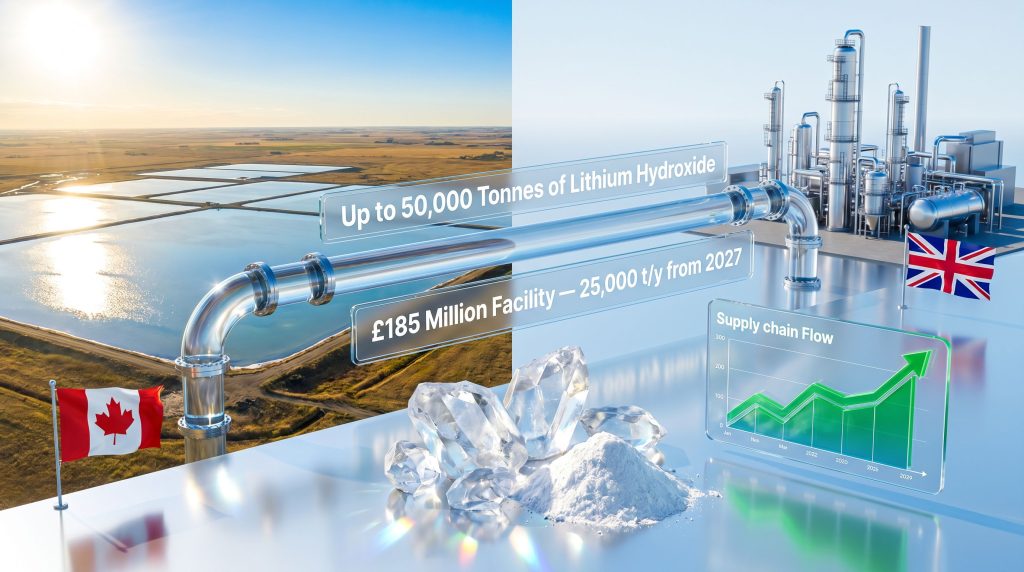
The E3 Lithium Clearwater Project sits at the heart of this arrangement. The E3 Lithium Tees Valley Lithium collaboration, announced in July 2026, represents a concrete attempt to bridge the carbonate-to-hydroxide gap across geographies. The arrangement, structured as a non-binding heads of terms agreement, establishes a framework under which E3 Lithium would supply lithium carbonate produced at its Clearwater project in Alberta, Canada, for conversion into battery-grade lithium hydroxide at Tees Valley Lithium's refinery in Billingham, Teesside, in the United Kingdom.
The commercial parameters of the proposed arrangement are summarised below:
| Parameter | Detail |
|---|---|
| Agreement Type | Non-Binding Collaboration (Heads of Terms) |
| Volume Contemplated | Up to 50,000 tonnes of lithium hydroxide |
| Initial Term | 10 years |
| Conversion Location | Billingham, Teesside, United Kingdom |
| Feedstock Origin | Clearwater Project, Alberta, Canada |
| Target Market | European battery-grade lithium hydroxide demand |
| Agreement Status | Non-binding; no guarantee of definitive agreement |
The non-binding nature of this arrangement deserves careful interpretation. It does not represent a committed commercial contract, and no volume guarantees exist. However, framing it purely as a preliminary document misses the strategic function it serves. By establishing a conversion framework before locking in offtake agreements with European customers, E3 Lithium can present a more complete product offering during customer negotiations, specifically, the ability to deliver battery-grade hydroxide rather than just carbonate intermediate. This distinction matters enormously to downstream buyers who are increasingly demanding specification-ready product with traceable provenance.
E3 Lithium's leadership has characterised the framework as a mechanism to strengthen the company's negotiating position with potential offtake partners, enabling it to compete for hydroxide supply contracts in the European market rather than being confined to the smaller and lower-margin carbonate market.
What Non-Binding Really Means in Practice
Investors and analysts sometimes view non-binding agreements with scepticism, treating them as announcements of intent rather than tangible progress. A more nuanced reading recognises that heads of terms serve a specific commercial purpose in capital-intensive industries. They allow parties to align on key commercial parameters, including volume, term, and conversion economics, before committing to the legal and financial obligations of a definitive agreement. The pathway to a binding contract still requires, at minimum, a third-party offtake agreement being finalised and the full execution of binding commercial terms between E3 and TVL.
Alberta's Lithium Brine Resource: The Clearwater Project in Context
E3 Lithium's Clearwater project sits within the Leduc Formation, a prolific carbonate reef aquifer system that spans much of central Alberta. This geological setting is significant because the Leduc Formation has been extensively characterised through decades of oil and gas exploration, providing an unusually detailed subsurface dataset for a lithium project. The formation hosts highly concentrated lithium brines, and E3 has published a resource estimate exceeding 21.2 million tonnes of lithium carbonate equivalent, placing Clearwater among the larger brine-hosted lithium resources in North America.
Furthermore, direct lithium extraction technology underpins E3's approach to processing these brines. Rather than blasting and crushing ore, brine operations pump subsurface water to surface, extract lithium through chemical processes, and re-inject the depleted brine. The capital intensity profile is different, the environmental footprint is generally lower, and the lithium concentration in solution directly determines operating economics. Alberta's brines are notable for relatively high lithium concentrations compared to many global brine deposits, which supports the economic case for carbonate production ahead of a conversion step.
E3's chosen strategy of producing lithium carbonate at the project site and then converting it to hydroxide at a geographically separate facility reflects a deliberate capital efficiency calculation. Building an integrated hydroxide refinery in Alberta would add substantial upfront capital requirements and operational complexity to a project that is still progressing toward production. By partnering with an established European converter, the company preserves financial flexibility while retaining access to hydroxide market pricing.
Strategic Insight: The separation of extraction and conversion across geographies is not a compromise, it is an increasingly common architecture in modern critical minerals supply chains. It allows resource developers to focus capital on their core competency while accessing downstream value through partnership structures rather than vertical integration.
Tees Valley Lithium: The Independent Merchant Refiner Model Examined
Tees Valley Lithium, a wholly owned subsidiary of Alkemy Capital Investments, is developing a lithium hydroxide refinery in Billingham, within the Tees Valley region of northeast England. The facility is designed around Veolia processing technology and is targeting an annual production capacity of 25,000 tonnes of battery-grade lithium hydroxide, with a planned commencement of production in 2027. The capital cost of the refinery has been reported at approximately £185 million, equivalent to roughly US$243 million at prevailing exchange rates.
TVL has already demonstrated commercial validation through a binding offtake agreement with a wholly owned subsidiary of Glencore plc, covering up to 10,000 tonnes per annum of battery-grade lithium hydroxide. The Glencore arrangement is significant for several reasons beyond the volumes involved. Glencore is a sophisticated commodity trader with deep relationships across the battery materials supply chain, and its willingness to commit to a binding offtake from an independent UK refiner signals confidence in both the commercial model and the product specification TVL is targeting.
| TVL Commercial Milestone | Detail |
|---|---|
| Refinery Capital Cost | Approximately £185 million (~US$243 million) |
| Planned Annual Capacity | 25,000 tonnes per annum |
| Target Production Start | 2027 |
| Existing Binding Offtake | Up to 10,000 t/y with a Glencore subsidiary |
| Processing Technology | Veolia |
| Refinery Location | Billingham, Tees Valley, UK |
The merchant refining model TVL employs is architecturally distinct from vertically integrated producer models. Rather than controlling its own upstream lithium resource, TVL positions itself as a processing hub, accepting carbonate feedstock from multiple potential upstream partners and converting it to hydroxide for sale into European end markets. This creates a platform business structure in the battery materials sector, which is unusual and potentially valuable if lithium hydroxide demand in Europe scales as projected.
Comparing Supply Chain Models
| Model Type | Capital Requirement | Flexibility | Risk Profile |
|---|---|---|---|
| Vertically Integrated Producer | High | Low | Concentrated |
| Independent Merchant Refiner | Moderate | High | Distributed |
| Toll Processing Partnership | Low (for miner) | High | Shared |
European Demand for Battery-Grade Lithium Hydroxide: The Scale of the Opportunity
Europe's battery manufacturing capacity is expanding rapidly, driven by the scaling of gigafactories in countries including Germany, Sweden, Hungary, and Poland. The European automotive sector's commitment to electrification, reinforced by regulatory targets for internal combustion engine phase-outs, has created structural long-term demand for battery-grade lithium chemicals. Crucially, the high-nickel cathode chemistries preferred by premium European automakers are heavily skewed toward lithium hydroxide consumption.
Current domestic Europe's critical minerals supply chain capacity for lithium hydroxide conversion is extremely limited. The continent imports the vast majority of its battery-grade lithium chemicals from processors in China, which controls a dominant share of global hydroxide refining capacity. This dependency has become a recognised supply chain vulnerability, and European battery manufacturers have signalled willingness to pay a premium for hydroxide sourced from outside China, provided it meets specification and can be supplied reliably.
The European critical raw materials Act, which entered into force in 2024, establishes benchmarks for domestic processing of strategic minerals, including a target for the EU to process at least 40% of its annual consumption of critical raw materials domestically by 2030. While this regulatory framework creates a policy environment that incentivises European refining investment, it is important to note that E3 Lithium and TVL have not received any government designation, funding, or accelerated permitting as a result of this legislation. The Act represents a broad policy direction rather than project-specific support for this collaboration.
The next major ASX story will hit our subscribers first
Scenario Analysis: Three Pathways This Collaboration Could Follow
Given the non-binding nature of the E3 Lithium Tees Valley Lithium collaboration, investors should consider multiple commercial trajectories:
Scenario 1: Full Activation
A definitive binding agreement is executed between E3 and TVL, underpinned by a third-party offtake contract with a European battery customer. E3 ships carbonate from Alberta, TVL converts to hydroxide at Billingham, and the product flows into European gigafactory supply chains. This scenario fully realises the strategic intent of the framework.
Scenario 2: Partial Utilisation
A definitive agreement is executed but at reduced volumes, potentially tied to spot market conditions or phased offtake commitments. E3 uses TVL's capacity selectively while exploring additional conversion partnerships elsewhere. This preserves optionality while generating initial revenue from the hydroxide market.
Scenario 3: Framework Lapses
Neither a binding agreement nor a third-party offtake materialises within the commercial timeframe. The heads of terms expire, and E3 pursues alternative conversion pathways or sells carbonate directly. This outcome does not necessarily impair E3's resource value but removes the European hydroxide premium from the near-term commercial picture.
Investor Note: The existence of a non-binding framework should not be treated as equivalent to a confirmed revenue stream. The conditions precedent to a binding agreement, particularly securing a third-party offtake, remain the critical milestones to monitor.
The Canada-to-UK Lithium Corridor: Geopolitical and Trade Dimensions
The geographic architecture of this collaboration, Canadian brine to UK refinery to European end market, reflects a broader realignment in critical minerals trade flows. Western governments have been investing in diversifying lithium supply chains away from China-dominated processing nodes, and partnerships that connect resource-rich allies like Canada with European processing infrastructure align with this broader strategic direction.
The UK-Canada trade relationship, underpinned by the Comprehensive Economic and Trade Agreement framework and subsequent bilateral arrangements, provides a foundation for cross-Atlantic commodity flows. However, the commercial viability of a Canada-to-UK lithium carbonate supply chain will ultimately depend on logistics economics, specifically the cost of shipping carbonate in bulk across the Atlantic relative to the hydroxide price premium achievable in Europe. This equation will vary with lithium market conditions and freight costs, adding a layer of commercial sensitivity that must be resolved in any definitive agreement.
Key Risks Investors Should Understand
Several material risks could prevent this collaboration from progressing to a binding commercial arrangement:
-
Offtake dependency: No conversion arrangement will proceed without a committed third-party customer. Securing a European offtake partner is the single most important near-term milestone.
-
Capital execution risk at TVL: A £185 million refinery remains a significant infrastructure project. Construction delays, cost overruns, or financing challenges at TVL could affect the timeline and viability of the conversion arrangement.
-
Lithium price volatility: The economics of carbonate-to-hydroxide conversion are sensitive to the spread between carbonate feedstock costs and hydroxide market pricing. Sustained lithium price weakness could compress conversion margins and affect commercial terms.
-
Competing conversion capacity: The emergence of alternative European or UK-based conversion facilities, or the development of in-house processing capacity by major miners, could reduce TVL's competitive advantage as an independent refiner.
-
Regulatory and permitting risk: Any delay in TVL's refinery receiving necessary environmental or operational approvals in the UK could push the 2027 production target and affect the practical utility of the collaboration framework for E3.
Frequently Asked Questions
What is the E3 Lithium and Tees Valley Lithium collaboration agreement?
It is a non-binding heads of terms arrangement between E3 Lithium, a TSX-V listed Canadian lithium developer, and Tees Valley Lithium, a UK-based lithium hydroxide refiner and subsidiary of Alkemy Capital Investments. The framework contemplates converting E3's lithium carbonate production into battery-grade lithium hydroxide at TVL's Billingham facility for supply to European customers.
Is the agreement legally binding?
No. The arrangement is explicitly non-binding in all respects. A definitive binding agreement would require, among other conditions, the finalisation of a third-party offtake contract and the full negotiation and execution of binding commercial terms between the two parties.
How much lithium hydroxide could be produced under this arrangement?
The framework contemplates up to 50,000 tonnes of lithium hydroxide over an initial ten-year term, though no volumes are guaranteed under the current non-binding structure.
Where is Tees Valley Lithium's refinery located?
The refinery is located in Billingham, within the Tees Valley region of northeast England in the United Kingdom.
What is the Clearwater Project?
The Clearwater Project is E3 Lithium's flagship lithium brine asset located in Alberta, Canada. It hosts a resource exceeding 21.2 million tonnes of lithium carbonate equivalent and is the intended source of carbonate feedstock under the proposed collaboration framework.
Does TVL have other commercial agreements in place?
Yes. TVL has a binding offtake agreement with a wholly owned subsidiary of Glencore plc for up to 10,000 tonnes per annum of battery-grade lithium hydroxide, which provides commercial validation for its independent merchant refining model.
What is battery-grade lithium hydroxide used for?
Battery-grade lithium hydroxide monohydrate is a critical precursor chemical used in the production of high-nickel cathode active materials, particularly NMC (nickel-manganese-cobalt) formulations used in electric vehicle batteries. Its purity and specification consistency are essential to cathode performance and battery longevity.
What This Collaboration Reveals About the Future of Lithium Supply Architecture
The E3 Lithium Tees Valley Lithium collaboration is a window into the structural direction that critical minerals supply chains are taking as the energy transition matures. The days of linear, geographically concentrated supply chains dominated by a small number of vertically integrated producers are giving way to more modular, partnership-based architectures that distribute risk, specialise function, and span multiple jurisdictions.
For resource developers like E3, the ability to offer a complete value proposition to downstream customers, encompassing not just raw material supply but specification-ready battery chemicals with traceable Western provenance, is becoming a competitive differentiator. For independent refiners like TVL, building a processing platform in Europe with diversified feedstock sources and multiple potential customers creates a resilient commercial position in a market that is structurally undersupplied.
The broader lesson is that in the battery materials sector, owning the resource is necessary but no longer sufficient. Consequently, controlling, or credibly accessing, the conversion step is increasingly where commercial value is being determined.
This article contains forward-looking statements and scenario analysis based on publicly available information. The collaboration between E3 Lithium and Tees Valley Lithium remains non-binding, and no guarantee exists that a definitive agreement will be executed. This content does not constitute financial advice. Readers should conduct their own due diligence before making any investment decisions.
Want to Track the Next Major Mineral Discovery Before the Market Moves?
Discovery Alert's proprietary Discovery IQ model scans ASX announcements in real time, instantly identifying high-potential opportunities across lithium and more than 30 other commodities — visit the Discovery Alert discoveries page to see how historic mineral discoveries have generated substantial returns, and begin your 14-day free trial to position yourself ahead of the broader market.