July 9, 2026
The Geology Beneath the Politics: Why Hard-Rock Lithium in the Andes Is Rewriting the Supply Chain Conversation
For most of the past decade, the global lithium narrative has been written by salt flats. The Atacama Desert, the Bolivian altiplano, and Argentina's sprawling brine basins have dominated headlines, investment decks, and supply forecasts. Yet beneath that brine-centred orthodoxy, a different kind of lithium story has been quietly forming in the highlands of southern Peru — one rooted not in evaporation ponds but in hard rock, and one that the American Lithium Peru election mining positive outcome narrative is now bringing into sharp focus.
The convergence of a new pro-investment presidential administration, a formal policy framework elevating lithium and uranium to strategic status, and two advanced-stage projects in Peru's Puno region has created a rare alignment of conditions that seldom occurs simultaneously in any emerging mining jurisdiction. For investors, project developers, and supply chain strategists, understanding the geological, political, and economic dimensions of this moment is essential.
When big ASX news breaks, our subscribers know first
Hard-Rock vs. Brine: Why Deposit Type Matters More Than Location
Most investors familiar with South American lithium associate the region almost exclusively with brine operations. Lithium brine extraction involves pumping lithium-rich subsurface water into large evaporation ponds — a process that is low-cost but highly water-intensive, slow, and geographically constrained to high-altitude salt flats with specific hydrological conditions.
Hard-rock lithium deposits, by contrast, occur within crystalline rock formations, most commonly spodumene pegmatites. The process of spodumene extraction involves conventional mining and crushing followed by flotation or hydrometallurgical treatment, producing a lithium concentrate that is then refined into battery-grade lithium hydroxide or carbonate.
Key distinctions between the two deposit types include:
- Water consumption: Hard-rock operations typically consume far less water per tonne of lithium produced than brine evaporation, a meaningful advantage in water-stressed regions
- Production predictability: Concentrate grades from hard-rock mines tend to be more consistent and controllable than brine operations, which are subject to seasonal evaporation variability and brine chemistry fluctuations
- Processing flexibility: Hard-rock spodumene can be refined into either lithium hydroxide or lithium carbonate, offering downstream optionality depending on battery chemistry demand
- Timeline to production: Hard-rock projects can theoretically move from construction to first production faster than brine operations, which require multiple years of pond filling before output stabilises
The Falchani deposit in Peru's Puno region is classified among the world's largest hard-rock lithium deposits, positioning it as a genuinely distinct and strategically complementary supply source to the brine-dominated Lithium Triangle. Furthermore, innovations such as direct lithium extraction are reshaping how the broader industry thinks about processing flexibility across both deposit types.
Peru's Political Realignment and What It Means for Critical Minerals Development
A Governance Shift With Real Consequences
Keiko Fujimori's confirmed presidential election victory in Peru marks a meaningful governance transition for a country whose mining sector had endured a prolonged period of regulatory uncertainty, permitting delays, and investor hesitation under previous administrations. Her incoming administration has articulated priorities centred on economic stability, national security, and investment facilitation — all of which align directly with the operational requirements of large-scale, capital-intensive mining projects.
The significance of this shift cannot be overstated for projects at the scale of Falchani and Macusani. Political instability in Peru over recent years contributed directly to project delays across the resource sector, as investors embedded heightened sovereign risk premiums into financing models and deferred capital allocation decisions pending governance clarity. American Lithium highlights renewed momentum for Peru's mining sector as a direct consequence of this electoral result.
Political clarity in resource-rich nations does not merely improve investor sentiment. It directly compresses the risk-adjusted cost of capital for project developers, transforming previously marginal projects into financeable opportunities and accelerating the timeline from exploration to construction decision.
The incoming administration's stated view that Peru is fundamentally a mining country — and that resource extraction must proceed with a sustainability orientation — represents a clear policy realignment that project operators in the Puno region will be watching closely. In addition, South America's rightward shift across several major economies is reinforcing this broader trend towards mining-friendly governance across the continent.
The Supreme Decree: Strategic Mineral Classification and Its Practical Implications
Alongside the electoral shift, Peru recently issued a Supreme Decree formally declaring both lithium and uranium to be minerals of national importance. This classification creates a policy framework that can inform permitting prioritisation, attract institutional financing interest, and reduce some of the bureaucratic friction that has historically complicated project advancement in Peru.
Importantly, this type of strategic mineral designation is not unique to Peru. Several major resource nations have deployed similar policy instruments with notable downstream effects on investment flows:
| Country | Strategic Mineral Policy | Primary Effect |
|---|---|---|
| Australia | Critical Minerals Strategy (2023) | Focused permitting and export frameworks for lithium and rare earths |
| United States | Defense Production Act Invocations | Domestic battery mineral supply chain acceleration |
| Canada | Critical Minerals Strategy | Federal co-investment frameworks for lithium and nickel |
| Peru | Supreme Decree (Lithium & Uranium) | National importance designation; policy alignment with energy transition |
For operators advancing projects in the Puno region, the decree signals that both lithium and uranium development is formally aligned with Peru's national economic agenda — a meaningful signal for financing discussions and offtake negotiations with downstream partners. The broader picture of critical minerals demand across the global energy transition only reinforces why such policy frameworks matter.
Falchani: Project Economics and Development Timeline
What the Numbers Tell Us
The Falchani lithium project represents one of the most significant hard-rock lithium development opportunities currently advancing anywhere in the Western Hemisphere. Its scale, geological quality, and project maturity distinguish it from the many early-stage lithium exploration plays that have populated investor portfolios over recent years.
Key project metrics currently on record include:
| Metric | Detail |
|---|---|
| Deposit Classification | Hard-rock lithium (spodumene-hosted) |
| Geographic Location | Puno Region, southeastern Peru |
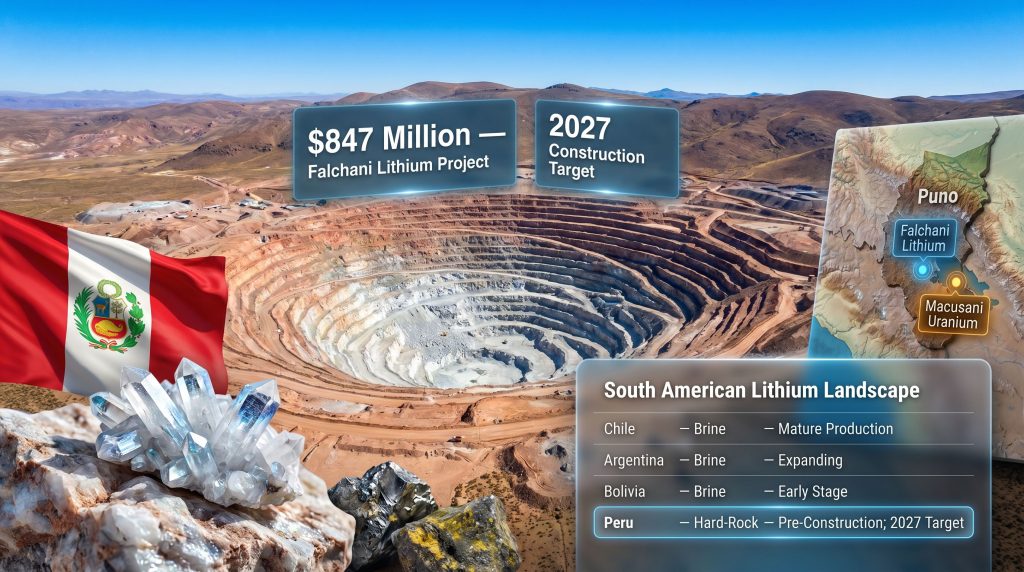
| Total Project Investment | $847 million |
| Targeted Construction Commencement | 2027 |
| Permitting Status | Early environmental permit study submitted |
| Legal Status | 32 concession disputes resolved in operator's favour |
| Regional Significance | Among the world's largest hard-rock lithium deposits |
The resolution of a 32-concession legal dispute in the project operator's favour is a development that deserves particular attention. Concession security is one of the most fundamental risk factors in any mining jurisdiction, and the removal of this legal uncertainty substantially de-risks the investment thesis for Falchani.
Combined with the submission of an early environmental permit study, the project is clearly advancing through the pre-construction milestones necessary to support a 2027 construction target. The $847 million total investment commitment reflects the genuine capital intensity of bringing a deposit of this scale into production, and signals that project financing at this level requires precisely the kind of political and regulatory clarity that Peru's new administration is positioned to provide.
Macusani: Latin America's Largest Undeveloped Uranium Deposit in a Changing Energy Landscape
While lithium commands the majority of energy transition investment attention, the Macusani uranium project in the same Puno region carries its own distinct strategic significance. Macusani holds the distinction of being the largest undeveloped uranium deposit in Latin America — a designation that has taken on new relevance as the global energy transition debate has increasingly incorporated nuclear power as a low-carbon baseload generation source.
Several dynamics are reshaping uranium's investment profile:
- Major economies including France, Japan, South Korea, and the United States have recommitted to nuclear energy expansion as part of their long-term decarbonisation strategies
- Uranium spot prices experienced significant upward pressure during 2023 and 2024, driven by supply concentration concerns and growing demand from both existing reactor fleets and planned new capacity
- Supply concentration risk is particularly acute for uranium, with Kazakhstan and Russia historically accounting for a disproportionate share of global mine output, creating strategic diversification imperatives for utilities in Western markets
- Latin America's underdeveloped uranium sector represents a potential supply diversification opportunity largely overlooked within conventional energy transition investment frameworks
Understanding uranium market dynamics is consequently essential context for evaluating Macusani's strategic position. Peru's Supreme Decree classifying uranium as a mineral of national importance directly elevates Macusani's profile within the national resource development agenda.
The next major ASX story will hit our subscribers first
South America's Lithium Landscape: Peru's Structural Position
Understanding where Peru sits within the broader South American lithium landscape is important context for evaluating the strategic significance of Falchani's development trajectory.
| Country | Primary Deposit Type | Development Stage | Political Risk Profile |
|---|---|---|---|
| Chile | Brine (Atacama) | Mature production | Moderate (nationalisation debate ongoing) |
| Argentina | Brine (multiple basins) | Expanding production | Moderate-High (fiscal instability) |
| Bolivia | Brine (Salar de Uyuni) | Early-stage, state-controlled | High (restrictive state model) |
| Peru | Hard-rock (Puno region) | Pre-construction; 2027 target | Improving (post-election governance clarity) |
Peru's hard-rock endowment offers battery manufacturers and automakers something the brine-dominated Lithium Triangle cannot: geological and processing diversification. For companies seeking to reduce concentration risk in their raw material sourcing, the American Lithium Peru election mining positive outcome creates a compelling entry point into a structurally distinct and complementary supply proposition.
Key Risks That Remain on the Investment Horizon
A balanced assessment of Peru's critical minerals opportunity requires clear-eyed recognition of the structural challenges that persist beyond the electoral result and policy framework improvements.
| Risk Factor | Current Severity | Mitigating Development |
|---|---|---|
| Political instability | Reduced | Fujimori election confirmed; pro-mining mandate |
| Permitting delays | Moderate | Environmental study submitted; Supreme Decree in place |
| Community opposition | Ongoing | Active social licence management required |
| Legal/concession disputes | Reduced | 32-concession dispute resolved in operator's favour |
| Lithium price volatility | Moderate | Long-term demand fundamentals remain supportive |
| Infrastructure access | Moderate | Puno region remoteness requires capital planning |
Community relations in the Puno region represent perhaps the most persistent and complex challenge. Large-scale mining projects in the Peruvian highlands have historically encountered resistance from indigenous and rural communities, and no degree of political or regulatory improvement at the national level substitutes for the patient, locally-grounded work of building genuine social licence.
Infrastructure deficits in the Puno region also deserve investor attention. The geographic remoteness of both Falchani and Macusani creates logistical complexity for construction material delivery, heavy equipment mobilisation, and eventual product transportation to Pacific export terminals — all of which affect capital cost estimates and project schedules.
Frequently Asked Questions
What makes the American Lithium Peru election mining positive outcome significant for the global supply chain?
The combination of a pro-investment administration, Peru's strategic mineral classification of lithium and uranium, and the advanced development status of the Falchani and Macusani projects creates a convergence of enabling conditions that could bring a world-class hard-rock lithium deposit and Latin America's largest undeveloped uranium project meaningfully closer to production.
Why is hard-rock lithium from Peru strategically different from brine-based lithium?
Hard-rock deposits offer more consistent extraction volumes, lower water dependency, and greater processing flexibility than brine operations. For battery manufacturers seeking supply chain diversification beyond the Atacama-centred brine belt, a large-scale hard-rock operation in Peru represents a structurally distinct and complementary source.
What is the current investment commitment at Falchani?
Total project investment for the Falchani lithium project stands at $847 million, with construction targeted to commence in 2027, subject to permitting milestones.
How does Peru's Supreme Decree affect project development timelines?
The decree classifying lithium and uranium as minerals of national importance creates a formal policy framework that can inform permitting prioritisation and strengthen the project's profile in financing and offtake discussions. It does not guarantee accelerated approvals but signals meaningful policy alignment.
What is Macusani's significance within the uranium sector?
Macusani is the largest undeveloped uranium deposit in Latin America. Its development is strategically aligned with growing global institutional interest in nuclear energy as a low-carbon baseload power source within long-term decarbonisation frameworks.
Peru's Window: Converting Political Momentum Into Durable Supply Chain Position
The mining sector has seen many political cycles in Latin America, and experienced investors know that electoral outcomes create windows of opportunity rather than guarantees of delivery. What distinguishes the current moment in Peru is the unusual simultaneity of favourable conditions: a governance shift, a formal strategic minerals framework, projects with resolved legal disputes and submitted environmental studies, and a global demand environment that has made lithium and uranium supply security a genuine geopolitical priority for major economies.
Whether this window translates into a 2027 construction commencement at Falchani — and eventual production from Macusani — will depend on execution quality across permitting, community engagement, infrastructure planning, and capital markets access. The enabling conditions are more favourable than they have been in years, but the distance between political momentum and commissioned production infrastructure remains substantial in any jurisdiction.
For investors, project analysts, and supply chain strategists, the convergence of hard-rock lithium geology, strategic policy alignment, and improving governance clarity represents the kind of structural setup that, if executed effectively, could deliver a genuinely consequential new node in the global critical minerals supply chain. The American Lithium Peru election mining positive outcome is, however, only the beginning of a much longer operational and regulatory journey.
Disclaimer: This article contains forward-looking statements, financial projections, and speculative analysis relating to mining project development timelines, commodity demand forecasts, and political risk assessments. These statements involve inherent uncertainties and should not be construed as investment advice. Readers should conduct their own due diligence and consult qualified financial advisers before making investment decisions. All financial figures and project metrics cited are sourced from publicly available company announcements and industry reporting.
Ready to Identify the Next Major Critical Minerals Discovery Before the Broader Market?
Discovery Alert's proprietary Discovery IQ model delivers real-time alerts on significant ASX mineral discoveries — including lithium and uranium plays — instantly translating complex geological and market data into actionable investment insights for both short-term traders and long-term investors. Explore why historic mineral discoveries have generated substantial returns by visiting Discovery Alert's dedicated discoveries page, and begin your 14-day free trial today to position yourself ahead of the market.