July 9, 2026
The Geology Beneath the Numbers: Why the Atacama Is the World's Most Consequential Lithium Basin
Long before the electric vehicle era reshaped commodity markets, geologists understood that Chile's Atacama Desert held something extraordinary. The salt flats, known as salares, concentrate lithium-rich brines through a combination of volcanic geology, extreme aridity, and thousands of years of evaporative accumulation. The resulting lithium grade in Atacama brines consistently ranks among the highest on Earth, with concentrations frequently exceeding 1,500 milligrams per litre, far surpassing the economic threshold that makes brine-based lithium extraction viable at scale.
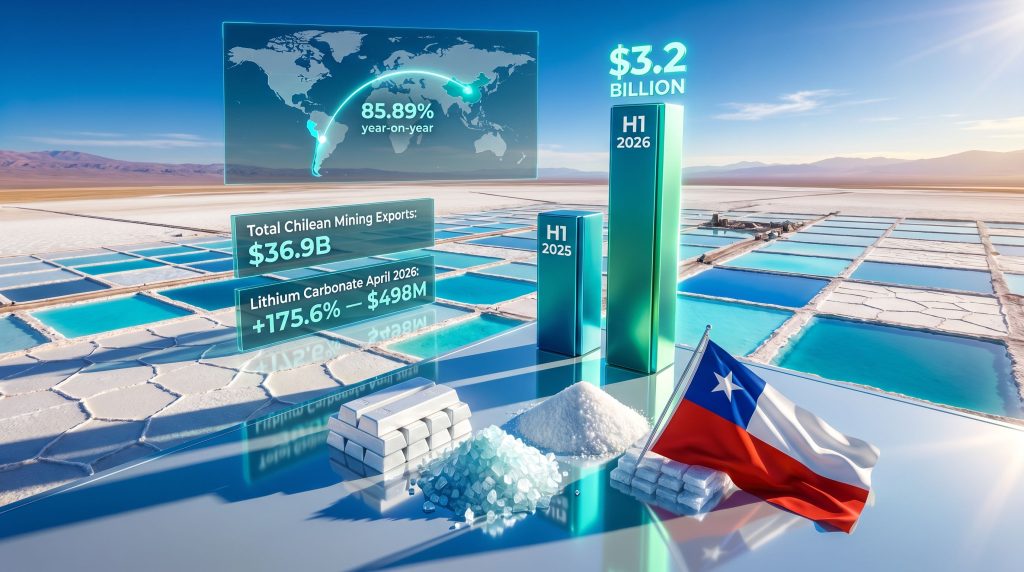
That geological endowment now sits at the centre of one of the most dramatic commodity revenue stories of 2026. Chile lithium exports nearly tripled in H1 on rising prices and strong demand, generating $3.2 billion in the first six months of the year. Understanding why this happened, and what it means for markets going forward, requires looking well beyond the headline figure.
When big ASX news breaks, our subscribers know first
From Trough to Recovery: The Price Cycle Driving Chile's Lithium Revenue Surge
Lithium markets are notoriously cyclical, and the 2024 to 2025 period demonstrated that dynamic with painful clarity. The lithium market downturn saw benchmark lithium carbonate prices collapse from their 2022 to 2023 peaks as a wave of new production from Australia and South America overwhelmed near-term demand growth. By mid-2025, prices had fallen to multi-year lows, eroding margins across the entire supply chain and forcing several junior producers to suspend operations.
The reversal that followed was sharp. By January 2026, lithium carbonate prices had surpassed US$16,000 per tonne, representing a recovery of more than 100% from the 2025 floor. Several converging forces drove this rebound:
- Inventory destocking completion: Downstream battery manufacturers and cathode producers had aggressively drawn down safety stocks during the price downturn. By late 2025, those inventories reached critically low levels, triggering urgent restocking demand.
- Project deferrals: The prolonged price weakness prompted a number of marginal lithium projects, particularly in Argentina lithium brines and parts of Western Australia, to delay commissioning or reduce capital expenditure, effectively withdrawing future supply from the market.
- EV demand acceleration: Global electric vehicle sales growth re-accelerated heading into 2026, tightening the demand outlook faster than many analysts anticipated.
The result was a supply-demand inflection that translated directly into Chile's export revenue figures. The $3.2 billion generated in H1 2026 not only represented close to three times the H1 2025 figure but also exceeded Chile's entire 2025 full-year lithium export total by 34.4%. That is not a seasonal effect. It is a structural price re-rating compressing into a single six-month window.
Demand Anatomy: What Is Actually Consuming All This Lithium?
Electric Vehicles and the Battery Chemistry Question
EV battery manufacturing remains the dominant consumption engine for lithium globally, and the market dynamics here are more nuanced than most reporting suggests. The type of lithium compound demanded varies by battery chemistry, and this distinction has direct implications for Chile's product mix and pricing power.
Lithium iron phosphate, or LFP, batteries predominantly use lithium carbonate as a feedstock. LFP chemistry has surged in adoption across Chinese EV manufacturers and is increasingly penetrating Western markets due to its lower cost and improved thermal stability. High-nickel cathode chemistries such as NMC 811, favoured for long-range premium vehicles, require lithium hydroxide instead. Understanding these lithium carbonate dynamics is therefore essential for interpreting Chile's export revenues accurately.
Global lithium consumption is projected to grow by 13 to 17% in 2026, with Morgan Stanley estimating a supply deficit of approximately 80,000 metric tonnes of lithium carbonate equivalent (LCE) for the year. A deficit of that magnitude, if realised, would represent meaningful upward pressure on prices through the second half.
Energy Storage, AI Infrastructure, and the Emerging Demand Vectors
Beyond EVs, several less-discussed demand streams are quietly reshaping lithium's consumption profile:
- Grid-scale battery energy storage systems (BESS): The rapid build-out of renewable energy capacity across the US, Europe, China, and Southeast Asia is creating substantial incremental demand for lithium-based storage. Utility-scale projects increasingly require lithium iron phosphate systems for their cycle life and safety characteristics.
- AI data centre infrastructure: This is perhaps the least appreciated demand driver in mainstream commodity analysis. Large-scale data centres require uninterruptible power supply systems and backup battery banks capable of sustaining operations through grid interruptions. As AI infrastructure investment accelerates, so too does the associated demand for industrial-grade battery backup systems.
- Consumer electronics: While growth here is more modest, smartphones, laptops, and wearables collectively maintain a substantial baseline demand floor that insulates the market from EV-specific cyclicality.
The Chilean government explicitly cited AI-related technologies and data centres as contributing demand factors when reporting H1 2026 export figures, signalling that lithium's use case is broadening in ways that traditional commodity frameworks have not fully priced in.
Chile's H1 2026 Product Mix: Carbonate Leads, Hydroxide Watches
| Lithium Product | Growth Contribution Rank | Primary End-Use | Key Buyers |
|---|---|---|---|
| Lithium Carbonate | 1st (largest contributor) | LFP batteries, grid storage | China, Asia-Pacific |
| Lithium Sulfates | 2nd | Battery precursor processing | Integrated Asian refiners |
| Lithium Hydroxide | 3rd | NMC high-nickel EV cathodes | Korea, Japan, Europe |
The April 2026 data point illustrates the intensity of demand particularly clearly. In that single month, lithium carbonate prices and exports surged 175.6% to $498 million, a figure that underscores how concentrated demand pulses can be when restocking cycles align with price momentum.
Lithium sulfate exports, often overlooked in mainstream coverage, serve as a barometer for upstream integration activity. When buyers purchase sulfates rather than processed carbonate or hydroxide, it typically indicates they are internalising downstream conversion steps, a pattern that reflects growing sophistication among Asian battery supply chain operators.
The Two-Producer Constraint: Chile's Supply Ceiling and Its Implications
Chile currently operates with only two active lithium producers: SQM, a locally headquartered company, and Albemarle, which is US-based. This duopoly structure is simultaneously Chile's greatest competitive advantage and its most significant structural vulnerability.
On the advantage side, the concentration of production among two experienced operators with established brine extraction infrastructure and long-standing offtake relationships ensures operational reliability and quality consistency. On the vulnerability side, it limits the speed at which Chile can respond to demand surges or geopolitical supply chain pressures.
The Chilean government is actively pursuing expansion through state-partnered frameworks and privately operated concessions. The planned joint venture structure involving state mining company Codelco and SQM represents a significant shift in the governance model for Atacama lithium production, introducing a direct state economic interest in the sector's most productive asset. Furthermore, Chile's lithium reserves and the evolving governance model aim to balance resource nationalism objectives with the operational expertise and capital that private participation provides.
New project approvals and additional concession awards are expected to gradually broaden the producer base, though environmental constraints around water usage in the Atacama represent a genuine limiting factor. Brine extraction in an already hyper-arid environment generates legitimate ecological concerns, and permitting timelines in Chile have historically reflected the complexity of balancing production ambitions against environmental obligations.
Chile's Dual Commodity Position: The Copper Dimension
Lithium may be the fastest-growing revenue category, but copper remains the foundation of Chile's export economy. Copper exports reached $30.2 billion in H1 2026, up 11.5% year-on-year, representing 50.1% of Chile's total export value. Chile holds the title of the world's largest copper producer, and total mining exports climbed 20.4% to $36.9 billion across the same period.
The strategic significance of this dual position is rarely articulated with sufficient precision:
- Copper provides the transmission layer of electrification: wiring, grid infrastructure, EV motors, and charging networks.
- Lithium provides the storage layer: the batteries that capture, retain, and deploy electrical energy.
Chile is one of very few sovereign jurisdictions capable of supplying both the conduction and storage components of the global energy transition from within its own borders. That is a geopolitical and commercial asymmetry that has not yet been fully priced into how the country is valued as a critical mineral jurisdiction.
The next major ASX story will hit our subscribers first
Scenario Analysis: What H2 2026 Could Look Like
| Scenario | Price Assumption | Demand Assumption | Full-Year Revenue Implication |
|---|---|---|---|
| Bull Case | Prices hold above US$16,000/t | EV and storage demand accelerates; deficit widens | Full-year revenue could reach $5.5 to $6 billion |
| Base Case | Prices stabilise near current levels | Demand grows 13 to 17% as projected | Full-year revenue tracks $5 to $5.5 billion range |
| Bear Case | Price correction from new supply entries | Demand growth moderates or battery chemistry shifts | H2 softens; full-year lands near $4 to $4.5 billion |
Disclaimer: The above scenarios are illustrative projections based on publicly available market forecasts and analyst estimates. They do not constitute financial advice. Commodity markets are subject to significant volatility, and actual outcomes may differ materially from any projection.
Key Variables Worth Monitoring Closely
- Monthly Chinese EV sales data: China accounts for the majority of global lithium carbonate demand. Monthly passenger EV registration figures from China's CPCA are the most reliable leading indicator of near-term offtake.
- New project commissioning timelines: First production from deferred Australian and Argentine projects could shift the supply balance more quickly than current consensus assumes.
- Battery chemistry evolution: A faster-than-expected commercial rollout of sodium-ion batteries, which do not use lithium, could reduce demand growth projections. However, sodium-ion remains primarily suited to short-range applications and is unlikely to displace lithium in high-energy-density applications within the current decade.
- Trade policy developments: US and EU tariff structures affecting battery imports and critical mineral supply chains could redirect trade flows, altering which buyers Chile's producers prioritise.
The Long Cycle Perspective: Why This Recovery Looks Structural, Not Speculative
Experienced commodity investors distinguish between price recoveries driven by temporary supply disruptions and those reflecting a genuine structural demand uplift. The 2026 lithium rebound has characteristics of the latter category.
The demand drivers underpinning Chile's export surge, including EV adoption, grid storage deployment, and digital infrastructure expansion, are not short-cycle phenomena. They are decade-long capital allocation themes backed by policy commitments, industrial investment, and consumer behaviour shifts across the world's three largest economies. In addition, advances in direct lithium extraction technology may further lower production costs and expand viable resource boundaries over the coming years.
Chile's Atacama brines, with their exceptional lithium grades and relatively low extraction costs compared to hard-rock spodumene mining in Australia, position the country as a structurally advantaged supplier throughout this cycle. The cost advantage matters most when prices decline, because low-cost producers are the last to exit and the first to generate positive returns when prices recover.
What the H1 2026 figures ultimately reveal is that the market had been underpricing both the speed of demand recovery and the depth of the supply response that the 2024 to 2025 downturn triggered. Chile lithium exports nearly tripling in H1 on rising prices and strong demand is, in that sense, a correction of a mispricing rather than an anomaly to be discounted.
For those tracking the global critical minerals landscape, Chile's performance in the first half of 2026 offers a case study in how geological endowment, commodity cycle positioning, and diversified end-market demand can converge to produce outcomes that surprise even well-informed analysts.
Further reporting on Chile's lithium sector and broader critical mineral market dynamics is available through Mining Weekly at miningweekly.com, which provides ongoing coverage of South American mining developments.
Want to Capitalise on the Next Major Critical Mineral Discovery Before the Broader Market?
Discovery Alert's proprietary Discovery IQ model delivers real-time alerts on significant ASX mineral discoveries — instantly translating complex geological and commodity data into actionable investment insights for both short-term traders and long-term investors. Explore historic examples of exceptional discovery-driven returns and begin your 14-day free trial today to position yourself ahead of the next major market move.