July 12, 2026
When Forestry Meets Battery Metals: The Chemistry Reshaping Lithium Processing
The global race to secure battery-grade lithium has focused heavily on mine development, converter capacity, and geopolitical supply chains. Far less attention has been paid to a quieter but equally consequential challenge: the chemical reagents that make lithium ore concentration possible in the first place. Flotation reagents, the collectors and frothers that allow processors to separate lithium-bearing minerals from waste rock, are largely sourced from petrochemical supply chains, often imported, and subject to price volatility that can quietly erode processing economics. It is within this overlooked corner of the global lithium market that a genuinely novel research programme is taking shape in northern Ontario.
When big ASX news breaks, our subscribers know first
Understanding the Rock Tech Lithium Grant for Crude Tall Oil in Lithium Processing
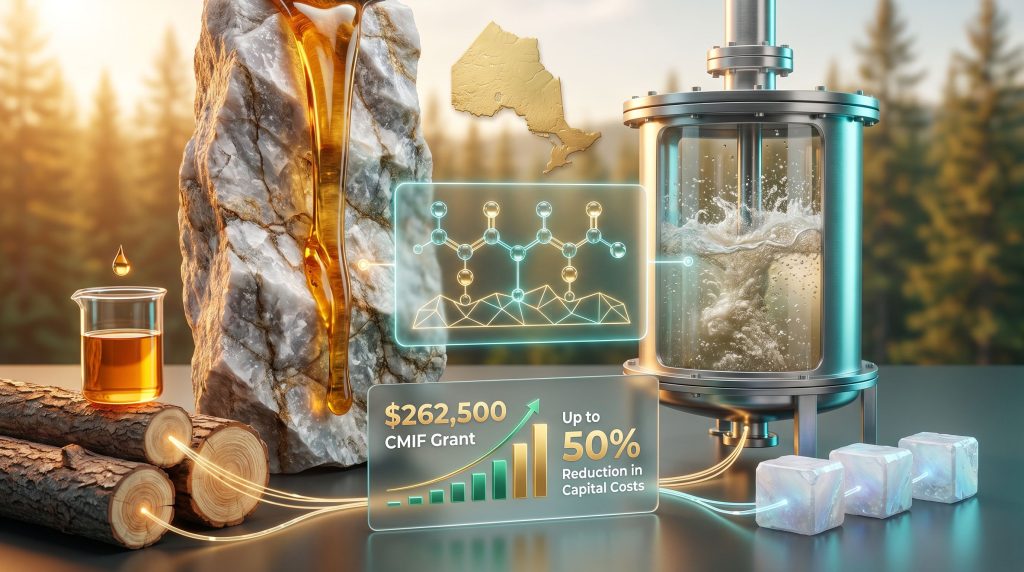
Ontario's Critical Minerals Innovation Fund (CMIF) has awarded Rock Tech Lithium a $262,500 grant to evaluate and validate crude tall oil (CTO) as a locally sourced flotation reagent for lithium ore processing. The project brings together three distinct Ontario institutions: Thunder Bay Pulp and Paper as the industrial CTO supplier, Queen's University as the metallurgical research partner, and Rock Tech Lithium as the critical minerals developer steering process design. The Rock Tech Lithium grant for crude tall oil in lithium processing represents one of the more unconventional cross-sector collaborations to emerge from Canada's critical minerals policy landscape in recent years.
What makes this initiative technically interesting is not just the funding amount, but what it signals about where lithium processing innovation is heading. Rather than pursuing exotic new ore types or frontier processing technologies, this programme asks a deceptively simple question: can an abundant, low-cost forestry byproduct replace imported synthetic reagents in spodumene flotation circuits?
What Is Crude Tall Oil and Why Does It Matter to Lithium Processors?
Crude tall oil is a viscous, dark resinous liquid generated as a byproduct during the kraft pulping process, the dominant industrial method used to convert coniferous wood into paper pulp. During kraft pulping, wood chips are cooked under high pressure in a strongly alkaline solution of sodium hydroxide and sodium sulphide. This process dissolves the lignin binding wood fibres together, releasing fatty acids and resin acids that float to the surface of the black liquor as soap. When this soap is acidified and separated, the result is crude tall oil.
Traditionally, CTO has found markets in:
- Biofuel production, where it serves as a feedstock for tall oil fatty acid methyl esters
- Surface coatings and adhesives, where its resin acid content provides useful film-forming properties
- Specialty chemicals, including tall oil rosin used in rubber and ink formulations
- Flotation chemistry for base metals, where fatty acid derivatives derived from CTO have been used as collectors in iron ore and phosphate processing for decades
That last application is the critical precedent. Fatty acid-based collectors have a well-documented history in industrial mineral flotation. What is genuinely novel here is the systematic evaluation of unrefined CTO, sourced directly from an Ontario pulp mill, as a potential collector in spodumene flotation specifically. Understanding spodumene extraction basics helps clarify why spodumene presents different surface chemistry challenges compared to iron ore or phosphate minerals, making direct translation of existing fatty acid collector knowledge non-trivial.
How Spodumene Flotation Chemistry Works and Why Reagents Are a Strategic Vulnerability
The Mechanics of Collector-Based Separation
Froth flotation is the workhorse of hard-rock lithium ore concentration. Ground ore is mixed into a water slurry, and chemical collectors are added that selectively attach to the surface of spodumene particles, rendering them hydrophobic. When air is bubbled through the slurry, these hydrophobic particles attach to rising bubbles and accumulate in a froth layer at the surface, while hydrophilic gangue minerals sink. The selectivity of this process depends critically on the collector chemistry.
Spodumene flotation is notoriously demanding. The mineral shares surface chemical characteristics with several gangue silicates, particularly feldspar and quartz, making selective separation technically challenging. Conventional collectors used in spodumene circuits include:
- Amine-based collectors, which are synthesised from petrochemical precursors and carry significant environmental and handling concerns
- Petroleum sulphonate collectors, derived directly from crude oil refining streams
- Fatty acid collectors, typically oleic acid or tall oil derivatives, which are already used in some spodumene circuits internationally
The Import Dependency Problem
Most conventional flotation reagents used in Canadian lithium processing are sourced from offshore chemical suppliers or integrated into global petrochemical supply chains. This creates a structural vulnerability that is rarely discussed in project feasibility studies but can materially affect operating costs over a mine's life. Reagent costs typically represent between 5% and 15% of total milling operating costs in hard-rock lithium operations, and any supply disruption or price spike in petrochemical feedstocks flows directly through to processing economics.
Furthermore, the comparison below illustrates why Ontario-sourced CTO presents a structurally different risk profile:
| Reagent Type | Source | Environmental Profile | Supply Chain Risk | Cost Sensitivity |
|---|---|---|---|---|
| Synthetic amine collectors | Petrochemical | High carbon intensity | Import-dependent | Highly volatile |
| Petroleum sulphonates | Crude oil refining | High carbon intensity | Import-dependent | Volatile |
| Fatty acid derivatives | Agricultural oils | Moderate | Regionally variable | Moderate |
| Crude tall oil (CTO) | Ontario forestry byproduct | Low-emission potential | Locally sourced | Low marginal cost |
Ontario's Critical Minerals Innovation Fund as a Technical De-Risking Mechanism
The CMIF is a provincial funding instrument designed to accelerate applied research at the intersection of Ontario's industrial base and its critical minerals sector. Crucially, CMIF funding is not passive grant-making. The programme targets cross-sector collaboration projects where industrial supply chains, academic research capacity, and minerals developers can collectively reduce technical risk at a pre-commercial stage.
Rock Tech Lithium's relationship with CMIF predates this CTO initiative. A previous CMIF-funded programme examined ore sorting technology applied to material from the Georgia Lake lithium project. The findings from that earlier work identified a preliminary pathway toward reducing future crushing and concentrator capital costs by up to 50%, based on initial testwork results. Engineering validation and further technical studies remain ongoing.
That preliminary ore sorting result is significant context. A 50% reduction in crushing and concentrator capital costs, if validated at engineering scale, would materially alter the project economics of Georgia Lake. It also demonstrates CMIF's capacity to fund research that targets capital cost reduction, not just operating cost optimisation.
The CTO reagent study follows a similar logic: if locally sourced crude tall oil can perform comparably to imported synthetic collectors, the long-run operating cost and supply chain resilience advantages could be substantial over the life of a converter-scale processing facility.
Technology Readiness and the Path to Commercial Application
Understanding where this research sits on the technology readiness scale is essential for interpreting its significance. The programme is not a commercial deployment; it is applied laboratory and pilot-scale validation work. This approach aligns closely with how direct lithium extraction technologies have been progressively de-risked before commercial deployment.
| Technology Readiness Level (TRL) | Stage Description | CTO in Lithium Flotation (Estimated) |
|---|---|---|
| TRL 1-2 | Basic research and concept formulation | Completed |
| TRL 3-4 | Laboratory validation and proof of concept | Current phase (CMIF-funded) |
| TRL 5-6 | Pilot-scale and relevant environment testing | Pending validation outcomes |
| TRL 7-9 | Full-scale demonstration and commercial deployment | Future, Red Rock integration potential |
The current CMIF-funded work is targeting TRL 3-4, which means the primary outputs will be laboratory-scale flotation data using Georgia Lake spodumene ore material with CTO as the collector variable. Success at this stage does not guarantee commercial viability, but negative results would provide equally valuable data for process design at the Red Rock converter project.
The next major ASX story will hit our subscribers first
Rock Tech's Mine-to-Converter Strategy and Where CTO Fits
Georgia Lake and Red Rock: Two Nodes in One Supply Chain
Rock Tech Lithium's Ontario strategy is built around vertical integration within a single provincial supply chain. The Georgia Lake lithium project in northern Ontario hosts a hard-rock spodumene resource that would be mined and concentrated into spodumene concentrate. That concentrate would then be processed at the proposed Red Rock lithium converter project, which is designed to transform spodumene concentrate into battery-grade lithium refining output suitable for electric vehicle battery cathode manufacturing.
The reagent sourcing strategy being evaluated through the CTO programme is directly relevant to both nodes of this chain. At the concentration stage, CTO could serve as the primary flotation collector. At the converter stage, understanding the reagent chemistry of the incoming concentrate matters for downstream processing design. A made-in-Ontario reagent supply chain would, consequently, reduce the number of imported chemical inputs across both facilities.
What Success Would Mean for Ontario's Forestry Sector
If laboratory validation confirms that Ontario-sourced CTO can perform as a spodumene flotation collector, the implications extend well beyond Rock Tech's balance sheet. Thunder Bay Pulp and Paper, one of the project partners, would gain access to an entirely new industrial offtake market for a material that currently commands limited value as a processing residue.
This byproduct valorisation dynamic is a well-established pattern in sustainable industrial chemistry. Agricultural sectors have long supplied oleic acid and other fatty acid derivatives to the minerals processing industry. Extending this model to Ontario's forestry sector would, in addition, create a new revenue stream for pulp mills while reducing the critical minerals sector's dependence on petrochemical inputs. Provincial funding initiatives are increasingly recognising this potential, as seen in similar mill byproduct research programmes across Canada.
Key Risks and Uncertainties in the Research Programme
Investors and industry observers should approach this programme with clear-eyed awareness of its uncertainties:
-
Performance variability across ore types: CTO composition varies depending on the wood species, pulping conditions, and seasonal factors. Collector performance in spodumene flotation may show inconsistency across different CTO batches, requiring quality standardisation protocols before commercial use.
-
Selectivity challenges: Spodumene flotation demands high collector selectivity against silicate gangue minerals. Whether CTO's fatty acid and resin acid composition can deliver the required selectivity without depressant additives remains an open research question.
-
Scalability from laboratory to concentrator: Flotation behaviour observed at bench scale does not always replicate at pilot or full concentrator scale, particularly when reagent dosing, pulp chemistry, and temperature interact differently at larger volumes.
-
Supply consistency from forestry operations: Securing stable, contract-volume CTO supply from Ontario pulp mills over a multi-decade mine and converter operating life introduces a procurement management dimension that adds complexity to operational planning.
Frequently Asked Questions
What is crude tall oil and why is it being tested in lithium processing?
Crude tall oil is a resinous byproduct of the kraft paper pulping process, containing fatty acids and resin acids that have known collector properties in mineral flotation. It is being evaluated as a locally sourced, lower-emission alternative to imported synthetic flotation reagents in spodumene lithium ore concentration. Understanding how lithium mining works provides useful context for why such reagent innovations matter to the broader processing chain.
How much funding did Rock Tech Lithium receive from Ontario's Critical Minerals Innovation Fund?
Rock Tech Lithium received a $262,500 CMIF grant to conduct the crude tall oil validation study in collaboration with Thunder Bay Pulp and Paper and Queen's University. The Rock Tech Lithium grant for crude tall oil in lithium processing is one of several CMIF-supported initiatives targeting applied critical minerals research in Ontario.
What projects make up Rock Tech Lithium's Ontario mine-to-converter strategy?
The strategy centres on the Georgia Lake lithium project, a hard-rock spodumene deposit in northern Ontario, and the proposed Red Rock lithium converter project, designed to produce battery-grade lithium hydroxide from spodumene concentrate.
Has crude tall oil been used in mineral flotation before?
Fatty acid derivatives derived from tall oil have been used as collectors in iron ore, phosphate, and some industrial mineral flotation circuits for decades. However, the application of unrefined crude tall oil specifically to spodumene flotation is the novel element being investigated in this programme.
What happens if the CTO validation study is successful?
A successful outcome would provide the technical data foundation for incorporating Ontario-sourced CTO into the process design of Rock Tech's Red Rock converter project, while potentially opening a new industrial offtake market for Ontario's pulp and paper sector. The Rock Tech Lithium grant for crude tall oil in lithium processing could, therefore, prove transformative for both industries.
Key Takeaways for the Critical Minerals Sector
- $262,500 in CMIF provincial funding is directed toward validating a forestry byproduct as a lithium processing reagent, targeting reagent supply chain localisation
- Three-way collaboration between Thunder Bay Pulp and Paper, Queen's University, and Rock Tech Lithium creates an applied research structure with industrial, academic, and commercial dimensions
- Reagent import dependency is a largely underappreciated operational risk in Canadian lithium processing, with conventional synthetic collectors tied to petrochemical supply chains and volatile pricing
- Previous CMIF-funded ore sorting work at Georgia Lake identified a preliminary pathway to up to 50% reduction in crushing and concentrator capital costs, establishing CMIF as a credible technical de-risking mechanism for Rock Tech
- CTO as a forestry byproduct carries low marginal cost and local supply chain advantages that could compound in value over a multi-decade mine and converter operating life
- The research sits at TRL 3-4, meaning commercial deployment timelines remain contingent on laboratory and pilot validation outcomes, and investor expectations should be calibrated accordingly
Disclaimer: This article contains forward-looking statements and analysis based on publicly available information. Research outcomes, capital cost projections, and commercial viability assessments referenced herein are preliminary and subject to ongoing technical validation. This content does not constitute financial or investment advice.
Want to Spot the Next Major ASX Lithium Discovery Before the Market Does?
Discovery Alert's proprietary Discovery IQ model scans ASX announcements in real time, instantly identifying significant mineral discoveries across lithium and 30+ other commodities — turning complex data into actionable opportunities for investors at every level. Start your 14-day free trial today, or explore how historic mineral discoveries have delivered extraordinary returns to better understand the potential upside of getting in early.