June 20, 2026
The Architecture Behind the World's Most Ambitious Grid Storage Buildout
China battery energy storage systems represent far more than a technology solution to a supply-and-demand problem. Across most of the world, battery energy storage systems are treated as a grid-balancing tool. In China, however, they are treated as something closer to sovereign infrastructure, sitting alongside highways, ports, and transmission networks in the strategic planning hierarchy. Understanding this distinction is the starting point for understanding why China's battery energy storage systems sector operates by rules that simply do not exist anywhere else on Earth.
This is not merely a story about scale, though the scale is extraordinary. It is a story about how a government can simultaneously engineer supply, mandate demand, and build the standards infrastructure to validate an entire industry, all within a single policy cycle. The result is a market that grows faster, deploys deeper, and competes harder than any Western equivalent has managed to replicate.
When big ASX news breaks, our subscribers know first
Why China's BESS Market Defies Conventional Analysis
Three Forces Operating at Once
Most major energy storage markets are demand-driven: utilities or developers identify a need, procure storage, and deploy it when economics justify the decision. China's approach, however, collapses this sequence. Rather than waiting for market signals, Beijing has constructed a three-layer architecture that generates its own momentum.
The first layer is supply engineering. China's domestic manufacturing base for lithium iron phosphate (LFP) battery cells is the largest and lowest-cost in the world, a position built through years of EV battery investment that has since been redirected toward stationary storage. The second layer is policy-mandated demand, where renewable energy project approvals are contingent on co-locating battery storage, effectively converting every new wind or solar installation into a guaranteed procurement event.
The third layer is standards infrastructure, where facilities like the newly opened Xiamen Energy Storage Validation Research Institute give Chinese manufacturers a credibility framework that reaches into export markets. Together, these three pillars create compounding growth dynamics that most external market analyses have consistently underestimated. For context on how this connects to the broader battery raw materials market, the implications are considerable.
Energy Security, Not Environmentalism
A critical reframing is necessary for anyone approaching this sector from a Western clean energy perspective. Beijing's internal rationale for driving China battery energy storage systems deployment is not primarily environmental. Grid stability, energy sovereignty, and industrial self-sufficiency are the dominant motivations embedded in official planning documents.
The 15th Five-Year Plan, covering 2026 to 2030, explicitly elevates energy security as the central justification for continued storage investment, with targets embedded in provincial performance metrics that make local government officials directly accountable for deployment progress. Furthermore, the intersection of critical minerals and energy security is increasingly shaping how Beijing frames its entire storage ambition.
This administrative accountability mechanism is one of the most underappreciated drivers of Chinese infrastructure deployment speed. When grid storage targets are tied to official performance reviews, the incentive to move quickly becomes structural rather than aspirational.
China's Current Battery Energy Storage Capacity: The Numbers in Context
Where China Stands Heading Into 2025
The headline figures describing China's installed storage base are significant enough on their own, but their true weight only becomes clear when placed against the forward trajectory.
| Metric | Value |
|---|---|
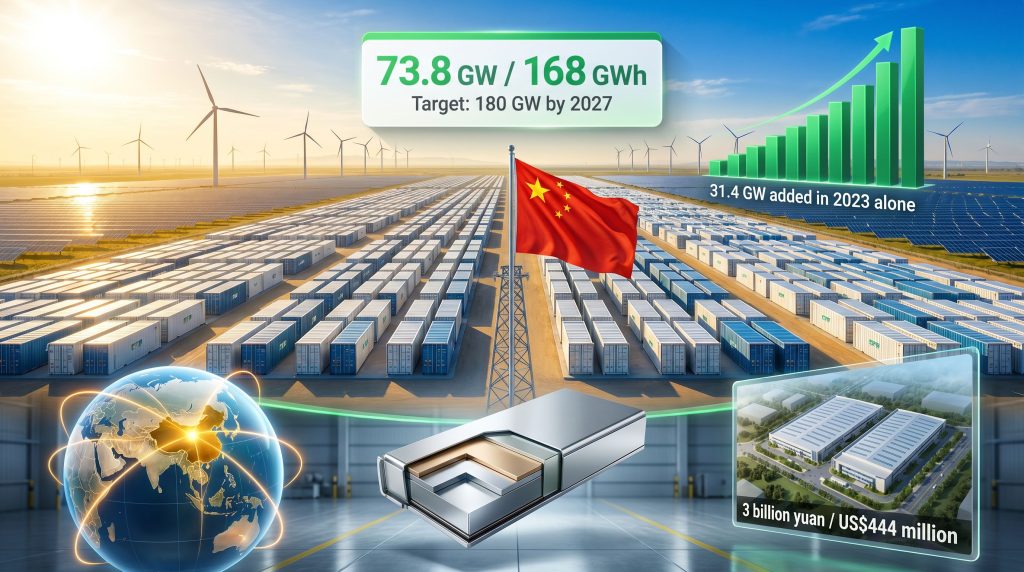
| Total large-scale energy storage installed (end 2024) | 73.8 GW / 168 GWh |
| National deployment target (end of 2027) | 180 GW |
| Required growth to reach target | Approximately 144% in under three years |
| New-type storage capacity added in 2023 alone | 31.4 GW |
| Share of new deployments that are grid-side or generation-side | 97% (2023 data) |
The 2023 single-year addition of 31.4 GW represented a near-quadrupling of China's new-type storage base in twelve months, a deployment velocity without precedent in any comparable market. Behind-the-meter and residential applications remain secondary priorities, with grid-side and generation-side installations absorbing the overwhelming majority of new capacity. China is already aiming for energy storage installations equivalent to today's global capacity by 2027, underscoring the scale of ambition involved.
Geographic Concentration and the West-to-East Imbalance
Storage deployment in China is not evenly distributed. High-renewable provinces in the interior, including Xinjiang, Inner Mongolia, Qinghai, and Gansu, are absorbing disproportionate volumes of new capacity because they generate far more electricity than they consume locally. Coastal industrial zones such as Guangdong, Zhejiang, and Fujian are also major deployment sites, driven by grid reliability requirements in high-demand manufacturing regions.
This structural mismatch between generation-heavy western provinces and consumption-heavy eastern cities is itself a major driver of grid-side storage demand, as batteries are needed to manage the timing and flow of power across long-distance transmission infrastructure.
Policy Mechanisms That Turn Targets Into Reality
The Mandatory Co-Location Framework
The most powerful demand-creation mechanism in China's BESS sector is not a subsidy. It is a structural requirement embedded in project approval processes: across most provinces, renewable energy developers must co-locate battery storage equivalent to between 5% and 20% of their installed generation capacity before receiving approval to proceed.
This mandatory pairing policy means that every gigawatt of new solar or wind capacity automatically generates a corresponding BESS procurement requirement. It is a demand guarantee without parallel in any other major market, and it has produced rapid deployment volumes that market-based incentives alone could not have achieved in the same timeframe.
The policy does carry a recognised weakness. A proportion of installations built for compliance purposes rather than commercial operation are running at low utilisation rates, a structural problem that the 2026–2030 planning cycle is explicitly designed to address through market reform.
Building Commercial Viability Through Electricity Market Reform
Mandatory deployment creates capacity, but it does not on its own create sustainable businesses. China's electricity market reform agenda is attempting to solve this problem by opening revenue streams for BESS operators beyond basic compliance, including:
- Frequency regulation services
- Peak-shaving arbitrage opportunities
- Participation in capacity market auctions
- Ancillary services markets
Reform pilots are currently concentrated in Guangdong, Shanxi, and Shandong provinces. The transition from compliance-driven to commercially-driven investment represents the defining challenge of the current policy cycle, and its success will determine whether China's installed storage base delivers genuine system value or simply impressive headline numbers.
The Xiamen ESVL: Standards Infrastructure as Industrial Policy
What the Facility Actually Does
In late May 2026, a facility spanning the equivalent of 14 football pitches officially opened in Xiamen, Fujian province. Built and operated by CATL, the global leader in EV battery manufacturing, the Xiamen Energy Storage Validation Research Institute represents a 3 billion yuan investment (approximately US$444 million) in battery system certification and stress-testing infrastructure.
The ESVL is designed to subject BESS equipment to the most extreme operational environments it will encounter in real-world grid deployment:
- High-heat and sub-zero temperature cycling
- Simulated sandstorm and particulate exposure
- Salt-spray and coastal corrosion testing
- Fire resistance and thermal runaway containment evaluation
Critically, the facility is open to equipment from all manufacturers, not exclusively CATL products. This positions it as a national-level certification resource rather than a proprietary testing platform, which significantly expands its strategic value as a standards-setting institution.
Why Standards Infrastructure Is the Hidden Variable
The opening of the ESVL reflects a dimension of China's BESS strategy that receives far less attention than deployment volumes or manufacturing capacity: the deliberate construction of standards-setting authority. By building world-class testing infrastructure, China is positioning itself to define what grid-ready battery energy storage systems look like, both domestically and in export markets.
This mirrors China's earlier approach in EV battery manufacturing. Domestic standards were established through rigorous domestic infrastructure investment, and those standards subsequently carried credibility in international procurement processes. The ESVL appears designed to replicate this trajectory for stationary storage.
In addition, the Chinese battery recycling breakthrough underway in parallel suggests that China is building a fully integrated battery ecosystem, from raw materials through to end-of-life management. Officials at the facility's inauguration noted that China's accumulated experience in large-scale energy storage deployment positions it to offer a reference model for global grid modernisation efforts.
How China Compares to the Rest of the World
A Global Market Snapshot
| Dimension | China | United States | Europe |
|---|---|---|---|
| Market scale | Largest globally | Second largest | Third (fragmented) |
| Primary deployment driver | Policy mandate + grid integration | IRA incentives + utility procurement | REPowerEU + grid decarbonisation |
| Dominant technology | Lithium-ion LFP | Lithium-ion NMC + LFP | Lithium-ion (mixed) |
| Manufacturing base | Dominant global exporter | Emerging domestic capacity | Largely import-dependent |
| Market structure | State-directed + emerging market-based | Regulated utility + merchant | Multi-regulatory patchwork |
| Key structural challenge | Utilisation rates + profitability | Supply chain + permitting | Grid interconnection + cost |
Chinese LFP-based systems are substantially cheaper per kilowatt-hour than Western alternatives, a price advantage that reflects both manufacturing scale and years of supply chain integration. Geopolitical barriers in the US and EU are increasingly redirecting Chinese BESS exports toward Southeast Asia, the Middle East, Africa, and Latin America, markets where cost competitiveness often outweighs geopolitical considerations.
The next major ASX story will hit our subscribers first
Structural Risks That Investors and Analysts Must Understand
The Utilisation Gap
A significant proportion of China's mandatorily-allocated storage capacity operates at low utilisation rates. Installed to satisfy regulatory requirements, these assets are often not performing the economically meaningful grid services that would justify their capital cost. This creates a divergence between headline capacity figures and genuine system value delivered to the grid.
Low utilisation undermines asset economics and creates a weak foundation for private capital formation in the sector. The 2026–2030 policy cycle contains explicit provisions aimed at closing this gap through market mechanism development, but the reform process is uneven across provinces.
Manufacturing Overcapacity and Margin Compression
China's BESS manufacturing base has expanded faster than both domestic deployment and export demand can absorb. The result is severe margin compression across the value chain, from cell manufacturers to system integrators. While this dynamic benefits end-users through lower system costs, it creates financial stress throughout the supplier ecosystem.
Consolidation among manufacturers is widely expected, with vertically integrated players holding the strongest position for long-term survival. Smaller or less-integrated manufacturers face meaningful attrition risk as pricing pressure continues.
Revenue Model Immaturity
Many grid-scale BESS projects in China currently depend on capacity payments rather than market-based revenue, raising questions about long-term commercial sustainability as policy frameworks evolve. Ancillary service markets remain underdeveloped in most provinces, limiting the revenue diversification options available to storage operators.
The Technology Horizon Beyond Lithium-Ion
Emerging Chemistries and Long-Duration Storage
LFP lithium-ion technology dominates current deployments by a wide margin, but the 2026–2030 planning cycle includes explicit targets for long-duration storage systems capable of eight or more hours of discharge, a threshold that pushes beyond the practical limits of standard LFP configurations.
| Technology | Status in China | Key Advantage | Key Limitation |
|---|---|---|---|
| LFP Lithium-Ion | Dominant, mass deployment | Cost, cycle life, safety | Energy density ceiling |
| Sodium-Ion | Pilot deployments active | Lithium-independent inputs | Lower energy density |
| Vanadium Flow Batteries | Niche long-duration pilots | Unlimited cycle life | High upfront capital cost |
| Compressed Air (CAES) | Early-stage | Long-duration, low degradation | Site-specific constraints |
| Gravity Storage | Experimental | No chemical inputs required | Infrastructure intensity |
Sodium-ion technology is attracting particular interest because it removes lithium from the supply chain equation entirely, a meaningful consideration for a government focused on energy sovereignty. Vanadium flow batteries are the primary candidate for large-scale long-duration deployment, though their high upfront cost remains a barrier to rapid scaling. The evolving battery metals investment landscape reflects these shifting technology preferences across the sector.
Three Scenarios for China's Global BESS Influence Through 2030
Projecting forward, three broad pathways describe how China's battery energy storage systems strategy could evolve in its interaction with global markets:
Scenario One: Domestic Consolidation Priority. China focuses internal resources on resolving utilisation and profitability challenges before pursuing aggressive international expansion. Global market share gains are moderate, and technology standards remain regionally fragmented.
Scenario Two: Emerging Market Export Surge. Geopolitical barriers in the US and EU redirect Chinese BESS exports decisively toward Southeast Asia, Africa, and Latin America. Chinese manufacturers establish dominant positions in high-growth developing markets, building long-term infrastructure relationships that prove difficult to displace.
Scenario Three: Global Standards Leadership. ESVL-style certification frameworks gain international recognition, and Chinese BESS technical standards become the de facto global benchmark, replicating the trajectory established in EV battery specifications. This scenario represents the highest-value strategic outcome for Beijing's industrial policy ambitions.
The near-tripling of installed capacity implied by China's 2027 target will generate procurement volumes that stress even a manufacturing base of China's scale. International investors tracking the energy transition should treat China's BESS deployment targets as a leading indicator for global demand across lithium, manganese, vanadium, and the associated grid integration supply chain.
Furthermore, shifts in the global lithium market are increasingly intertwined with how China's storage ambitions are being realised on a timetable that is compressing rapidly.
Frequently Asked Questions: China Battery Energy Storage Systems
What is China's current installed battery energy storage capacity?
As of the end of 2024, China had approximately 73.8 GW / 168 GWh of large-scale energy storage installed, with a national target of 180 GW by the end of 2027, implying growth of roughly 144% within three years.
What is driving China's BESS expansion so rapidly?
Three interconnected forces are operating simultaneously: mandatory co-location policies requiring renewable projects to incorporate storage, grid integration pressures created by high renewable penetration in specific regions, and energy security priorities formalised in China's national five-year planning framework.
Which companies lead China's battery energy storage market?
The sector is dominated by large vertically integrated manufacturers with established EV battery operations, most prominently CATL and BYD. CATL is also the developer and operator of the newly opened Xiamen ESVL testing facility. How China became the world's leading market for energy storage is, in no small part, the story of these two companies scaling at extraordinary speed.
What are the main structural challenges facing China's BESS sector?
The three primary structural challenges are low utilisation rates in mandatorily-allocated projects, manufacturing overcapacity driving severe margin compression, and revenue model immaturity that makes long-term commercial viability uncertain without sustained policy support.
How does China's battery storage market compare to the US and Europe?
China holds the position of the world's largest battery energy storage market by installed capacity and deployment rate, and it is also the dominant global manufacturer of LFP battery cells, providing a structural cost advantage in both domestic and international procurement.
What is the strategic purpose of the Xiamen ESVL facility?
The ESVL functions as a national-level quality validation and standards-setting institution. By establishing rigorous certification infrastructure open to all manufacturers, China is building the technical credibility needed to support BESS export ambitions while simultaneously raising the quality floor for domestic grid deployments.
This article contains forward-looking analysis, scenario projections, and market commentary. These represent informed analytical perspectives and should not be construed as financial advice or investment recommendations. Readers should conduct their own due diligence before making any investment decisions related to the sectors discussed.
Want to Track the ASX Opportunities Emerging From the Global Battery Storage Boom?
As China's battery energy storage buildout accelerates toward its 180 GW target, the downstream demand for lithium, vanadium, manganese, and associated critical minerals creates real-time discovery opportunities on the ASX — and Discovery Alert's proprietary Discovery IQ model instantly identifies significant mineral discoveries the moment they are announced, turning complex data across 30-plus commodities into clear, actionable insights. Explore historic examples of what major mineral discoveries can deliver and begin a 14-day free trial to position yourself ahead of the broader market.