
August 26, 2026
The Infrastructure Crisis Hidden Inside the AI Revolution
The electricity grid was not built for this moment. Designed over decades to serve gradually expanding residential neighbourhoods, commercial precincts, and conventional industrial loads, transmission and distribution networks across the developed world are now confronting a fundamentally different challenge: the sudden, concentrated, and relentless power appetite of artificial intelligence infrastructure.
Understanding why AI data centre power demand and regulation have become defining issues of the mid-2020s requires stepping back from the headlines and examining the mechanics of the problem itself. This is not simply a story about technology companies using more electricity. It is a story about the structural mismatch between how energy systems were engineered and how AI workloads actually behave on the grid.
When big ASX news breaks, our subscribers know first
The Power Density Revolution: A Decade of Radical Change
To appreciate the scale of the transformation, consider what a data centre looked like before the deep learning era. Traditional enterprise facilities were architected around power densities of 5 to 10 kilowatts per rack, with total facility draws in the range of 50 to 100 megawatts considered substantial achievements in infrastructure planning.
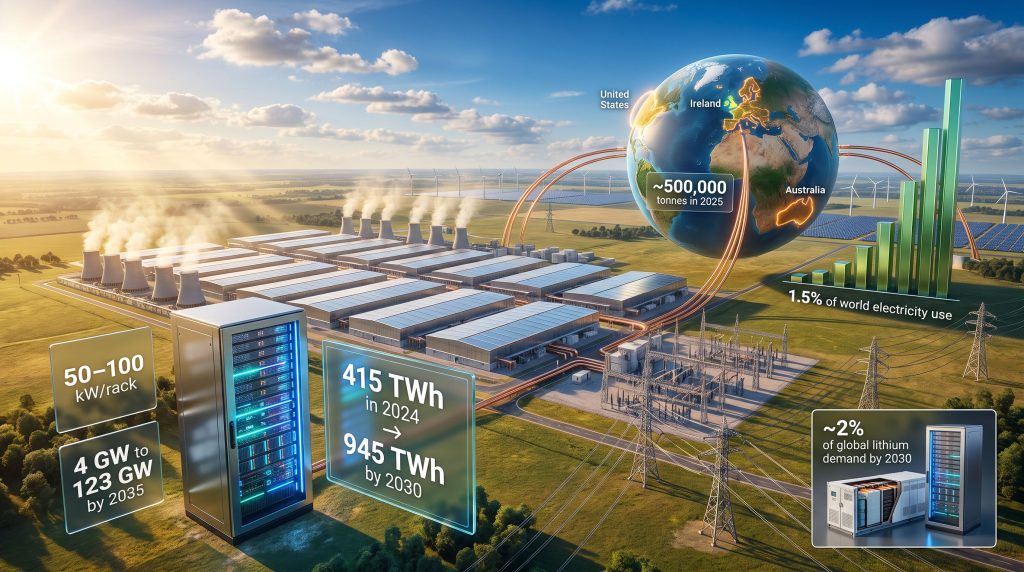
That baseline has been obliterated. GPU-optimised AI training facilities now routinely deploy at 50 to 100 kW per rack, and next-generation liquid-cooled configurations are pushing beyond 200 kW per rack in the most advanced installations, according to analysis from Benchmark Mineral Intelligence. The following table captures the magnitude of this shift:
| Era | Rack Power Density | Typical Facility Draw | Grid Equivalent |
|---|---|---|---|
| Legacy Enterprise (pre-2020) | 5–10 kW/rack | 50–100 MW | Modest city district |
| Current AI Hyperscale | 50–100 kW/rack | 200–500+ MW | Mid-sized regional grid zone |
| Next-Gen Liquid-Cooled (emerging) | 200+ kW/rack | 1 GW+ (projected) | Small nation-state load |
This represents roughly a 20-fold increase in rack-level power density within less than a decade, a compression of infrastructure evolution that no grid planning framework was designed to accommodate.
Global Consumption Figures: What the Numbers Actually Tell Us
Global data centre electricity consumption reached approximately 415 terawatt-hours in 2024, representing around 1.5% of total world electricity use, according to the International Energy Agency. That figure sounds manageable in isolation. The trajectory it sits on is anything but.
IEA projections indicate data centre electricity demand could surpass 945 TWh annually by 2030, more than doubling within six years. To contextualise that volume: a single large AI-focused facility can consume electricity equivalent to the annual usage of 100,000 average households.
The United States presents the starkest regional picture. Benchmark Mineral Intelligence estimates that 58 gigawatts of new data centre capacity will be added in the US alone between 2026 and 2030, a figure exceeding the total installed data centre capacity of any other individual nation currently in existence. Deloitte projections extend that trajectory further, estimating US AI data centre power demand could escalate from approximately 4 GW in 2024 to 123 GW by 2035, potentially representing 9% of total US electricity demand by 2030 under current growth assumptions.
These are not incremental adjustments to existing load forecasts. They represent an entirely new demand category that most grid operators have limited experience planning for.
Why AI Workloads Create Grid Stress That Conventional Demand Does Not
The challenge is not simply volume. It is the character of AI data centre demand that creates the most acute infrastructure problems. Furthermore, the critical minerals demand associated with building out this infrastructure adds additional complexity to long-term planning frameworks.
Residential and commercial electricity consumption follows predictable daily and seasonal rhythms. AI training and inference workloads do not. These facilities operate as continuous, high-intensity baseload consumers, running at near-maximum draw around the clock regardless of time of day, season, or grid conditions. The following comparison illustrates the distinction:
| Demand Type | Load Profile | Grid Planning Complexity | Geographic Concentration |
|---|---|---|---|
| Residential Growth | Gradual, dispersed | Low–Medium | Distributed |
| Commercial/Industrial | Variable, predictable | Medium | Moderate |
| AI Hyperscale Data Centres | Continuous, sudden-onset | Very High | Highly concentrated |
The geographic concentration factor compounds the problem significantly. Rather than demand growth spreading organically across a region, hyperscale AI facilities create sudden, large-scale stress on specific local transmission and distribution nodes, precisely the infrastructure segments least equipped to absorb rapid, unplanned load growth.
Regulatory Responses Emerging Across Major Markets
The United States: State-Level Policy Takes the First Move
New York State made international headlines when it announced a moratorium on environmental permits for hyperscale data centre developments. The stated rationale centred on building a comprehensive regulatory framework capable of protecting electricity ratepayers, preserving natural resources, maintaining grid stability, and safeguarding community amenity.
New York Governor Kathy Hochul framed the decision around the risk that unchecked data centre expansion poses to household utility costs and public resources, positioning the pause as a responsible governance measure rather than an anti-technology stance. Indeed, new rules on data centre costs are increasingly being designed specifically to keep the power boom off ordinary consumer bills.
Beyond New York, federal-level policy discussions increasingly centre on:
- Interconnection queue reform to manage the surge in large-load connection applications
- Siting incentives designed to redirect new facilities toward grid-unconstrained regions
- Improved stakeholder coordination mechanisms between grid operators, utilities, and data centre developers
- Clearer regulatory pathways for very large load applicants seeking connection approvals
The European Union: Binding Transparency and Compliance Architecture
The EU has taken a structurally different approach, focusing on mandatory disclosure rather than development pauses. Under the EU Energy Efficiency Directive, data centres operating above 500 kW of IT power demand are now required to submit annual reports covering:
- Total energy consumption
- Water usage metrics
- Waste-heat recovery performance
- Renewable energy sourcing data
This framework constitutes the most comprehensive binding transparency regime applied to data centre operators globally, and is increasingly being examined by other jurisdictions as a potential template for national-level governance. European regulators face a simultaneous tension between expanding AI infrastructure to remain economically competitive and meeting climate commitments that recurring summer heatwaves have made politically urgent.
Ireland: The Early Warning Case Study
Ireland's experience has become one of the most frequently cited reference points in international regulatory discussions. The country's grid regulator introduced stricter connection policies requiring on-site backup power capability and contractual demand reduction obligations during grid stress events.
Ireland's situation, where data centres have grown to represent a dominant share of national electricity consumption, is now widely studied as an early-warning signal for what unconstrained data centre growth can mean for small or medium-sized grid systems.
Australia: The Net-Generator Mandate
Australia's approach represents one of the most structurally distinctive regulatory positions to emerge globally. Prime Minister Anthony Albanese indicated that large-scale data centre operators would be required to underwrite new power supply, positioning qualifying facilities as obligated net-generators rather than net-consumers.
A National Cabinet process is underway to establish AI infrastructure standards agreed across federal and state governments. This framing reflects a broader policy philosophy: that entities placing exceptional demand on shared infrastructure should bear proportionate responsibility for expanding that infrastructure, rather than drawing down on capacity built to serve existing users.
Battery Storage and the Optimisation Paradox
Battery energy storage systems have emerged as an increasingly discussed tool for managing data centre power challenges. The appeal is intuitive: BESS can provide backup power, smooth load fluctuations, and help operators navigate grid pricing events. However, a critical limitation identified by Benchmark Mineral Intelligence warrants careful attention.
A BESS system optimised for one operational function will be structurally compromised in another. The underlying physics create an unavoidable trade-off:
| BESS Function | Power Requirement | Energy Capacity Requirement | Response Speed |
|---|---|---|---|
| Short-term backup / load management | Very High | Low | Near-instantaneous |
| Long-duration backup / peak shaving | Moderate | Very High | Planned/scheduled |
| Grid frequency response | High | Low–Moderate | Instantaneous |
Short-term backup and rapid load management demand very high power output and near-instantaneous response, but require minimal stored energy capacity. Long-duration backup and peak shaving demand the precise inverse: large energy reserves with lower instantaneous power requirements.
This means data centre operators cannot rely on a single unified BESS architecture to address their full range of power management needs. Purpose-configured systems for distinct functions are required, increasing capital complexity and cost.
The next major ASX story will hit our subscribers first
Sovereign AI: The Geopolitical Layer Regulators Cannot Ignore
Regulatory frameworks are increasingly shaped by a dimension that sits beyond pure energy economics: the question of who controls AI infrastructure and the data flowing through it.
The concept of sovereign AI — that nations should exercise meaningful control over the physical infrastructure, data pipelines, and governance structures of AI systems operating within their borders — is actively reshaping how governments approach data centre investment policy. This dynamic helps explain why Microsoft's multibillion-dollar strategic agreement with French AI company Mistral carries significance well beyond a conventional commercial partnership. It reflects European regulatory pressure on sovereignty grounds as much as commercial opportunity.
Regulatory frameworks are beginning to distinguish formally between domestically governed infrastructure and foreign-operated facilities, a distinction that will increasingly influence where and how hyperscale facilities receive planning approval.
Commodity Markets: Which Materials Benefit Most from Data Centre Growth
The infrastructure build-out required to support AI data centre expansion has tangible implications for physical commodity markets. In particular, the battery raw materials market stands to be meaningfully shaped by the scale and pace of data centre deployment over the next decade.
Copper: The Primary Structural Beneficiary
Copper's role in data centre infrastructure spans power distribution systems, cooling architecture, rack interconnects, and grid connection infrastructure. Data centres are forecast to account for more than 5% of global copper demand related to electrical infrastructure by 2030, according to Benchmark Mineral Intelligence.
Copper demand from data centre installations is projected at approximately 500,000 tonnes in 2025, with forecasts indicating this volume will more than double by 2040. The ongoing copper supply crunch adds further tension to this outlook, as new mine supply struggles to keep pace with rapidly expanding end-use demand across multiple sectors simultaneously.
This growth is structural rather than cyclical. Every new hyperscale facility requires extensive copper deployment across multiple systems, and the trend toward higher-density liquid-cooled racks increases per-rack copper intensity relative to legacy air-cooled configurations.
Lithium: A Smaller but Growing Demand Vector
Lithium's data centre demand story centres on BESS deployments for grid stability and backup power. Data centres are projected to represent approximately 2% of global lithium demand by 2030, a smaller proportional share than copper but material in absolute terms given lithium's already constrained supply dynamics. Technologies such as direct lithium extraction may, however, prove critical in unlocking additional supply to meet this rising demand.
| Commodity | Projected Data Centre Demand Share (2030) | Key Application | Demand Trajectory to 2040 |
|---|---|---|---|
| Copper | ~5% of electrical infrastructure demand | Power distribution, grid connection, cooling | >2x current data centre volumes |
| Lithium | ~2% of total demand | BESS for backup and grid stability | Growing, supply-constrained |
Three Converging Pressure Points Shaping the Next Decade
1. Grid Infrastructure Investment Lag
Transmission and distribution networks across most developed markets were not engineered for the pace or geographic concentration of demand growth now being driven by AI infrastructure. Closing this investment gap will take years, during which grid operators will face ongoing stress from new facility connections.
2. Regulatory Fragmentation Across Jurisdictions
The absence of a globally harmonised framework means operators face divergent compliance obligations spanning the US, EU, Australia, and Asia. This fragmentation risks distorting investment flows toward less-regulated markets, potentially creating a regulatory arbitrage dynamic that undermines the policy goals of the jurisdictions that act first.
3. The Renewable Energy Alignment Problem
Many hyperscale operators carry net-zero or 100% renewable energy commitments. The 24/7 baseload nature of AI workloads makes genuine renewable matching structurally harder than periodic renewable procurement. In this context, renewable energy solutions developed for other energy-intensive industries may offer transferable lessons for data centre operators grappling with the same challenge.
Meeting these commitments will require significant investment in co-located generation, long-duration storage, or credible Power Purchase Agreements backed by new capacity rather than existing renewable production. Policy levers under active consideration across multiple jurisdictions include:
- Demand flexibility incentives to shift non-time-critical workloads to off-peak periods
- Siting reform directing new facilities to grid-unconstrained regions
- Mandatory efficiency standards extending EU-style reporting to additional major markets
- Underwriting obligations requiring large-scale operators to fund new generation capacity as a grid connection condition
Frequently Asked Questions: AI Data Centre Power Demand and Regulation
How much electricity do AI data centres consume globally?
Global data centre electricity consumption reached approximately 415 TWh in 2024, accounting for around 1.5% of world electricity use. IEA projections indicate this figure could exceed 945 TWh annually by 2030.
Why is AI data centre demand harder to manage on the grid than conventional loads?
AI workloads operate as continuous, high-intensity baseload demand concentrated in specific locations, creating sudden and substantial stress on local transmission infrastructure not designed for this type of load growth.
What is New York doing to regulate hyperscale data centres?
New York State imposed a moratorium on environmental permits for hyperscale developments to allow construction of a regulatory framework addressing ratepayer protection, grid stability, environmental outcomes, and community interests.
What does the EU require data centres to disclose?
Under the EU Energy Efficiency Directive, data centres with IT power demand above 500 kW must submit annual disclosures covering energy consumption, water use, waste-heat recovery performance, and renewable energy sourcing.
What is Australia's approach to AI data centre power regulation?
Australia's federal government has indicated large-scale data centres must underwrite new power supply and operate as net-generators rather than net-consumers, with national standards to be agreed through a National Cabinet process. This approach directly addresses the AI data centre power demand and regulation challenge at a structural rather than reactive level.
Which commodities benefit most from data centre expansion?
Copper is the primary structural beneficiary, with data centre-related demand projected at approximately 500,000 tonnes in 2025 and forecast to more than double by 2040. Lithium demand from data centre BESS deployments is also growing, projected to reach around 2% of global lithium demand by 2030. The broader critical minerals demand picture will consequently be shaped in meaningful part by the pace of AI infrastructure expansion through the remainder of this decade.
Disclaimer: Projections, forecasts, and market estimates referenced in this article reflect third-party research and public policy statements available at time of writing. They involve assumptions about future conditions and should not be treated as financial advice or guarantees of future outcomes. Readers should conduct independent research before making investment or business decisions based on any data or analysis contained herein.
Want to Track the Next Major Mineral Discovery Driving the AI Infrastructure Boom?
As copper and lithium demand accelerates alongside the rapid expansion of AI data centre infrastructure, Discovery Alert's proprietary Discovery IQ model delivers real-time alerts on significant ASX mineral discoveries — instantly turning complex mineral data into actionable investment insights. Explore historic discoveries and their exceptional returns on Discovery Alert's dedicated discoveries page, and begin your 14-day free trial today to position yourself ahead of the market.