
August 26, 2026
The Hidden Complexity Behind Restarting the World's Largest Aluminium Smelters
Industrial metals demand has a long and uncomfortable relationship with geopolitical disruption. From wartime bauxite rationing to sanctions-driven supply squeezes, the aluminium industry has periodically been forced to reckon with the fragility of mega-scale production infrastructure. Yet despite decades of experience, the specific challenge of restarting a fully idled electrolytic smelter remains one of the least-understood operational crises in all of heavy industry. When a facility of genuinely world-scale proportions goes dark, the consequences ripple far beyond the facility fence.
That dynamic is now playing out in real time at the Al Taweelah smelter in Abu Dhabi's Khalifa Industrial Zone, where Emirates Global Aluminium (EGA) is working through one of the most technically complex industrial recovery operations in the history of the global aluminium sector. The EGA Al Taweelah smelter restarts reduction cells process has become a closely watched indicator for aluminium market participants worldwide.
When big ASX news breaks, our subscribers know first
Understanding What Was Actually Lost in March 2026
When an Iranian attack struck the Al Taweelah facility in March 2026, it did not simply interrupt a manufacturing process. It severed a continuous electrochemical reaction that had been running, cell by cell, for years without interruption. Understanding why this matters requires a basic grasp of how primary aluminium is actually made.
The Hall-Héroult process, which underpins virtually all primary aluminium production globally, dissolves aluminium oxide (alumina) in a molten bath of cryolite at temperatures exceeding 950 degrees Celsius. Electrical current is then passed through carbon anodes into this bath, driving the electrochemical reduction that deposits liquid aluminium at the base of each cell. Each individual reduction cell is essentially a self-contained electrochemical reactor that must be kept within a precise thermal and chemical envelope at all times.
When a cell is shut down abruptly, the molten bath solidifies. The frozen cryolite and residual aluminium congeal into a dense, chemically complex mass. Restarting is not a matter of restoring power. It requires:
- Removing damaged or spent anodes from every cell individually
- Chemically cleaning the bath residue from the cell lining
- Clearing the solidified or frozen metal that has pooled at the cell base
- Thermally preconditioning the cell before new anodes are installed and electrical current is reintroduced
This is why aluminium smelter restarts are fundamentally different from, say, restarting a steel furnace or a cement kiln. The electrochemical nature of the process means there is no shortcut. Each of the 1,262 reduction cells at Al Taweelah must pass through this sequence individually and in a carefully managed order.
EGA Al Taweelah Smelter Reduction Cells: Where the Restart Stands
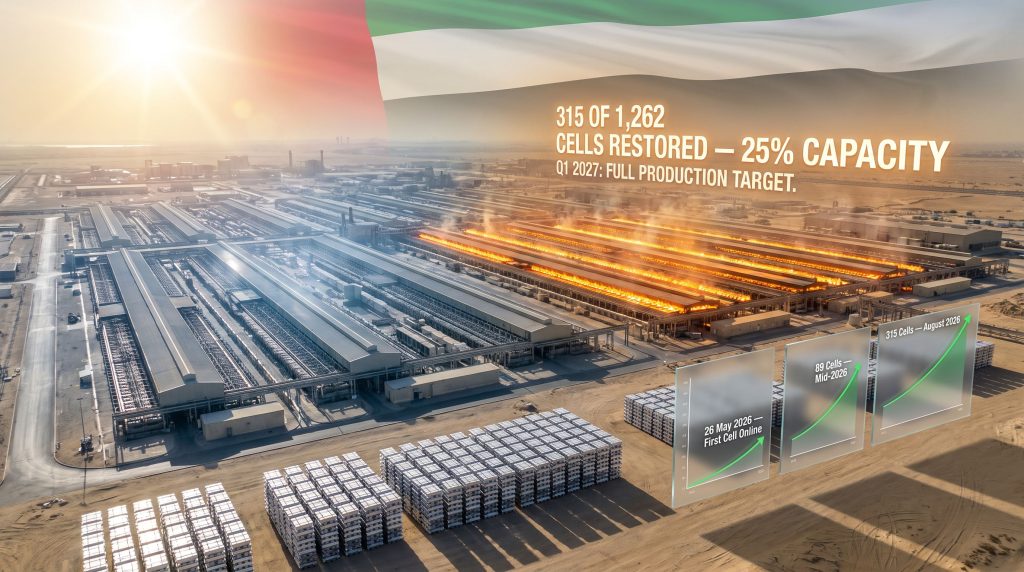
As of 26 August 2026, Emirates Global Aluminium confirmed that 315 of the facility's 1,262 reduction cells had been successfully restored to operation, representing approximately 25% of total reduction cell capacity at the site. This figure was reported by Reuters and published through Mining Weekly.
To appreciate the trajectory, it helps to see the progression of confirmed milestones in context:
| Recovery Milestone | Status (August 2026) |
|---|---|
| Total reduction cells at facility | 1,262 |
| Cells confirmed restarted | 315 (~25%) |
| First cell brought back online | 26 May 2026 |
| Anode removal across all cells | Fully complete |
| Bath cleaning progress | Approximately 90% complete |
| Frozen metal clearance | More than 20% of cells cleared |
| Projected full production recovery | Q1 2027 |
What makes this progression particularly significant is the velocity of the restart, not just the absolute numbers. Industry observers noted that EGA had restored 89 cells by its mid-year reporting point. The jump to 315 cells by late August indicates a pronounced acceleration in the restart pace, consistent with the natural compounding effect that occurs as bath cleaning and frozen metal clearance near completion across larger portions of the cell population. EGA has indicated the restart is tracking ahead of its original internal schedule.
Furthermore, as Aluminium Today has reported, the broader site recovery effort encompasses both reduction operations and supporting infrastructure, adding further context to the scale of the undertaking.
The progression from 89 to 315 operational cells between mid-year and late August 2026 represents more than a tripling of restored capacity within roughly two months, suggesting the restart has entered its highest-velocity phase.
Why Conflict Damage Creates Uniquely Difficult Recovery Conditions
Not all smelter shutdowns are equal in their complexity, and the distinction matters enormously for understanding recovery timelines. A useful comparison highlights just how exceptional the Al Taweelah situation is:
| Shutdown Scenario | Typical Cause | Scope | Recovery Duration |
|---|---|---|---|
| EGA Al Taweelah (2026) | Geopolitical attack | All 1,262 cells (100%) | 10-12 months projected |
| Scheduled planned maintenance | Operational decision | Partial, typically 10-30% | Days to weeks |
| Post-flood recovery | Natural disaster | Variable | 3-18 months |
| Post-power failure restart | Grid disruption | Full or partial | 1-6 months |
The specific challenge with conflict-related damage is that it combines physical infrastructure destruction with the need for engineering assessment, safety certification, and often equipment replacement before recovery can even begin. At Al Taweelah, the need to evaluate and then sequence repairs across every single cell in a 1,262-cell facility added an early phase of preparatory work before the first cell could be brought back online on 26 May 2026, roughly two months after the March 2026 attack.
A lesser-known technical reality is that prolonged cold shutdowns can also cause cell lining damage that is not immediately visible. The thermal cycling associated with rapid cooling can cause the refractory lining of reduction cells to crack or spall, potentially shortening cell lifespan even after restart. This means engineering assessments must evaluate not just whether a cell can be restarted, but whether restarting it is economically justified given the lining's remaining service life. This adds a layer of decision complexity that planned maintenance restarts simply do not face.
Facility Profile: Al Taweelah in the Global Aluminium Architecture
To understand the market significance of this restart, it is necessary to appreciate what Al Taweelah actually represents within the global supply landscape.
| Attribute | Detail |
|---|---|
| Location | Khalifa Industrial Zone, Abu Dhabi (KIZAD), UAE |
| Operator | Emirates Global Aluminium (EGA) |
| Total Reduction Cells | 1,262 |
| Smelter Classification | One of the largest single-site aluminium smelters globally |
| Ownership Structure | Joint venture between Mubadala Investment Company and Investment Corporation of Dubai |
EGA is one of the top aluminium producers operating outside China. The Al Taweelah smelter's position within KIZAD gives it structural advantages that are relevant to understanding why its recovery matters: Gulf-region smelters benefit from historically competitive energy cost structures, which have made them central to the non-Chinese aluminium supply balance serving Western manufacturers across automotive, aerospace, packaging, and construction applications.
When a facility of this scale goes offline entirely, the supply gap it creates cannot be quickly filled by ramping up other producers. Primary aluminium smelters cannot simply throttle up output in response to spot demand. They operate at near-full capacity continuously by design, meaning that displaced supply must either be absorbed from existing inventory or go unmet in the short term.
Market Implications: What 25% Recovery Means for Aluminium Prices and Premiums
The progressive restoration of hot metal output at Al Taweelah has significant implications for how aluminium premiums and spot prices evolve through the remainder of 2026 and into 2027. The commodity price impacts of this recovery are already being closely monitored by market analysts. Several dynamics are worth tracking:
- Inventory drawdown pressure: During the full shutdown period, buyers reliant on EGA's output were forced to draw on existing London Metal Exchange (LME) aluminium inventory or source from alternative suppliers, placing pressure on global stock levels.
- Regional premium inflation: Supply disruptions of this scale typically translate into elevated regional delivery premiums, particularly in markets that historically sourced significant volumes from the affected facility.
- Competitor ramp-up dynamics: Aluminium-producing regions with available capacity, including Canadian, Norwegian, and Australian smelter operators, would have seen incremental demand for their output during the disruption period. A faster-than-expected EGA Al Taweelah smelter restarts reduction cells outcome compresses the window of elevated demand for these alternative sources.
- Forward market visibility: EGA's confirmation of a Q1 2027 full production target gives downstream buyers a defined planning horizon, which itself has a moderating effect on panic procurement behaviour and spot premium spikes.
A Q1 2027 full-recovery confirmation, if maintained, provides aluminium consumers with sufficient forward visibility to avoid the most disruptive forms of supply chain reconfiguration, which would themselves carry lasting costs beyond the disruption period.
The next major ASX story will hit our subscribers first
Geopolitical Risk Pricing in Industrial Metals: A Structural Shift
The Al Taweelah incident has contributed to a broader reassessment of how geopolitical infrastructure risk is priced into industrial metals markets. Historically, commodity risk models have distinguished between operational risk (equipment failure, labour disputes), environmental risk (natural disasters, flooding), and political risk (sanctions, trade restrictions). Direct kinetic attacks on production infrastructure represent a fourth category that has received comparatively little systematic attention in supply chain risk frameworks.
The distinction matters because conflict-related shutdowns share characteristics of all three traditional risk categories simultaneously. They create sudden, complete supply disruptions (like natural disasters), they may involve equipment destruction requiring replacement rather than just repair (like major operational failures), and they introduce legal, insurance, and diplomatic complexity that purely operational shutdowns do not (like political risk events). This multidimensional nature means that standard business continuity models may significantly underestimate both recovery timelines and recovery costs for conflict-affected industrial facilities.
Furthermore, the broader aluminum and alumina markets are increasingly factoring geopolitical disruption risk into long-term pricing models, a shift that has been accelerated by the Al Taweelah incident. For investors and supply chain managers, this case is likely to prompt a reassessment of:
- Geographic concentration risk in aluminium sourcing strategies
- The adequacy of strategic inventory buffers for facilities with Gulf-region supply exposure
- Insurance and force majeure provisions in long-term aluminium supply contracts
- The discount or risk premium applied to industrial assets located in geopolitically sensitive zones
In addition, green steel pricing dynamics may also be indirectly influenced, as disruptions to primary metal supply chains prompt downstream manufacturers to revisit material substitution strategies across construction and automotive sectors.
Frequently Asked Questions: EGA Al Taweelah Smelter Restart
What caused the Al Taweelah smelter shutdown in 2026?
The facility was taken entirely offline in March 2026 following damage caused by an Iranian attack at the Khalifa Industrial Zone site in Abu Dhabi. All 1,262 reduction cells were shut down as a result.
How many reduction cells have been restarted at Al Taweelah?
As of 26 August 2026, Emirates Global Aluminium confirmed that 315 of the 1,262 reduction cells had been restored, representing approximately 25% of total facility capacity.
When will Al Taweelah return to full production?
EGA has indicated a target of returning to pre-incident production levels by Q1 2027, with the company reporting that the restart is progressing ahead of its original internal schedule.
Why does an aluminium smelter take so long to restart after a full shutdown?
Each reduction cell must individually undergo anode removal, chemical bath cleaning, and frozen metal clearance before electrical current can be safely reintroduced. This sequence cannot be executed simultaneously across all cells and must be carefully managed to avoid further cell lining damage or electrochemical instability.
How does this restart affect global aluminium prices?
The accelerating pace of restoration, now at 25% of capacity and tracking ahead of schedule, reduces the severity and duration of the supply deficit. A confirmed Q1 2027 full-recovery target moderates premium inflation and gives downstream buyers improved forward planning certainty.
Key Takeaways for Market Participants
- Restart velocity is accelerating: The jump from 89 to 315 operational cells between mid-year and late August 2026 indicates the recovery has entered its highest-output phase, consistent with the compounding effect as preparatory work nears completion across the cell population.
- Q1 2027 is the critical production horizon: A full return to pre-incident output within approximately 10-12 months of a complete facility shutdown would represent a technically impressive recovery given the scale of the disruption.
- Conflict risk has entered mainstream aluminium supply chain modelling: The Al Taweelah incident is likely to become a reference case for how kinetic geopolitical events are incorporated into industrial metals risk frameworks going forward.
- Downstream supply chain stabilisation is approaching: As hot metal output ramps progressively through the second half of 2026, manufacturers with exposure to EGA's production base can begin normalising procurement strategies ahead of the Q1 2027 full recovery milestone.
- Premium moderation is the logical market outcome: A faster-than-expected restart compresses both the duration and severity of the supply gap, applying downward pressure on the regional aluminium premiums that elevated during the disruption period.
Readers seeking ongoing coverage of global aluminium smelting operations and base metals supply chain dynamics can follow industry reporting through Mining Weekly (miningweekly.com), which provides continuous coverage of industrial metals markets and major production developments.
Want to Stay Ahead of Major Commodity Market Shifts?
Discovery Alert's proprietary Discovery IQ model delivers real-time alerts on significant ASX mineral discoveries, instantly transforming complex commodity data into actionable investment insights — explore historic examples of exceptional returns on Discovery Alert's discoveries page or begin your 14-day free trial today to position yourself ahead of the next major market-moving event.