August 26, 2026
The Quiet Transformation Reshaping Global Iron Ore Pellet Trade
For decades, the seaborne iron ore pellet market operated as a largely predictable hierarchy, dominated by a handful of major Brazilian and Scandinavian producers whose output volumes shaped blast furnace economics across Asia and Europe. That hierarchy is now in flux. Structural shifts in steelmaking technology, the accelerating push toward lower-carbon production pathways, and the slow-motion recovery of one of Brazil's most significant mining operations are converging to create a compelling case for Samarco regaining second-largest iron ore pellet exporter status.
Understanding where this market is heading requires looking beyond headline iron ore price trends. Pellet-grade material occupies a fundamentally different position in the value chain than standard fines, and the producers who supply it are navigating a demand environment that is becoming increasingly favourable over the long term.
When big ASX news breaks, our subscribers know first
Why Iron Ore Pellets Occupy a Premium Position in the Steel Value Chain
Iron ore pellets are not simply a processed form of raw iron ore. They represent a specific product engineered to meet the exacting feed requirements of both blast furnace and direct reduced iron operations. Pellets are small, spherical balls of concentrated iron ore, typically containing iron grades of 64% to 67% Fe or higher, produced by grinding ore fines, mixing with binding agents, and firing in a kiln to create a consistent, porous, and mechanically strong product.
This consistency matters enormously to steelmakers. Blast furnaces fed with high-quality pellets achieve better gas permeability, lower coke consumption rates, and more stable thermal profiles than those relying solely on sinter. In a commodity industry where marginal efficiency gains translate into meaningful cost reductions at scale, pellet quality directly influences a mill's operating economics.
The DRI Connection: Why Are Pellets Gaining Strategic Importance?
The more significant demand driver emerging over the coming decade is the rapid expansion of direct reduced iron technology. DRI processes, including gas-based shaft furnace methods such as the MIDREX and HYL systems, require pellets with very high iron content and extremely low levels of impurities. Furthermore, advances in hydrogen iron ore reduction technology are adding additional momentum to this shift, as steelmakers seek cleaner alternatives to traditional blast furnace routes.
As steelmakers globally face mounting pressure to reduce carbon intensity, DRI-based steelmaking is attracting substantial capital investment. This creates a structural, long-term demand tailwind for producers capable of supplying premium-grade pellets that meet DRI feed specifications. The commercial case for high-grade pellet supply has arguably never been stronger, a reality that makes Samarco's capacity recovery story far more than a corporate rehabilitation narrative.
The pellet premium over standard iron ore fines has historically ranged between $20 and $50 per tonne depending on market conditions, but DRI-grade pellet premiums can reach even higher levels given the tighter quality specifications involved. This pricing differential is a critical variable in Samarco's long-term revenue model.
How the Fundão Disaster Dismantled a Decade of Market Progress
Samarco had spent years building its position as one of the world's leading seaborne pellet exporters before the collapse of the Fundão tailings dam in November 2015. The dam failure released approximately 40 to 60 million cubic metres of iron ore tailings into the Doce River catchment, causing widespread environmental destruction across hundreds of kilometres and resulting in significant loss of life.
The immediate operational consequence was a forced shutdown of Samarco's concentrating and pelletising facilities in Minas Gerais, removing a major volume of pellet supply from global markets virtually overnight. For context, Samarco had been operating at nameplate capacity of around 26 to 27 million metric tonnes per year of combined iron ore fines and pellets before the disaster, making its sudden absence a material event for Asian steel mill procurement teams.
The recovery process was extraordinarily complex. Samarco faced criminal investigations, civil litigation, extensive reparation obligations negotiated with Brazilian federal and state authorities, and the challenge of rebuilding technical credibility in a post-Brumadinho regulatory environment. The 2019 collapse of Vale's Brumadinho tailings dam added further political and regulatory pressure on all Brazilian mining operations with tailings management obligations.
Restarting production required not only physical reconstruction and regulatory approvals, but also the development of entirely new tailings management approaches that could withstand the heightened scrutiny being applied across Brazil's mining sector.
Samarco's Current Position: A Snapshot of Where Things Stand
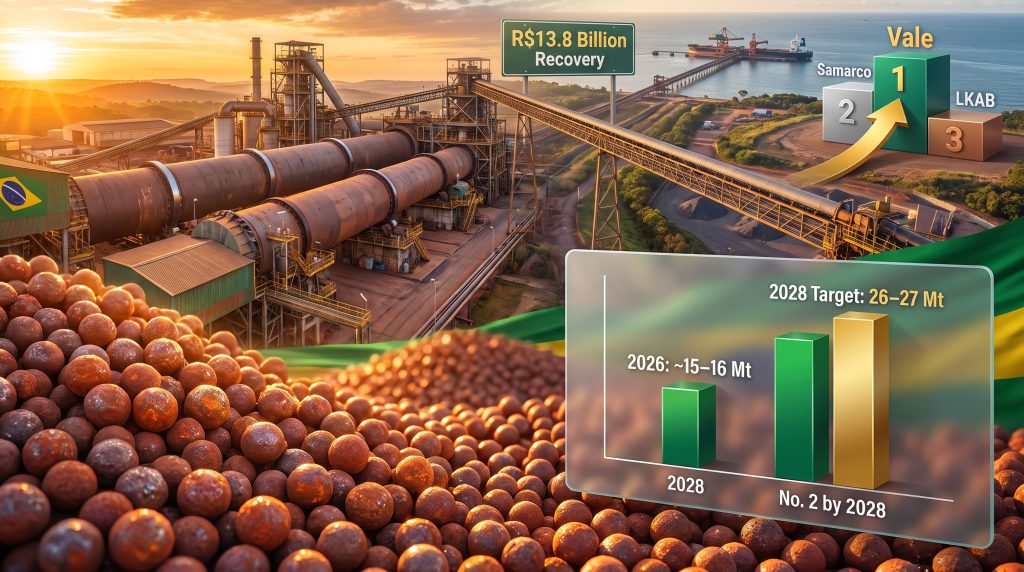
By 2025, Samarco had clawed back enough operational ground to reclaim third place in the global seaborne transoceanic pellet export rankings, a meaningful milestone given the operational challenges the company had navigated over the preceding decade. According to Samarco's own production figures, output in 2025 reached its highest volume since resuming operations. As of 2026, production sits at approximately 60% of nameplate capacity, translating to roughly 15 to 16 million metric tonnes per year of combined iron ore fines and pellets.
Critically, Samarco has also begun producing iron ore fines from its tailings reprocessing programme. This is not simply a financial opportunity; it serves a dual environmental and commercial purpose. By reprocessing tailings, the company extracts residual iron ore value from material that would otherwise represent a liability, while simultaneously reducing the volume of legacy tailings requiring long-term management.
| Metric | Current (2026 Estimate) | Target (2028) |
|---|---|---|
| Capacity Utilisation | ~60% | 100% |
| Annual Iron Ore Fines and Pellets Output | ~15-16 Mt | 26-27 Mt |
| Iron Ore Fines from Tailings | ~300,000 t | ~2,000,000 t |
| Global Pellet Export Ranking | 3rd | 2nd |
| Capital Investment Required | Ongoing deployment | R$13.8B (~USD $2.7B) total |
The tailings reprocessing scale-up is particularly noteworthy from a technical standpoint. Growing output from 300,000 tonnes in 2026 to a targeted 2 million tonnes by 2028 requires significant investment in processing infrastructure, water management systems, and classification technology capable of recovering fine iron ore particles from previously deposited slurry material.
The $2.7 Billion Bet: Samarco's 2028 Capacity Restoration Plan
Samarco's pathway back to Samarco regaining second-largest iron ore pellet exporter status rests on executing a R$13.8 billion capital investment programme, equivalent to approximately USD $2.7 billion at current exchange rates. Samarco CEO Rodrigo Vilela outlined this commitment during a mining event in Belo Horizonte, framing it as the foundation of the company's return to full operational capacity by 2028.
The investment is directed across several operational pillars:
- Restoration and optimisation of concentrating circuits to increase iron ore fines throughput
- Expansion and rehabilitation of pelletising plant capacity to reach full output across all production lines
- Development of tailings reprocessing infrastructure to unlock the 2 million tonne per year target
- Environmental remediation and dam safety upgrades required under reparation agreements
- Supporting logistics and infrastructure improvements to enable higher export volumes
Deploying capital of this scale within a compressed timeframe carries execution risk. Brazil's permitting environment, particularly for mining and tailings-related infrastructure, has become substantially more rigorous since 2019. Supply chain constraints, cost inflation in industrial equipment, and the need to coordinate construction activity while maintaining ongoing production all add complexity to the delivery timeline.
Step-by-Step: Samarco's Path to the No. 2 Ranking
- Stabilise existing operations at current concentrators and pellet plants to ensure consistent throughput at the current 60% capacity level
- Scale tailings reprocessing from 300,000 tonnes in 2026 toward the 2 million tonne per year target by deploying new classification and processing technology
- Execute the capital investment programme across infrastructure, pelletising capacity, and processing upgrades within the R$13.8 billion budget envelope
- Achieve full nameplate capacity of 26 to 27 million metric tonnes per year of combined iron ore fines and pellets by 2028
- Reclaim the No. 2 seaborne pellet export position by displacing the current second-ranked producer through volume growth and re-established trade relationships with Asian and European steel mills
- Evaluate post-2028 expansion options once full capacity restoration is confirmed, with Vilela indicating openness to greenfield or brownfield growth beyond the current nameplate
Who Owns Samarco and Why the Joint Venture Structure Shapes Every Decision
Samarco operates as a 50/50 joint venture between Vale and BHP, a governance structure that creates an unusual dynamic in global iron ore markets. Vale holds the top position in the global pellet export hierarchy by a significant margin, while simultaneously being a co-owner of the operation most likely to challenge LKAB for second place. Details of BHP's involvement in the Samarco operation illustrate how the joint venture is structured across both owners' broader portfolios.
For BHP, Samarco's recovery represents a meaningful contribution to its broader iron ore earnings base. BHP does not operate its own pelletising infrastructure at the scale Samarco provides, making the joint venture's pellet output a distinct and valuable product stream within its portfolio.
Capital allocation decisions, strategic planning, and major investment approvals at Samarco require alignment between two of the world's largest and most sophisticated mining companies. This can act as both a governance strength and a potential source of decision-making friction when parent company priorities diverge.
The next major ASX story will hit our subscribers first
How Samarco Compares to the World's Top Pellet Exporters
The global seaborne iron ore pellet export market is dominated by a small number of producers, with significant volume concentration at the top of the hierarchy. Understanding the broader iron ore market types and deposit structures provides useful context for assessing where pellet producers sit within the wider supply chain.
| Producer | Country | Estimated Pellet Output/Capacity | Current Global Rank |
|---|---|---|---|
| Vale | Brazil | 120+ Mt total iron ore; significant pellet subset | 1st |
| LKAB | Sweden | ~27 Mt pellets | 2nd (contested) |
| Samarco | Brazil | ~15-16 Mt current / 26-27 Mt target | 3rd (targeting 2nd) |
LKAB, the Swedish state-owned mining company, produces high-grade magnetite pellets from its northern Swedish iron ore deposits. LKAB's pellets are renowned for their quality, and the company supplies a significant share of European blast furnace pellet demand. Displacing LKAB from second position in seaborne transoceanic rankings would require Samarco to sustain production growth through 2028 and successfully re-establish shipping volumes across key trade lanes to Asian buyers.
Brazilian Iron Ore Quality and the Asian Mill Relationship
One dimension of Samarco's competitive position that deserves closer attention is the quality profile of its pellets relative to market requirements. Brazilian iron ore from the Iron Quadrangle region of Minas Gerais is predominantly hematite, with relatively high iron content and manageable impurity levels, though silica and alumina specifications vary by ore body and processing approach.
Asian steel mills, particularly in China, Japan, South Korea, and Taiwan, have historically been significant buyers of Brazilian pellets. However, the China steel and iron ore market continues to evolve, and re-establishing these procurement relationships after years of reduced supply will be a critical commercial task alongside the physical capacity restoration programme.
Market Conditions Samarco Is Counting On
Any capital programme of this scale implies a set of assumptions about market conditions over the investment horizon. Several structural factors support the commercial logic of Samarco's expansion timeline:
- DRI expansion globally is accelerating, particularly in the Middle East, India, and increasingly in Europe, creating growing demand for the high-grade pellets that DRI shaft furnaces require
- Electric arc furnace capacity growth is expanding demand for direct reduced iron as a scrap supplement, further pulling pellet demand higher
- China's steel sector restructuring continues to drive interest in higher-quality iron ore inputs that improve blast furnace efficiency and reduce emissions per tonne of steel produced
- Pellet premiums over standard fines have historically supported attractive margins for pellet producers, and the structural shift toward lower-carbon steelmaking is expected to sustain and potentially widen this premium differential
In addition, green iron production initiatives are reinforcing the case for high-grade pellets, as low-emission steelmaking pathways consistently require superior feed material. The global iron ore pellets market is consequently projected to grow steadily over the coming decade, underpinned by these converging structural forces.
Key Risks That Could Derail the 2028 Timeline
Investors and market observers should, however, weigh several categories of risk against the recovery thesis:
- Reparation obligations and legal exposure from the Fundão disaster remain an ongoing financial and operational variable, creating potential cash flow pressures if iron ore prices decline materially
- Capital execution risk is substantial, as deploying R$13.8 billion within a compressed timeline in Brazil's current permitting and construction environment requires disciplined project management
- Iron ore price volatility affects pellet premium economics directly, and extended periods of low prices compress the margins that justify large-scale capital investment
- Dam safety and tailings management scrutiny has intensified significantly across Brazil following the Brumadinho disaster, meaning any operational incident would carry severe regulatory, financial, and reputational consequences
- Joint venture governance complexity between Vale and BHP introduces an additional layer of decision-making that could affect the speed of capital deployment or strategic pivots if market conditions change
This article contains forward-looking statements and projections based on publicly available information. Actual outcomes may differ materially from those described. Nothing in this article constitutes investment advice.
Could Samarco Eventually Look Beyond Second Place?
Vilela has indicated that once full capacity is restored and the No. 2 export ranking is reclaimed, Samarco would be open to evaluating further production expansion beyond the current 26 to 27 million tonne nameplate. This signals that the 2028 milestone is conceived not as an endpoint but as the foundation for a subsequent growth phase.
Whether that growth materialises depends on factors well beyond Samarco's operational control. Challenging Vale's dominance would require an entirely different order of capital commitment, along with access to additional high-grade ore resources and the sustained alignment of both parent companies behind an aggressive expansion agenda. Nevertheless, the stated openness to post-2028 options does signal management confidence in the long-term commercial environment for premium pellet supply, reinforcing why Samarco regaining second-largest iron ore pellet exporter status is considered a milestone rather than a ceiling.
Frequently Asked Questions: Samarco and the Iron Ore Pellet Market
What is Samarco's current production capacity?
As of 2026, Samarco is operating at approximately 60% of its full nameplate capacity, which equates to roughly 15 to 16 million metric tonnes per year of iron ore fines and pellets combined.
When does Samarco expect to reach full capacity?
Samarco's management has targeted 2028 as the year for returning to full capacity of 26 to 27 million metric tonnes per year.
What caused Samarco to lose its pellet export ranking?
The 2015 collapse of the Fundão tailings dam forced Samarco to curtail substantial portions of its operations, resulting in a multi-year decline in output and a significant fall in its global pellet export ranking.
How much is Samarco investing to restore capacity?
The company has committed approximately R$13.8 billion, equivalent to roughly USD $2.7 billion, to fund its capacity restoration and operational recovery programme.
What global ranking does Samarco currently hold?
Samarco regained third place in the seaborne transoceanic pellet market in 2025 and is targeting the second position by 2028.
Who are Samarco's main competitors in the pellet export market?
Vale holds the top position globally, while LKAB of Sweden currently occupies the second-largest seaborne pellet export position that Samarco is working to reclaim.
What is tailings reprocessing and why does it matter for Samarco?
Tailings reprocessing involves recovering residual iron ore value from previously deposited slurry waste material. For Samarco, this programme serves both as a revenue-generating activity and an environmental remediation measure, with output targeted to reach 2 million tonnes per year by 2028 from 300,000 tonnes in 2026.
Want to Track the Next Major Iron Ore Discovery Before the Market Does?
Discovery Alert's proprietary Discovery IQ model delivers real-time alerts on significant ASX mineral discoveries — instantly translating complex geological data into actionable investment insights for both short-term traders and long-term investors. Explore the historic returns major mineral discoveries have generated and begin your 14-day free trial today to position yourself ahead of the broader market.